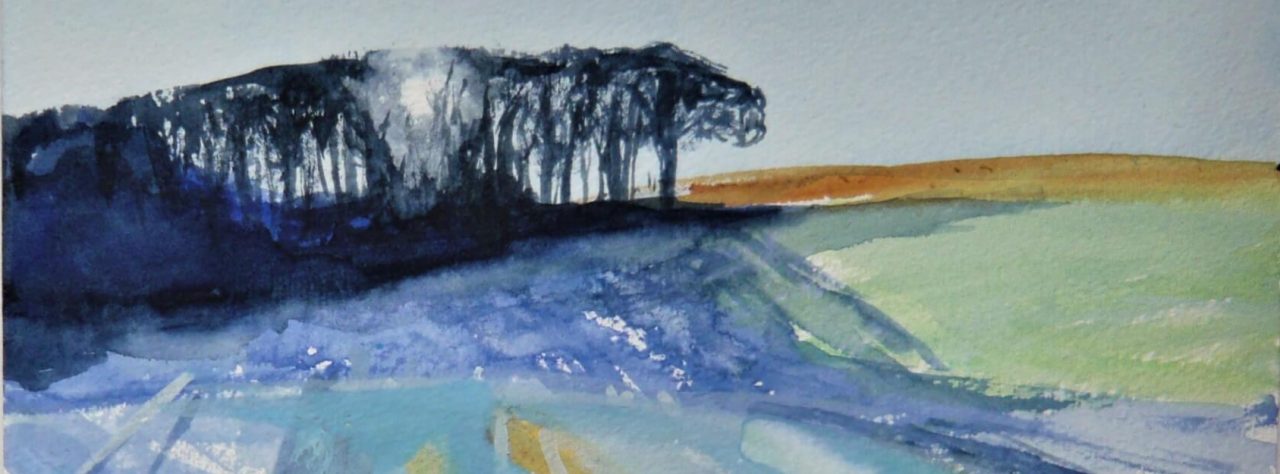
Although not perhaps the first county one would think of when discussing ancient standing stones, Kent does have its share. There are two main sites approximately equidistant on either side of the river Medway in north Kent. The eastern site consists of the remains of two burial chambers (Kit’s Coty House and Little Kit’s Coty House) and the White Horse Stone, all within a kilometre of each other, while the western site consists of the Coldrum Stones (burial chamber) and Addington Long Barrow and Addington Burial Chamber.
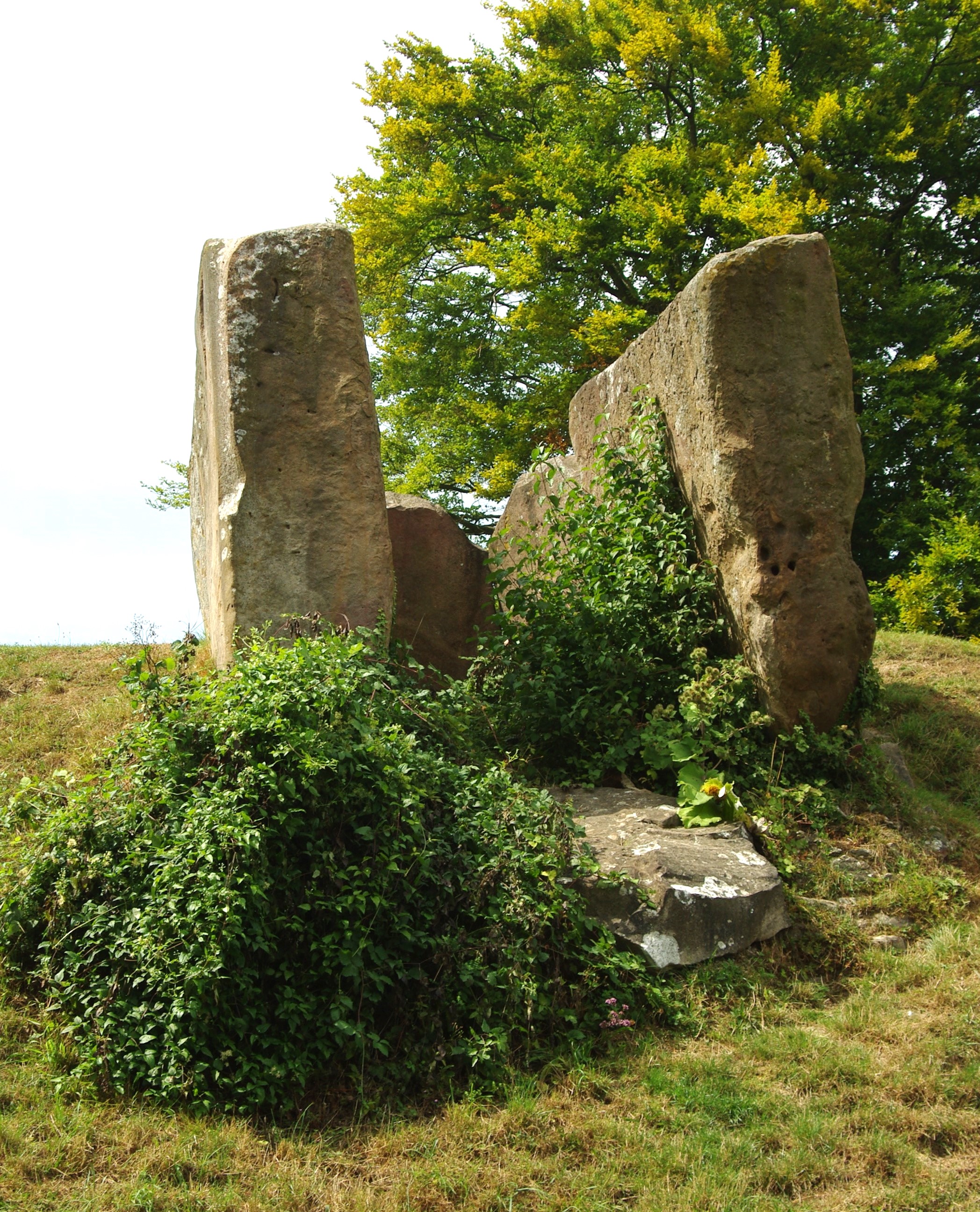
The Coldrum Stones
At Little Kit’s Coty House in a light drizzle, I counted seventeen stones, although Donald Maxwell writing in The Pilgrim’s Way in Kent, a short guide published in 1932, claims twelve to fourteen. Various other authorities suggest between nineteen and twenty-one. This is one of those sets of remains that comprise such a jumble of stones it is supposedly impossible to accurately count them – and just to make it harder, they are also supposed to move around (presumably when no one is looking). Thus they are also known by the name The Countless Stones. The largest ones I reckoned were about four meters by two and about three and a half meters by three. The shapes are very irregular, and since they are in a collapsed state there might have been serious damage to some of them. I immediately wondered whether it had originally been the same shape as Kit’s Coty House, a Neolithic chambered long barrow, just a few hundred meters to the north, where the stones are in the form of a dolmen, which would have been a burial chamber at one end of an eighty-four meter mound.

The Countless Stones, or Little Kit’s Coty House
William Stukeley, writing in 1722, recorded that he was told local people remembered a chamber at Little Kit’s Coty House. It had had a covering stone and was pulled down in about 1690.
Both Kit’s Coty House and Little Kit’s Coty House are reckoned to be just under six thousand years old.
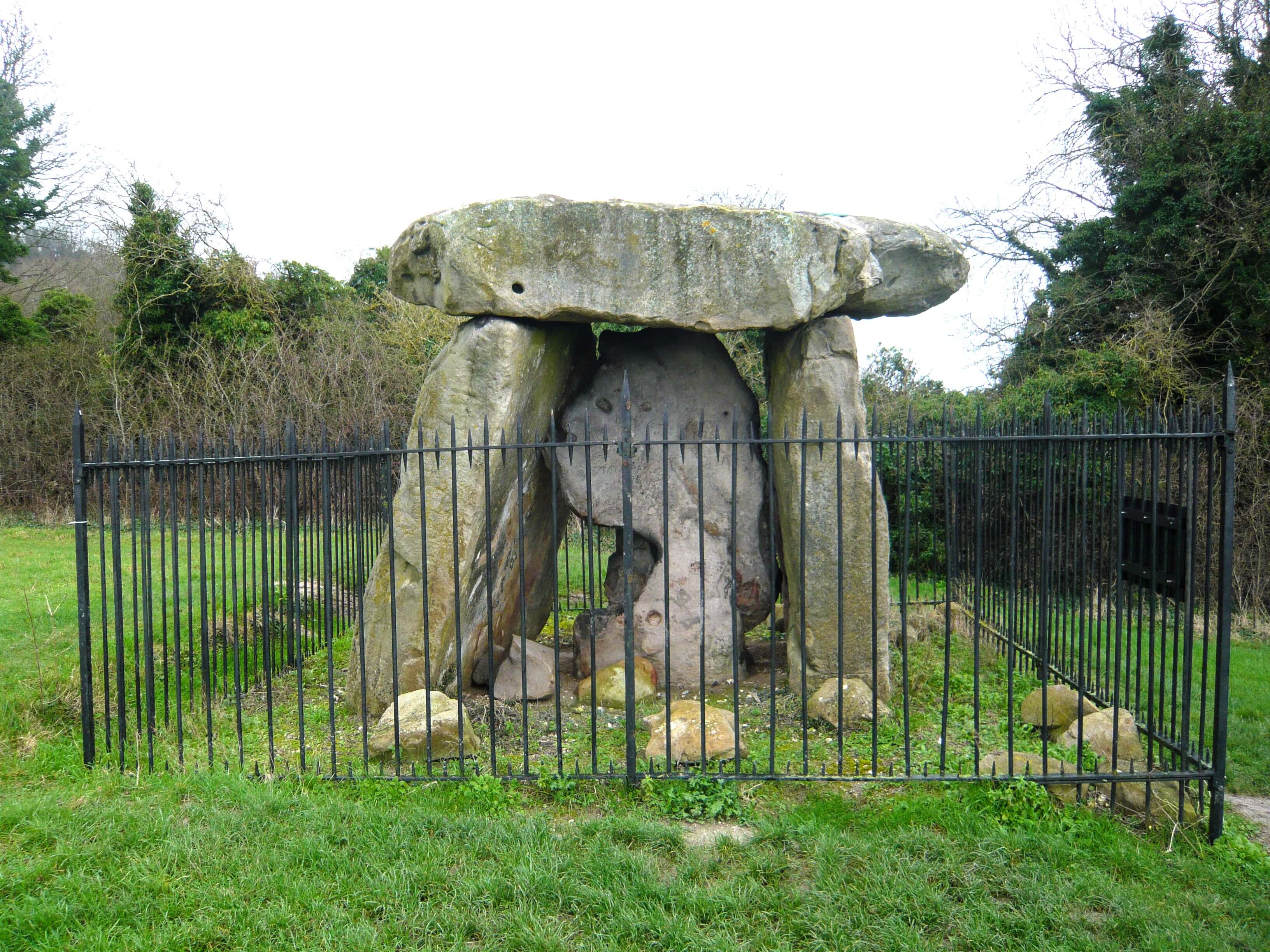
Kit’s Coty House
Some nine or ten kilometres away across the Medway Valley are the Coldrum Stones, or Coldrum Long Barrow, dated to between 3985 and 3855 BC. These ones, looked after by the National Trust, are also a burial chamber. Donald Maxwell claimed that there were forty-one stones and that a further fifteen were broken up at an unspecified date during quarrying work. Maxwell also reported a tradition ‘amongst the country people’ that an avenue of stones stretched across the valley from Coldrum to Kit’s Coty, although there is no evidence it ever existed. But coincidence or not, both of these chambers are situated at the same height, about eighty five meters above sea level.
All three burial chambers, then, have been dated to the same period, a thousand years before Stonehenge was built. It seems reasonable, then, to assume they were produced by the same society.
Coldrum has been proved to be a family tomb, the remains of at least 22 people being interred there, with DNA analysis proving their likely close family relationship. Yet amongst these kinsfolk, recent isotopic analysis has shown that maybe the chamber also contained the remains of individuals interred in the fifth to seventh centuries AD.

The White Horse Stone
I say maybe, as there is a very strong caveat connected to this research, and that is that when the human remains were removed in the early twentieth century they were not only not labelled very thoroughly, but they were also passed around several museums and the possibility exists that some bones ended up mis-accredited. Yet it has been proven that some neolithic burial chambers were re-used for burials in the early Anglo-Saxon period.*
The land here has been sculpted by man. Of course, we sculpt the land more and more violently and obviously in the twenty first century, but here, from all these thousands of years ago, are these simple shapes built by ancient folk to inter and celebrate their dead. And these were interactive places. Evidence from other sites shows that some of the bones of these ancestors would be removed at times, although whether as a simple reminder of their elders, or whether for magic or sacred purposes, can only be conjecture. But I like the thought that these bones might be invested with power, that they could be brought into the everyday for protective or ritual purpose.
Now, we view them in a different light, and their sacredness has evaporated. Like a deconsecrated church, but without ever having been formally deconsecrated. It is possible our ancestors would view our visits there as desecration.
But I’m never sure whether you can take any arrangement of stones for granted; they’ve been dismantled in the past, could they have been reassembled?
Incidentally, for those who enjoy Ley Lines, it is worth mentioning that the Ley Line hunter Paul Devereux has described a line passing through The Coldrum Stones and aligning with six nearby churches. Although just to put a dampener on that, perhaps it is also worth mentioning that students at Cambridge University investigated this particular line using computer simulations based on the Ordnance Survey details and concluded that it wasn’t statistically significant – that it was almost certainly just a chance alignment. You takes your pick.
*Research carried out by members of Durham University, Oxford University School of Archaeology and British Geological Survey (Isotope Facility) 2022
 Mick Canning
Very interesting. If only the stones could talk ….
LikeLiked by 1 person
Ah, now, who knows?
LikeLiked by 1 person
Absolutely…I’m sure they do, amongst themselves and with their surroundings.
LikeLiked by 1 person
We found some of these when I did the Pilgrims Way. As for ley lines, if you’re selective enough with the data you make ley lines out of anything. Wasn’t it Ben Goldacre who did it for Macdonalds, and someone else who did a sauasage roll ley line for Greggs.
btw Thank you for recommending that newsletter, I actually managed to get tickets for the Tin Tabernacle Hear Hard performance!
LikeLiked by 1 person
Yes, I reckon you could make ley lines from anything. I read Watkins’ book a couple of times, but he didn’t convince me for all sorts of reasons.
Glad you subscribed. Lots of good stuff there. I didn’t try for tickets for this – thought it might be slightly hard work, but I’ll be interested to hear what you make of it.
LikeLiked by 1 person
I messaged you on the old facebook, at least I hope it’s youor someone’s gonna be confused 😀
LikeLiked by 1 person
No worries. It’s me.
LikeLike
Another interesting read, Mick! And that photo of the Coldrum Stones is so stunning. The colors and the vibrance just make the image seem so warm and alive.
LikeLiked by 1 person
Thanks, Damyanti. That was taken on a much nicer day than the other photos!
LikeLike
There’s history, and then there’s History: written in the land and in mysterious remnants of long-ago peoples. The new one for me was ley lines; I’d never heard of such. I did a very cursory bit of reading, including just a bit about Watkins, and ended up thinking, “Ummm… well. OK.”
LikeLiked by 1 person
I think that’s a lot of folk’s response to ley lines. Not 100% impossible, but, yeah.
LikeLiked by 1 person
The Countless Stones looks like a giant’s game of falling dominoes. Perhaps they got off the beam of the ley lines. Very cool to see these ancient sites!
LikeLiked by 1 person
Cool is the word, Robert. You really feel their age when you stand amongst them – at least, I do.
LikeLiked by 1 person
This is interesting stuff! I am also somehow reminded of the short film “Das Rad” 😀
https://www.youtube.com/watch?v=HOPwXNFU7oU
LikeLike
Thanks, Aud. I’ll take a look at that tomorrow.
LikeLiked by 1 person
I see what you mean.
LikeLiked by 1 person
For some reason these bring to mind the Tiffany Aching subset of Terry Pratchett’s books. There must be some Wee Free Men hiding away under those rocks….
LikeLiked by 1 person
I think she’d feel quite at home around there, Dave. Definitely that sort of area.
LikeLiked by 1 person
I love the idea of the “Countless Stones” and even more, that they move around when no one’s looking. Joe and I say exactly that about our biggest mountains. 🙂 Standing stones are fascinating, whether standing or not. The idea that someone 3 centuries ago talked to local people who remembered stories about people moving those stones further back exemplifies the threads that tie residents of the British Isles so powerfully to the land. In the US, only native people have that and so much has been lost – at least in my opinion. A thousand years before Stonehenge – it’s just unimaginable but what little sense of that I can grasp is captivating. The notion that bones may have been removed “from time to time” – even more interesting. I don’t think the sacredness has evaporated…
LikeLiked by 1 person
Standing stones are fascinating. I think the fact they’ve been standing for six thousand years or so and probably with local people interacting with them for much of that time, makes them such an integral part of the landscape, almost part of a living landscape.
And I think you could be right about the sacredness – certainly, there are many people who would agree with you.
LikeLiked by 1 person
A living landscape for sure. Thanks for creating the post, Mick.
LikeLiked by 1 person
When I see things like these standing stones or Iron Age hill forts I wonder how and why. To my mind the effort needed to move and erect these stones without machinery (presumably) is boggling. When you now read the ‘altar’ stone at Henge came from North east Scotland, just how?
Guess if we knew the answers the magic of such places would be eroded but hats off to the ancients, they were real grafters!
LikeLiked by 1 person
Real grafters, indeed. The why? we can make quite a good guess at, as for the how? mainly muscle, presumably, but they must have worked out the basics at least of levers and movement.
And a mindset we are incapable of entering.
LikeLike
Quite interesting! I have never read about this before. Stonehenge? Of course, yes. But that’s it.
LikeLiked by 1 person
We’ve lots of standing stones all over Britain, Arv. But, there again, so has India, and we never read anything of them!
LikeLiked by 1 person
well said!
LikeLiked by 1 person
Hi Mick, this information is very interesting. Scholars of science always try to prove or disprove everything that isn’t completely factual or fitting in with everyday explanations.
LikeLiked by 1 person
I have lived in Kent or at least very near it all my life and never knew about these things. Thank you for bringing them to my attention, Mick.
LikeLiked by 2 people
It’s rather fun to think we have them here. Even though I’m familiar with them, it still seems slightly to strange to think of them in Kent.
LikeLiked by 1 person