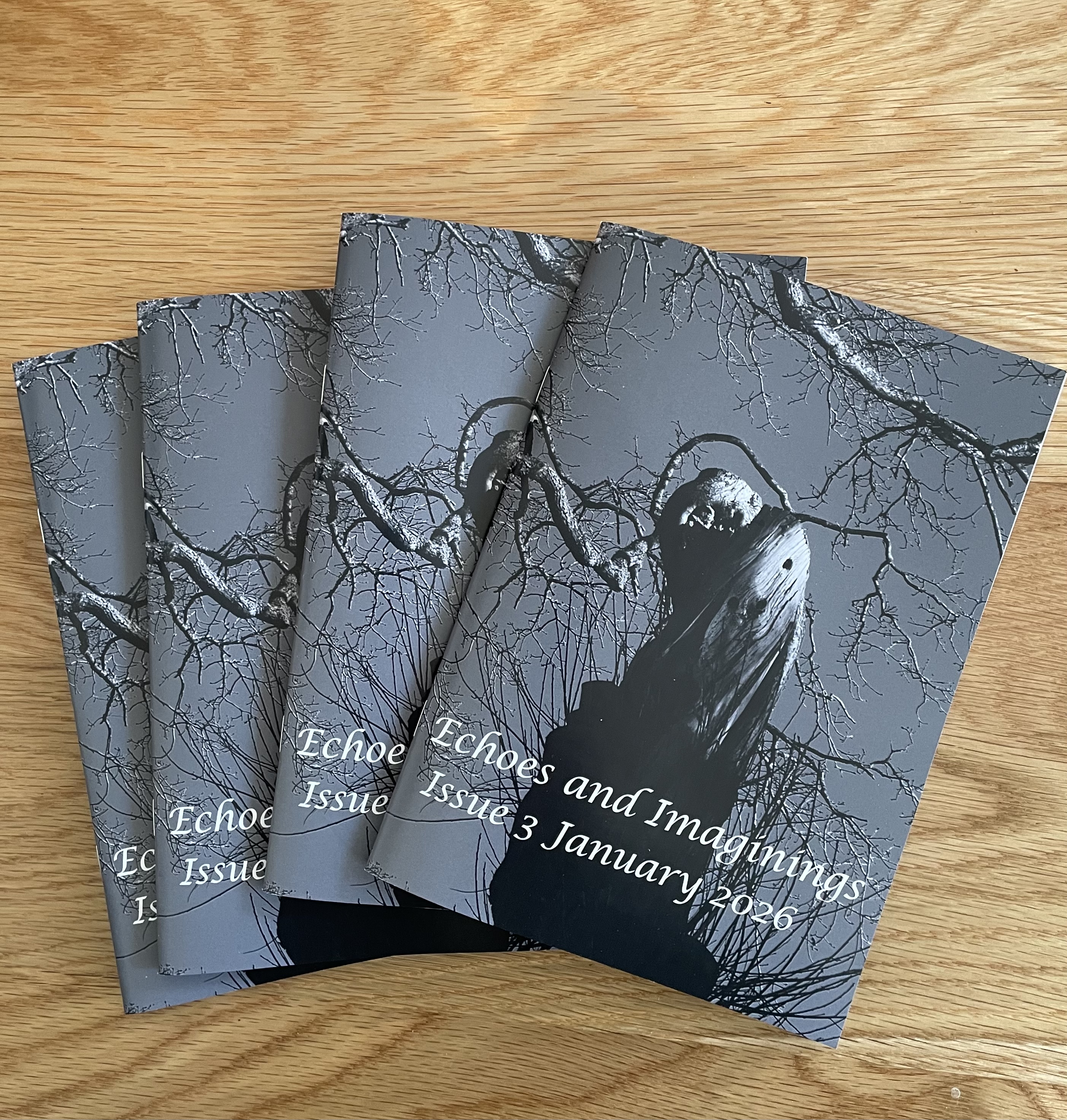
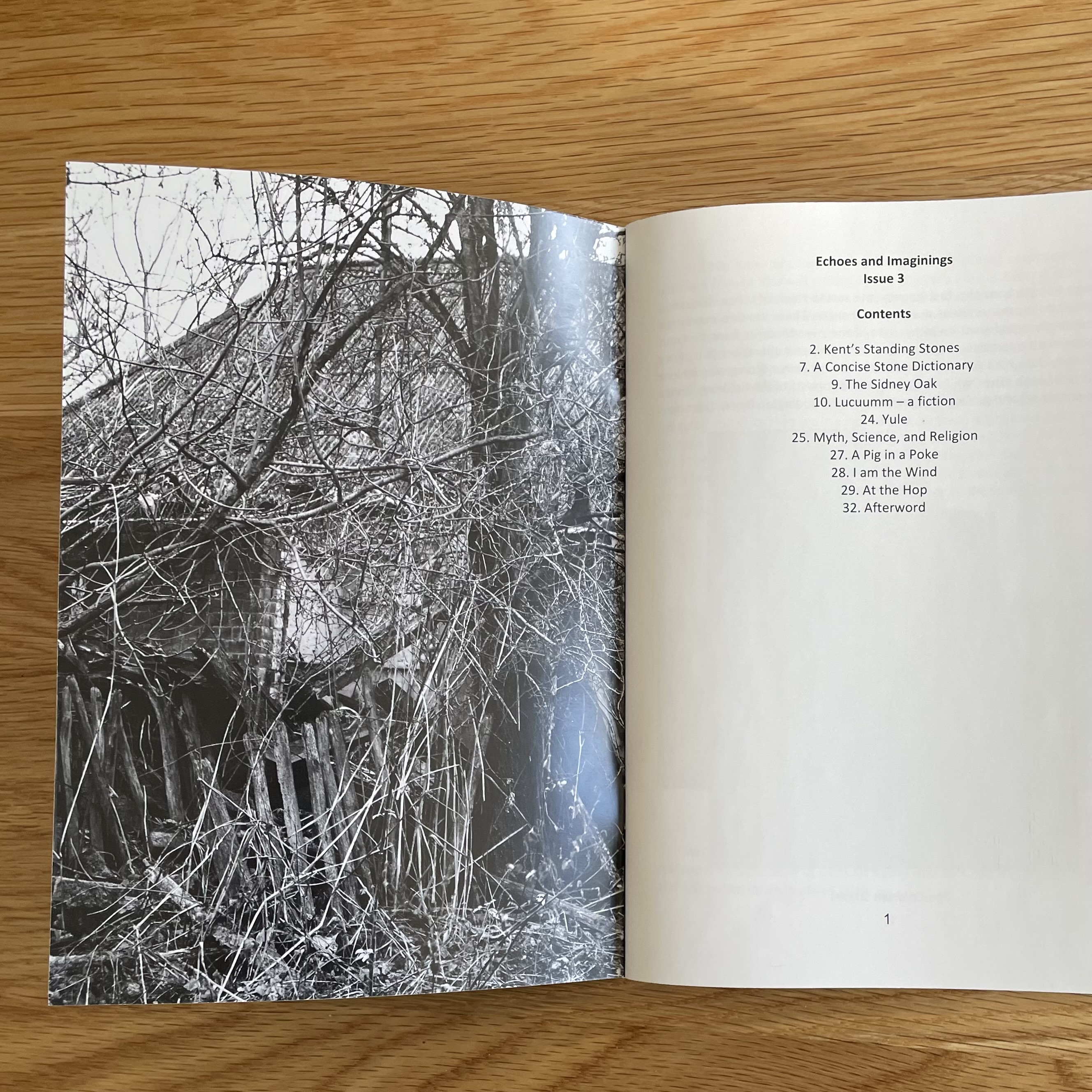
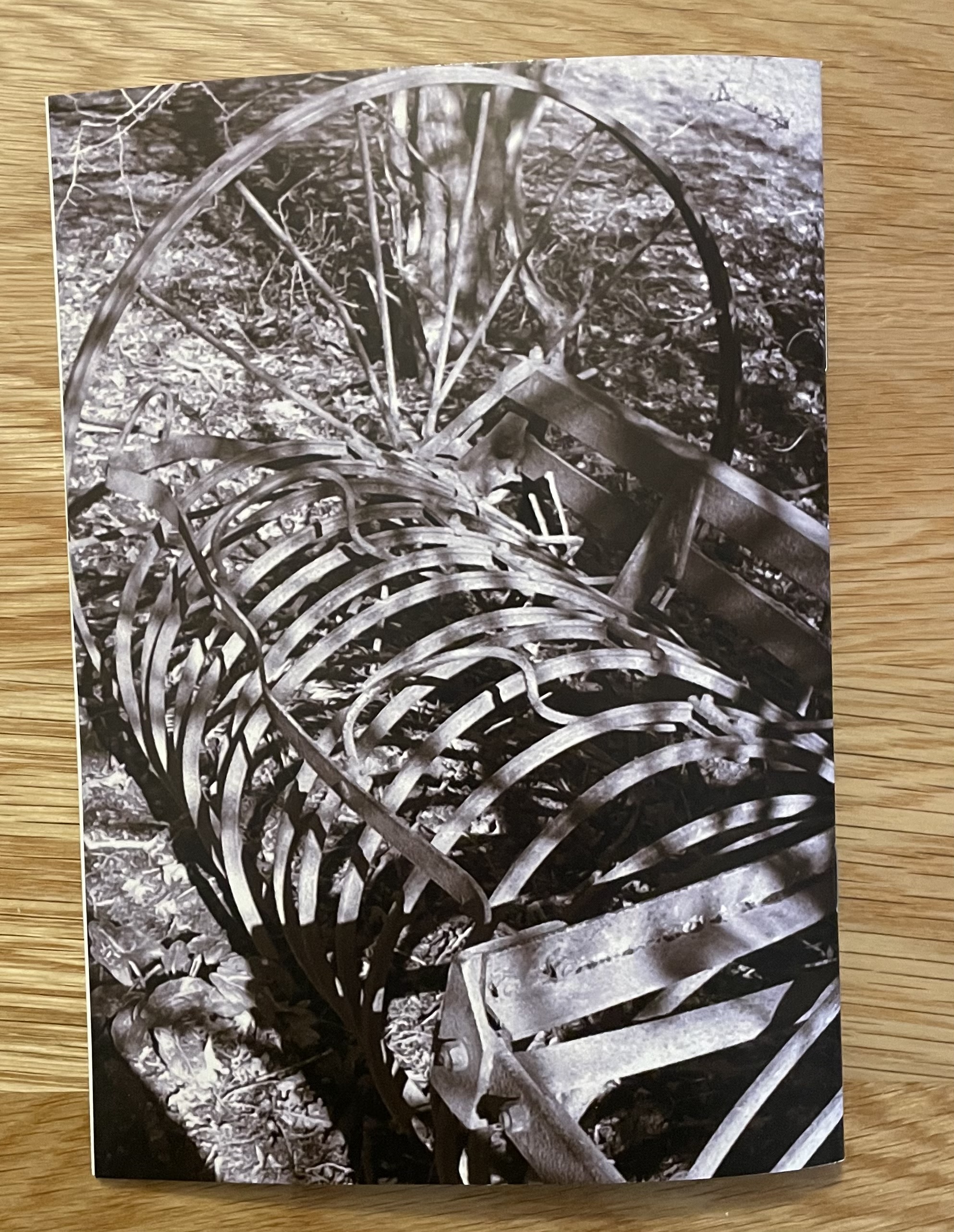
It follows the same pattern as the first two issues, more or less, although there is a bit of a change in the contents – nothing drastic, but in this issue, for the first time, I’ve included a fiction piece. Against that, there are only two poems. I want it to keep the same vibe, but I also want it to change and grow. There is one piece of my artwork included, and I think I might use more of this in future editions. But that vibe is still folklore, psychogeography, speculation…
And my timing is atrocious. All three issues so far have been compiled just before Christmas, so by the time they’ve been printed up we’re into January. If I had any commercial acumen, they’d have been up for sale around the end of November just in time for Christmas.
But I haven’t. Put it down to the anti-capitalist in me.
Initially, I had thought I would limit the zine to four issues, but I think now it might go on for a little longer than that.
We’ll see.
And I also have a zine on a completely different subject almost ready to go to print. Watch this space!
Issue #2 of Echoes and Imaginings has arrived. It’s available both in my Etsy shop or directly from me – message me on the contact page. The format is similar to the first issue, with articles folkloric and psychogeographical. Poetry and photographs. A bit of re-hash from this blog, and new stuff.
And speaking of this blog, I’m slimming it down. It may not be immediately obvious, but I’ve already deleted a third of the posts, with more to go. For all sorts of reasons. Just tidying up, really.
Ladies and gentlemen, I’d like to present Echoes and Imaginings, issue one.
Quite pleased with the title, actually. My aim is to produce at least four issues, although whether I do or not depends largely on how quickly I can put each issue together. I want them to roughly reflect the seasons of the year, without being too dogmatic about it. There is a slant towards folklore, psychogeography and a bit of speculation, as well as photography and poetry. Future issues may well have some of my artwork included.
I’m already writing articles for issue 2…
In this issue you can find Hoodening, Wassailing, a meditation on time, photographs, poetry, and more. There are lots of trees. Some of the articles have appeared here as posts, although there is some re-writing, but most of the poetry and the pictures are new. It is available through my Etsy shop, or just message me directly (I use PayPal).
Personally, I reckon it’s a thing of beauty.
And as well as these four issues, I have ideas for some others, which I expect to bring out at random times.
At the moment, I feel this is the way for me to go. I don’t see myself finishing a novel any time soon, although I do have an almost finished one sitting there. I don’t currently feel inclined to get it published, though. And equally, I don’t feel inclined to go through all the hassle of submitting poems or short stories to different publications or into competitions.
And on another note, you have probably seen on other blogs the ongoing issues of pirated e-books (especially on Amazon, I hear). I think we have AI to thank for a lot of this, and it seems so many authors are having their books ripped or plagiarised it’s becoming ridiculous. For that reason, I have simply decided my books will no longer be available as e-books, and have deleted them.
If you care to Google (other search engines are available) Wassailing, you will learn it traditionally takes place on the Twelfth Night (after Christmas), i.e. 5th January, and is a British custom. You will also discover that wassailing involves groups (traditionally men) visiting apple orchards, usually after dark, and to encourage the trees to be especially fruitful the following year songs are sung, trees might be beaten with sticks to wake them up, and offerings of bread soaked cider left in the branches of certain trees. Perhaps one particular tree would be selected to represent the whole orchard.
A Dictionary of the Sussex Dialect published in 1875 has something to say on the subject. It defines howlers as ‘boys who in former times went round wassailing the orchards. A custom now nearly obsolete. The custom of wassailing used to be observed on the eve of the Epiphany, when the howlers went to the orchards, and there encircling one of the best bearing trees, drank the following toast,-
‘Here’s a health to thee, old apple tree,
May’st thou bud, may’st thou blow,
May’st thou bear apples enow!
Hats full! Caps full!
Bushel, bushel, sacks full!
And my pockets full, too! Huzza!
The wassailers derived their name from the Anglo-Saxon salutation on pledging one to drink, which was waeshael, be of health; to which the person pledged replied drinc hael, I drink your health.‘
Epiphany occurs usually on 6th January, or on the first Sunday falling between 2nd and 8th January, which tends to tie in roughly with Twelfth Night, at least as far as 6th January goes.
Groups of wassailers might also take the opportunity to go from door to door singing wassailing songs (like the one above and plentiful variations) to earn a penny or two. It is possible that the tradition of Christmas carolling derived from this. A wassail bowl was often also taken around, which would hold spicy mulled cider. This might perhaps also be offered at houses visited, although my copy of the 1849 Chambers Dictionary suggests a wassail bowl was used to drink in the New Year and does not mention anything about wassailing itself. I suppose this might represent a sort of official disapproval of the tradition. But it does confirm that drinking was involved, and I’ve no doubt the revellers enjoyed their share.
Howlers would appear to be a Sussex tradition, the name deriving from the boys ‘howling’ the orchard.
Away from the south of England, wassailing appears to have been more widespread, in the sense that not just apple orchards, but also bees might be wassailed, to encourage them to be productive, and it might also happen at other times of the year.
It being 6th January, we took a bus and a couple of trains and made our way to the village of Worth, just outside Sandwich, in East Kent, to not only join in with wassailing apple orchards but also watch some Hooden Horse antics. Hooden Horses you shriek in confusion? Look no further than this post, which even explains why we chose to go to East Kent.
Anyway, ale was drunk in the pub where we began the afternoon, with the Hooden Horse company performing their version of the traditional play – this particular company have recently revived the custom in this area – before we set off (horse and all) to wassail a nearby orchard on our way into Sandwich. In this case, the wassailing consisted of making plenty of noise as we passed the orchard – many a shout of waes hael and drinc hael, ringing of hand bells, and clashing of sticks. Personally, I am convinced there will be a bountiful harvest there next autumn. Then on to Sandwich for further Hooden Horse Hi-jinks (and further ale) in a welcoming taproom, before we made our way back home (since we had quite a long journey), although hardier folk than us went on for further malarky elsewhere in town.
Warning! Do not let this ‘doctor’ anywhere near your loved ones!
Gathering in the pub car park before the Wassailing walk
In the taproom, Sandwich
several of these photos courtesy of Sabina
We’ll just have to look out for another malarky opportunity soon, I guess.
In February 1600 Will Kemp Morris-danced his way from London to Norwich, a distance of approximately a hundred miles.
Kemp (or Kempe), born around 1560 and died, probably of the plague. in 1603, was an actor, dancer and all-round clown. A member of Shakespeare’s company, Chamberlain’s Men, he regularly played the role of the clown in Shakespeare’s plays. He undertook his famous dance after some sort of disagreement within Shakespeare’s company as a result of which Kemp took his shares and left. Although we don’t know what form this disagreement took, it is widely assumed Kemp was very much a scene-stealer who was apt to improvise during a performance – possibly Shakespeare was alluding to Kemp when he has Hamlet declare ‘let those that play your clowns speak no more than is set down for them’. Kemp also had a tendency to dance jigs at the end of a performance that critics declared ruined the mood of a tragic performance.
Afterwards he described his dance as a ‘nine daies wonder’ in a booklet he published, although it actually took him twenty eight days to accomplish as he rested up for a while between each day dancing,
By the time he had joined Chamberlain’s Men, he was already famous for his acting and dancing. He had toured the Low Countries (now referred to as Benelux) and Denmark 1585-86 as a performer with the Earl of Leicester’s Men, performed frequently as a solo dancer and actor – usually performing clownish parts – and his improvised jigs were renowned for being frequently both ridiculous and lewd, which might go some way to explaining the rift with Shakespeare’s company, who by then were attempting to attract a more refined audience.
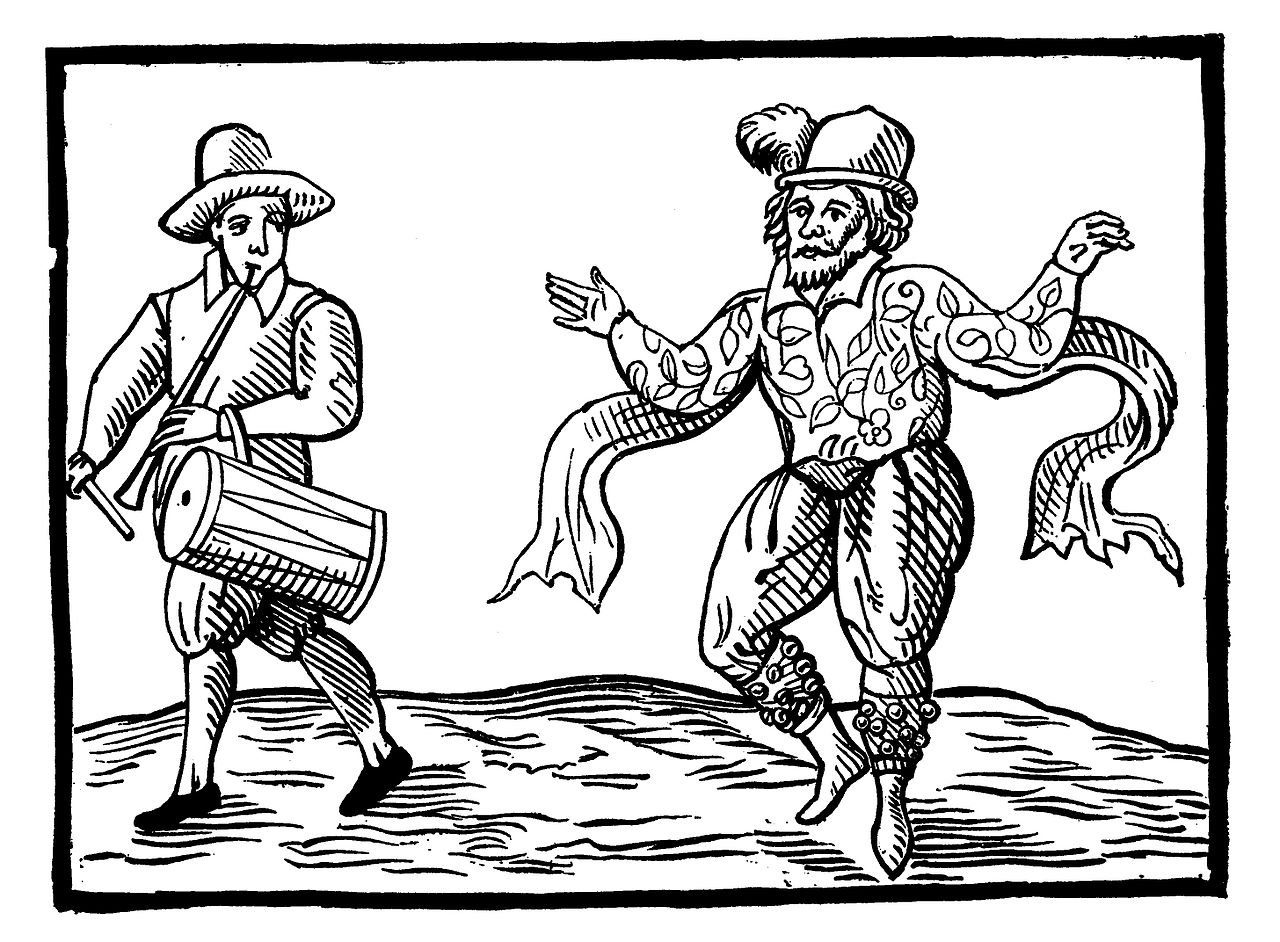
The dance from London to Norwich was performed as a publicity stunt and also as a way for Kemp to raise money by betting on himself to complete the journey. He was accompanied by a Thomas Slye, who played both the tabor (a small drum) and a fife to accompany the dance steps, and George Spratt who acted as overseer to the spectacle. Kemp wore a feathered cap, a slashed doublet with streamers attached to the shoulders, slashed breeches, and with clusters of jingle bells around his ankles and calves. A large crowd assembled to watch him set off from London at seven in the morning on February 10th 1600, and he continued to attract great crowds the length of his journey, which he completed on March 9th. He wrote the booklet later, as a riposte to those who doubted he had completed the journey.
This isn’t the origin of the phrase nine days wonder, incidentally, that goes back to at least the early thirteen hundreds.
The tune Kemp’s Jig appears in John Playford’s The English Dancing Master of 1651 and is attributed to John Dowland, but it is known that Kemp himself composed some jigs – four examples survive today. Whether Dowland (if it were he) wrote the jig to honour this journey, however, or whether it was a more generic tribute, we don’t know.
The journey, though, was quite an achievement.
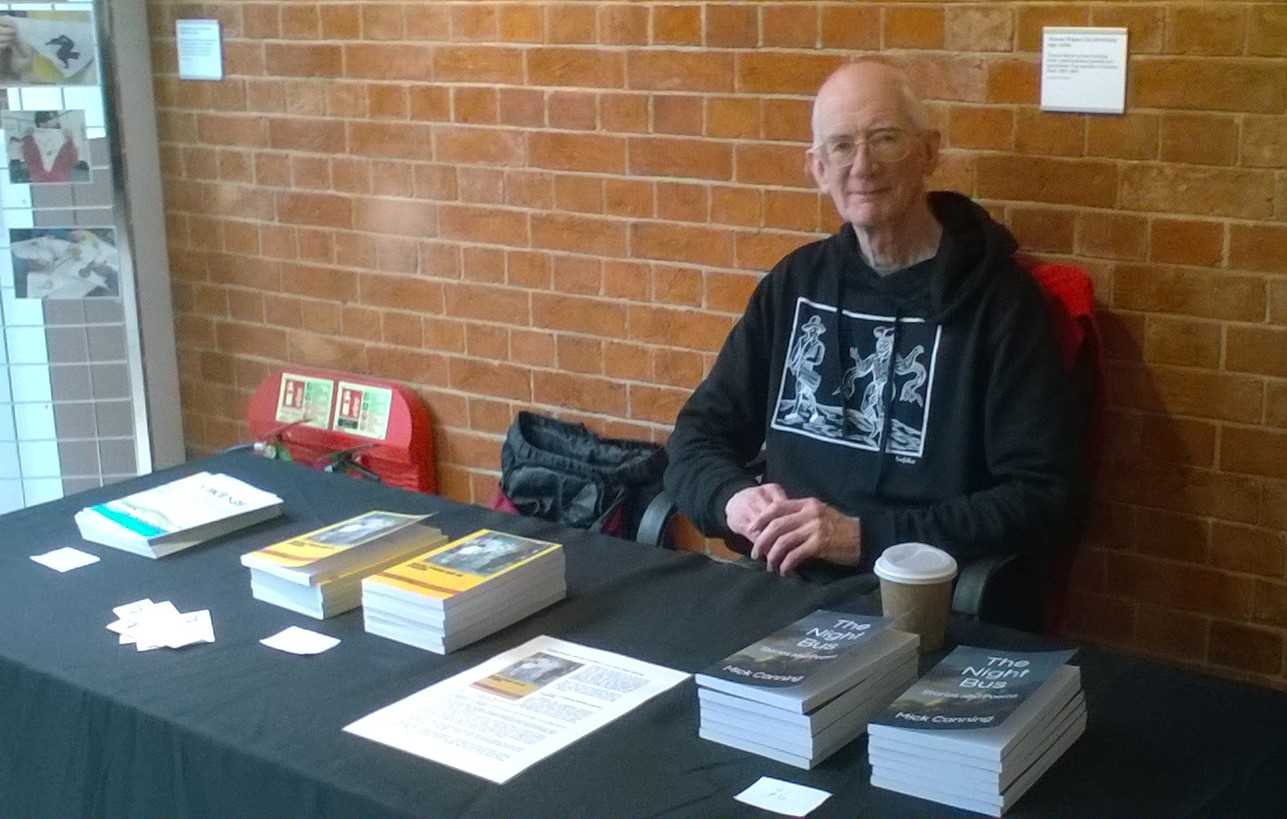
I know this is all a bit niche, but having bought myself a sweatshirt featuring the image, I decided to learn a bit more about Mr Kemp and this is the result of that. I already knew about his dancing from London to Norwich, but I knew little about him beyond that.
The May Day festival, Beltane, is a survival, or revival, from the Iron Age, celebrated in Celtic communities – Scotland and Ireland particularly – and revived as a full festival in Scotland in the 1980’s by the Beltane Fire Society. Beltane was a fire festival, although nothing of that remains in the festivities carried out in England. Beltane was first mentioned by name in Irish writings from the late 800’s / early 900’s.
The English version of this festival involves cutting flowers and greenery and dancing around a maypole, which things are also carried out during Beltane, celebrating the beginning of Summer which begins on May 1st. When I was a child, dancing around the maypole was the chief, possibly only, activity carried out on May Day. I have a photograph of my brother, my cousin, and myself, dressed up for the May Day Fair at which there was maypole dancing, but no obvious indication of surplus greenery. Past generations in England celebrated May Day with a day of celebrations which while including maypole dancing as an important manifestation of encouraging the fertility of the soil (and the festival-goers!) would also have included plenty of food and drink and general gaiety.
Mayhem, if you like.
This year, I managed two May Day days out.
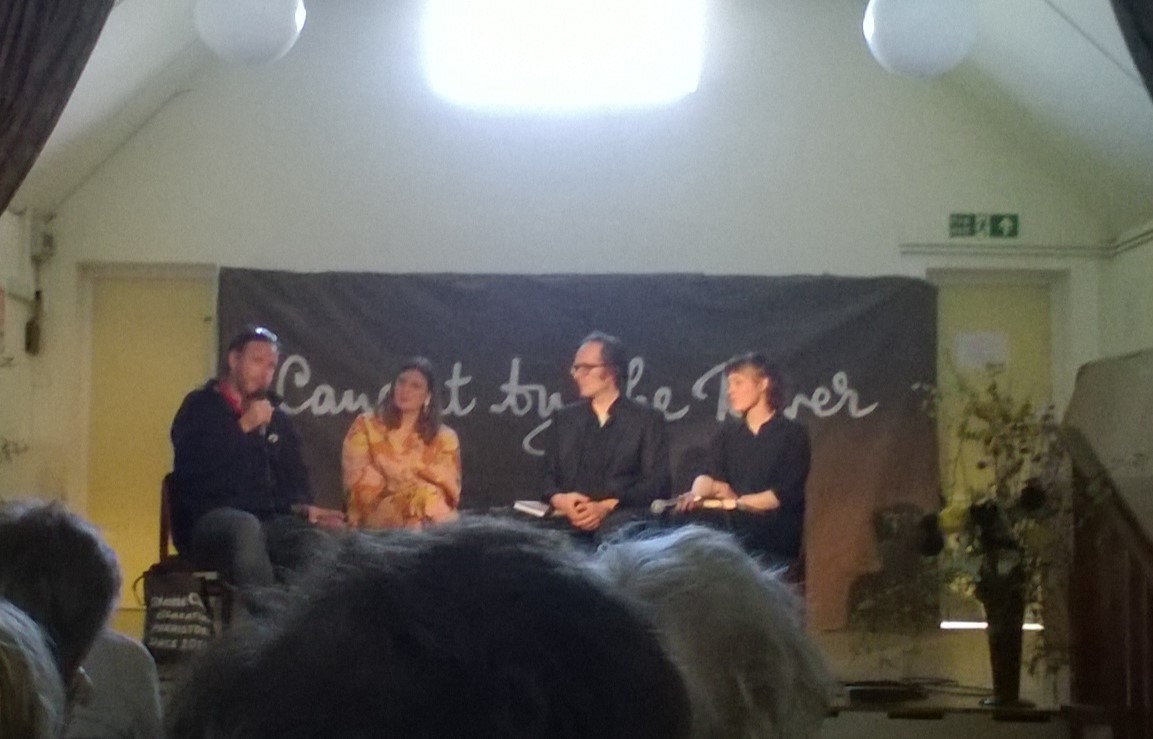
On Saturday, two days before May Day, I visited Kingston near Lewes, in Sussex, for the Caught by the River Mayday event. Caught by the River describe themselves as an arts/nature/culture clash and you can read all about them here. I have followed them now for several years, and this seems as good a time as any to mention that their coverage of arts, nature, and culture are second to none and if you’re not yet following them, well, you should be.
There was mask-making to begin with, especially to involve the children, the makers encouraged to incorporate flowers and greenery into their masks, and almost inevitably a certain amount of folk-horror found its way into some of these.
Nice, Richard.
This was followed by a promenade around the maypole, after which the activity moved indoors.
There were films, talks, and discussions, subjects including rivers, village life in the early eighteenth century, art, standing stones and the like, and the environment. After which, in the late afternoon, we all promenaded up the hillside to the Gurdy Stone.
This is the Gurdy Stone, a modern standing stone on a hillside overlooking Kingston. Here, Local Psycho (Jem Finer and Jimmy Cauty), held a gathering to encode the music of their Hurdy Gurdy song into the stone “To mark the 50,000 year return of the Green Comet and release of The Hurdy-Gurdy song on Heavenly Recordings.”
Throughout the day, naturally, we all had access to the pub.
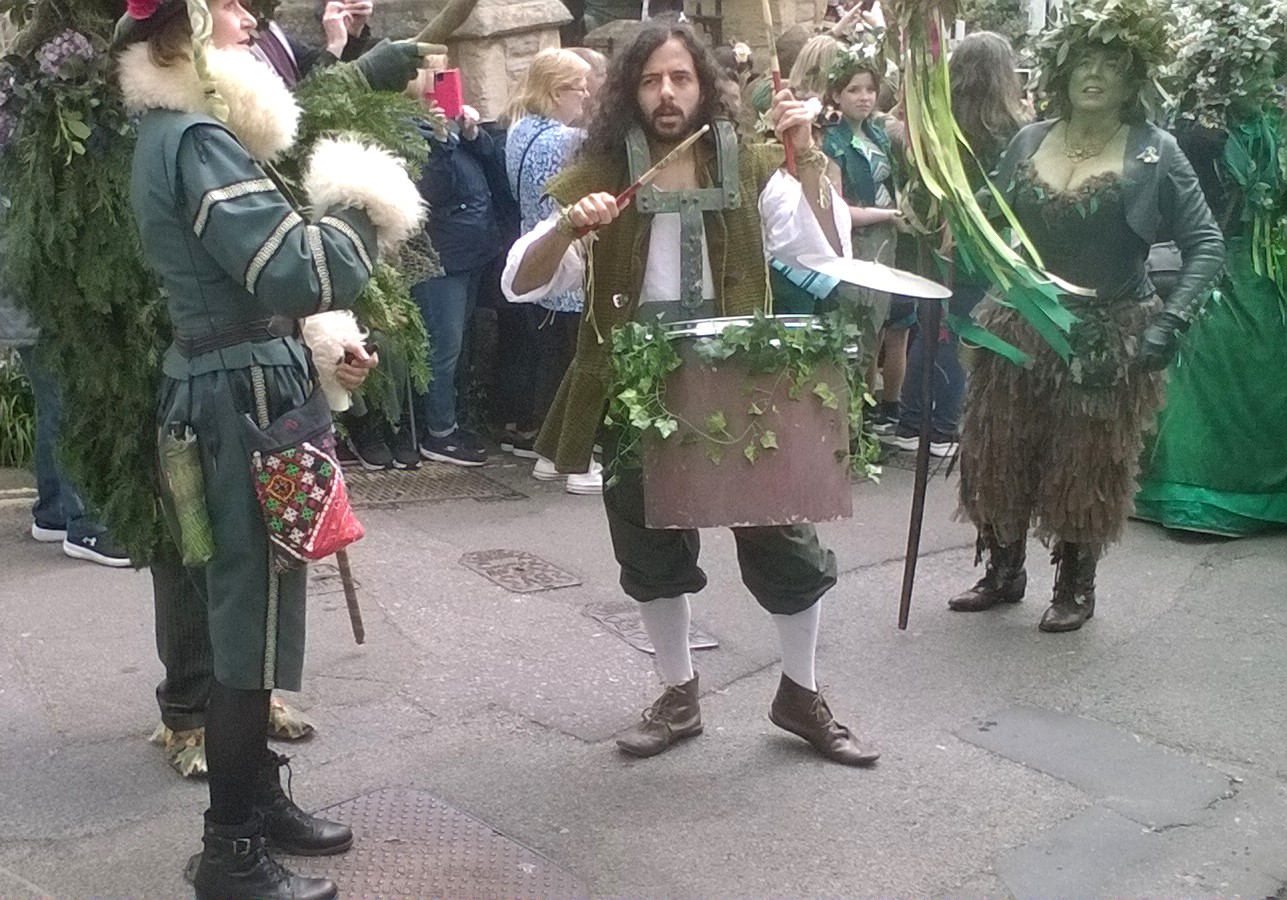
And then on Monday, which was May Day, we went down to Hastings. It rather felt as though everyone in South East England must be in the town, either at the Jack in the Green festivities or watching blokes on motorbikes roaring up and down the seafront for no discernible reason. I don’t much like crowds, and some of this was very difficult. But away from the huge horsepower and testosterone nonsense, amongst the Jack in the Green celebrations the atmosphere was brilliant and the large numbers of people perfectly acceptable. Jack in the Green is a manifestation of the spirit of spring, related to the Green Man, a dancing figure covered in greenery.
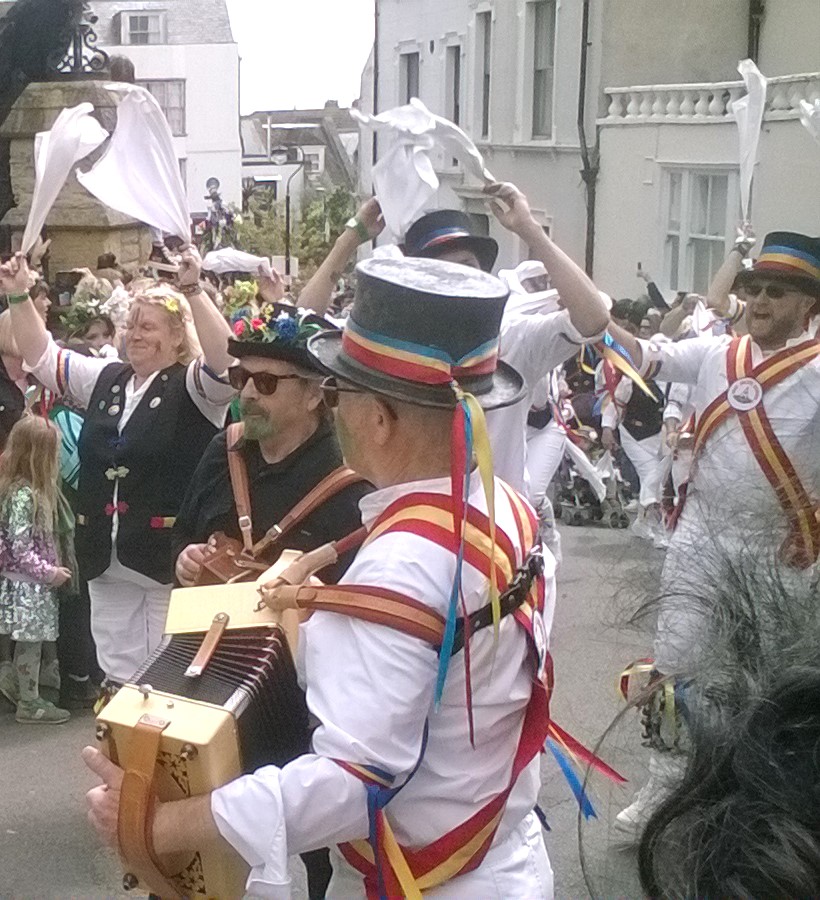
The festival in Hastings has grown over the years into a large event involving musicians, dancers, Morris sides, huge figures in addition to Jack in the Green such as the Queen of the May, a witch, and others, plus any number of people joining in the procession around the town, all decorated with as much, or as little, greenery and/or flowers as they feel suitable.
There you go, a Morris side.
Followed by a large witch with a cat. Why the witch? I’ve no idea. Why not? I suppose.
And there you have it. Music. Drumming. Greenery. Crowd involvement. Summer is icumen in and winter’s gone away-o.
In the town I used to live in, there was once a pub called the Hooden Horse, sadly now renamed to something much less interesting. I was reminded of this at an exhibition at Maidstone museum on Hooden Horses. Hooden Horses? Well, briefly…
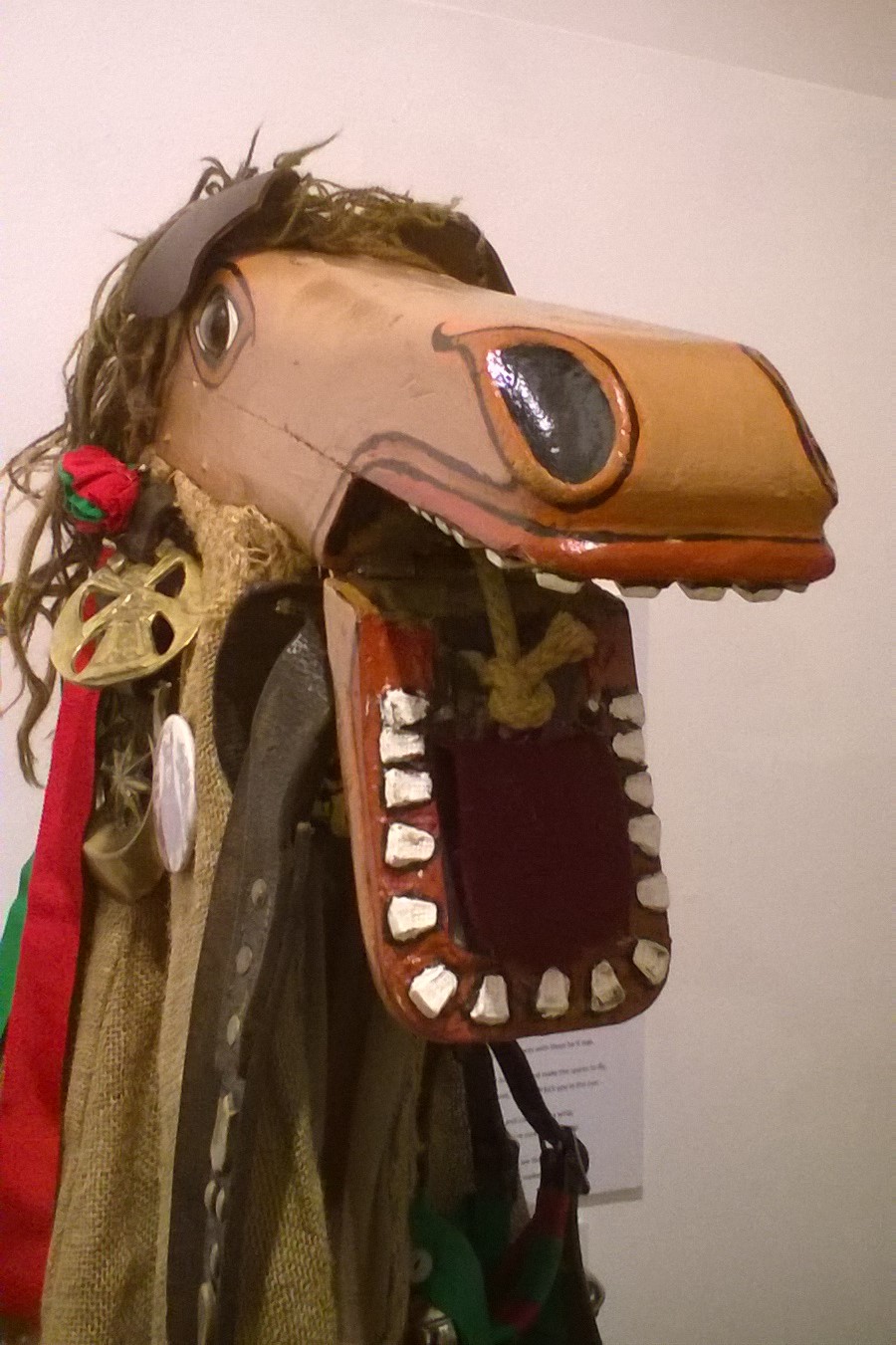
Hoodening is a rural folk tradition unique to East Kent, England. Going back a few hundred years, in the week or so running up to Christmas, groups of farm labourers would dress up as various characters and go from door to door requesting money, cake and beer. One of the characters would be the Hooden Horse, which was an artificial horse’s head made of wood, with a jaw operated by string, on a wooden pole, held by one of the performers with his body covered in cloth – usually sacking. A sort of play was then performed in rhyme, a mixture of plot and satire, usually featuring a few local characters who would be well known to the watchers and might be the butt of jokes and scorn, as well as stock characters such as Molly, a waggoner, and the Mayor. And of course the horse (him)self, invariably called Dobbin. There would also be music performed on whatever might be available – accordions, fiddles, drums or whistles.
The relationship to Morris dancing and Mummers is hard to avoid and, like these traditions, has been revived in modern times by enthusiastic traditionalists.
A photo from the early twentieth century
A modern Hooden Horse
Another early twentieth century photo.
There are many other traditions in Britain involving what is known as ‘animal guising’, where men or women take the guise of an animal, the Padstow ‘obby ‘oss being perhaps the best known of these. The performance on May Day in Padstow, Cornwall, invariably draws large crowds.
On the left, a Hooden horse, and on the right a Mari Lwyd, the ‘skull horse’ of Welsh tradition. Although unconnected (as far as I know) the Welsh had a similar tradition, also taking place around Christmas and New Year. Skull horses are to be found in other parts of England, however, including Yorkshire.
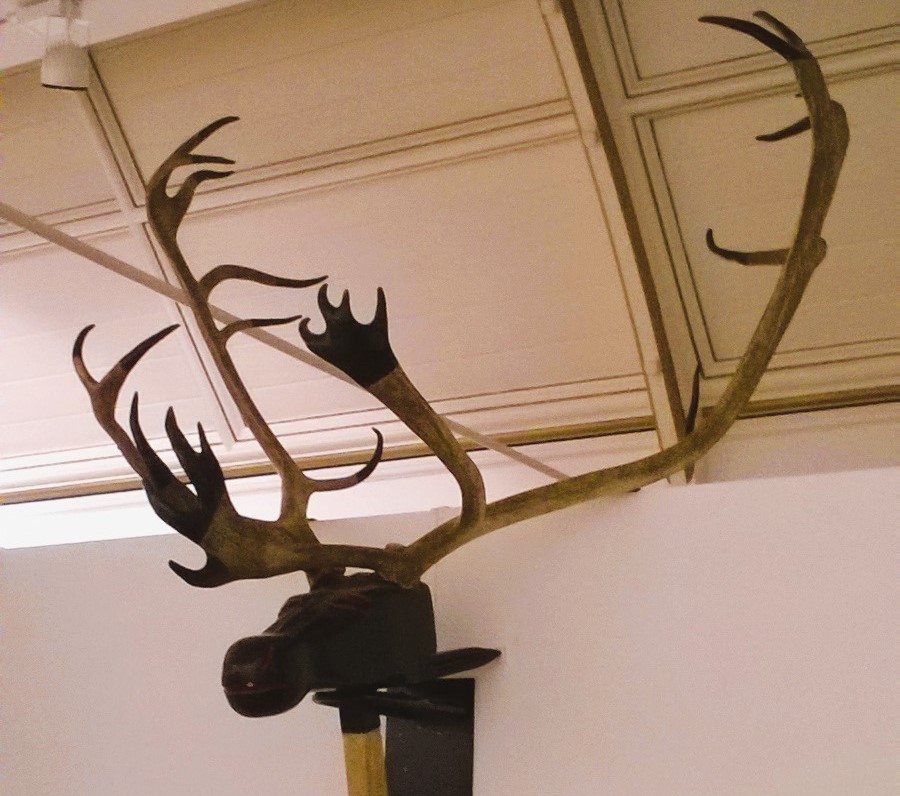
Stag guising is another old tradition – possibly older than horse guising. It was certainly in existence during medieval times and survives today in the form of the Abbots Bromley Horn dancers, Staffordshire, who perform carrying reindeer antlers on poles on the Monday following ‘Wakes Sunday’ in September. Wakes Week became a tradition in industrial Northern England when factories and mills closed down for a week for maintenance giving the workers a holiday. This began in the early nineteenth century, but before this the ritual presumably took place at a different time of year.
The exhibition is on until 17th July 2023 and there is a link to their site here.












 Mick Canning