I had read a little bit about Bodhgaya before I travelled out to India, and if I had taken any notice of what I had read, I don’t suppose I would have gone there at all.
The place was crawling with bandits.
I was likely to be kidnapped.
I was certain to be shot and robbed.
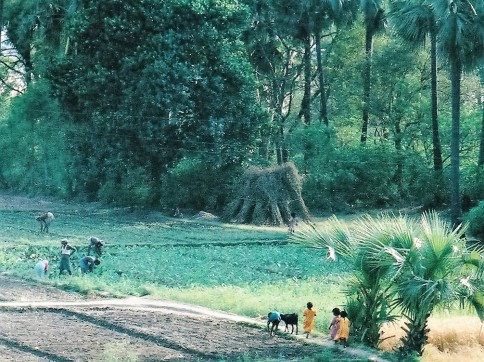
Sitting in the autotaxi as it bumped its way through the countryside between Gaya and Bodhgaya, with the sun shining on the fields and trees, this all seemed most unlikely. Yet, for those who lived there, these fears were very real. Later on in my stay, I travelled with another westerner and two Indians by jeep to Patna, which was a four hour drive.
We were delayed in Patna as the jeep broke down, the result being that we were several hours late in setting out on our return journey. It was beginning to get dark soon after we left Patna, and the two Indians on board were clearly very fearful of being stopped. They said that if we encountered a roadblock, it was quite likely to have been set up by bandits, and that we would veer off of the road and drive hell for leather – anywhere – to avoid them. They were less worried about crashing the jeep in the darkness somewhere than they were of the bandits. I used this as the basis of an incident in my forthcoming novel ‘Making Friends with the Crocodile’. *shameless plug*+.
+Well, why not. It’s my blog, after all.
But, I’m getting ahead of myself, and so back to the autotaxi. My driver had no idea where the guest house was that I wanted to go to, but cheerfully said that would be no problem. Once we reached Bodhgaya, he asked a few people where it was, and I was soon offloaded on the doorstep.
Once I had checked in, I walked into the town to explore and, more importantly, track down some supper.
By the time I reached the Mahabodhi Temple Park, it was dark. The temple looked absolutely stunning lit up by a number of spotlights, but I deliberately decided not to go in until the next day. I felt that I should wait until I felt a little cleaner and fresher. There was no rush; I was there for some time. I was looking forward to getting to know Bodhgaya better and treating it as home for a month or so.
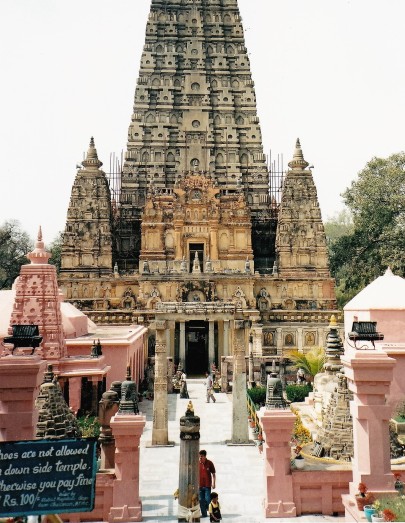
The road outside, which was the only one in Bodhgaya that was well-paved (and pedestrianized, no less!) was, not surprisingly, full of various vendors and supplicants. But they were not overly pushy, not overly expensive, and interesting. I bought some incense, partly just to help to drive the mozzies out of my room! Just standing outside the park gates I got a great feeling of well-being and pleasure.
The following morning, after breakfast, I visited the temple.
Stunning, I had thought the previous evening, and, yes, stunning it was.
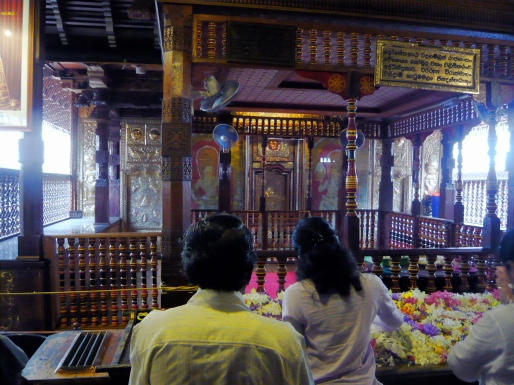
Not stunning in the sense that the Taj Mahal, for example, is stunning, although the architecture is interesting; there was just a massive sense of place, of solidity, and the thought came into my head that Hindus and Buddhists alike ascribe the centre of the world to Mount Meru, but this felt like the centre to me. As I was walking around, several times I just felt an unexpected urge to burst into tears.
All around the temple, there were pilgrims and tourists. At one side, there is an old Neem tree, supposedly a 4th generation descendant of the one that the Buddha sat beneath to achieve enlightenment, two and half millennia ago. When it is grown at a Buddhist temple, it is referred to as a Bodhi (which literally means ‘enlightenment’) Tree.
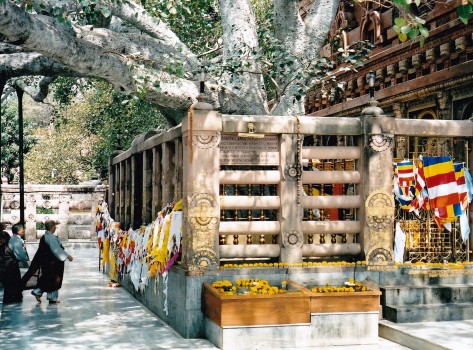
The reason that this site is so special, however, is that this was the actual site of the Buddha’s enlightenment. For a Buddhist, places just don’t come more special than this.
Everywhere, groups of pilgrims were conducting pujas (ceremonies); there were large numbers of Japanese and Korean pilgrims, but also many from other countries. This is reflected in the large number of Buddhist temples built in other places around Bodhgaya. There are a dozen or so temples built by Buddhist orders from all of the countries with substantial Buddhist populations, such as Thai, Chinese, Tibetan, Vietnamese…lots to visit, I decided. Outside the gates, a CD of chanting monks was playing. Despite the swarm of visitors, the whole place exuded peace, and I found myself just gently strolling around, sitting, watching everything…
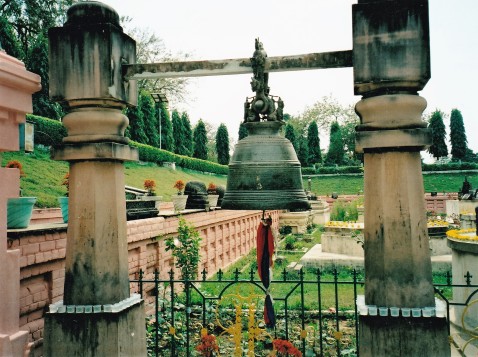
It was lunchtime, I found with surprise, when I left the temple grounds.
The presence of so many Buddhists in Bodhgaya has led to the setting up of a number of ‘projects’. These take many forms, but there are a good number of medical projects, schools, and orphanages, all set up to provide these services free to those that would otherwise not be able to afford them. Bihar is the poorest state in India, with higher levels of poverty, lower life expectancy and lower rates of literacy than any other state (the last time I checked!).
Human nature being what it is, a few of these are scams. I had checked out the project that I had volunteered for as well as I was able to beforehand, and was reasonably certain that it was genuine. I was volunteering my time, rather than donating money, so I was fairly sure that I would be able to see what was happening on the project as I worked, and if I was helping to (for example) improve the English of a few children, then that would be beneficial regardless of anything else.
I made contact with the project organiser and told him I had arrived in Bodhgaya.
The next morning I was at the orphanage.




 Mick Canning