Just Look at Ghat!

Ouch! Probably my worst title yet!

I can’t help it…I’ve not been well…

…well, only a cold, but you know what we men are like.

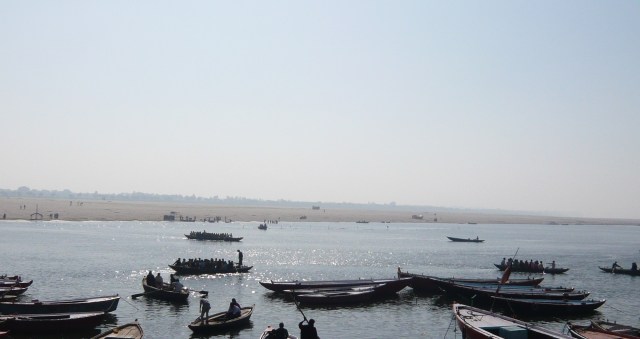
In another attempt to feel instantly better, I’ve nipped across to North India (only in my imagination, unfortunately), to picture Kedar Ghat, on the banks of the Ganges, in Varanasi.

056a

Ghats, a Hindi word, are sets of steps leading down to a river (and also mountain ranges or passes – The eastern and Western Ghats in Central India). It has also come to mean a level place at the edge of a river where Hindus cremate their dead.

In Varanasi, there are between 84 and 87 ghats, depending upon who you get this information from,. The Manikarnika Ghat, or Ghats (possibly this is the origin of the confusion over the number) is the ‘burning ghat’, where cremations are carried out 24 hours a day, all through the year. The source fire there has supposedly been burning for thousands of years, but photography is actively discouraged, hence my only shot is one taken from a distance.

046a

Of course, the ghats are also used for bathing. Hindus bathe en masse there, as a dip in the Ganges is meant to wash away sins. Important pujas (ceremonies) take place at sunrise and sunset. Boat trips to view the ghats are very popular, and finally much of the city’s laundry gets done at the dhobi ghats (dhobi meaning laundry).
040a

Namaste!

Indian Salt Miners

salt-workers

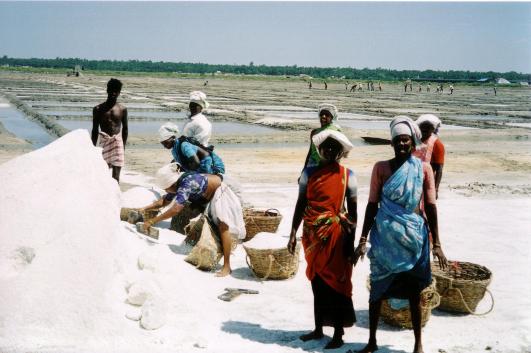
Salt workers pose for a photograph at the salt pans near Marakkanam, just north of Pondicherry (now renamed Puducherry, its original name before the French arrived, although everybody continues to refer to it as Pondicherry, or just ‘Pondi’). The sea is allowed to flow into ‘pans’ (not unlike paddy fields) and then it evaporates over several days under the hot sun, leaving behind a layer of salt which is gathered by hand. Salt has been gathered this way in India since time immemorial.

Even when I took this photograph in 2006, on my first visit to South India, it struck me as a harsh environment in which to have to earn a living. Since then, I have learned more.

Salt is, and always has been, an essential commodity, especially for a population living in hot conditions, but when the British in India imposed a salt tax, this eventually led to the ‘Salt March’ led by Gandhi to Dandi, on the Gujarat coast, where he symbolically gathered salt at the coast after a 200km march, an action that contributed to the loosening of the hold that the British Raj held on India.

In Gujarat alone, approximately 112,000 labourers are employed in the industry (Gujarat State Law Commission figures).

In all, there are approximately 1,000,000 people employed across a total of nine states harvesting salt. Typically, women and girls make up most of the workforce.

But the conditions that the salt miners labour under today are little better than they were then.

They suffer eye problems and blindness from constant exposure to the sun reflected off of the brilliant white of the salt pans. Skin lesions from the salt are common. After a while, feet become septic and absorb salt; so much so, that according to some accounts even after death the salt content in their limbs are so high that hands and feet are difficult to burn during cremation (Daily Telegraph 24/2/10).

In addition, the labourers suffer from many of the other problems common across the labour force, such as exploitation by contractors and money lenders, and poor educational opportunities for their children. There is often inadequate housing, drinking water and food, and an absence of primary healthcare (Indian Express 26/4/16).

It is frequently said that saltpan workers have three ways to die: first gangrene, second TB (tuberculosis) or third blindness.

Their life expectancy is 50 – 60 years.

The hardships and problems they face are slowly being brought to the public’s attention, but clearly there is still a very long way to go before they enjoy what most would regard as decent working conditions.