David Nash and Impermanence

A few days ago we went to the Towner Gallery in Eastbourne, Sussex, specifically to see the Eric Ravilious paintings and prints on permanent exhibition there. There was also a large exhibition by the sculptor David Nash, who works with wood on a large scale. The fact that the whole exhibition, which also included a gallery of paintings, prints and a couple of small installations, and was intended to highlight the effects of the Climate Crisis, was the first one ever curated by Caroline Lucas M.P. of the Green Party was an added bonus for me.
007a


002a

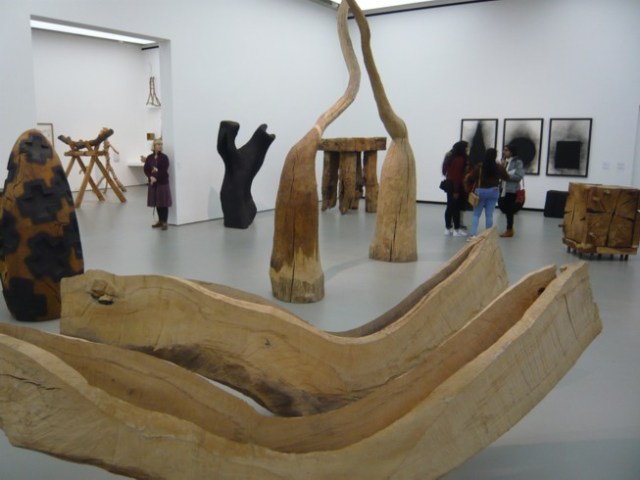
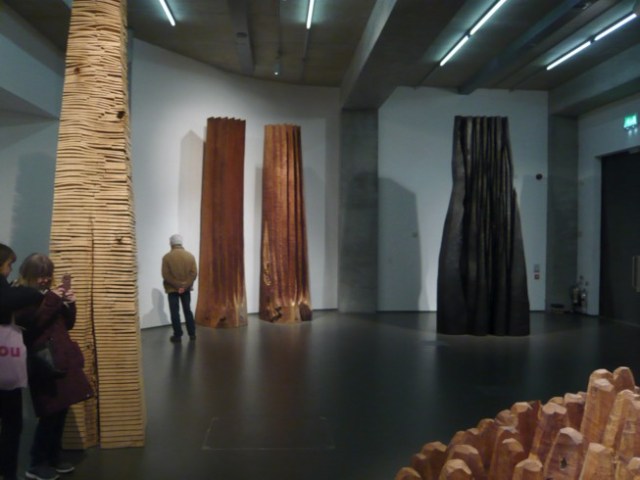
As much as I enjoyed the Ravilious, I was blown away by Nash’s sculptures. To see wooden sculptures on that scale is unusual in itself – usually that would be the preserve of stone or metal – but that very scale plays tricks with the mind and the eye. Boxes and bowls many times larger than one would expect meet the eye as you walk around the galleries, and many of the pieces also deceive where perhaps one looks to be made from several separate pieces of wood, but on closer inspection are carved from a single block like the boat shapes in the top picture, or the ‘stack’ in the one below that.

Much of the work is left rough-hewn, but even this can be deceptive. Some pieces have been carefully finished to give that appearance.

Sculpture is the art form that seems to exist to interact with the natural world. A number of the works here are based on natural forms, but there are also stories of projects Nash has undertaken where his sculpture is either living, in the form of carefully planted and managed groves of trees, or interact in other ways.
004a

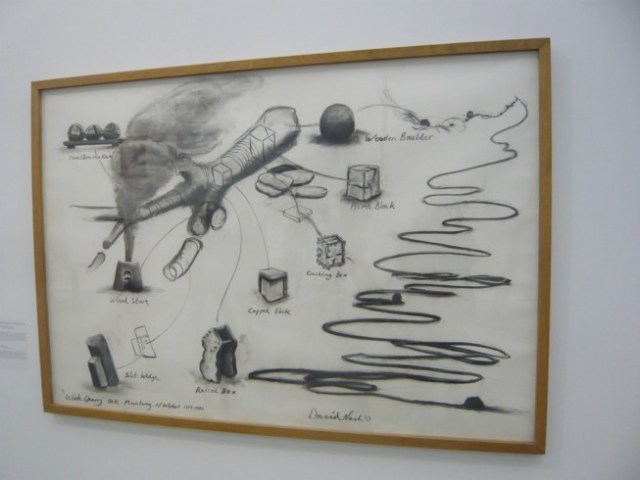
‘Boulder’ is one such project. One of the first large-scale pieces Nash made was to cut a boulder-shaped chunk from a tree (illustrated at the top of Nash’s charcoal drawing above) in 1978. This was then transported to a stream near to where he lives and works, in the Welsh hills, and rolled into the water. Since then, it has slowly made its way downstream until it reached the estuaries and inlets of the sea, where it finally disappeared in 2015. Nash documented its travels in a series of photographs and films made regularly all the while, and presented in the exhibition as a film.

006a


003a


003b

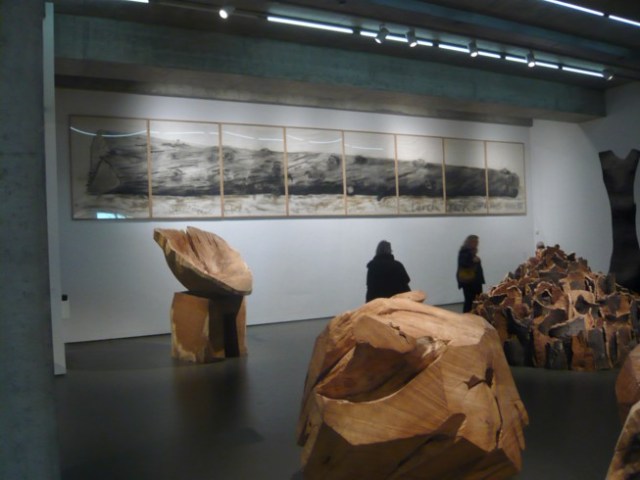
Nash’s sketch of a Larch trunk

It feels as though there is something of this meeting of art and the natural world in old ruins overrun with scrub and grass. They frequently seem to have a sculptural quality that complements the landscape around them, in a way that more pristine buildings do not.

And I like the sense that an artwork, like a ruined building, is not permanent and that eventually the natural world will absorb it back into itself. That it will reclaim it. Perhaps the artist and the environmentalist in me merge here.

My own sculptures are in wood, and some of them are set out in our garden where they gradually degrade over the years through the action of sun and rain, until they appear strangely like some weird plants that have sprouted unexpectedly there.

Stereotypes and Misunderstandings

In countries such as India, there is frequently an impression that Western visitors and therefore, by extension, all Westerners, own vast wealth and have massive amounts of leisure time at their disposal.

After all, they arrive on holiday, perhaps for a month or more, and they go around staying in places that are far beyond the means of the average Indian, spend the equivalent of several month’s wages on souvenirs, often hop on an aircraft to take a journey that would be one hundredth of the price by rail, flaunting expensive cameras and watches and phones and designer clothes. So who wouldn’t think that?

011a

This is not helped by the impressions given by many Western films and programs, where work seldom seems to get in the way of whatever action the film is depicting.

This often affects how local people interact with visitors, and their feelings about them.

I suspect it even drives a certain amount of international migration, too.

And so I think it very important to highlight a few facts;

Basically, the differences in exchange rates of different currencies give the impression of great wealth which is not, in fact, true.

A few numbers:

The average annual wage in the UK is currently £28,000, or $34,400. This sounds a lot (even to me!) but that hides a huge variation, of course.

It is quite hard to find figures that agree about the average annual Indian wage, with estimates varying from around $600, up to around $3500, although this may well reflect the massive difference between the rural worker and a worker in, for example, the IT industry. For sake of argument, I’m going to use the figure of $2000, which could still be slightly on the high side, looking at some of the sites I’ve gone to.

This would give the average UK worker a wage 17 times higher than the Indian. Sounds good for us, but the average cost of a house in the UK is now some £300,000 – that’s $369,000, and it is now almost impossible for young people to buy their own house unless they are helped by well-off parents, and they have very well-paid jobs. The average rent, otherwise, is around $12,300 per year. About a third of the average wage.

To find an average cost to rent in India is also difficult (for me!). I scoured a lot of sites, and seemed to come up with a figure of somewhere around $1,200 a year, although there were massive variations, both between cities and within them. If I have got these figures correct, that is around a half of the average wage.

The prices of basic commodities such as foodstuffs or power vary a lot between India and UK, too. Whereas I have bought street food in India for a rupee or two, making a lunch for perhaps 15 or 20 cents, it would cost me at least $2.50 to $3 in UK for the equivalent.

This isn’t to draw up an accurate comparison between the two – it would be quite a study to do that – but to try to make the point that the average person in the UK is better off (materially) than the average person in India, but not by nearly as much as many might think.

India has more of a problem with poverty, but the West has quite a bit, too. And whilst the poor in the West are emphatically not as badly off as their cousins in India, they still endure considerable hardship. Even with the existence of the supposed safety net of Social Security. There is homelessness. There is malnourishment.

Incidentally, and I pose this as a question to my Indian friends, I frequently read articles that focus on aid and development in poor (especially rural) areas of India, highlighting the fact that a large percentage of the population have to survive on around two dollars a day.

In the light of the above, I wonder whether this isn’t a little disingenuous, since that figure may not be as far below the average wage as many in the West believe, and wonder what you think?

I think it matters, because I believe this might distract attention from where work is needed more, such as improving sanitation, work conditions and medical care.