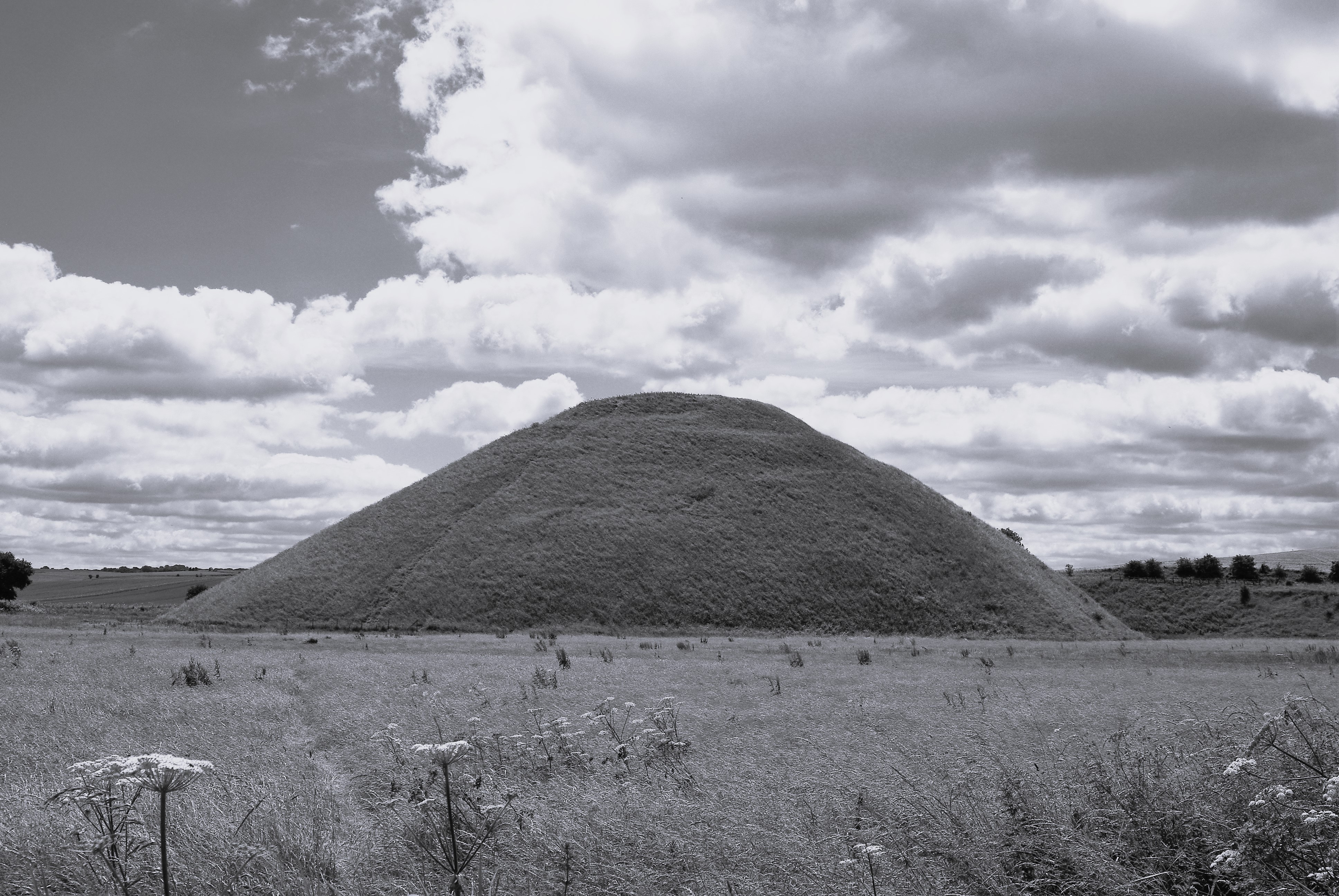
Silbury Hill, located a few miles from Avebury in Wiltshire, is the largest artificial mound in Europe, roughly the same size as the contemporaneous Egyptian pyramids, although it puts me more in mind of the Mexican pyramids. At 39m high and 160m wide and built of chalk, it was a colossal undertaking for the time – it was completed approximately four thousand four hundred years ago. Yet its purpose remains unknown; apparently it contains no burial, although folklore ascribes to it the final resting place of King Sil. Other theories connect it with the Goddess, and others yet suggest it as an observatory or sundial, although since Stonehenge was already in existence at the time of its construction, albeit in an earlier form as a henge monument, it seems highly unlikely that so much effort would have been put into the building of a mere mound, no matter how huge, if that was intended as its sole purpose.
Archaeological evidence suggests it was constructed over around a hundred years and there was probably a track spiralling around the hill to the top – used both in its construction and then afterwards to access the top of the hill which appeared to originally be flat. And that there was a constant tweaking of the shape over the following years, as though succeeding generations each felt the need to make their mark on the site.
Allowing for the fact it would have been a little higher due to the effects of weathering over the last four thousand years, it would have been as high as the nearby hills, Waden Hill and Knoll Down, but the difference would have been striking, since this perfectly shaped mound would have been dazzlingly white. The effect of the hill on anyone approaching would have been remarkable. Imagine it gleaming like a snow-covered mountain in the sunshine, or glowing mysteriously at night in a thin moonlight.
This isn’t something a tribe decided to do because they had some time on their hands – they’d had a good day’s hunting and the roof had been fixed, so why not? And not something just done on a whim – ‘You know, I like this place, but I really rather fancy putting a large hill just over there.’ This was a long term project, literally a lifetime’s work. And it was intended as one heck of a statement. Like a Medieval cathedral or Trump Tower, it was intended to be seen from a long way away and admired and talked about, although which of those two did it resemble? Was it the narcissistic project of an egotistical power-hungry madman or was it intended to glorify something greater than them?
On balance, I suspect the latter. Even if the project was begun by one strong-minded individual intent on somehow making a name for himself, it wouldn’t have been completed until long after his (or her) death, suggesting there was still a strong driving-force to complete the project.
But this is an area absolutely heaving with ancient monuments. Although Stonehenge is some twenty miles to the south, West Kennet long barrow is less than a mile away, Avebury Henge and stone circles only slightly further, and within the immediate landscape there are any number of burial mounds and standing stones. By any standard, this is a prehistoric landscape, and the visitor here must be looking at the evidence of ancient societies for whom memory and ritual were of great importance and significance.
I said earlier that there is no evidence of burials in the hill, yet all that means is that surveys have not revealed any chambers within the mound, or back-filled tunnels that might have been used to access the same. Yet I do wonder whether the entire structure might have been raised over the burial of an important personage. Perhaps future generations will find out.



 Mick Canning