Happy Holi to all of my Indian readers!
And, of course, to everyone else, too!
Holi is the Hindu spring festival, and is celebrated primarily in the north of India, as well as in Nepal. It is not generally observed much in the south, since spring was confiscated ages ago and there they have seasons defined by being either wet or dry, or fairly hot as opposed to very hot.
I was in India for Holi in both 2004 and 2005. The first year, I was assured by everyone I met (both Indian and foreigner) that I would be wise to hide in my room for the duration of Holi, and so that was what I did. The following year, I decided that I would join in, come what may.
March 25th 2005. Holi; eve.
This year Holi coincides exactly with Easter, which seems odd but makes perfect sense, really. They are both spring festivals, and we’ve just passed the equinox. You wouldn’t have any idea that it’s Easter here, though. The whole thing started today, as all the shops started closing early from Midday, and a few children who couldn’t wait began stalking the streets like miniature ragged versions of Clint Eastwood. By nightfall, a fair amount of alcohol and bhang – cannabis in an edible form, a speciality of Holi – had been consumed and, despite being invited to the evening celebration by a couple of Indian friends, my friend and I decided to stay in the Guest House.
A huge bonfire had been built in the middle of the dried up river, and by 9pm a huge crowd had gathered on the bridge (being India, all male and predominantly young) with lighted firebrands and a goodly amount of noise. After a while the shouting began to resemble more and more the chanting at a football match, the bonfire was lit and people swarmed across the bridge swinging their torches round and around. At this point, we felt that our vantage point on the roof was perfectly adequate.
March 26th 2005. Holi; Day one.
The following morning the fun really started. This is when there is license to soak everyone and everything in dye and gulal (powder): people, cars, rickshaws, passing dogs, whatever. The first few hours of the morning really are not a good time to be out, since this is when the mud and other unpleasantness’s (stones, dung) are quite often used as missiles We nipped down the road when the coast was clear for breakfast, then holed up until lunchtime back at the guesthouse. At lunchtime we returned to the same cafe, since very few were open and this is the nearest in any case. Soon a party of Indians arrived, some of whom we knew, who screeched to a halt in a car, came in loaded with beer and whisky, got the bhang out and very loudly invited us to join them. We made our excuses and left as soon as we could.
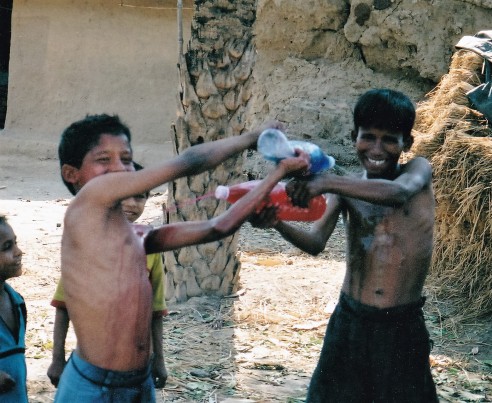
At this stage, I had already had a couple of hits from the kids (all of which seemed good-natured) and so I went over to the Foundation where I was working, where I had been invited to join in the festivities in the afternoon. As I approached the village, it became clear that I was not even going to reach the Foundation without much celebration (I guess that’s the best word). A few soakings from kids, then as soon as I plunged into the alleyway that led to the Foundation, A group of men emerged from a house, there was a fair amount of liquid dye squirted around, then handshakes and we swapped gulal markings (on each other’s foreheads, like cast marks) and I was presented with a piece of buttered toast soaked in milk for Holi – I had this last year, it’s actually rather nice! This activity then escalated until I reached the Foundation, where I walked into what felt like a carefully laid ambush, but was actually just the on-going hi jinks.
In no time at all, I was soaked from head to foot in dye and gulal. All the Foundation kids were there, plus the adults, and it also seemed as though half the village were charging in and out. Colours were flying in all directions, people rubbed handfuls of the stuff into each other’s faces and hair, handfuls of powder were dabbed on feet, on foreheads. We rubbed foreheads together, spreading the powder further and someone tipped a whole bucket of blue dye over me from behind. A man from the village, who was the father of one of the children in the school, swapped gulal marks with me and said ‘now I am your son.’ I probably should have replied ‘and I am your father’ but I just smiled and said that I was honoured. It seemed okay, because he beamed and gave me a great bear hug.
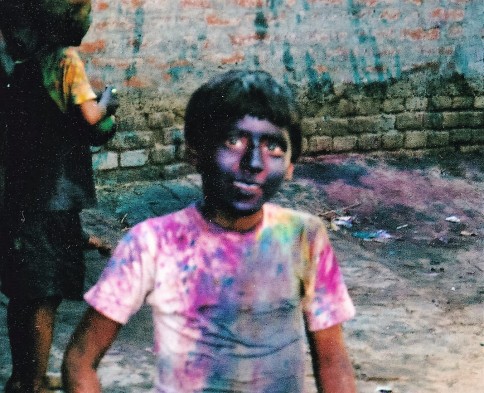
After an hour or so of this, it begins to wind down and the kids are slowly introduced to soap at the pump. Eventually we return to the guest house and I spend an extremely long time in the shower trying to remove the worst of the dye. Most of it eventually comes out, but I suspect the turquoise will be on me when I return to England. Goodness, I’ve got dye in the parts that other beers can’t reach!
By then it is evening, and we decide to try the other cafe that is open, since the party still seems to be going full-pelt in our usual one. We go in and, whilst impressed at the variety and quantity of insect life that it is possible to fit into one small cafe, decide that perhaps it is not the place to eat. We return to the first cafe, where there is an equally impressive array of human detritus – stoned, drunk and asleep. We eat, we go.
March 27th 2005. Holi; day two. Easter Sunday. Whatever.
I go into town after breakfast, where there is a little desultory squirting going on (don’t titter), but mainly people (at least young males) seem to be gathering in groups. There is one on the Tibetan Market ground and one on the river bed by the bridge. I’m not sure of the significance, but it seems to involve small bonfires and noise. Not much else seems to be happening.
After lunch, I walk over to the Foundation. It is still very quiet as I walk over, the bridge almost deserted and the only noise from some parties in the distance. As I walk towards the Foundation, the noise level rises and I turn the corner to see the afternoon’s entertainment in full swing, on the open ground in front of the Foundation.
A clay pot is suspended from a rope that hangs between two poles, containing coloured water and a load of rupee coins. Beneath it are twenty or thirty village lads engaged in attempting to reach it. This they have to do by means of making a human pyramid. To be successful, it must reach three persons high. To complicate matters ever so slightly, an equal number of lads hurl dye, water, mud and straw, etc, at them as they climb. The passage of time is enlivened whenever a rickshaw or bicycle attempt to get past, with predictable results. One group of three on a motorbike particularly unwisely decide to hoot imperiously at the group as it approaches. It and its riders immediately disappear beneath a deluge of water, dye, straw, mud, etc.
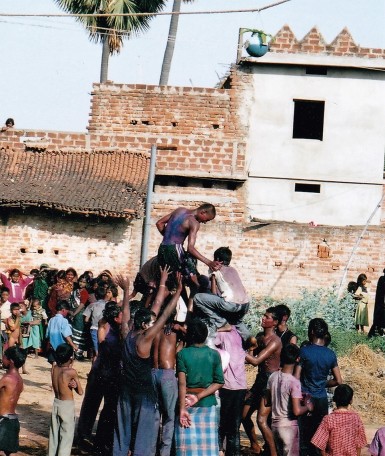
It takes two to three hours before one lad successfully reaches the pot, hanging by one hand from the rope and tipping out the dye and rupees onto the crowd below. The waiting children swoop, and everybody slowly drifts away.
Bumping into a friend in the evening, it turns out that she spent the afternoon at a teacher’s house (she works at a school) where it was music, dancing and feasting. Lots of decorum. Really not the same.





 Mick Canning