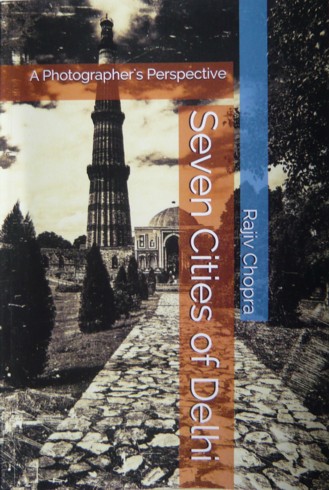
Seven Cities of Delhi by Rajiv Chopra


001

On my first visit to Delhi, almost thirty years ago, I was overwhelmed by the huge numbers of monuments there, such as the Red Fort and Purana Qila. I found the area around Paharganj to be chaotic and exciting and everything an inquisitive Westerner could wish for – a mixture of smells of food and incense and, yes, sewage. A mixture of ugly concrete buildings and beautiful dilapidated buildings left over from the British Raj and often much earlier. Milling crowds of people and cows and rickshaws and bicycles and autos, and history, history, history.

Chadni Chowk was incredibly crowded, the Lodi Gardens completely deserted. The Jama Masjid crowded by tourists and worshippers alike, the Janta Manta often almost empty.

There is so much history everywhere you turn in Delhi.

Other Westerners I met tended to be highly disparaging of Delhi, which was something I couldn’t completely understand since many of these same Westerners seemed to praise Mumbai and Kolkata for the very reasons they hated Delhi.

Yet Delhi is, I think, one of the most exciting and interesting cities I have ever visited. From a historical viewpoint alone, it has over ten thousand listed monuments.

Ten thousand!

Rajiv Chopra is a Delhi based photographer with a passion for recording both the historical Delhi and the street life he comes across from day to day. In this book, he has combined his photographs with a little of the history of the seven historical cities that constitute Delhi, and also a perspective of the differing processes that photography has passed through from its invention up to the present day.

To illustrate all these factors, his book is split into seven sections – one for each of the historical periods – and in each section he has outlined one of these photographic processes so that, for example, in the section covering the first city, Mehrauli, he speaks of daguerrotypes. And then his own photographs he processes through Photoshop to simulate the effects of these processes.

This is not a long book, but it does not pretend to do more than act as an introduction to the history of Delhi. And in this it certainly whets the appetite for more, and then for anyone with even a passing interest in photography it gives a concise and potted description of these photographic processes. Finally the photographs themselves complement the text perfectly.

I unhesitatingly recommend this book for anyone who wants to know a little of the history of Delhi, and who enjoys photographs that give a real flavour of the history of that magnificent city.

Five stars out of five.

You can find Rajiv’s website and blog here
A random bit of Delhi for the weekend

‘Once I leave, I am back out in noisy, smelly, confusing, squalid, hassling, bright Paharganj. When I first came here, it seemed very strange and exotic, had an unusual, exciting feel to it that was difficult to identify but was certainly the strange, unfamiliar sounds, smells, sights and feel of an unknown culture. Even the bits that were new, still seemed dirty and somehow old, as if something about them owed their existence to the distant, Indian past. This has gone and I miss it most keenly, since I keep getting a hint of it, floating unexpectedly on the breeze with sounds and smells that remind me of when I first came out here. This has been replaced, however, by something almost as precious…I feel completely at home.’ 13th November 2009
006 (2).JPG


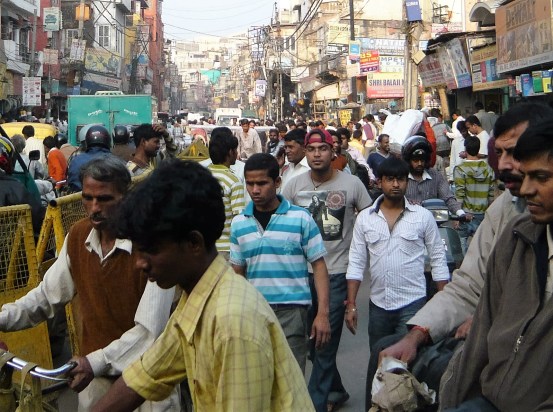
Crowds near the Ajmeri Gate, Old Delhi

010.JPG

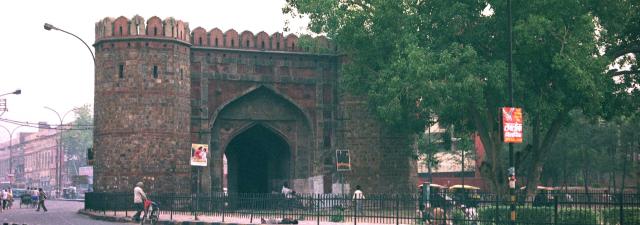
Turkman gate, Old Delhi. One of the gates in the city walls at the time of the Indian Mutiny / 1st Indian War of Independence, it dates from the seventh city of Delhi, Shahjehanabad. More recently, in 1976, during the Emergency declared by Indira Gandhi’s government, it was the scene of another infamous episode, when crowds protesting about the bulldozing of their houses in an effort to clear slum areas and force them out of the city were fired upon by the police, killing several of them.

011a

Tenements near the Turkman Gate, Old Delhi


IMG_0023.jpg

Mihrab, or Arch, in a building in the Lodi Gardens, Delhi

delhi_gate

Delhi Gate, in the old city near Chandni Chowk. This photo was taken in 1989. When I passed the same gate in 2009, the traffic was a whole lot worse!

191.JPG

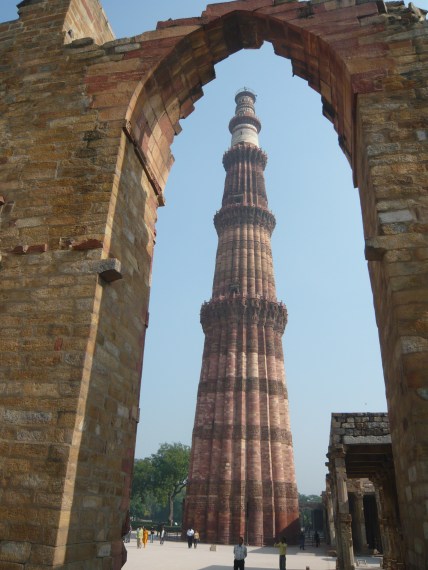
The great tower of Qutb Minar. The first of the Moslem invasions was by Muhammed, Sultan of Ghur in what is now Afghanistan, in 1192. Having overrun a large part of the Northern Indian plains, he returned to Ghur, leaving his new territory in the hands of his army commander and favourite slave, Qutbuddin Aibak. Qutbuddin decided to leave a monument to his religion that was designed to overawe his new subjects and inspire his own people, and set about building a mosque with a massive tower nearby. The tower itself is almost 73m high and is 15m in diameter at the base, tapering to 2.5m at the top.

183

Decorative details of the stonework. Most artistic decoration is, as usual with Islamic craftwork, patterned work and verses from the Koran. At Qutb Minar, there are also plentiful stylised, and sometimes surprisingly realistic, depictions of plants with flowers and buds and long, winding stems and tendrils. To construct the mosque, artisans used stone from Hindu and Jain temples and many stones and panels still depict the original carvings, frequently defaced but still recognisable.

178.JPG

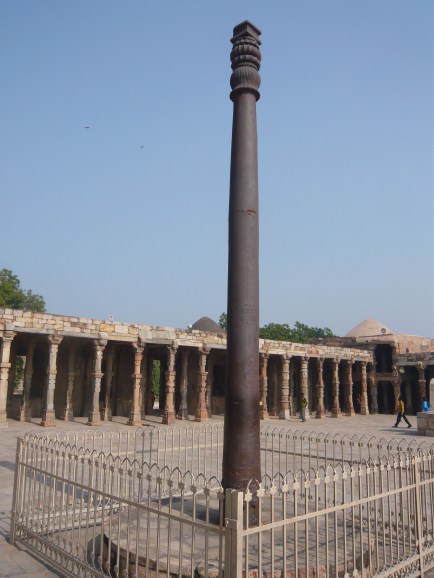
The famous ‘non-rusting’ iron pillar. This stands in the courtyard of the mosque and was here long before the mosque was built. It was made in the reign of Chandragupta II (AD 375-413), is composed of almost pure iron (99.72%) and shows only the slightest sign of rusting. A sanskrit inscription on the pillar indicates that it probably stood originally outside a Vishnu temple, possibly in Bihar, and was moved later to this site. It would probably have had a garuda, the vehicle of Vishna, on the top. 

207.JPG

Squinch-arch in Iltutmish’s Tomb. A squinch is a ‘bridging’ structure, used here to support a dome (now gone). Iltutmish was Shamsuddin Iltutmish (ruled 1211-1236), 3rd ruler of Delhi (after Qutbuddin and Aram).

175a

Brahminical motifs on the columns of the Quwwat-ul-Islam Mosque. These pillars were originally part of the Hindu and Jain temples that were razed in the area when Qutbuddin built his capital. It is chronicalled that 27 temples were destroyed. They would have been reassembled by Hindu craftsmen, Qutbuddin using local labour.