I picked up my bus ticket from the travel agent, and went for lunch. Whilst I was eating, I looked at the newspaper and noticed that the ‘People’s War’ (Naxalites) had blown up the railway line near Jehanabad again. It was a good job that I had decided to get the bus to Patna.
And so, the following morning, after packing, having breakfast and attending to a few final tasks that I had promised I would do, I went off to the Project to say goodbye. I knew it would be difficult! It seemed as though everyone came up for a hug, and then I went off with the manager back to my guest house to pick up my pack, and then off to meet the bus. One final, slightly teary, goodbye, and I was on the bus and off.
Four and half hours later in Patna, I was set down amidst total chaos. There were flashing lights, seas of red flags, loud music blaring through countless loudspeakers,millions of people, it seemed, singing – another Hindu festival. I found the station, with a little difficulty, and then the nearest restaurant and bar, for some sustenance.
I learned that the chaos had a name – Ram Naumi.
As I ate, it felt quite odd to know that outside was Patna, and that the Project and the open countryside weren’t just around the corner. It rather felt as though I had just left home.
My train left roughly on time, and I slept well until the morning. We then trundled along gently, getting in about one thirty (two hours late) to New Jalpaiguri. It was slightly cooler, and felt almost refreshing. I hadn’t expected a temperature drop then, I must admit. Presumably it was because we were that much closer to the mountains. Soon, I found myself and my rucksack jammed into a bicycle rickshaw heading north through the long streets of Siliguri, at the foot of the Himalaya, during what should have been lunchtime. There followed a three hour jeep ride in which we immediately began to climb up away from the plains as we left Siliguri, through farms, tea gardens and jungle that gradually began to look more typical of Nepal than of the India that I had lived in for the previous month and a half.

I arrived in Darjeeling at dusk, found myself a room and settled in to enjoy a week’s rest. I then proceeded to explore the temples, markets and surrounding countryside, make plans to move on to Sikkim and dropped into Joey’s Bar for the odd beer.
Later, I decided to have afternoon tea at the Planter’s Club, a hangover from the tea planting days of the Raj. It’s something that I felt I ought to sample.
I wasn’t disappointed. Inside, I was the only customer and it was much as I had imagined that it would be; dark wood floor and ceiling, brick fireplace, piano in the corner, trophy heads high up all around the walls. I was served tea by a Nepali who wanted to talk politics. That morning there had been a strike that had closed the town down for several hours, over the irregularity of water supplies. We agreed that it was down to the government. And when that’s finally solved, he added, then there’s the electricity…
He asked if I wanted music and I said yes, almost immediately regretting it, but was surprised when it was classical music. Looking around, it really did look as though the Colonels and their ladies had gone home and everything was still waiting for them. Outside, it was raining gently and just above me a couple of lights glowed yellow in the afternoon gloom. The shade of Miss Haversham from Great Expectations seemed to hover at my shoulder. All that was needed was a thick layer of dust over everything and the image would have been complete.
Also, it was strange that there was nothing Indian in there, and if it was in the UK, then it would look really ordinary, yet it had a powerful atmosphere there. Only, I suppose, because I knew that I was in India. And then, as Fur Elise played softly in the background, I was suddenly, utterly and helplessly homesick. Nothing like the continual yes, it’ll be nice to get back and see everyone once I’ve finished here, but I could picture myself strongly, sitting in an old stone inn somewhere in Wales having a beer with friends, or perhaps sitting around a log fire with close family. Seeing my family! As the music continued, I sat at the table with my tea, unable to think of anything but home.
It finished, and another piece started. I forget now what it was, but I had to literally shake myself to break the spell. I sat a while longer, paid the bill, and left.
A couple of days later I went and had tea again at the Planters – this time there were several Indian families in there and some Hindi pop playing – a decidedly different ambience! Although the afternoon was again gloomy, the piano still in the corner and the threadbare heads staring balefully down, I was unable to conjure up anything like the same feelings. It seemed impossible that I should have felt so differently here a couple of days before. I felt that I had re-joined India.

Darjeeling still retains much of its old colonial character, in places.
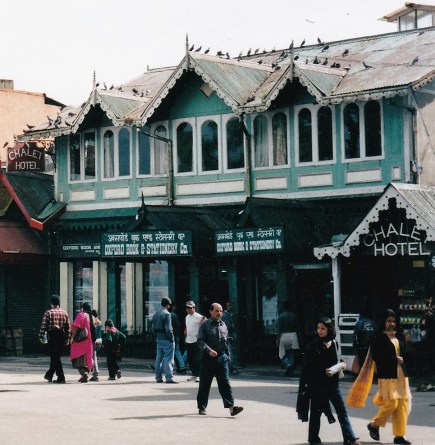
The Oxford Bookshop, on Chaurasta, where I spent far too much and had to have my purchases shipped home.

A sea of prayer flags on Observatory Hill. Darjeeling has a large Tibetan population and many gompas (monasteries) both in the town and surrounding hills. Observatory Hill is the site of the original temple of Dorge Ling , long destroyed, but after which the town was named, once the British had persuaded the then ruler of the area, the Chogyal of Sikkim, to lease them the land to build a hill station. the hill is now home to a Hindu shrine, with the British-built church of Saint Andrew close-by.
But no gompa.
After a week in Darjeeling, I moved on to Sikkim. After a really cold night, I left Darjeeling in a share-jeep for Gangtok on a lovely sunny morning, with clouds ebbing and flowing across the horizon and in the valleys. I got there about two, and then got a room in the travel lodge. It was big and clean, with lots of hot water, and the rest of the day I spent looking around the town.
 Mick Canning