
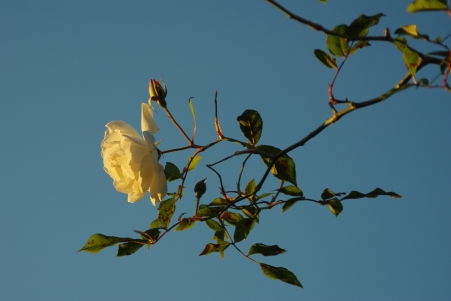
The clocks have gone back, and it’s getting dark earlier and earlier, but there is still a blackbird singing in the garden, although there is also the smell of wood smoke in the air – from a bonfire, I would guess – and a definite chill in the air. The autumn leaves have been exceptionally beautiful this year, seeming to have an extra couple of tones of red and orange. And there are still plenty of late flowers out. I may be a summer person, but it is decidedly beautiful at the moment..
I said I’d take part in NaNoWriMo this year, didn’t I? What on earth could I have been thinking of?
Did I really commit to writing over a thousand words a day all through the month?
Oh, for goodness sake! I’ve not even had time to look at anyone’s posts for the last five days, let alone write anything.
I quit. November 2nd, and I quit. Just like that. I’m sure no one else has ever backed out of it that early. Can I claim some sort of record?
But, as some sort of penance, I’m going to put up a short fiction piece for today’s post. I wrote it last week, so that’s almost November…
Light Years
It appears now both ridiculously arrogant and incredibly stupid, but after a mere few thousand years of development we seemed to think that we had arrived at a stage of development that we should consider to be an advanced civilisation. For a handful of years we had been capable of a rather limited space travel. We were beginning to probe the makeup of the universe and were on our way to some understanding of its complexities. And out of all of these thousands of years of development, we had had machines only for a few hundred years. We had had electric light for less than two hundred years. Computers for less than a hundred. We reached the moon one year, and two generations later we were probing the edges of the Solar System. And in those two generations, the life expectancy of almost everyone on the planet increased dramatically. We invented mobile phones and within one generation they were tiny computers that virtually controlled our lives.
In short, the pace of our technological progress increased exponentially.
But we had had wars and cruelty and genocide all of this time. We never solved that problem, we only invented crueller and more effective killing machines.
And should we ever make contact with another civilisation – that’s civilisation, mark you, not just life form – then the odds were that it might be several millions of years old.
No one seemed to realise the rather obvious implications.
And, despite warnings from a few of our more eminent and talented thinkers, we continued to recklessly send signals out into this huge unknown, advertising both our presence and our level of development.
Science fiction in popular culture would have aliens suddenly visiting our planet, swooping through the skies in huge flying saucers with deadly heat rays as weapons. The visitors would be recognisably bipedal – large headed, of course, since their brains would be more developed than ours – but with a limited range of facial expressions (why limited, I always wondered? Surely they would have developed more subtle ones? But perhaps they no longer needed them). The world would be in a panic; world leaders would meet, and attempt to make contact with the visitors. There would be an ill-advised attempt to engage them in battle, which would turn out very badly, but they would finally be forced to leave, or leave of their own accord, and in the end we would be the wiser for it.
But it wasn’t like that at all.
No one seemed to know what they saw, and many seemed unaware even that they had seen anything at all. There was light, but not the lights of UFOs buzzing through the skies at night, and not the stabbing beams of destruction envisioned by the writers and film-makers. For several days, it seemed to me that the light was a rather odd colour, and at times a little misty, or…hard. Others noticed that the light would move around, almost in blocks. It sounds ridiculous, but there you go.
That was about the time that I noticed a slight throbbing in my head and my brother complained of a ringing in his ears. No more than that, although it did seem that there was more shouting and arguing from some of the families in the neighbourhood, but this wasn’t particularly unusual and I thought nothing of it then.
It was the following day, which was yesterday, that everything seemed to go quiet. The arguing had stopped, for which I was grateful, but so had the background noise of traffic. I walked down to the ground floor and pushed open the door, and with that the throbbing in my head seemed to get worse. There were one or two people in the street outside, but no one seemed to be in a particular rush. All of them appeared to be strolling or standing around aimlessly and when I began to walk towards one of them, I found it quite difficult to move my legs; they felt very, very tired. I stopped and looked at the man I had been approaching, but when I caught his eye he began crying. It seemed shocking, and I wanted to cry too, although I did manage to stop myself. In the end, I turned around and went back home. I thought I’d see if there was anything on the news, but the TV no longer worked, and nor did my laptop. There was power, since the power lights came on, and I filled the electric kettle and made a cup of tea, but that tasted awful – perhaps the milk was off – and I poured it away.
My head was still throbbing, but I thought I ought to see how my brother was this morning. I tapped on his door, then went in, but he wasn’t in his room and the bed looked as though it hadn’t been slept in. He had gone out the previous evening, and it seemed obvious that he had stayed out all night. It didn’t seem to matter.
I still felt tired, and now I did start to cry. It only lasted a moment, though, and then I thought I should have some breakfast. I put a couple of slices of bread into the toaster and put a pan on the cooker. I was going to fry a couple of eggs, but the oil in the bottle seemed to have turned a greenish colour and set solid overnight. I pushed the lever down on the toaster anyway, and for about a second the whole thing glowed with a bright orange light that hurt my eyes, and then just faded away. There was no smell of burning, and the toaster looked unharmed. I unplugged it from the wall, and lifted the lever. The bread was still white.
All of this should have worried me more than it did, but the truth was that I felt that I didn’t care. For the next hour or so I sat at the window, watching the few people outside trudging slowly along or standing and crying. A couple of them were lying motionless in the road. With an effort, I lifted my head and looked up to see that there were bands of thick colour across the sky; not clouds, because they were too transparent to be clouds, and they were the wrong colour anyway. I don’t know what colour they were, but it was wrong.
When I looked down again, the street was empty, apart from the colours.
It is possible that what we saw was no more than a trick of the light, or perhaps they were machines. Possibly, they were even the creatures that had sent them. Who knows, maybe they were both at once.
Light. Yes, light. It keeps coming back to light.
I don’t even know whether this is the end.
But I think it is.
 Mick Canning