
Coolie – now there is a word that is remarkably offensive; offensive not so much because of what it is, but the implications behind it.
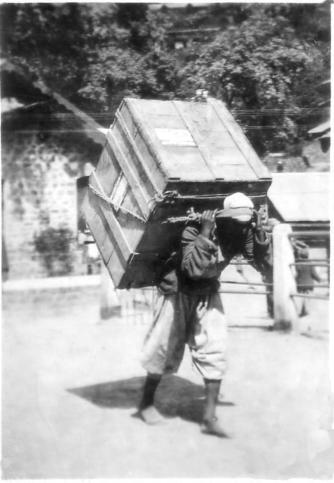
The Oxford Dictionary defines the word thus: unskilled native labourer in eastern countries and gives the word’s origin as perhaps from Kuli, an aboriginal tribe of Gujarat, India.
Hobson-Jobson, the 1886 Anglo-Indian Dictionary, has rather more to say upon the matter.
It gives the spelling as ‘cooly’ and the definition as follows: a hired labourer, or burden-carrier; and, in modern days especially, a labourer induced to emigrate from India, or from China, to labour in the plantations of Mauritius, Reunion, or the West Indies, sometimes under circumstances, especially in French colonies, which have brought the cooly’s condition very near to slavery.
It goes on to give further definitions and details of the word, and then makes several suggestions for its origin. One possibility, agreeing with the Oxford Dictionary, is that it derives from Koli, the name of a caste or race in Western India who frequently carried out these tasks and who, the dictionary reports, had long held a reputation for ‘savagery, filth and general degredation.’ This would make its origin analogous to that of slave, which is presumed to come from the racial term Slav.
But it suggests the waters are rather muddied by a couple of similar words in the Sub-continent: In Southern India a Tamil word Kuli signifying ‘hire’, and Khol is a Tibetan word for slave.
And then there is also a Turkish word kol meaning a slave while, more specifically, kuleh means ‘a male slave, a bondsman’.
But back to the implication. It is impossible to get away from the colonial undercurrents with this word, as brought out in the Hobson-Jobson definition above. So to use the word to describe a person or persons today, is to call them a servant or slave of a foreign overlord.
 Mick Canning