At The Hop

I was talking about hop pockets and pokes last week – and pigs, of course, which was how it all started, but forget the pigs for now. Let’s stick with the pokes and pockets. At the weekend we went for a walk through a part of Kent we hadn’t walked for a few years and part of the walk took us through this field:

This was a hop garden many years ago. Conveniently close to the oast houses so that as soon as the hops were picked they could be taken in and dried before there was any chance of them spoiling. Taken in bagged up in pokes, and once dried shipped out to the brewers in pockets. A word of explanation for those not familiar with these terms: hops are not grown in fields, they are grown in gardens. Not like your or my back garden, but like a field. But a field full of poles. Hop poles. With huge cable-like wires strung between them to support the hop bines as they grow.

When they are ready for harvesting, the bines are pulled down and the hops picked and put in pokes – large sacks (but you knew that, of course. You remembered it from last week). Then once dried they are shovelled into pockets – another size of sack.

And what are the hops for? Making beer, my friend. Lovely beer.

I don’t have a picture of the hop garden from back then, but late one cold, misty, autumn night about thirty years ago, I walked through it and the eeriness was instantly imprinted on me and once I was home I felt compelled to make an oil pastel painting of it (below).
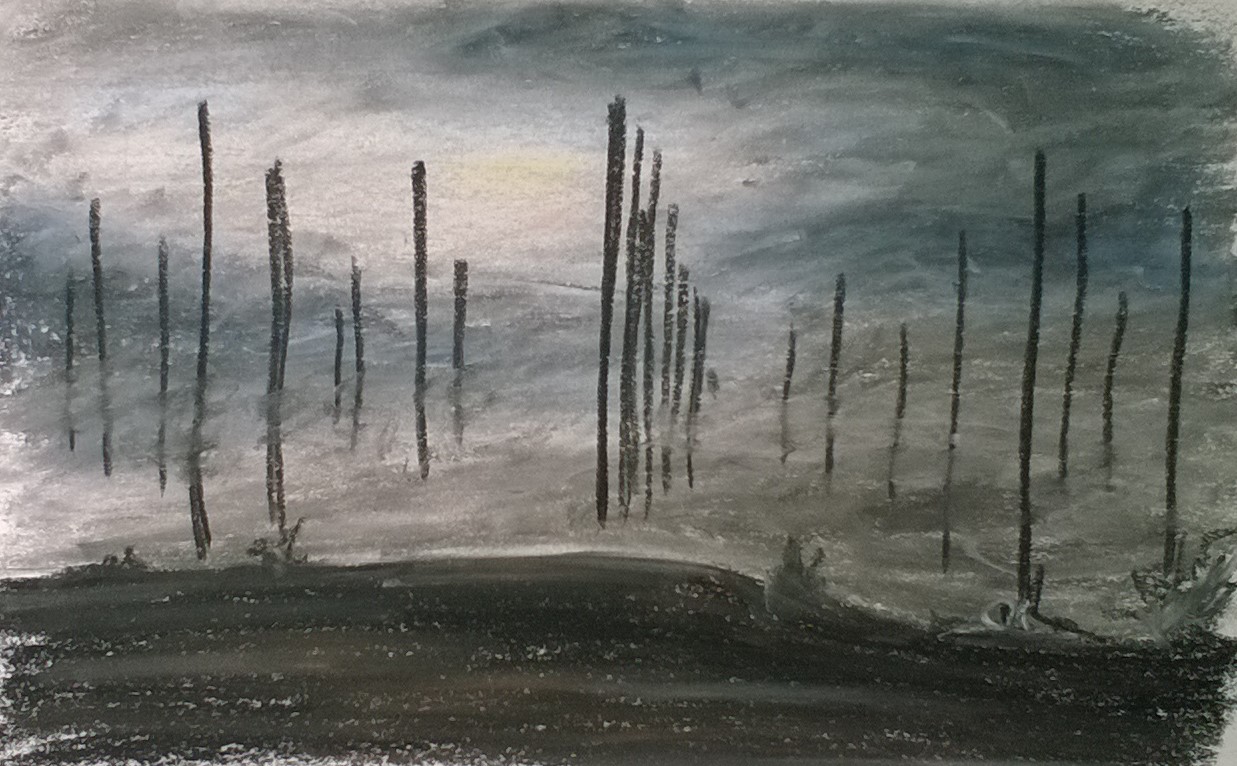
Anyway, as I said I don’t have a photo of the hop garden in question, but this one from Pixabay illustrates very nicely the hop poles and wires with the growing hop bines growing up and across them:
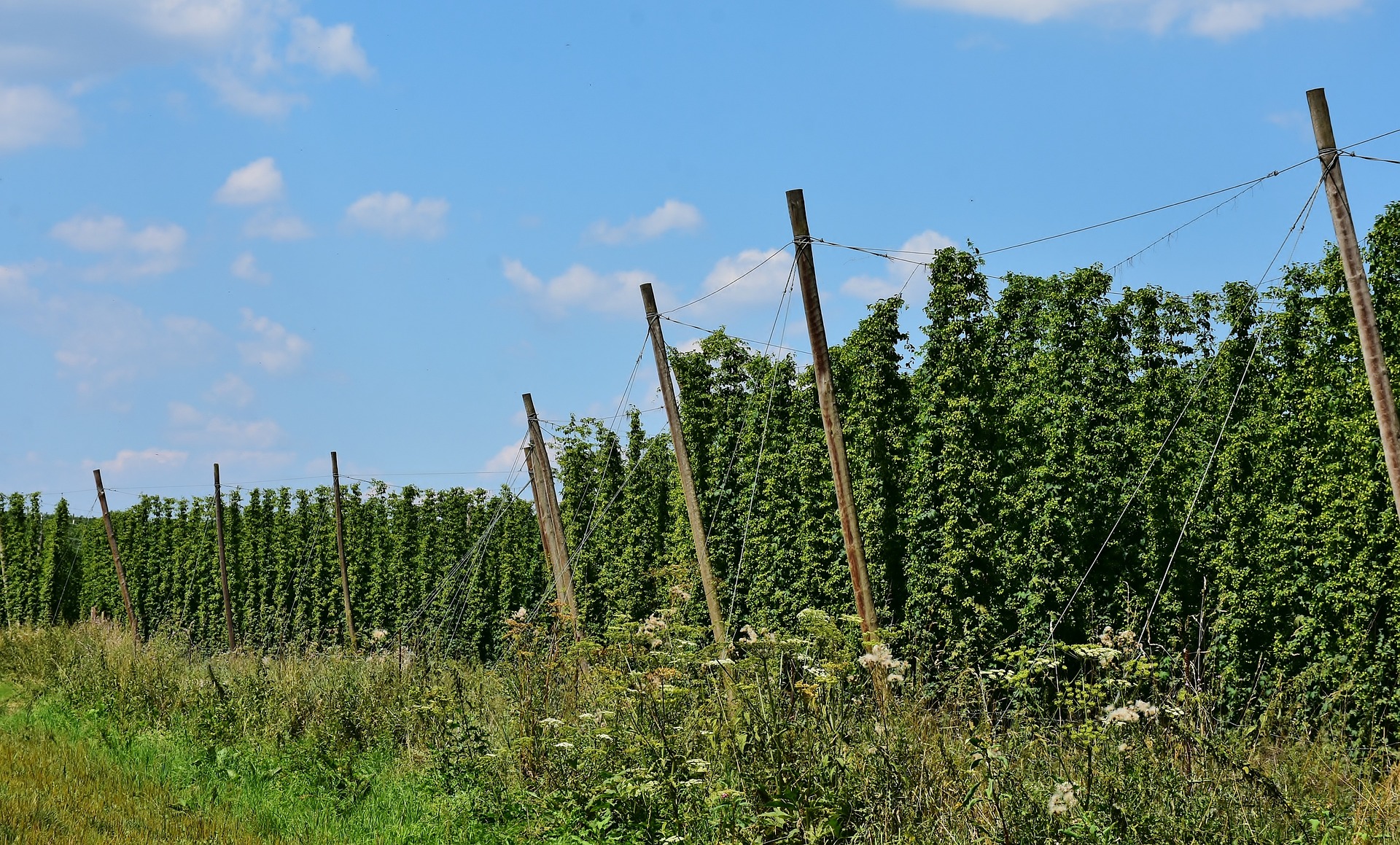
Image by -Rita-👩‍🍳 und 📷 mit ❤ from Pixabay

The poles were supported by wires kept under tension, anchored into the ground around the edge of the garden. Quite a few of these are still in situ around the very edge of the field and just into the woodland and hedgerows bordering it.

In 1872, there were 72,000 acres of land in England growing hops, the majority of these being in Kent, employing over 100,000 seasonal workers at picking time. By 2003, the acreage in Kent was down to just over 1,000 and for the first time ever the county had been overtaken by Herefordshire, which now grew more, although the decline does at least appear to have halted for now. In 2011 there were a total of just over 2,500 acres under cultivation in England but it is such a small number there were fears the industry could die out. Although hops are still used in beer brewing, much of the requirement is imported, especially with a popular shift towards less bitter-tasting beers. But in much the same way that Kent has also lost a huge percentage of its apple orchards, a once rich and diverse farming landscape has become more and more homogenised, with endless huge fields of arable crops and sheep and cattle replacing the hop bines and apple trees.

I spent one autumn apple picking around thirty years ago and the farm I was working on had a large acreage of hop gardens (both apples and hops all sadly gone, now). It was an incredibly busy and bustling time, with our diverse group apple picking – a mixture of locals and Europeans come over for the work – and a traditional mix of workers in the hop gardens; as well as locals, there were a lot of gypsies and possibly still a few people down from London’s East End, which was a traditional way for those workers to make some extra money in the nineteenth and early twentieth centuries. It was busy, noisy, very hard work, and a lot of fun.

And, not surprisingly, there are a number of traditional songs about hop picking. So here is the wonderful Shirley Collins and the Albion Dance Band to perform ‘Hopping down in Kent’ especially for you.

The Hooden Horse

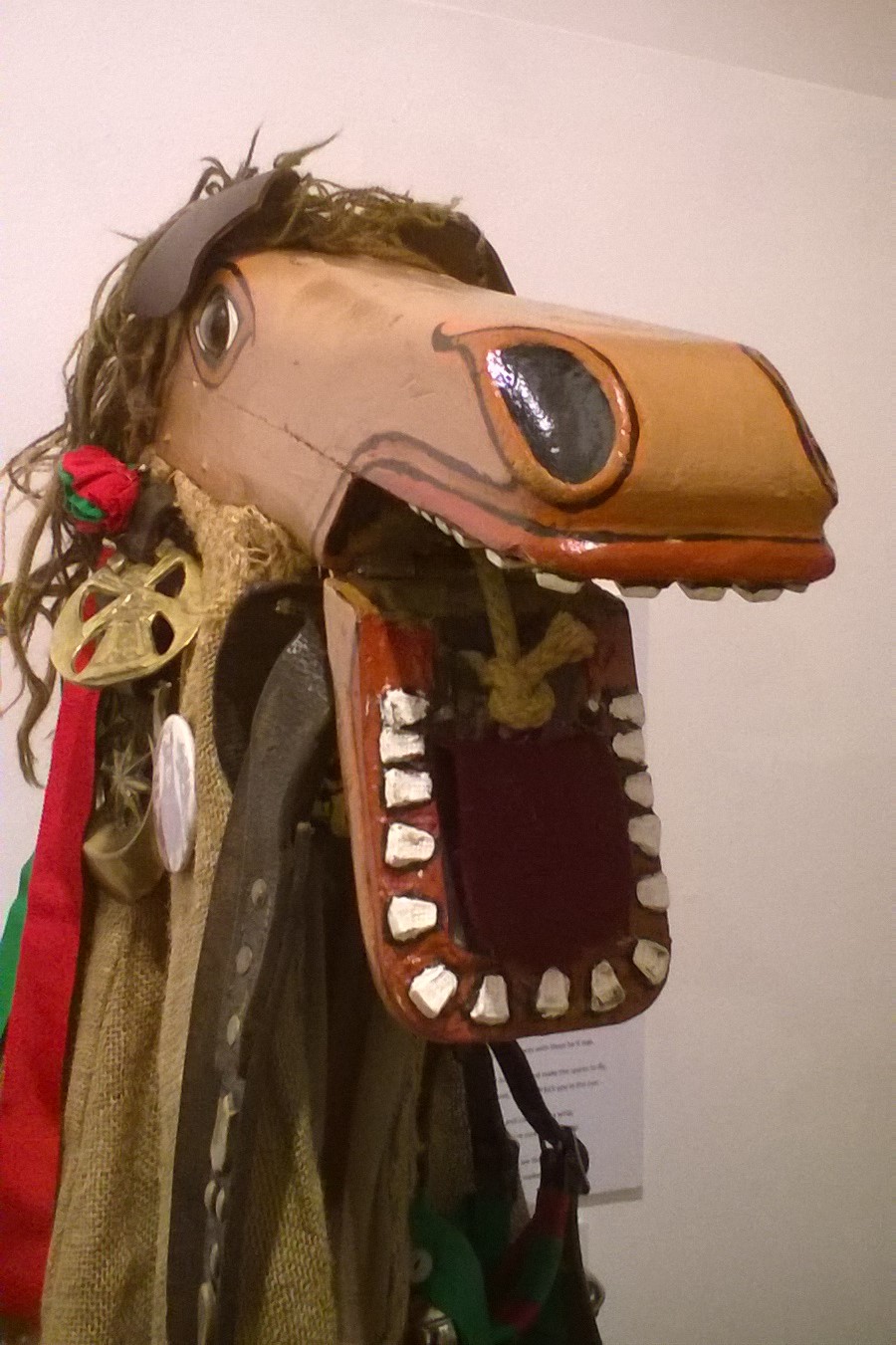
In the town I used to live in, there was once a pub called the Hooden Horse, sadly now renamed to something much less interesting. I was reminded of this at an exhibition at Maidstone museum on Hooden Horses. Hooden Horses? Well, briefly…

Hoodening is a rural folk tradition unique to East Kent, England. Going back a few hundred years, in the week or so running up to Christmas, groups of farm labourers would dress up as various characters and go from door to door requesting money, cake and beer. One of the characters would be the Hooden Horse, which was an artificial horse’s head made of wood, with a jaw operated by string, on a wooden pole, held by one of the performers with his body covered in cloth – usually sacking. A sort of play was then performed in rhyme, a mixture of plot and satire, usually featuring a few local characters who would be well known to the watchers and might be the butt of jokes and scorn, as well as stock characters such as Molly, a waggoner, and the Mayor. And of course the horse (him)self, invariably called Dobbin. There would also be music performed on whatever might be available – accordions, fiddles, drums or whistles.

The relationship to Morris dancing and Mummers is hard to avoid and, like these traditions, has been revived in modern times by enthusiastic traditionalists.

A photo from the early twentieth century

A modern Hooden Horse

Another early twentieth century photo.

There are many other traditions in Britain involving what is known as ‘animal guising’, where men or women take the guise of an animal, the Padstow ‘obby ‘oss being perhaps the best known of these. The performance on May Day in Padstow, Cornwall, invariably draws large crowds.

On the left, a Hooden horse, and on the right a Mari Lwyd, the ‘skull horse’ of Welsh tradition. Although unconnected (as far as I know) the Welsh had a similar tradition, also taking place around Christmas and New Year. Skull horses are to be found in other parts of England, however, including Yorkshire.

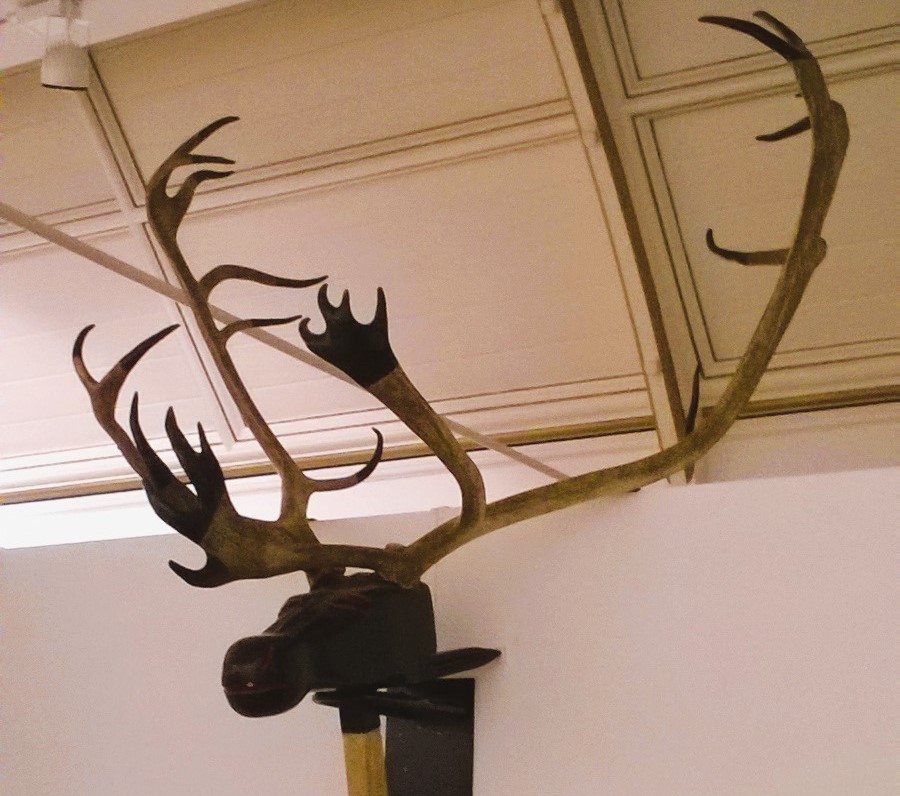
Stag guising is another old tradition – possibly older than horse guising. It was certainly in existence during medieval times and survives today in the form of the Abbots Bromley Horn dancers, Staffordshire, who perform carrying reindeer antlers on poles on the Monday following ‘Wakes Sunday’ in September. Wakes Week became a tradition in industrial Northern England when factories and mills closed down for a week for maintenance giving the workers a holiday. This began in the early nineteenth century, but before this the ritual presumably took place at a different time of year.

The exhibition is on until 17th July 2023 and there is a link to their site here.

Indian Salt Miners

salt-workers

Salt workers pose for a photograph at the salt pans near Marakkanam, just north of Pondicherry (now renamed Puducherry, its original name before the French arrived, although everybody continues to refer to it as Pondicherry, or just ‘Pondi’). The sea is allowed to flow into ‘pans’ (not unlike paddy fields) and then it evaporates over several days under the hot sun, leaving behind a layer of salt which is gathered by hand. Salt has been gathered this way in India since time immemorial.

Even when I took this photograph in 2006, on my first visit to South India, it struck me as a harsh environment in which to have to earn a living. Since then, I have learned more.

Salt is, and always has been, an essential commodity, especially for a population living in hot conditions, but when the British in India imposed a salt tax, this eventually led to the ‘Salt March’ led by Gandhi to Dandi, on the Gujarat coast, where he symbolically gathered salt at the coast after a 200km march, an action that contributed to the loosening of the hold that the British Raj held on India.

In Gujarat alone, approximately 112,000 labourers are employed in the industry (Gujarat State Law Commission figures).

In all, there are approximately 1,000,000 people employed across a total of nine states harvesting salt. Typically, women and girls make up most of the workforce.

But the conditions that the salt miners labour under today are little better than they were then.

They suffer eye problems and blindness from constant exposure to the sun reflected off of the brilliant white of the salt pans. Skin lesions from the salt are common. After a while, feet become septic and absorb salt; so much so, that according to some accounts even after death the salt content in their limbs are so high that hands and feet are difficult to burn during cremation (Daily Telegraph 24/2/10).

In addition, the labourers suffer from many of the other problems common across the labour force, such as exploitation by contractors and money lenders, and poor educational opportunities for their children. There is often inadequate housing, drinking water and food, and an absence of primary healthcare (Indian Express 26/4/16).

It is frequently said that saltpan workers have three ways to die: first gangrene, second TB (tuberculosis) or third blindness.

Their life expectancy is 50 – 60 years.

The hardships and problems they face are slowly being brought to the public’s attention, but clearly there is still a very long way to go before they enjoy what most would regard as decent working conditions.