In February 1600 Will Kemp Morris-danced his way from London to Norwich, a distance of approximately a hundred miles.
Kemp (or Kempe), born around 1560 and died, probably of the plague. in 1603, was an actor, dancer and all-round clown. A member of Shakespeare’s company, Chamberlain’s Men, he regularly played the role of the clown in Shakespeare’s plays. He undertook his famous dance after some sort of disagreement within Shakespeare’s company as a result of which Kemp took his shares and left. Although we don’t know what form this disagreement took, it is widely assumed Kemp was very much a scene-stealer who was apt to improvise during a performance – possibly Shakespeare was alluding to Kemp when he has Hamlet declare ‘let those that play your clowns speak no more than is set down for them’. Kemp also had a tendency to dance jigs at the end of a performance that critics declared ruined the mood of a tragic performance.
Afterwards he described his dance as a ‘nine daies wonder’ in a booklet he published, although it actually took him twenty eight days to accomplish as he rested up for a while between each day dancing,
By the time he had joined Chamberlain’s Men, he was already famous for his acting and dancing. He had toured the Low Countries (now referred to as Benelux) and Denmark 1585-86 as a performer with the Earl of Leicester’s Men, performed frequently as a solo dancer and actor – usually performing clownish parts – and his improvised jigs were renowned for being frequently both ridiculous and lewd, which might go some way to explaining the rift with Shakespeare’s company, who by then were attempting to attract a more refined audience.
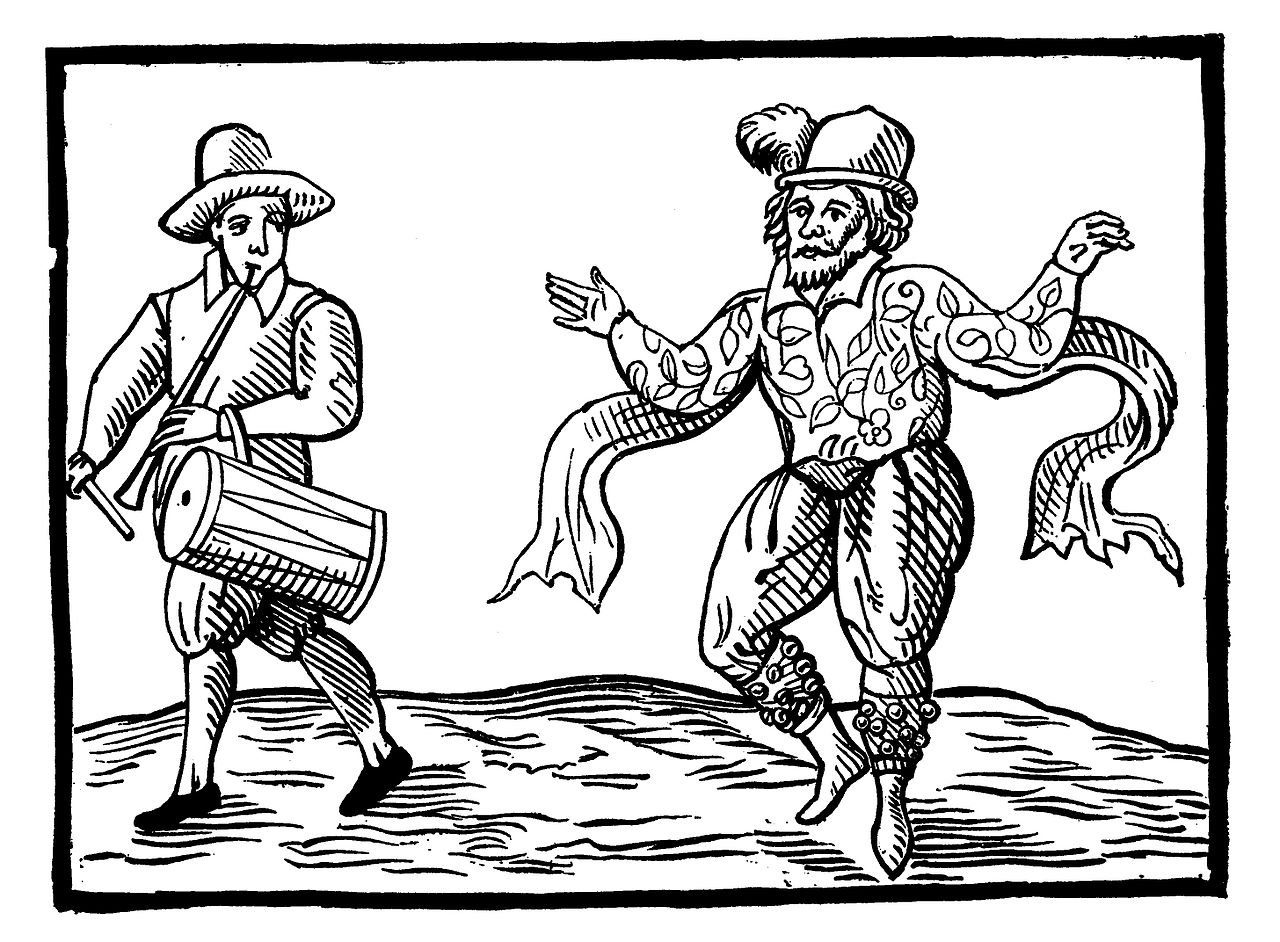
The dance from London to Norwich was performed as a publicity stunt and also as a way for Kemp to raise money by betting on himself to complete the journey. He was accompanied by a Thomas Slye, who played both the tabor (a small drum) and a fife to accompany the dance steps, and George Spratt who acted as overseer to the spectacle. Kemp wore a feathered cap, a slashed doublet with streamers attached to the shoulders, slashed breeches, and with clusters of jingle bells around his ankles and calves. A large crowd assembled to watch him set off from London at seven in the morning on February 10th 1600, and he continued to attract great crowds the length of his journey, which he completed on March 9th. He wrote the booklet later, as a riposte to those who doubted he had completed the journey.
This isn’t the origin of the phrase nine days wonder, incidentally, that goes back to at least the early thirteen hundreds.
The tune Kemp’s Jig appears in John Playford’s The English Dancing Master of 1651 and is attributed to John Dowland, but it is known that Kemp himself composed some jigs – four examples survive today. Whether Dowland (if it were he) wrote the jig to honour this journey, however, or whether it was a more generic tribute, we don’t know.
The journey, though, was quite an achievement.
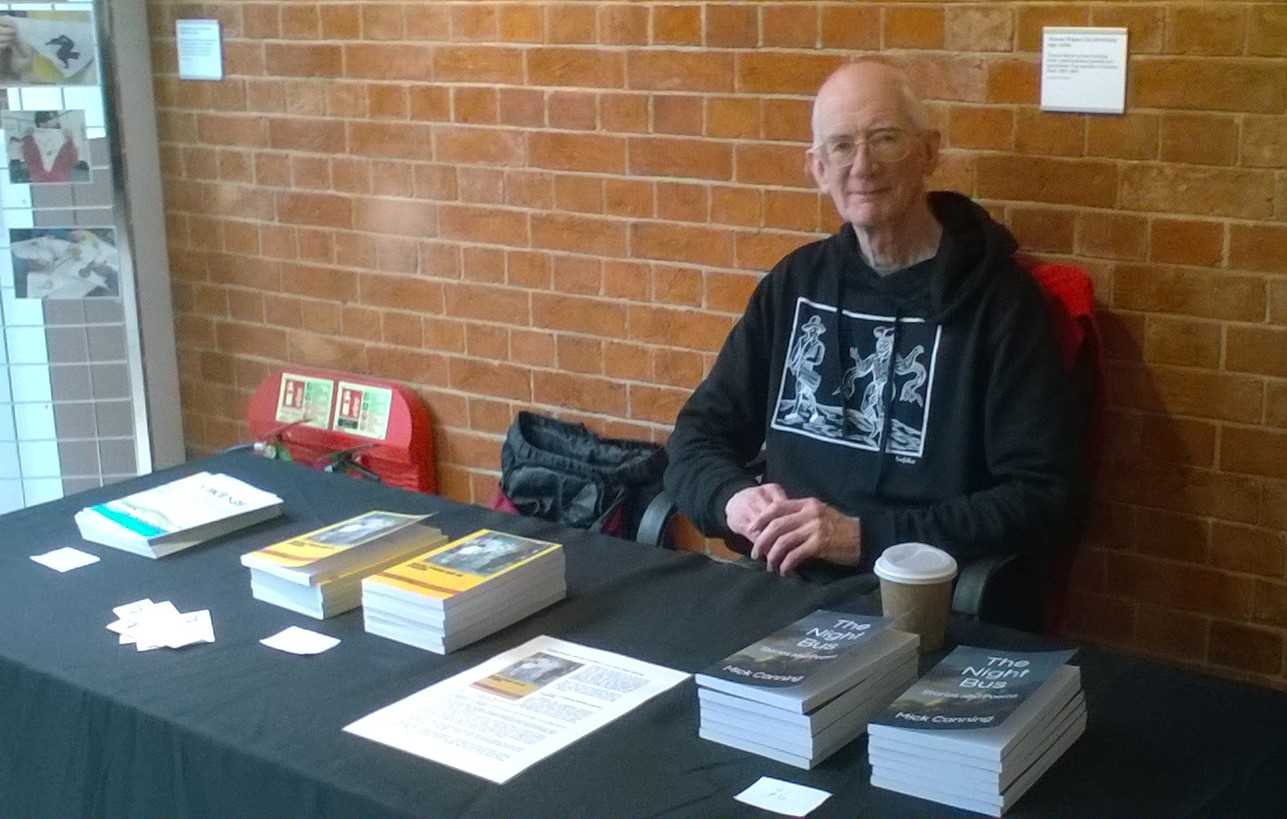
I know this is all a bit niche, but having bought myself a sweatshirt featuring the image, I decided to learn a bit more about Mr Kemp and this is the result of that. I already knew about his dancing from London to Norwich, but I knew little about him beyond that.
 Mick Canning
So: going on the road precedes stadium and arena tours by a good bit!
LikeLiked by 1 person
Very much so. And I doubt they had to book ahead, either!
LikeLiked by 1 person
This is fascinating. I could just picture Kemp dancing to the tabor and fife, in his slashed doublet and feathered cap , all the way from London to Norwich. And the Shakespeare connection makes it even more interesting reading. That’s a great sweatshirt too.
LikeLiked by 1 person
I saw the sweatshirt and couldn’t resist it! Having watched Morris dancers just performing their normal routines, I’m extremely impressed with the thought of him dancing over ten miles each day. It must feel more like walking three times that distance.
LikeLiked by 1 person
Absolutely…..that’s quite an amazing feat. Must have been a marvelous spectacle too!
LikeLiked by 1 person
I’m sure it was. He apparently drew crowds along the whole route.
LikeLiked by 1 person
Hi Mick, this is very interesting. I didn’t know any of it. Horrible to die of the plague.
LikeLiked by 1 person
I’m a mine of obscure stuff at times, Robbie. And yes, not a good way to go.
LikeLiked by 1 person
There’s a nice account in Morris Marples’ book “Shank’s Pony”.
LikeLiked by 1 person
I can see that’s another book I have to add to my reading list, John. One of the benefits of WordPress is the book recommendations from other bloggers!
LikeLiked by 1 person
A good one too – a study of many of the great walkers of the past.
LikeLiked by 1 person
I’ve just had a look on a couple of the second hand book sites I sometimes use. I think I’ll have to get one!
LikeLiked by 1 person
Well worth it – a favourite of mine for fifty years,
LikeLiked by 1 person
In the same vein is Geoffrey Murray’s The Gentle Art of Walking (1939).
LikeLiked by 1 person
Thanks, John.
LikeLiked by 1 person
He sounds like a nightmare, imagine trying to have a quiet pint and he comes in.
LikeLiked by 1 person
I know. Most pubs seem to have one, though. At least he’d be a lot more interesting than the average Saturday night bore / oaf.
LikeLike
Well you wouldn’t need a juke box.
LikeLiked by 1 person
I had heard that most of the Shakespearean plays – particularly the Comedies – were improvised until they found out what worked with the audience – however too much improv could be a problem!
LikeLiked by 1 person
I hadn’t heard that, Jan. But presumably he was okay with a certain amount of improvisation, or he would have got rid of the likes of Kemp pretty sharpish.
LikeLike
I’ve heard of Morris dancers, but not Will Kemp Morris. Are they related?
LikeLiked by 1 person
I think the question was whether Kemp will Morris dance…
LikeLiked by 1 person
Am now following as I find lots of gems within your vast oevre of posts!
As a musician – classically trained guitarist – I drank in this info written in such a ‘readable’ way! Thank you! In music school, this is what we were basically told when learning/playing this piece:
“He (Kemp) was an actor in Shakespeare’s theater, famous for his dancing, and this is an hommage to him by an anonymous lutenist.” nice short quote by the musician in the video below.
I figured you are familiar with Julian Bream since you two are Brits, so I opted for this vid which shows the lute being played. I’m sure you know the lute was what it was written for and that subsequent cg recordings of it are from transcription…and that what was actually written back in the day had the understanding that improv was a given during any performance…fun connections to your post content.
LikeLiked by 1 person
Good to see you here, Laura. Yes, I’m familiar with Bream’s playing of Kemp’s Jip – I used to have it on vinyl, although that was a long time ago. I played very amateurish classical guitar then, too, and listened to a lot of Renaissance music. Nowadays I seem to have rediscovered folk music which is what I tend to listen to mostly. That’s the problem with life; there is so much in the world that is interesting and so little time to get to grips with more than just a little of it.
LikeLiked by 1 person