
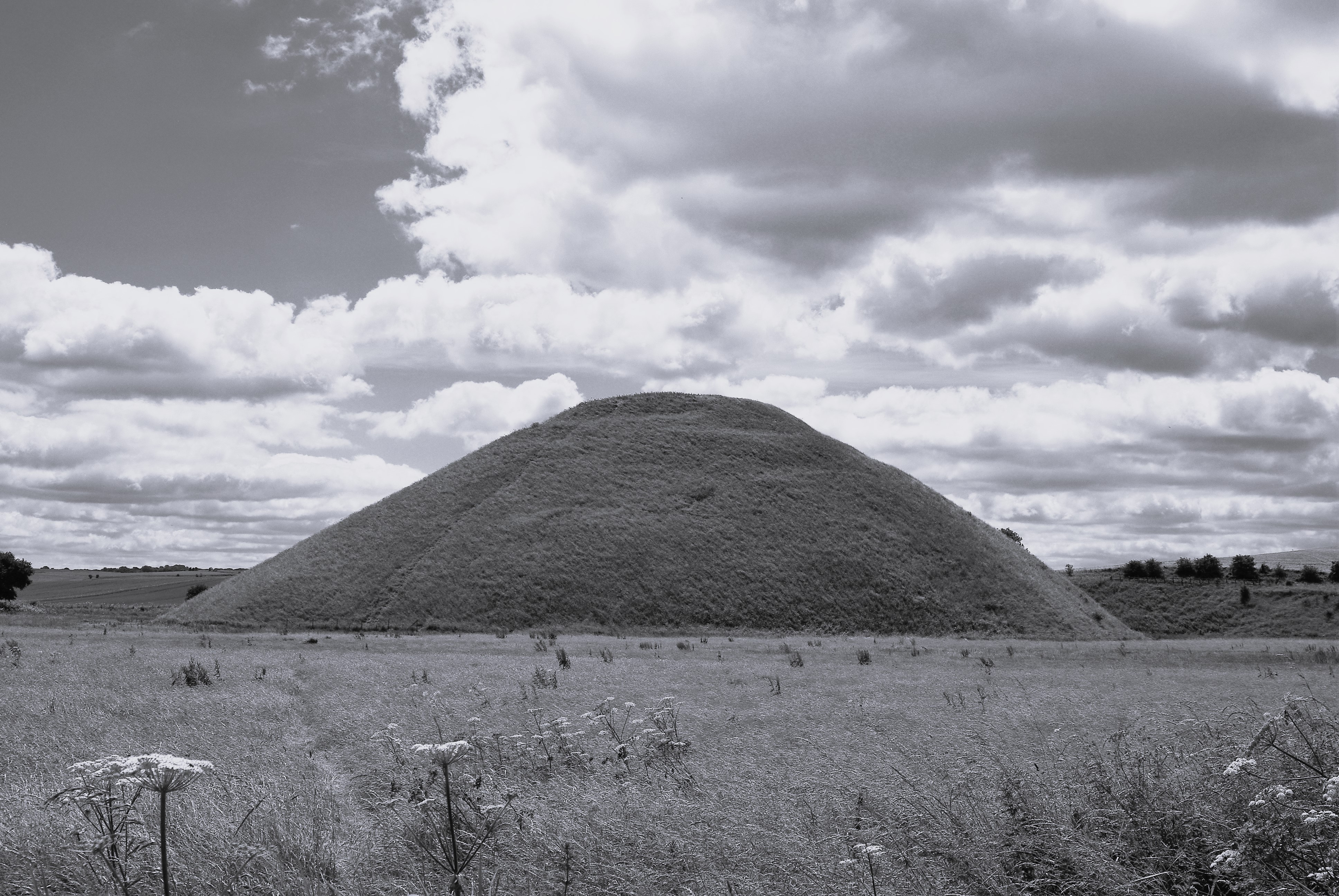
Silbury Hill, located a few miles from Avebury in Wiltshire, is the largest artificial mound in Europe, roughly the same size as the contemporaneous Egyptian pyramids, although it puts me more in mind of the Mexican pyramids. At 39m high and 160m wide and built of chalk, it was a colossal undertaking for the time – it was completed approximately four thousand four hundred years ago. Yet its purpose remains unknown; apparently it contains no burial, although folklore ascribes to it the final resting place of King Sil. Other theories connect it with the Goddess, and others yet suggest it as an observatory or sundial, although since Stonehenge was already in existence at the time of its construction, albeit in an earlier form as a henge monument, it seems highly unlikely that so much effort would have been put into the building of a mere mound, no matter how huge, if that was intended as its sole purpose.
Archaeological evidence suggests it was constructed over around a hundred years and there was probably a track spiralling around the hill to the top – used both in its construction and then afterwards to access the top of the hill which appeared to originally be flat. And that there was a constant tweaking of the shape over the following years, as though succeeding generations each felt the need to make their mark on the site.

Allowing for the fact it would have been a little higher due to the effects of weathering over the last four thousand years, it would have been as high as the nearby hills, Waden Hill and Knoll Down, but the difference would have been striking, since this perfectly shaped mound would have been dazzlingly white. The effect of the hill on anyone approaching would have been remarkable. Imagine it gleaming like a snow-covered mountain in the sunshine, or glowing mysteriously at night in a thin moonlight.
This isn’t something a tribe decided to do because they had some time on their hands – they’d had a good day’s hunting and the roof had been fixed, so why not? And not something just done on a whim – ‘You know, I like this place, but I really rather fancy putting a large hill just over there.’ This was a long term project, literally a lifetime’s work. And it was intended as one heck of a statement. Like a Medieval cathedral or Trump Tower, it was intended to be seen from a long way away and admired and talked about, although which of those two did it resemble? Was it the narcissistic project of an egotistical power-hungry madman or was it intended to glorify something greater than them?
On balance, I suspect the latter. Even if the project was begun by one strong-minded individual intent on somehow making a name for himself, it wouldn’t have been completed until long after his (or her) death, suggesting there was still a strong driving-force to complete the project.
But this is an area absolutely heaving with ancient monuments. Although Stonehenge is some twenty miles to the south, West Kennet long barrow is less than a mile away, Avebury Henge and stone circles only slightly further, and within the immediate landscape there are any number of burial mounds and standing stones. By any standard, this is a prehistoric landscape, and the visitor here must be looking at the evidence of ancient societies for whom memory and ritual were of great importance and significance.
I said earlier that there is no evidence of burials in the hill, yet all that means is that surveys have not revealed any chambers within the mound, or back-filled tunnels that might have been used to access the same. Yet I do wonder whether the entire structure might have been raised over the burial of an important personage. Perhaps future generations will find out.
 Mick Canning
Always fascinates me. Quite a place.
LikeLiked by 1 person
It’s just so huge when you get up close to it. Trying to imagine people building it essentially with their bare hands is mind-blowing.
LikeLiked by 1 person
Hi Mick, I’d not heard of this mound and it is fascinating. It would be great to know it’s purpose, as you say there must be one.
LikeLiked by 1 person
All conjecture at the moment, Robbie. I like to think they said to each other ‘in four and a half thousand years they’ll all be scratching their heads over this.’
LikeLiked by 1 person
😀
LikeLiked by 1 person
It’s such a curious monument, it’s hard to imagine it has nothing inside.
LikeLiked by 2 people
It does seem strange to us, but it’s possible we simply have no idea of the mindset these folk had when they built it, and even if we could imagine their reasons for doing so perhaps we’d discount them as we wouldn’t think them likely.
LikeLike
I’d never heard of this place, despite having been to Stonehenge and Avebury. Perhaps as proof that our personal place in the world can shape our vision, I have to confess that your photos of this mysterious hill first brought to mind the enormous fire ant mounds that develop here. They’re not as large as African termite mounds, but they’re often as perfectly symmetrical as this mound.
Given that we can see both galaxies far, far away and visualize dna strands, I’m wondering if there’s some sort of tech that could see into this thing. It would be great to be able to do some sort of geological CT scan!
LikeLiked by 1 person
We can and do carry out these scans – geophysical surveys – but they don’t currently reach terribly far into the ground. and wouldn’t be able to see something right at the bottom of the mound. In the future, who knows?
And I know what you mean about the anthills – that would be some ant colony!
LikeLiked by 1 person
This mound is fascinating, Mick. I wonder if any future technology will detect what’s inside or locate its entrance. There must be motivation to build it over a hundred years.
LikeLiked by 1 person
I suspect future technology could well make a few breakthroughs, Miriam. There have been so many developments over the last twenty or so years I think it’s very possible.
LikeLiked by 1 person
I think so, Mick. I wonder if the surrounding areas rose up blocking the entrance.
LikeLiked by 1 person
Probably not that. If there is anything under there, I suspect there are no side tunnels but that the hill was built directly over it.
LikeLiked by 1 person
Wow, I’m sure the geologists and researchers thought of any questions we can think of.
LikeLiked by 1 person
And I suspect it’ll be a while before they can answer them.
LikeLiked by 1 person
I hope they have enough funds for this endeavor.
LikeLiked by 1 person
Probably well into the future, Miriam. I’m not aware of any ongoing surveys there at present.
LikeLiked by 1 person
I think so, Mick. It may have renewed interest in the future.
LikeLiked by 1 person
I’m sure it will.
LikeLiked by 1 person
Fascinating! I do love a good mystery, and now my mind is imagining all sorts of reasons for the mound’s existence! If 4,000 years hasn’t revealed the purpose, I somehow doubt it will ever be known, but … that’s okay … we’re all entitled to our secrets!
LikeLiked by 1 person
Well, the various sciences employed in archaeology have come on leaps and bounds over the last twenty years or so, so I’d never say there won’t be more discoveries there. It’s always possible something completely new will come to light, which is what’s so exciting about it.
LikeLiked by 1 person
That’s all very true … but you’ll never get into the mind of the person who came up with the idea. 😉
LikeLiked by 1 person
No. A totally different mindset. It’s difficult enough to get into the mind of your nearest and dearest, but once you begin to try to get into the mindsets of people either foreign to yourself or living a long time ago, absolutely impossible.
LikeLiked by 1 person
Heck, sometimes I have trouble figuring out what my own mindset was yesterday, let alone someone else’s! 🤓
LikeLiked by 1 person
Um, yes, there is that, too…
LikeLiked by 1 person
Hi Mick, This is an interesting subject. What would the purpose be of such a mound in the middle of some place? It’s strange that archeologists have not bothered checking it out despite being built so long ago. Who knows if there is really nothing under it, and it’s just someone’s creative genius.
LikeLiked by 1 person
Well, archaeologists have certainly done some investigations, but they’ve not found any evidence of burials. If there is a burial at the very base, it would require a huge (and potentially ruinous) excavation to reach it – the hill is huge!
Naturally, there are all sorts of theories as to why it was built, but nothing provable.
LikeLiked by 1 person