Let’s Rid the Internet of Kittens

What is it about the internet and kittens, for goodness’ sake? There are far too many pictures of them.

Okay, that’s too provocative. Let’s move on.
005

She Who Dislikes Being Referred To This Way has been away for a few days. I had presumed that I would sleep better without the snoring, and the duvet being constantly pulled off me, but I was wrong.

For some reason, I’ve not slept particularly well at all.

Perhaps it was the wild parties I’ve no idea why not.

I had intended to begin a painting, maybe even get it finished, but although I carefully planned said painting, even finding a few resource pictures to use, once I sat down in front of the paper, it just refused to happen. My mind went completely blank and my enthusiasm kicked the wall sulkily for a few moments and then ran out of the house sobbing.

Oh well, back to the writing.

I did have a few ideas for short stories and, because I know how to use my time both productively and wisely, immediately started writing two of them, as well as continuing with both the novels I’m writing. That’s what you’re meant to do, right? Isn’t it?

Oh, and a poem.

And, of course, I need to do research for all the various Tales In Process. Isn’t it amazing what a little bit of research throws up?

Here are just a couple of little snippets, a few gobbets of curiosity, that I have come across recently while researching topics in medieval Persia and India, for use in my #1 Novel In Progress, The Assassin’s Garden.

All of the prostitutes in Fatephur Sikri, India, during the short time that it was Akhbar’s capital, were kept in an area just outside the city called ‘The Devil’s Quarter’.

You do get sidetracked, of course, but perhaps that will be an integral part of the plot? Possible spoiler alert?

I wouldn’t like to say.

And at one point, there is a long journey undertaken in my book, by caravan.

‘Caravan’ is a Persian word, I discover. That seems appropriate. In some parts of Persia they would travel by day and rest by night.

In others, the reverse was true. Something to do with the temperature, I expect.

In the nineteenth century, there were caravans that existed just to transfer corpses to holy cities for burial. These disappeared in the early twentieth century, largely due to better understanding of how diseases spread!

And, obviously, I mean the caravans that are chock full of camels and traders and an ill-assorted collection of ne’er-do-wells, not the wretched giant metal boxes blocking ninety percent of our roads as soon as the weather shows even the faintest promise of a few hours of sunshine.

But enough of caravans, for now, I’ve got some words to beat into shape.

Oh, and there are still people who would prefer pictures of kittens?
The Past is Another Country…

…they do things differently there (L.P.Hartley )

Almost 20 years ago I was a care-worker, paying visits to support elderly folk who were, for various reasons, unable to cope on their own. I would provide support in a number of ways – cooking, washing and dressing,and cleaning, for example.

One man I visited quite often would talk a lot about his younger days – as is natural. He had a wealth of stories, and I always told him he should get someone to write them down. It is the ordinary person’s stories that are frequently the most interesting, and the ones that we usually don’t hear. Famous politicians, sports stars, movie stars…well, they write autobiographies, or have them written for them, and we hear all about the other famous people they knew and the hotels they stayed in…yawn, yawn, yawn.

But we hear far less about the family in the village 80 years ago, their day to day life and how the outside world impacted upon them.

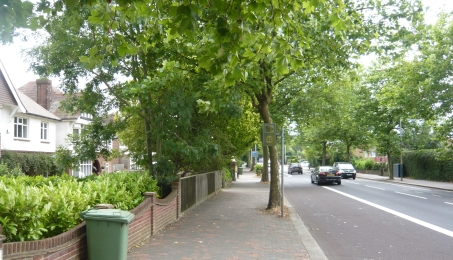
Below, there is a photo of London Road, just outside of Tunbridge Wells, taken earlier today.

005

My client told me that during his youth, he would walk back along this road after an evening out in town, describing how there was nothing but open fields on both sides for much of the walk. Looking at it now, it is hard to picture that, since I have never known it any way other than how it looks now.

But prior to this, in his childhood, he lived in the village of Groombridge, on the other side of Tunbridge Wells, and he told me how, as a schoolboy during the First World War, he and his classmates ran out of the class one day and across a field, to see a German Zeppelin airship that had just been shot down.

It is stories like this, that are the genuinely interesting stories that come out of the past.

And for my large Work In Progress, the past really is a foreign country. Much of it is set in Persia and India, in a time frame that covers some 300 years up until the late 19th century.

Now, I was about to write that if it is difficult for me to picture the main road near where I live as it was some 50 to 75 years ago, then it is far more difficult for me to picture the places in India and Persia where and when I have set my novel, but then I realised that this is not actually true.

And so this post is now taking a turn that I had not expected when I sat down to write it.

The Indian capital at the time was at Fatehpur Sikri, which today is just the remains of those buildings – it was only occupied for some 22 years, and then abandoned. I have visited the site and walked around it, and it is quite easy to imagine it occupied by Akhbar, his court, and the general population.

I have never been to Persia (modern day Iran), so my impressions are formed only at second hand. And much of what I have read consists of works about the 1500’s, and I am familiar with many of the paintings of the period, so again it seems almost natural to imagine it as it was then.

And then when I have travelled in India, as well as in the Middle East, I have spent a lot of time visiting the old parts of the towns and cities, and many rural areas where life follows the same patterns that it has for hundreds of years, and so, again, it seems more natural to picture the settings for my book in those time periods that concern me.

Finally, researching these areas, I often come across old black and white photos of places of interest to me, and since I have not been there, they are the only impression of these places that I have.

Of course, Tunbridge Wells in the Victorian era is much harder for me to visualise. All of the modern buildings get in the way of my imagination. All of the roads are surfaced with tarmac, the open spaces have largely gone, and many parts of the common that used to be open and windswept are now covered in trees.

On a slightly different note….

As a project, I occasionally take photos in sepia of the area around where I live, as though they might have been taken about 80 years ago – around the time that my elderly client was walking along the London Road, winds blowing across the fields either side of him, and the only light from the moon. Each photo that I take has something in it to show that it was taken recently though, rather than a long time ago, such as a modern vehicle, a modern street lamp, road markings, or modern windows. The shot below is an example.

Holden Pond

Easy to feel that it might be taken in 1930.