The last couple of weeks have seen a real mix of weather – typically autumnal. At times it’s been absolutely hammering it down here. After what feels like an impossibly long spell of parched heat, in the last week we’ve had some marvellous rainstorms.
These rains have freshened the tired summer greens as though they’ve suddenly been woken up and sparked into life again. As summer drifts into autumn, we’re suddenly presented with the lusciousness of spring.
The heat had left me both mentally and physically exhausted, but I’m finally reviving a little. Autumn, like spring, is a season of change and I’m feeling the effects.
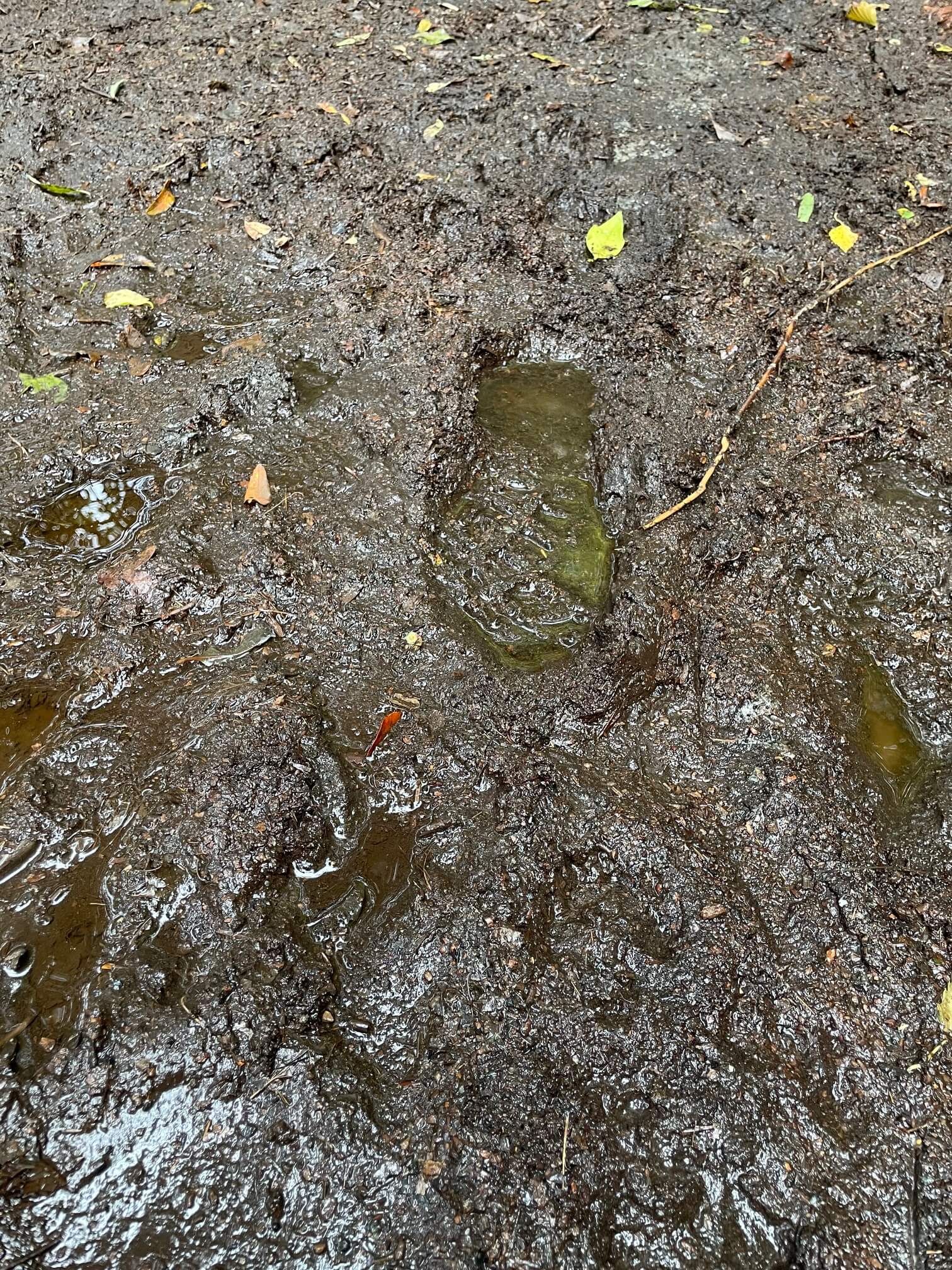
I’m also celebrating the return of mud. No doubt in the depths of Winter I’ll be sick of the stuff, but right now it appears like a magical substance. To walk upon ground that gives, ground that reacts other than by producing a puff of dust, is magical.
I’ve become very bad at taking photographs. Not exactly lazy, it’s more that my focus is on the world around me. More and more now I find that when I’m out for a walk all my senses are tuned into the world around me – sounds, sights, smells – and I feel I just want to take them all in, rather than try to record them. I just want to be in the moment.
And, incidentally, a photograph is a poor substitute. It can never capture a complete experience – the colour is frequently leached out by bright sunshine, I cannot hear the wind in the trees, or smell the scents of autumn. I cannot feel the nip of the sharp early morning air. The sounds surrounding me would all be lost. The leaves suddenly whirling all around me in the breeze. I would lose the deceptive simplicity and is-ness of all this.
And yet, I enjoy photographs. I use them a lot in my writing. How to square the circle? Must I only take photographs on days I set out to focus on photography? They are good memory joggers. You may not get the sounds or scents (or sharp nips), but a photo may well remind you of them. And they can be things of beauty on their own, of course.
I think I need to find a way of taking photographs without disturbing whatever is my current train of thought at the time. A sort of Zen-like process.
I tested one of the few apples on our tree in the middle of the month to see how ripe it was, and it came away from the branch easily. We shouldn’t be picking apples in mid-August, surely? But it’s a poor year, too. There are barely a dozen apples on the tree, whereas last year we must have had at least five times as many. And our crab apple, usually weighed down with fruit which we leave in situ for the birds over winter, is almost equally bare. Our neighbour’s Rowan tree looks beautiful, although Rowan trees always do, but it definitely has fewer berries on it than usual. Our Hazel tree also seems to have far fewer nuts than last year.
And in the wild?
Bit of a mixed bag, really. Some of the hazel trees near us are fairly heaving with nuts, while others have very few. The oaks have a good crop of acorns, but nothing on last year when the woodland floor was covered an inch or two deep. But last year was a spectacularly good mast year. This year the hawthorns have a decent amount of berries but nothing special, much like the elders, while the hollies seem to be loading up with a whole mass of them. That, at least, is the picture in my little corner of South East England. Last winter was quite mild. But even should we have a harsh winter this year, the outlook for wildlife seems not too bad from the nuts and berries perspective.
These things do often seem to follow a cycle of alternate years, although I don’t know why that should be. I had thought the apple blossom was a little late this year, but I really don’t know whether that’s just my imagination.
On Tuesday evening I went for a short walk. It had been a hot day and earlier I had seen three tiger moths, which was rather a treat. By the time I left the house, though, a little before eight, the air was cool, the birdsong seemed a little louder than usual, and there was a magical light in the sky as the sun disappeared below the horizon. The church clock struck eight as it did so. In the woods, there were now patches of sudden night where the trees grew close together, through which the path could be seen like a pale wisp of misty light. By the time the church clock chimed the quarter hour it was quite dark, although patches of daylight still showed in the clearings. Soon there was so little light I headed out of the woods and homeward.
A few minutes before half past, a mixed flock of jackdaws and rooks flew over, the jackdaws chuckling and gossiping noisily as usual as they headed east towards their gathering place on the edge of the town. There, they will be joined by other flocks and once all are there, just before dark, they will all fly off together to their night’s roost.
Although it is still August, the air already seems to have an autumnal feel to it.
I was talking about hop pockets and pokes last week – and pigs, of course, which was how it all started, but forget the pigs for now. Let’s stick with the pokes and pockets. At the weekend we went for a walk through a part of Kent we hadn’t walked for a few years and part of the walk took us through this field:
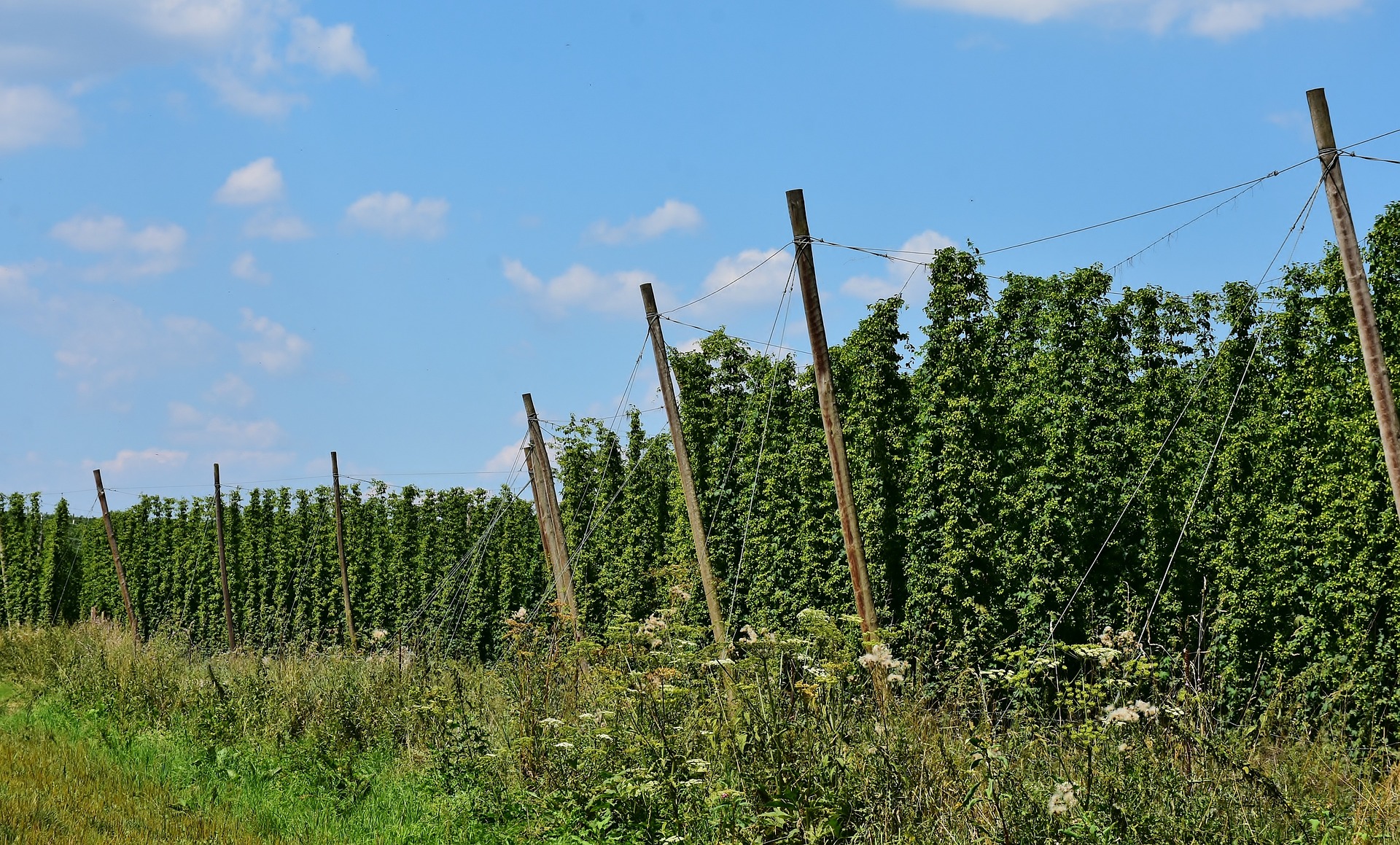
This was a hop garden many years ago. Conveniently close to the oast houses so that as soon as the hops were picked they could be taken in and dried before there was any chance of them spoiling. Taken in bagged up in pokes, and once dried shipped out to the brewers in pockets. A word of explanation for those not familiar with these terms: hops are not grown in fields, they are grown in gardens. Not like your or my back garden, but like a field. But a field full of poles. Hop poles. With huge cable-like wires strung between them to support the hop bines as they grow.
When they are ready for harvesting, the bines are pulled down and the hops picked and put in pokes – large sacks (but you knew that, of course. You remembered it from last week). Then once dried they are shovelled into pockets – another size of sack.
And what are the hops for? Making beer, my friend. Lovely beer.
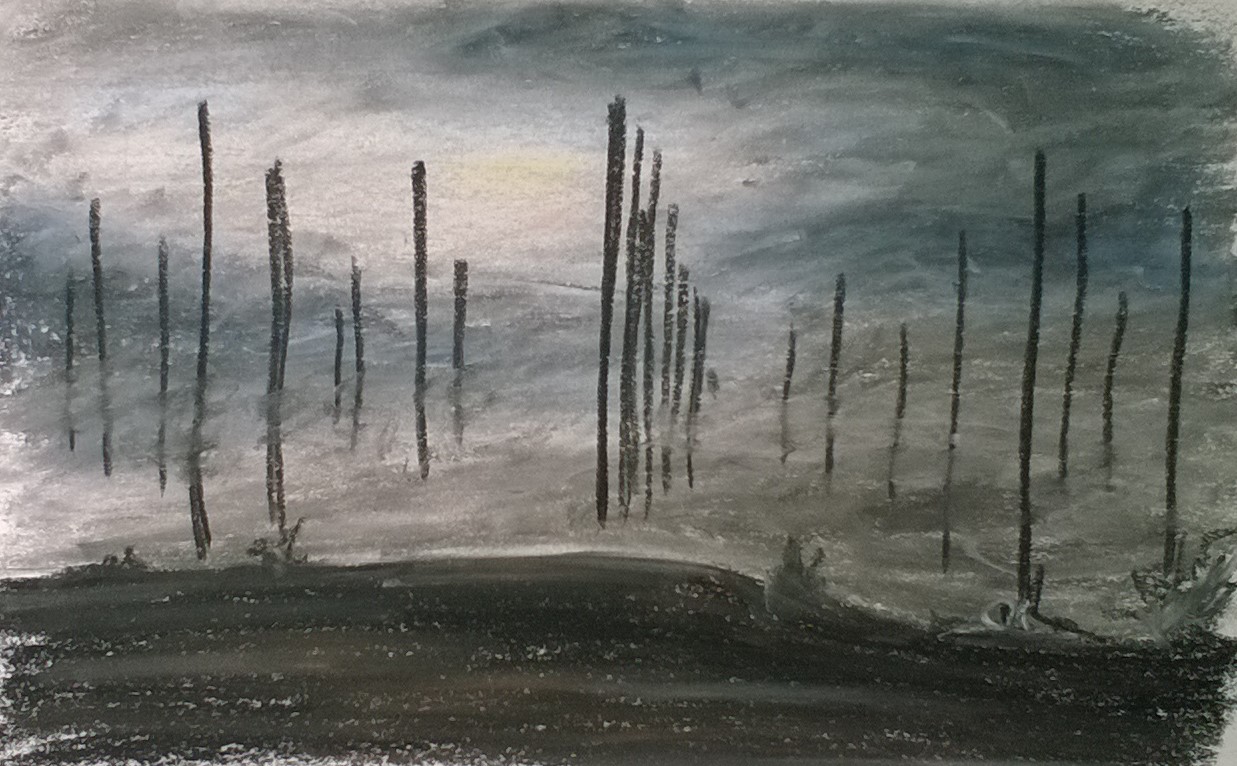
I don’t have a picture of the hop garden from back then, but late one cold, misty, autumn night about thirty years ago, I walked through it and the eeriness was instantly imprinted on me and once I was home I felt compelled to make an oil pastel painting of it (below).
Anyway, as I said I don’t have a photo of the hop garden in question, but this one from Pixabay illustrates very nicely the hop poles and wires with the growing hop bines growing up and across them:
The poles were supported by wires kept under tension, anchored into the ground around the edge of the garden. Quite a few of these are still in situ around the very edge of the field and just into the woodland and hedgerows bordering it.
In 1872, there were 72,000 acres of land in England growing hops, the majority of these being in Kent, employing over 100,000 seasonal workers at picking time. By 2003, the acreage in Kent was down to just over 1,000 and for the first time ever the county had been overtaken by Herefordshire, which now grew more, although the decline does at least appear to have halted for now. In 2011 there were a total of just over 2,500 acres under cultivation in England but it is such a small number there were fears the industry could die out. Although hops are still used in beer brewing, much of the requirement is imported, especially with a popular shift towards less bitter-tasting beers. But in much the same way that Kent has also lost a huge percentage of its apple orchards, a once rich and diverse farming landscape has become more and more homogenised, with endless huge fields of arable crops and sheep and cattle replacing the hop bines and apple trees.
I spent one autumn apple picking around thirty years ago and the farm I was working on had a large acreage of hop gardens (both apples and hops all sadly gone, now). It was an incredibly busy and bustling time, with our diverse group apple picking – a mixture of locals and Europeans come over for the work – and a traditional mix of workers in the hop gardens; as well as locals, there were a lot of gypsies and possibly still a few people down from London’s East End, which was a traditional way for those workers to make some extra money in the nineteenth and early twentieth centuries. It was busy, noisy, very hard work, and a lot of fun.
And, not surprisingly, there are a number of traditional songs about hop picking. So here is the wonderful Shirley Collins and the Albion Dance Band to perform ‘Hopping down in Kent’ especially for you.
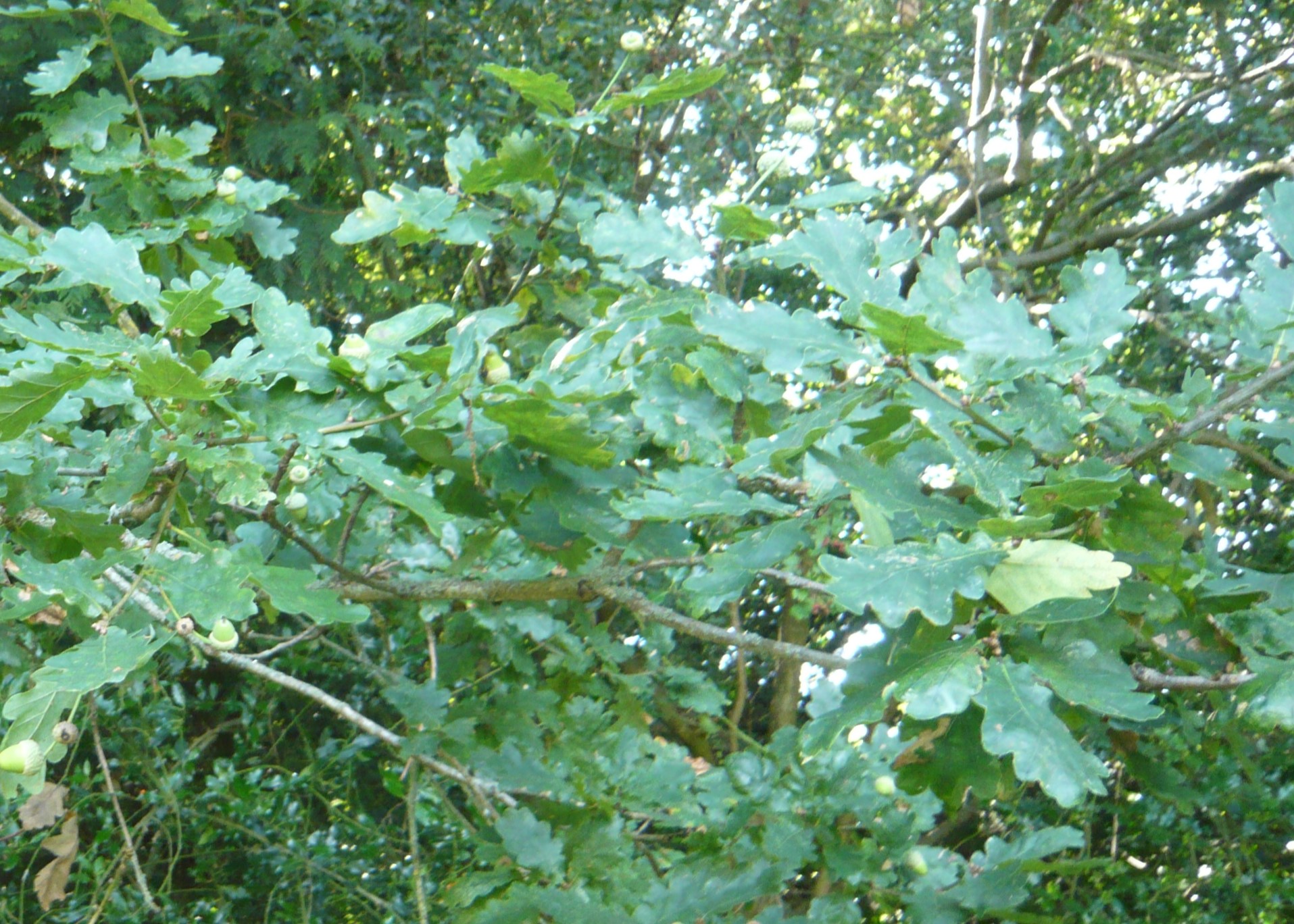
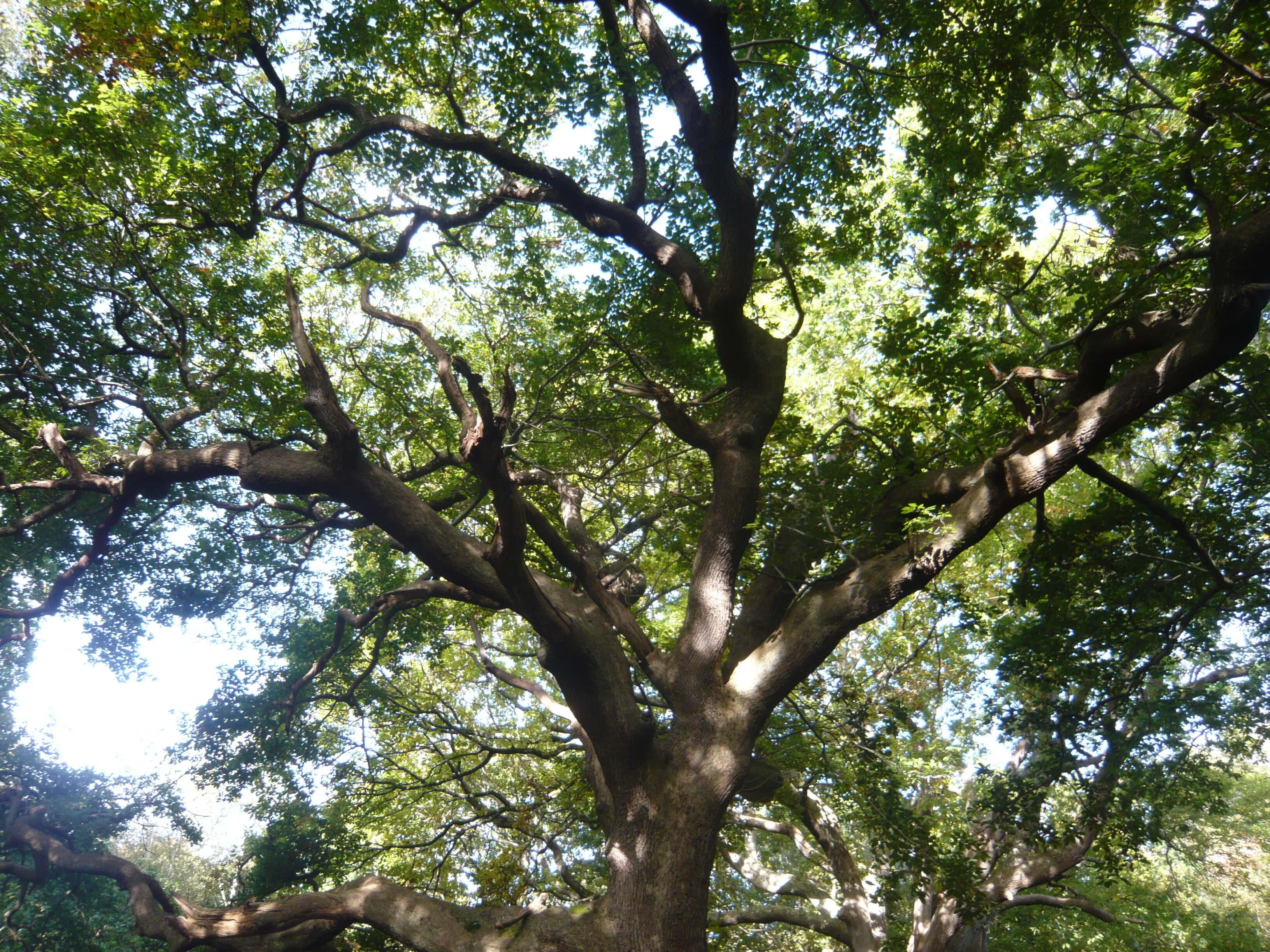
The leaves are turning, but in some cases, such as these oaks, still very slowly.
On Sunday, I was wandering around under the oak trees in the woods for a while. It was a gloriously sunny morning and I found myself stuffing my pockets with acorns and oak leaves. For no particular reason – they just looked interesting.
Maybe I was channelling my inner squirrel. Back indoors, I thought I might try to arrange them a little bit artistically, but I’m not sure it has really worked. Never mind. I love the way that both the leaves and the acorns turn from green to brown, passing through many different pastel colours on the way, many of them ochres – the earth colours.
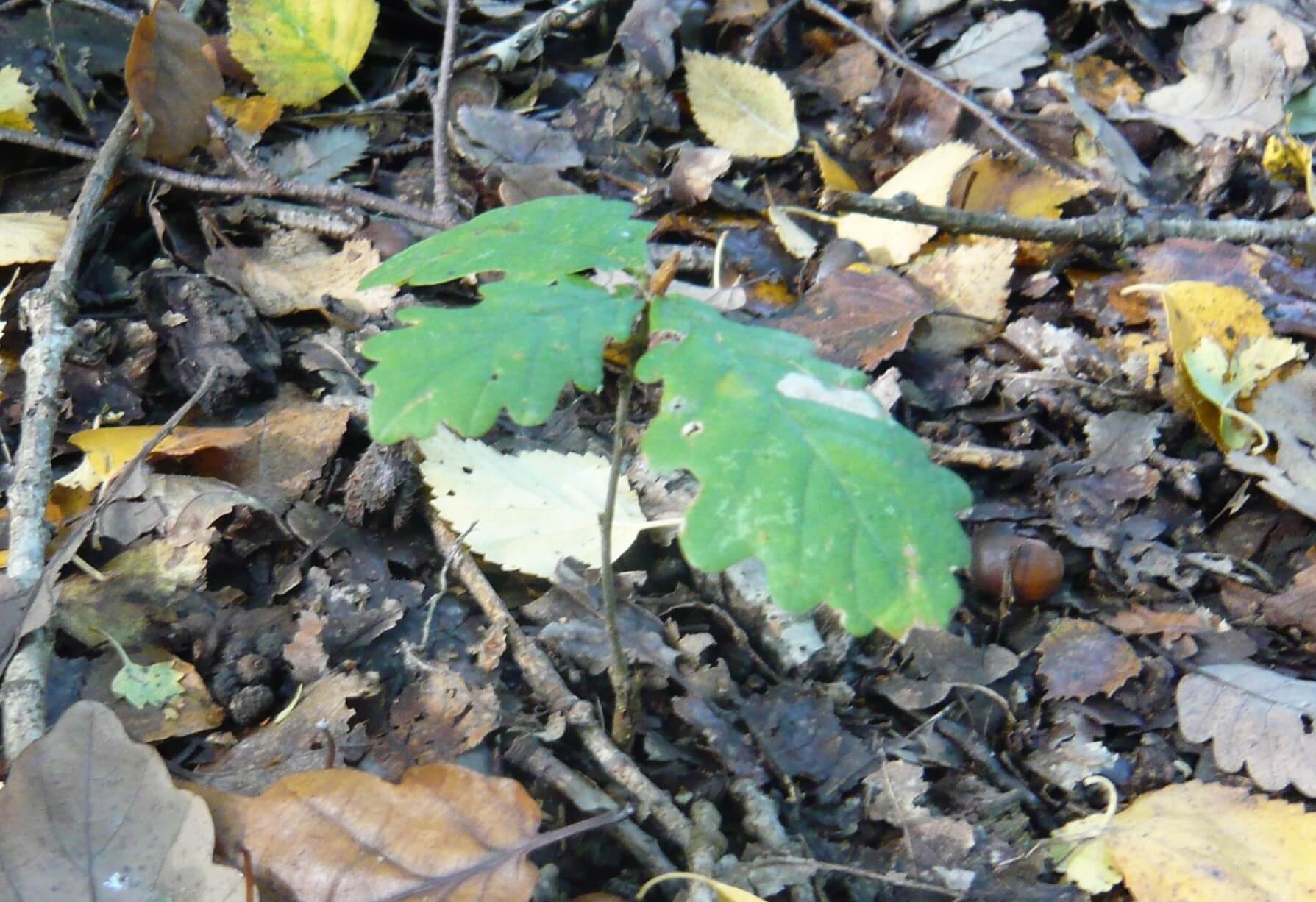
‘From tiny acorns mighty oaks do grow’ as the saying goes. This one has a little way to go yet, but as long as it doesn’t get broken or knocked down, its chances are good. There is a lot of light where it is growing, and currently little competition for light or space.
I felt a little menaced by a fallen branch, but all was well.
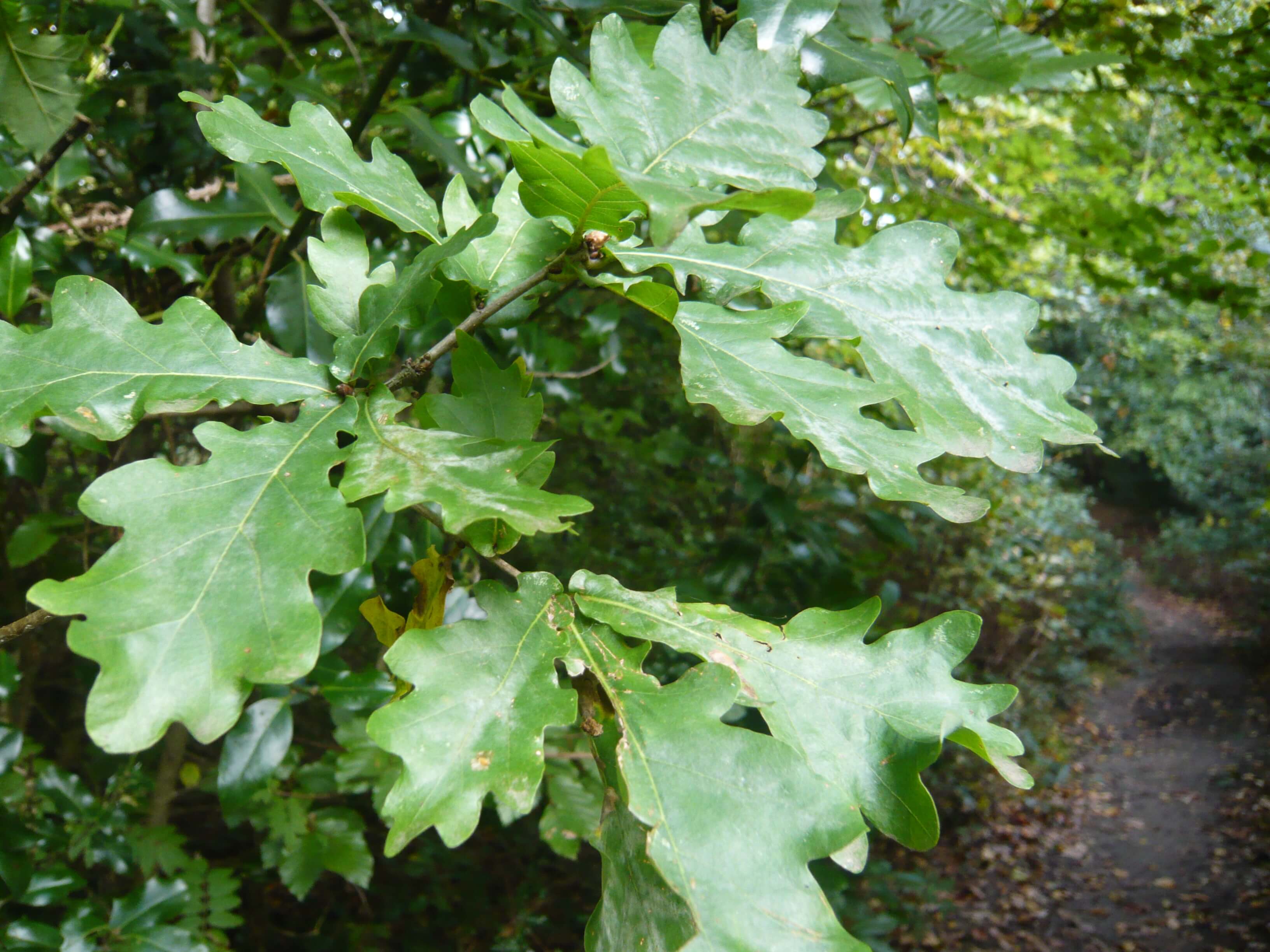
And despite it being mid-October, as I said at the beginning, there are still plenty of summery green leaves to be found.
Often, it still feels like summer at this time of year, but I feel autumn has truly arrived now. This morning I walked a path I haven’t walked for a week or more to find the sun was that much lower than it had been and I was constantly having to shade my eyes. It’s all about colours, now. Colours and the cooling of the world. Russet. Browns. Fading drab greens. Yellows and orange. Autumn can be beautiful, although it can also be dull and dreary and occasionally fierce. But mornings often arrive with an added sparkle, with heavy dews on cobwebs and leaves glinting in the low sun, hedgerows of thistledown, rosehips, and hawthorn. There is usually a freshness in the air, especially in the mornings, which has been absent for most of the summer, that invariably lifts my spirits.
I like summer, of course I do, but the arrival of autumn reminds me in some ways of the arrival of spring. In spring we have the stirring of life after a long period of hibernation, whereas the beginning of autumn always feels to me like the start of a new, second, outburst of life. Many plants have a sudden growth spurt, fruits and nuts and berries swell and glow and are plundered by birds and beasts. It is still warm, warm enough to bask in the sun and to feel hot walking up even quite gentle hills.
The Equinox occurs on Friday (at 2.03am in the UK, to be precise) and after this the hours of darkness outnumber the hours of daylight until the end of next March (counting dusk and pre-dawn as night time). After this, the year always feels to me quite different, even if the weather from the one day to the next is much the same. I can already feel myself slipping into a different place; the logs for the burner have arrived and have been stacked ready for use. The apples have been picked, shortly to be wrapped and stored away. Much in the garden is in the process of being cut back for winter. When the days are short and the nights are long, there will be many books to read, lots of music to listen to, a few beers to drink, and many long conversations to be had.
But also many long walks as well, I hope. I love winter too.
Nature dies down in winter. Certainly, at those latitudes where the days become much shorter and the temperatures plummet. Both wind and rain seem to become more frequent. Snow. It is a period of rest and renewal after autumn has put on a final glorious display of colour. Animals adapt to this in one of three ways: some will eat and eat of the autumn bounty of, especially, fruit, putting on large fat reserves and surviving the winter in a state of hibernation, their heart-rates dropping to a scarcely believable one or two beats a minute, their bodies slowly using these fat reserves for the little energy required to maintain a flickering life through those months. Some migrate, seeking a warmer climate until spring returns. These animals are, due to the obvious logistics required to travel hundreds of miles to reach those more hospitable climes, the larger animals and many of the birds. Travel over those kinds of distances would be out of the question for the smaller ones. Others stay put and, in the case of the plant eaters, scratch out a meagre living on whatever leaves and grasses survive through the winter. The carnivores, of course, stay and try to catch them.
Our Neolithic ancestors’ life cycles would be attuned to this pattern too. Autumn must have been lived fast and furiously. In the same way our medieval ancestors worked long hours to bring in the harvests, Neolithic man and woman must have used all the dwindling daylight to bring in as much food and fuel and dry bedding as possible before the winter period. Then by the end of autumn gathering would have largely ceased and they would have moved into a winter rhythm of life.
But how did they get through winter? What of the food they had gathered? Presumably, they had no way of storing fruit – could any of it be dried? Was it fermented for drink? Or was it all eaten as soon as it was gathered, as though they were all so many dormice seeking to build up their reserves? And could this, in fact, have been a part of their strategy to get through those months? To eat and eat until the perishable foods were all gone, and then to stop all but the most essential activities. To expend as little energy as possible and stay as warm as they could. Spending as much time as possible asleep.
And yet, they would still need to eat, and so with dwindling food reserves they would slaughter any beasts kept for that purpose, possibly smoking the meat to enable it to keep for as long as possible. Hunting would continue and might, in some ways, become a little easier. With less vegetation around, there would be less cover for their prey, and in snow there would be clear tracks to follow. But presumably this prey would still need to be pursued, and this would use precious energy, unless they relied more upon pits and snares.
The long-range weather forecast is predicting generally mild, wet weather in the run-up to Christmas. So still no sign of ‘winter’ yet.
Although there is a lot to be said for mild weather, we need the cold of winter to help to break up the soil for the following year and kill off many pests. But our climate is changing.
There are some swallows still around, apparently. Presumably because there are still plenty of insects for them to eat. They should have left ages ago. What does this mean for them in the coming months? If the weather remains mild and the insects persist, will they be able to survive the winter here? And will they still be able to successfully migrate if the expected colder weather kills off these insects, or will they have left it too late? I suspect it will not end well for them.
There have always been a few of these days at the turn of the seasons, although probably nowhere near as many as now, and I wonder how our ancestors would deal with these days; the days I am sometimes tempted to call the Nothing Days. Those days which are grey and cold, but not severely so. The leaves are continuing to fall but seem in no hurry to complete the job. Nothing seems to be contributing to the change of the seasons. If any plants or animals are responding to anything, it can only be to the shortening of the daylight hours. There are still plenty of nuts and berries for the wildlife to forage – the birds are largely ignoring our bird feeders at the moment – although little for the human forager; the blackberries have finished, the chestnuts and hazelnuts all gone.
I suspect our ancestors would have moved into their own winter routines anyway, and got on with the jobs in hand, largely mending and making. With the onset of rains and wind and snow, rooves and walls would be repaired and strengthened, leaks caulked, trenches dug out to drain water away from dwellings. Tools and weapons would be fashioned and repaired. Measures taken for comfort and warmth – perhaps grasses and rushes and bracken collected and heaped up inside, likewise firewood, and fodder for animals.
Although I’m only guessing, but a fire in the middle of a hut filled with heaps of dried grasses might have required a Neolithic risk assessment following a visit by a fire and safety officer.
It’s beginning to feel both as though autumn has been with us forever, and that it is especially reluctant to leave us, this year.
This year has been a mast year; the trees and bushes have been laden with prodigious quantities of nuts and berries. The hawthorns, especially, seem to be weighed down with berries, and we have gathered large quantities of nuts from the hazel in our garden. There are so many acorns beneath the oaks nearby that there is a thick, continuous, crunchy, carpet of them underfoot. Traditionally, this has been said to indicate a harsh winter ahead, although how the trees and bushes are meant to work this out when we have no idea what the weather will be then, heaven only knows.
What it really indicates, of course, is that the climatic conditions have been such throughout the year that these trees and bushes have successfully produced their large crops. Nothing to do with what will come along later.
On the other hand, the leaves have held onto their greens for longer than usual and only turned late, and still seem most reluctant to fall. It has taken the determined efforts of a few strong winds just to remove about half of them. Certainly, around my part of Britain, anyway.
It is not cold. There are no signs of a proper winter chill approaching, with the long-range weather forecast contenting itself with predictions of the occasional cold spell in the next month, which takes us through to mid-December. In the garden the grass and many of our other plants are still engaged in that crazy autumn growth spurt.
Of course, it was never unusual for November to be wet and mild, and we may yet have a biting cold winter, although I wouldn’t bet on it. It is a long, long time since we have had a winter like that in these parts. In my lifetime, only the winters of 1963 and 1978/79 really stand out as being extremely harsh, although a few others have had shorter periods of cold and snow. The expectation for winter around here now is that it will just be chilly and wet. I think only once in the last six or seven years have we had more than just the odd flurry of snow; that was from the so-called ‘Beast from the East’ a couple of years ago, and even that only lasted a few days.
We seem to have lost winter somewhere along the way, which sounds very careless of us.
In fact, that is quite a good way of describing it.
You don’t need me to tell you we have been careless in the way we have interacted with nature, the result being our world is heating up dangerously. And in our part of the world, this has led to hotter, drier, summers and milder, wetter, winters. There has been a notable increase in destructive flooding events. Downpours are frequently very heavy and long-lasting. Rather than being spread out through the month, we may get an entire month’s worth of rain in less than a day. Summers, conversely, have become very dry.
This is absolutely nothing to the extreme climate conditions suffered by millions of others in other parts of the world, but it helps to bring it home to us that the Climate Emergency is real, and it is happening. With everything else happening in the world at the moment, this seems to have been conveniently ignored by the mainstream media for the last six months.
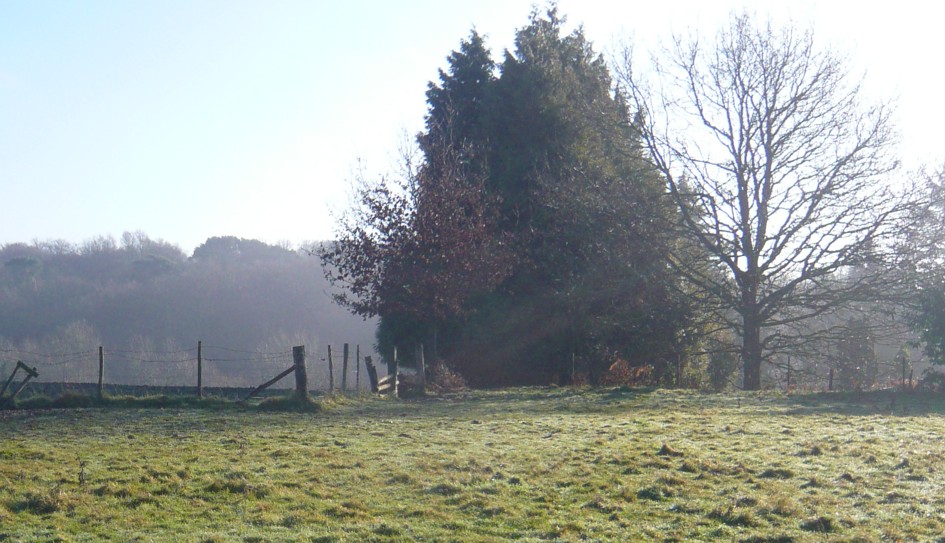
I went out for a walk in the morning as the overnight mist was lifting, and the air was cool but not cold, under a sunny, clear sky filled with birdsong. I felt a powerful sense of renewal in the world.
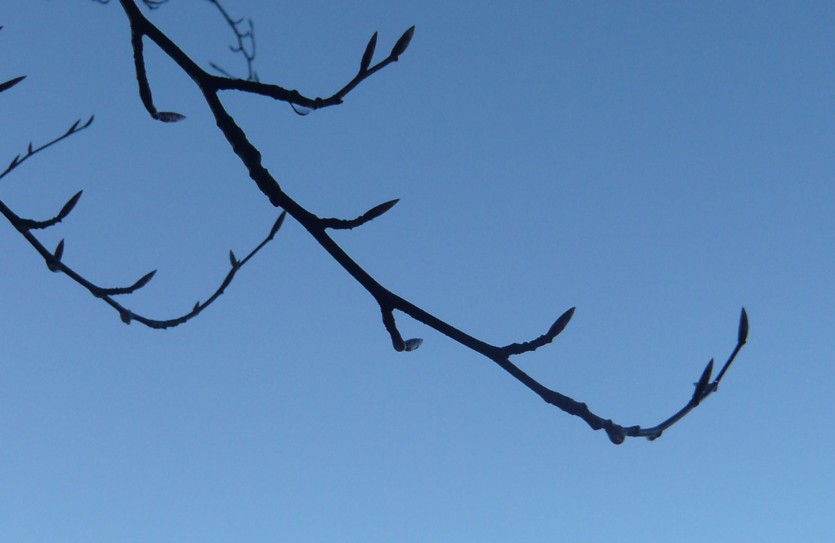
There is little new growth yet, but the trees were covered in buds. Although we are not long past the shortest day of the year, the ridiculously mild temperature and the sun which felt warm on my face, reminded me that there is one more minute of daylight today than there was yesterday, and tomorrow there will be one more than that. And it will not be long before each day gains an extra two minutes, then three, then four…
The air smelt clearer and cleaner than it had for months, and I felt like beginning a long journey. I yearned to be walking on the Downs, or heading through fields and woods with my destination nothing more elaborate than a bed in a basic bunkhouse or hostel, and somewhere to get a meal, preferably in a tiny village surrounded by hills and streams and woods. This is a feeling I get every Spring, that it is a time to explore more of the world.
Everything seems to be fresh. I need to do something new, something positive. To plant some trees, perhaps (always a good idea).
I thought of Christmas. This year, we had a string of lights in one room, with handfuls of greenery as the only other decorations. This, for me, is a way to make sense of the season. It has nothing to do with religion, unless it be the ancient religions that worshipped the sun and the moon and celebrated the turn of the year at the Winter Solstice when the seasons begin their long, slow journey back towards the promise of Spring and the harvests of Autumn. A simple wisdom, in tune with the natural world.
I do not, I cannot – I will not – associate it with any other form of mythical gods. For me, it is all about the natural cycle of the seasons, simple and uncomplicated.
And I particularly like the period when Christmas is definitely over, and we’re only just getting into the new year. Everything seems to have this feeling of renewal, which was the whole point of the Yule festival. A time to look forward and plan for the coming year. This will be where the tradition of New Year Resolutions comes from, no doubt.
This year, I shall resolve to try and simplify my life further, and to live more in tune with the natural world.











 Mick Canning