Ladakh 3


IMG_0027

The Wheel of Life, Tibetan Buddhist wall painting, Thikse Gompa. The Wheel represents the cycle of being, the various realms of existence, and the three poisons (desire, ignorance and hatred).

IMG_0026

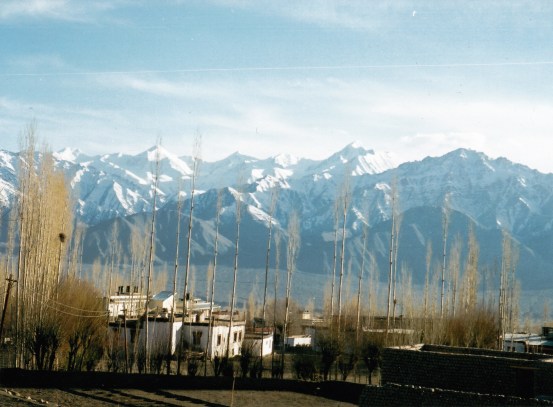
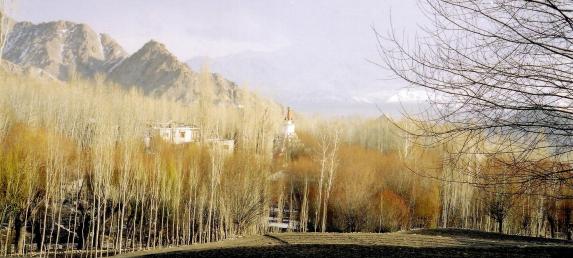
View of the Stok Mountains, Part of the Himalaya Range, above farms and poplars on the edge of Leh, Ladakh.

From my diary, Friday 15th April 2005:

Outside, my hosts are planting their potatoes, today. It’s been fascinating watching over the last week, as they’ve dug over the whole vegetable garden (about an acre), then divided it up into a total of about fifty smallish and four large plots, all neatly divided with earth walls, between which are carefully dug channels to the stream that runs along the side.

Then, over the last couple of days, half of the plots have had compost dug in and the channels opened one by one to flood each plot for a set time, then closed and the water allowed to soak into the earth.

The first of the large plots is now being planted with potatoes, presumably saved from last year’s crop, and some more digging is commencing at the far end of the garden, where so far there are no small plots.

I’ve just noticed what’s happening at the far end of the garden. It’s going to be one huge potato patch. Dad is digging, Mum is planting, whilst Granny is sorting the potatoes ready for planting. The little girl is happily employed in making mud-pies, like small children anywhere in the world under these circumstances!


The monastery at Thikse, Ladakh. Virtually the whole of the hill is covered in buildings belonging to the monastery, whilst the Gompa or temple crowns the top. Founded in the fifteenth century by monks of the Gelugpa, or ‘yellow hat’ school of Tibetan Buddhism, to which the Dalai Lamas belong.

Wednesday 13th April 2005:

12.45 and I’m sitting on a rock in hot sunshine at the foot of Thikse Gompa. The bus ride here was remarkable. Where else in India would you find that they don’t bother charging anyone for just going a couple of stops, or that they’d wait a few minutes whilst a passenger nipped off the bus to buy some bread? All along here, passed all this desert scenery, so similar to Oman. And so many fairy-tale castles and palaces and the like hanging precariously to the tops of cliffs. 

IMG_0028

Building at Thikse Gompa.

If it is so beautiful now, in winter, then what must it be like in the other seasons? I’d dearly love to come back to see! And after all the heat, dust and pollution in Delhi, well, need I say more? I’ve not even been asked once for baksheesh, either. 

Mandala painted onto roof of entrance to Shanti Stupa, Leh. The Shanti Stupa, or Japanese Peace Pagoda, is one of more than 70 built around the world by the Japanese Buddhist Nipponzan Myohoji Organisation, which was run by Fujii Guruji. They were built to promote world peace.

indus at chog

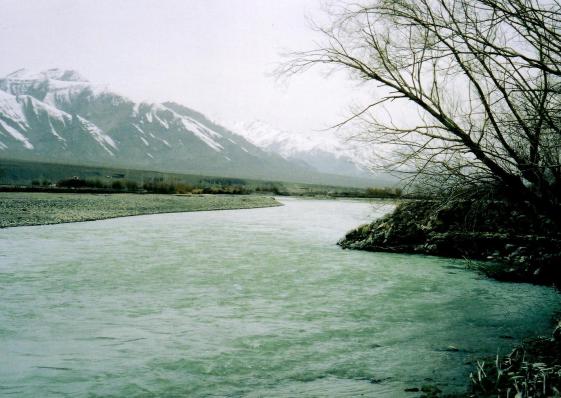
The River Indus at Choglamsar . The Indus originates in Tibet, near Lake Mansarovar – a lake sacred to both Hindus and Buddhists – and after flowing through Northern Kashmir, including Ladakh, passes into, and flows the length of, Pakistan, to the Arabian Sea. So, ironically, the river that gave its name to the state of India, flows mainly through Pakistan.

trees

Trees on the edge of Leh. Trees are highly important to Ladakhis – they provide timber for building, fuel, food in the form of walnuts and apricots, and fodder for animals. In all of Ladakh, the only trees that grow are willow, poplar, walnut and apricot.

Dodgy digestion in Dharamshala

I am not sure why, but I frequently think of the room that I stayed in when I went to McCloud Ganj in 2009. It was not my best trip to India, since it was the one time that I have picked up a bad stomach bug that I could not shake off for the entire duration of my trip. I had a few days in Jaipur, the condition of my digestive system rapidly going downhill despite medication and fasting, and finally took the bus back to Delhi where I felt strangely comfortable in the familiar warren of Paharganj.

When I felt that my stomach had at least stabilised, although it was by no means cured, I decided I was well enough to go and spend a week or so in Dharamshala. Or McCloud Ganj, which is what most people mean when they mention Dharamshala. McCloud Ganj is where the Dalai Lama and many Tibetan refugees actually live; Dharamshala is a town close by. Anyway, instead of taking the bus – a twelve hour journey that I just couldn’t face – I splashed out and took a flight.

Actually, the flight was wonderful.

The plane was a twin engine prop, rather than a jet, carrying just a few passengers. If one has to travel by air, then I think that there is no nicer way of doing it. We were crossing the North Indian plains for a while, then all of a sudden the Himalaya jagged up like freshly whitened teeth from side to side across the horizon. We slowly approached, the ground beginning to rise up into hills and the towns disappearing. We passed Shimla atop a ridge, with its airport running along a second ridge, looking for all the world as though the top had been sliced off – and perhaps it had.

Eventually we came into land – a tiny airport where the aircraft taxied up to the small building, switched off, and then when we got out all was quiet. After the hum of the engines during the flight, the sudden silence with the mountains staring down at us, and the air clear and cool, was breathtaking and almost indescribably beautiful. I just wanted to stand still and drink it all in, but was eventually ushered into the terminal.

And the aircraft terminal was small enough to feel that it was built on a human scale. A few rooms and halls, and not too many people around. And even those people appeared to be in no real hurry, unlike the larger airports that I usually find myself in.

I thought immediately of Leh airport, in Ladakh. That had the same feel.

So I picked up my luggage, and went outside to get a taxi to McLeod Ganj (or Gunj).

Once in McLeod Ganj, I checked into my room at Hotel Ladies Venture. It was basic, but it was clean, had hot water, a bed with lots of blankets, a table and a chair. For RS 200/- a night I had nothing to complain about, and if you wish to read this as a recommendation, then feel free to do so.

219

I shall write a proper blog post on McCloud Ganj at some point, but suffice to say I did very little during the week that I was there, other than wander around and look at the mountains, read, eat and drink, and visit the Tsuglagkhang Complex; the temples and the residence of the Dalai Lama (who was out when I visited).

But my guest house room has stuck in my mind.

By the end of my second day there, I had slightly rearranged the room to get it how I wanted it. My few books were lined up on the windowsill. Various belongings were on the table. I had hung a string of prayer flags along the wall. Little touches.

I have stayed in far nicer rooms. I have enjoyed better health at other times. But every time that I feel my life is too cluttered; too full of unnecessary junk and too complicated, it is this room that suddenly springs to mind, and I’m not entirely certain why.

It might have something to do with the fact that I do travel light, and so have nothing with me but essentials plus a few books and my notebook (although I would argue that they are also essentials!).

It might have something to do with the fact that my room that week felt like a bit of a refuge, partly because I still felt unwell, although I am not entirely convinced by this since I loved the town, the people were lovely, and I was completely at ease there.

I think that it is simply symbolic of the feeling that I constantly have that I need desperately to declutter and simplify my life. I think that when feelings of stress and anxiety threaten to overwhelm me, then it is an image of a refuge. I think that it is a reminder of much that I love about India and its people.

Dammit, I need to get out there again!

Himalayan Foothills

I am going offline for a few days, since I need a bit of a break, so I will leave you with a selection of photographs from the Himalayan Foothills, Northern India. When I log on again in a few days, I’ll catch up with everyone’s blogs and comments.

By ‘Foothills’ I mean the ranges of hills and smaller mountains that guard the approach to the Himalaya proper, where the big beasties rise up to heights of over 8000m with permanent ice and snow cover. The old Raj hill stations such as Nainital and Darjeeling were built at heights of around 2000m – high by UK standards, but certainly not by Himalayan ones.

one

Naini Tal, Nainital Town, Northern India. Morning Light. Nainital lake, (‘naina’ is Sanskrit for eye and ‘tal’ means lake) in Hindu mythology, is one of the emerald green eyes of Sati, Shiva’s wife. This was my first view of it after getting off of the overnight bus from Delhi.

two

Gadhar Kunkyop Ling Gompa, Nainital. Unlike many other Himalayan towns, Nainital has no sizeable Tibetan population, and this Monastery, perched high to the North East, overlooking the lake, is the only one in Nainital and home to just seven monks.

three

Morning mist, Nainital.

four

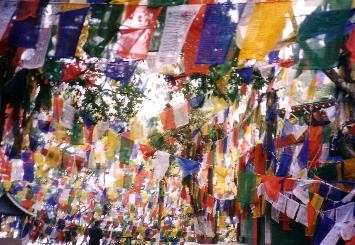
A sea of prayer flags on Observatory Hill, Darjeeling. Darjeeling, unlike Nainital, has a large Tibetan population and many Gompas both in the town and the surrounding hills. Observatory Hill is the site of the original temple of Dorje Ling, long destroyed, but after which the town was named, once the British had persuaded the then ruler of the area, the Chogyal of Sikkim, to lease them the land to build a hill station. The hill is now home to a Hindu shrine, with the British built church of Saint Andrew close-by.

But no Gompa.

five

The ‘Toy Train’ stopped outside Samten Choling Gompa at Ghoom, near Darjeeling. This train runs for 51 miles from Siliguri to Darjeeling, rising a total of just over 7000 ft. It has numerous steep gradients and sharp curves, including the famous one at ‘Agony Point’ – originally the loop there was a diameter of only 59.5 ft and the train literally overhung the mountainside as it rounded the curve. All in all, quite a remarkable engineering feat and deservedly a World Heritage site.

six

Druk Sangak Gompa, a large Buddhist monastery on the edge of Darjeeling, West Bengal. A fairly new gompa, it was inaugurated by the Dalai Lama in 1992.
seven

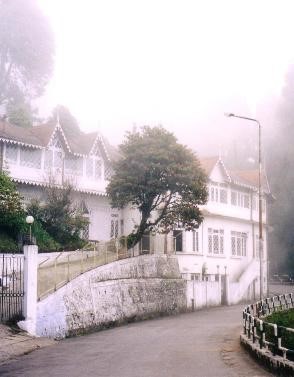
Not Chelmsford, UK, but Darjeeling, West Bengal). Many of the old British hill stations, such as Darjeeling, still retain much of their colonial character.
eight

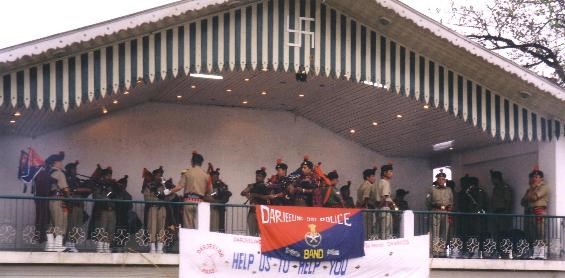
A clash of cultures! And what a clash. East meets west, with brass band in the park meeting the Indian Himalaya, courtesy of the Darjeeling Police Band. The band played in a bandstand on the Chowrasta, the open square at the top of Darjeeling, close to Observatory Hill. In the days of the Raj, this would, no doubt, have been familiar to all who lived there. Close your eyes and think of England…
nine

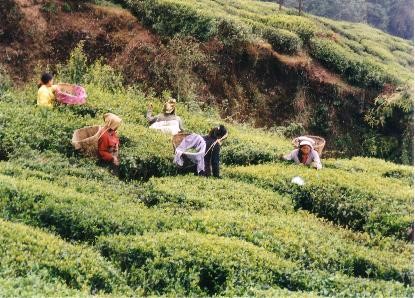
Tea pickers, Darjeeling. Think of Darjeeling, think of tea. In the hills surrounding Darjeeling are numerous tea estates, where the job of tea picking, sorting, drying and packing goes on much as it has done for the last 150 years.

ten

Buddhist painting on rock wall, by open air shrine, Darjeeling. As well as the larger gompas, you come across small shrines and gompas unexpectedly around odd corners everywhere.

eleven

Prayer Lags in Yumthang Valley, Northern Sikkim. This is as far north in Sikkim that you are allowed to travel, just a few miles south and west of Tibet. Everybody is still very touchy about borders.

twelve

Crossing a bridge in the Yumthang valley. It should be safe, considering the number of prayer flags!

thirteen

Unnamed 6000m peaks overlooking the Yumthang Valley. We asked our guide the names of these peaks, only to be disparagingly told ‘They don’t have names. They’re less than 6000m tall.
fourteen

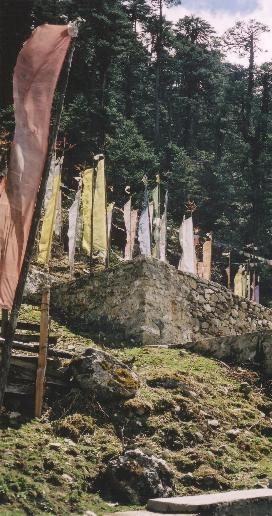
And more prayer flags…

fifteen

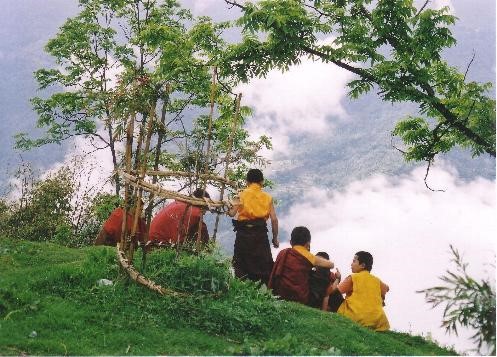
Young monks on a hillside, Phodong Gompa, Sikkim.

sixteen

Monastery wall painting, Lachung Gompa, Northern Sikkim. Lachung Gompa is about 2km above Lachung village, at a height of about 3000m. It is not a ‘working’ gompa, the monks living down in the village rather than at the gompa, so it is generally kept locked and only used on festivals and full moon days.
seventeen

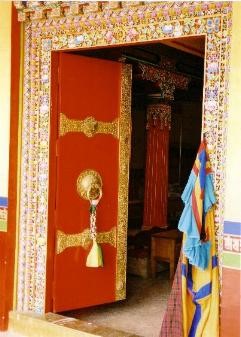
Monastery door, Tharpa Choling Gompa, Kalimpong, W.B. Kalimpong, not far from Darjeeling, but 1000 metres lower, has also a large Tibetan population.

eighteen

Statue of Chenrezig (Avalokiteshvara), Durpin Gompa, Kalimpong, West Bengal. Chenrezig (Tibetan) or Avalokiteshvara is the Bodhisattva (a being who has partly or completely attained the state of enlightenment) of compassion. The well-known mantra ‘Om Mani Padme Hum’ is dedicated to him.

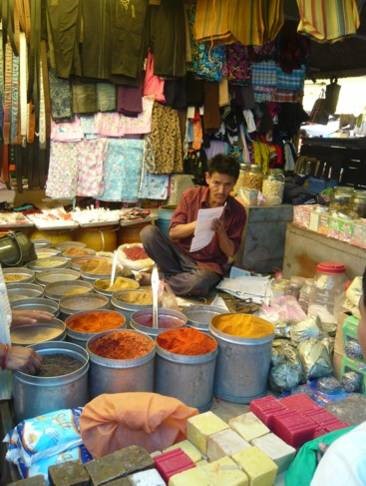
Kalimpong market:
nineteen

I watched this gentleman for some time before I approached and asked for a photo. he was rapidly serving a succession of customers at great speed, making up little paper screws of spices and powders at a tremendous rate…

twenty

…whereas this gentleman served his customers at a more leisurely pace, as if he had all the time in the world.

twenty one

This gentleman was delighted to be photographed with his fine collection of Kukris. As I prepared to take the photo, he picked up a kukri and brandished it with a none too convincing snarl, to the obvious amusement of most of the people around him.

twenty two

This stall-holder seemed to find it hilarious that I should want to photograph her.

twenty three

This lady, on the other hand, was delighted to be photographed; volunteering eagerly when a lady on a nearby stall refused.
twenty four

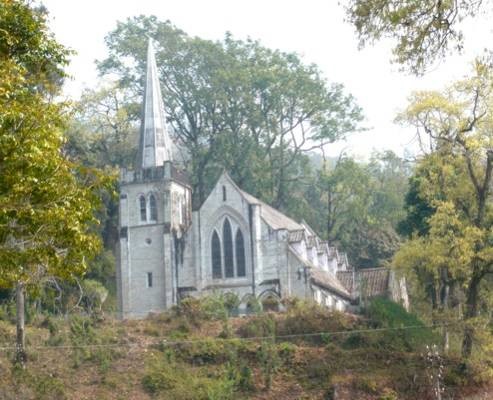
The Katherine Graham Memorial Chapel, in the grounds of the Dr Graham School and home, Kalimpong. Built in 1925, it looks to have materialised straight out of the Scottish Highlands. Dr Graham was a Scottish missionary, and built the home and school originally to educate the children of local tea estate workers. It now has a far broader intake.

twenty five

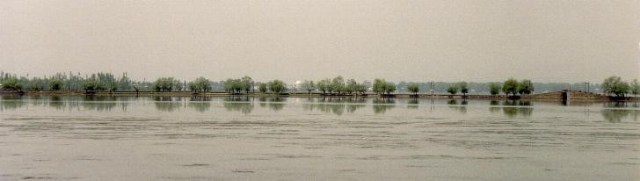
Lake Dal, Srinagar, Kashmir. Unfortunately, it is still probably unwise to visit most of Kashmir, and things will probably remain this way for some considerable time to come. A pity, because this really is a most beautiful part of India and Pakistan. I took these photos in 1989, a very short while before the area became off-limits to tourists.
twenty six

Panorama – Lake Dal, Srinagar, Kashmir). In the distance is the Hazratbal Mosque, a comparatively modern mosque, enshrining a hair of the prophet.

twenty seven

Hindu shrine. Near the shore of Lake Dal in Kashmir.

twenty eight

Houseboats around the shore of Lake Dal, Shrinagar, Kashmir. In the nineteenth century, the British, who first developed Srinagar as a hill station to get away from the stifling heat of the Indian Plains in the summer, found that the then Maharajah refused to sell them land to build houses. The solution? They built boats to live on…great, elaborate, ornate carved and decorated houseboats. These same boats, with many more recent editions, now function as floating hotels to tourists. The majority are moored not on the actual shore, but a little way off, often on the edge of small islands. This gives the local shakira (a type of small boat unique to Lake Dal) owners a chance to clean up, as a taxi service.
twenty nine

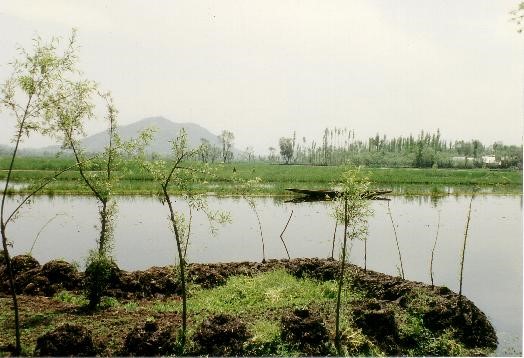
Shakira moored on Lake Dal.