
The entrance to Swayambunath. Swayambunath is the main Tibetan Buddhist site of Kathmandu. Sitting on top of a hill overlooking Kathmandu, it comprises temples, stupas and various other buildings, including a couple of Hindu shrines. Here, a Hindu holy man lurks in ambush, ready to dab a tikka mark on the forehead of (especially) western tourists and demand rupees for the privilege.

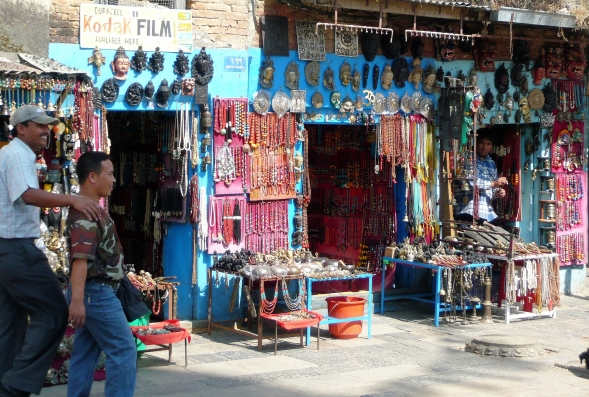
The sacred and the secular at Swayambunath. In Nepal, as in India, it is almost impossible to visit a religious site without Mammon getting a good look in. Here, in the main Buddhist site of Kathmandu, everything from yak bells to masks.

Nuns lighting butter lamps beneath a row of prayer wheels at Swayambunath.
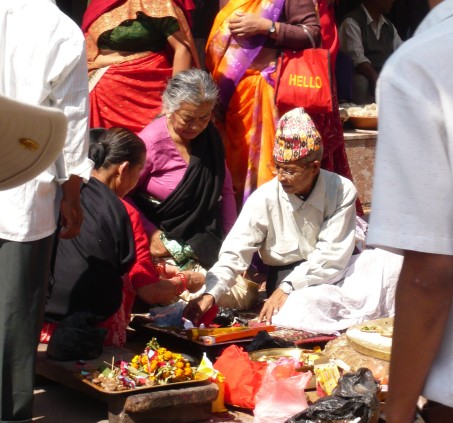
Hindu puja at Swayambunath. Probably a private ceremony at the request of the beneficiary, either for good luck in general or with a particular goal in mind (e.g. birth of a son, successful business venture.)


Tourist shop in the Swayambunath complex.

Buildings in Durbar Square. Durbar (or ‘Palace’) Square is the heart of the old town and the area where the Kings used to live in the 18th and 19th centuries. In contrast to Swayambunath, this area is entirely Hindu, reflecting the vast majority of the lowland Nepali population.

Side street in Thamel, Kathmandu. The lovely old buildings…beautiful wood carvings…collapsing brickwork…wiring all over the place…speed…calm…old and new…………the only things I can’t bring you are the sounds and smells…you must imagine them for yourselves. Coming soon, scratch and sniff websites!!!

Bicycle rickshaws awaiting customers in Durbar Square.

Balloon seller and hopeful customer, Durbar Square.

Kala Bhairab – an image of Shiva in his most fearsome aspect. Wearing a garland of skulls, the six armed Kala Bhairab tramples a corpse, symbolic of ignorance. Carved originally from a single stone, it was set up by Pratap Malla, king in the 17th century. He was a pious Hindu, but interested in the arts and tolerant of other religions. He even restored much of Buddhist Swayambunath. It is said that telling a lie while standing before Kala Bhariab will bring instant death. It was once used as a form of trial by ordeal.

 Mick Canning