The Wood Wide Web and a Bill of Rights

012a

Today, the Guardian’s Review section carries a piece by Robert Macfarlane about a growing movement to grant rights to parts of the landscape, seen by some as one way to protect and preserve them. It opens by describing how in December 2018 the Ohio city of Toledo passed a ‘Bill of Rights’ for Lake Erie, which for years had been heavily polluted and reached a crisis point in 2014 when for three days, during the hottest part of the year, it had been impossible to extract drinkable water from the lake.

The piece goes on to discuss the pros and cons of these laws, especially the potential problems of recognising, say, a river or a forest as a ‘person’ in law, and how that might play out in legal disputes.

At the heart of the Extinction Crisis we are currently suffering, in what is now recognised as the Anthropocene – the period during which human activity has been the dominant influence on climate and the environment. – is the way that we, as a society, view the world we live in and those we share it with. And this has powerful consequences at a time when we are directly causing the extinction of so many plant and animal species, and thence the wholesale destruction of ecosystems and the consequent changes to the climate this triggers.

I have always thought of the Earth as consisting of two distinct layers; a rocky planet – a core – wrapped in a mantle of life, a mantle whole and made up of countless billions of organisms all influencing and influenced by each other; a true web of life that we are all part of, but no longer seem to recognise. And by the same token when we think of somewhere as a ‘place’, we commonly imagine it in isolation, as though it existed somehow despite its myriad neighbours. For example, if I ask you to imagine ‘London’ you may have an image of Central London with its familiar landmarks, filled with hurrying people and buses and cars. Or it might be the Docklands area, the West End – any one of thousands of parts of the city. But would you have an image of a city connected to the counties around it by roads, by streams and rivers, by areas of woodland and fields, the flight paths of birds, the daily migration of commuters or the dominant weather patterns, and then this greater area connected even further to the rest of the country, and then this country connected by seas filled with life to other countries and continents?

And this same lack of imagination frequently makes us see everything around us with the blinkered eyes of our own vested interests. Some will view a landscape as something to be exploited purely for financial gain, be it to extract oil, perhaps, or to maximise the yield of farmland by destroying woodland and hedgerow, infilling ponds and killing wildlife. Some may feel it imperative to build more and bigger roads, covering dozens more square kilometres with concrete and asphalt, as though it were so necessary that we should always be able to travel faster than we do already.

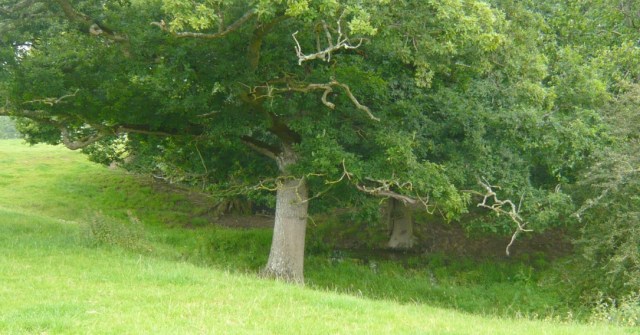
It is still quite controversial, but botanists are just beginning to understand the extent to which trees communicate with each other and the remarkable way their roots are all connected through networks of fungal threads – the Wood Wide Web, as it is sometimes called. It is supposed that trees communicate to each other through these threads about things such as insect attacks, which may trigger defence mechanisms in individuals before they are actually under attack. In that way alone, it is appropriate to think of a forest as a single living entity.

To return to the laws that might protect the natural world, what we really need are laws that recognise the importance of this mantle, and how every part of it relates to every other. And this includes our own part in this relationship, since we are very much part of it, and in the end we depend upon it for our own lives.
A Little Piece Of Wilderness

I went for a walk yesterday, in search of wilderness.

Although we live on the edge of a small town, surrounded by gentle countryside, I still contrive to find some wilderness. It takes me about ten minutes to leave the streets and houses behind, and then I slow my pace and feel myself relax. Tensions drop away as soon as I am surrounded by trees.

There is little wilderness to be had where I walk, yet that does not mean there is none.

Hedgerows can be corridors of wilderness. Perhaps a transient wilderness, but a wilderness all the same. Many hedgerows in the British Isles are hundreds of years old, and although each individual one may be comparatively small, places within them may have been undisturbed for most of that time and during that time many species of plants have flourished there and smaller creatures made their homes.

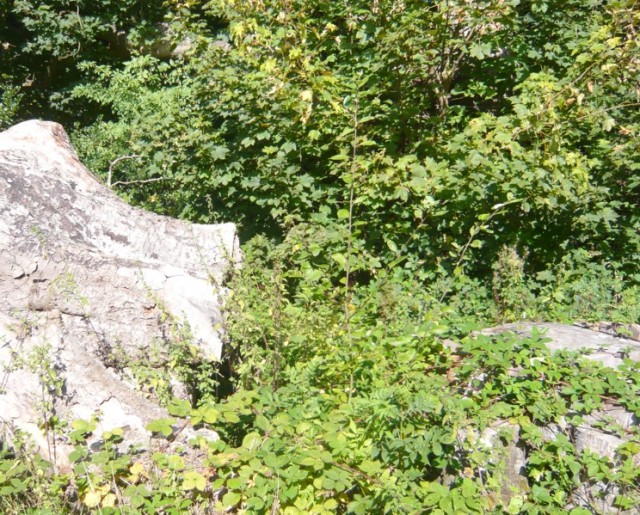
My path goes through a thin belt of woodland, too open to be classed as a hedgerow and too open to have private, wild, places, but once I emerge into the daylight again, there is a hedgerow alongside the path. And for a short distance, the hedgerow widens several feet, and becomes a true wilderness.

002

Here, a patch of elder, sycamore and ash trees are surrounded by a dense undergrowth of brambles, interspersed with patches of nettles, a couple of holly bushes, and a few smaller plants squeezing into the daylight where they can.

It is the home of flies and spiders and beetles, visited while I am there by blue tits, magpies and some smaller birds I cannot identify.

Deep within it, there will be mice and shrews, and very likely larger mammals making their homes.

It is impenetrable by anyone without hacking their way in, and fortunately there is no incentive for anyone to do that.

It is wild, and I love that it is there.

In Praise Of Trees

It has been mind-buggeringly hot and humid for most of the last week, breaking records for mind-buggeringly hot heat here in the UK. But now, with heavy rain and gloom and a delicious green light filling the kitchen from the trees and bushes outside in the garden, it not only feels refreshingly cooler but looks it, too.

During this last week, almost the only way I could bear to be outside at all, was sitting on our lawn in the shade of the gorgeous hazel tree that dominates the garden.

005a

In so many countries, trees are planted to provide shade whether it be for travellers, or for residents in towns and villages or city squares.

They understand the value of the shade the trees provide in hotter climates, but in the UK we, and by that I mean governments and entrepreneurs and business people, we seem to be obsessed with cutting down trees, almost for the sake of it.

012a

Yet we can no longer pretend we have no idea how vital trees are; for us, for the ecosystem, for the planet. We need them to remove the carbon from the air and to replenish oxygen. They are habitats for huge numbers of wildlife. Their roots help bind and provide stability to the soil, preventing erosion, landslides, and the spread of deserts. Where they exist in sufficiently large numbers the water vapour they give off helps to bring down local temperatures and increase rainfall.

067a

They are sources of food for animals and for people, and for thousands of years their wood has been used for building dwellings, making furniture and utensils, fencing, tools, boats and wagons, and as a beautiful raw material for artworks.

And they soothe the soul!

Used intelligently and sustainably, they will continue to perform this role for as long as we wish.

001a

Yet despite all we now know, we continue to cut down trees at a ridiculous rate. In Brazil, we are losing rainforest now the size of three football fields per minute! The rainforest in Indonesia is also being cut down at a rapid rate. The HS2 rail link planned for the UK will cost a stupid amount of money and destroy massive amounts of woodland, just to take a little time off rail journeys that already happen.

IMG_0018a

Yet there are many smaller – petty – instances of trees being cut down that amount to official vandalism, no less. I feel particularly strongly that in many towns in the UK it has long been the policy that when trees planted along streets have become larger than the council thinks appropriate, they cut them down but rarely if ever replace them with new, younger, ones.

The call to re-wild areas of the UK is growing, and I feel we should now be devoting as much land as possible to the creation of new woodland, as well as re-planting hedgerows to replace fences, and individual trees in gardens and parks and along roads.

And stop cutting them down!