Visit to Kashmir

I fell in love with Kashmir.

It was 1989, and I had come to India to have a closer look. A year before, I had flown to Delhi and the same day taken the bus to Kathmandu to go trekking in Nepal.

This meant that I had a lot of hours sitting and watching Northern India go past the windows of the bus, and this had piqued my interest and convinced me I should go and have a proper look.

So I arrived and, a couple of days later, took the bus up to Srinagar, a journey of 24 hours. In those days, I never kept a travel journal, which is something I regret now. It makes it difficult to piece together the details and leaves me, at best, with impressions and, of course, a number of photographs.

The photos, though, were taken on a cheap camera, and I did not take many.

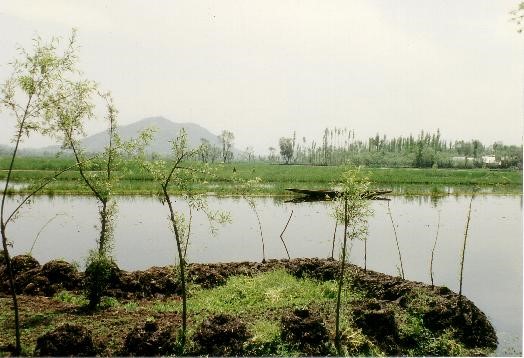
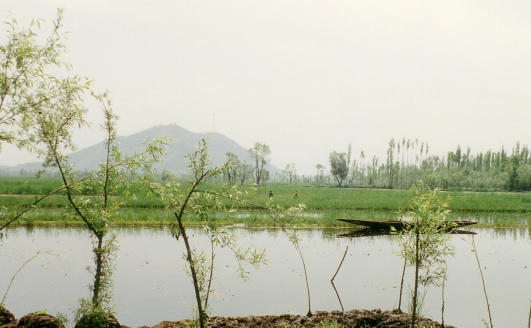
But I had a week in Srinagar and although I did not venture far afield from there, I loved what I saw of the valley with its gardens, Lake Dal with its confusion of meandering paths through fields and grass, naturally, the houseboats on the lake and also the shakiras, the sampan-like boats used by the fishermen and the traders on the lake.
shakirab

Shakira on Lake Dal

I found a houseboat when I arrived, managing to resist ending up in a hotel in town that was being pressed on me by a fellow on the bus. I seem to remember I found my houseboat by going to the lake, hiring a shakira and asking the boatman to take me to the first of a long line of moored houseboats, where I asked if there was a room. I think at the second or third I struck lucky.

I keep trying to remember the name of my houseboat.

Occasionally, during their waking day, a dreamer will catch a glimpse, a snapshot – no, not even that; perhaps no more than a hint, a flavour of a previous night’s dream. Something akin to catching a scent on the breeze that is gone before it is even realised that it was there. That is the best way I can describe the teasing hint I may get of the name of that boat. I think ‘Ah, yes, it began with ‘S’…no, wait, it didn’t, but there was definitely an ‘S’ in it somewhere. Perhaps…’ then it has gone.

But it was my own floating palace for a week. A marvel of beautifully carved wood, a magnificent bedroom and living room all to myself, and a fellow who lived on board (not the owner, I gathered) who cooked my meals. When I wasn’t ashore exploring, I sat on the deck and read.

I remember the Shalimar Gardens, and that there were at least one or two more; masses of flowers, large lawns, trees…I wandered around there with the high mountains towering above us.

And, there was the beginning of the agitation. At that point, I knew next to nothing of India’s history or politics, and although I could detect the tensions, I was unaware of what they comprised. Once or twice, there were isolated gunshots in the distance, especially at night. ‘Bandits’, said my fellow on board, rather too casually. I came across a mass demonstration outside a mosque in town, with either the police or the army, I’ve no idea which, a very heavy presence. There was a lot of shouting, and the atmosphere was hostile enough for me to make myself scarce fairly quickly.

But I personally encountered nothing but politeness and good humour, and other than the underlying tensions, despite getting ripped off now and again in shops (it was Kashmir, and I was a tourist!), I felt comfortable and happy there. When I left the valley to return to Delhi and thence further afield, it was with the thought I would return again one day.

Regrettably, though, each time I have returned, it has not been considered a safe destination.

Perhaps, though…perhaps…one day…

Himalayan Foothills

I am going offline for a few days, since I need a bit of a break, so I will leave you with a selection of photographs from the Himalayan Foothills, Northern India. When I log on again in a few days, I’ll catch up with everyone’s blogs and comments.

By ‘Foothills’ I mean the ranges of hills and smaller mountains that guard the approach to the Himalaya proper, where the big beasties rise up to heights of over 8000m with permanent ice and snow cover. The old Raj hill stations such as Nainital and Darjeeling were built at heights of around 2000m – high by UK standards, but certainly not by Himalayan ones.

one

Naini Tal, Nainital Town, Northern India. Morning Light. Nainital lake, (‘naina’ is Sanskrit for eye and ‘tal’ means lake) in Hindu mythology, is one of the emerald green eyes of Sati, Shiva’s wife. This was my first view of it after getting off of the overnight bus from Delhi.

two

Gadhar Kunkyop Ling Gompa, Nainital. Unlike many other Himalayan towns, Nainital has no sizeable Tibetan population, and this Monastery, perched high to the North East, overlooking the lake, is the only one in Nainital and home to just seven monks.

three

Morning mist, Nainital.

four

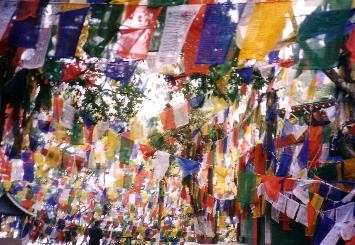
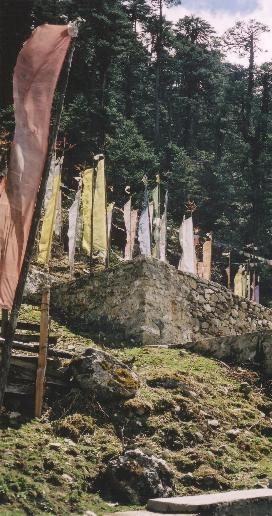
A sea of prayer flags on Observatory Hill, Darjeeling. Darjeeling, unlike Nainital, has a large Tibetan population and many Gompas both in the town and the surrounding hills. Observatory Hill is the site of the original temple of Dorje Ling, long destroyed, but after which the town was named, once the British had persuaded the then ruler of the area, the Chogyal of Sikkim, to lease them the land to build a hill station. The hill is now home to a Hindu shrine, with the British built church of Saint Andrew close-by.

But no Gompa.

five

The ‘Toy Train’ stopped outside Samten Choling Gompa at Ghoom, near Darjeeling. This train runs for 51 miles from Siliguri to Darjeeling, rising a total of just over 7000 ft. It has numerous steep gradients and sharp curves, including the famous one at ‘Agony Point’ – originally the loop there was a diameter of only 59.5 ft and the train literally overhung the mountainside as it rounded the curve. All in all, quite a remarkable engineering feat and deservedly a World Heritage site.

six

Druk Sangak Gompa, a large Buddhist monastery on the edge of Darjeeling, West Bengal. A fairly new gompa, it was inaugurated by the Dalai Lama in 1992.

seven

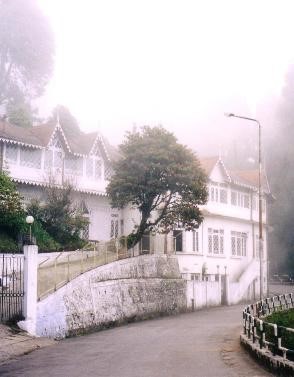
Not Chelmsford, UK, but Darjeeling, West Bengal). Many of the old British hill stations, such as Darjeeling, still retain much of their colonial character.

eight

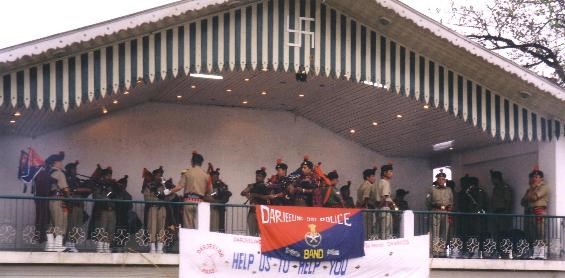
A clash of cultures! And what a clash. East meets west, with brass band in the park meeting the Indian Himalaya, courtesy of the Darjeeling Police Band. The band played in a bandstand on the Chowrasta, the open square at the top of Darjeeling, close to Observatory Hill. In the days of the Raj, this would, no doubt, have been familiar to all who lived there. Close your eyes and think of England…

nine

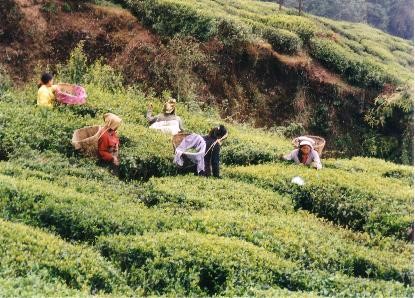
Tea pickers, Darjeeling. Think of Darjeeling, think of tea. In the hills surrounding Darjeeling are numerous tea estates, where the job of tea picking, sorting, drying and packing goes on much as it has done for the last 150 years.

ten

Buddhist painting on rock wall, by open air shrine, Darjeeling. As well as the larger gompas, you come across small shrines and gompas unexpectedly around odd corners everywhere.

eleven

Prayer Lags in Yumthang Valley, Northern Sikkim. This is as far north in Sikkim that you are allowed to travel, just a few miles south and west of Tibet. Everybody is still very touchy about borders.

twelve

Crossing a bridge in the Yumthang valley. It should be safe, considering the number of prayer flags!

thirteen

Unnamed 6000m peaks overlooking the Yumthang Valley. We asked our guide the names of these peaks, only to be disparagingly told ‘They don’t have names. They’re less than 6000m tall.

fourteen

And more prayer flags…

fifteen

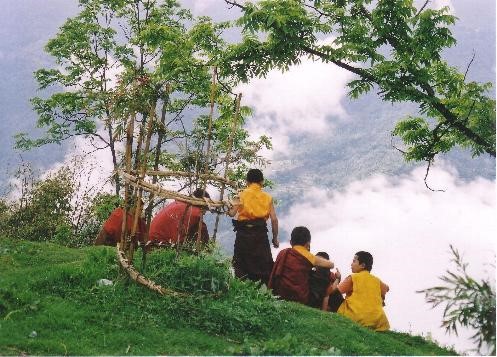
Young monks on a hillside, Phodong Gompa, Sikkim.

sixteen

Monastery wall painting, Lachung Gompa, Northern Sikkim. Lachung Gompa is about 2km above Lachung village, at a height of about 3000m. It is not a ‘working’ gompa, the monks living down in the village rather than at the gompa, so it is generally kept locked and only used on festivals and full moon days.

seventeen

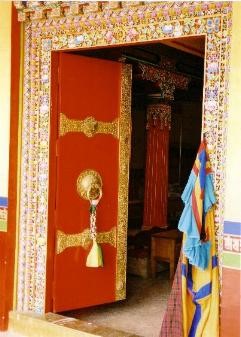
Monastery door, Tharpa Choling Gompa, Kalimpong, W.B. Kalimpong, not far from Darjeeling, but 1000 metres lower, has also a large Tibetan population.

eighteen

Statue of Chenrezig (Avalokiteshvara), Durpin Gompa, Kalimpong, West Bengal. Chenrezig (Tibetan) or Avalokiteshvara is the Bodhisattva (a being who has partly or completely attained the state of enlightenment) of compassion. The well-known mantra ‘Om Mani Padme Hum’ is dedicated to him.

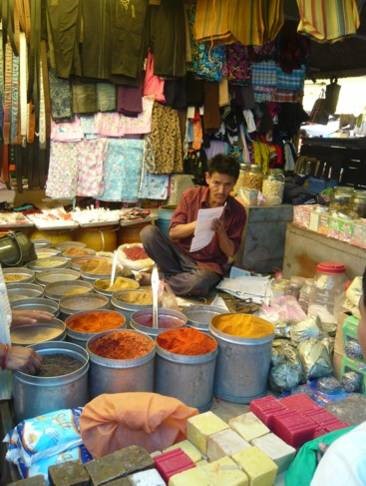
Kalimpong market:

nineteen

I watched this gentleman for some time before I approached and asked for a photo. he was rapidly serving a succession of customers at great speed, making up little paper screws of spices and powders at a tremendous rate…

twenty

…whereas this gentleman served his customers at a more leisurely pace, as if he had all the time in the world.

twenty one

This gentleman was delighted to be photographed with his fine collection of Kukris. As I prepared to take the photo, he picked up a kukri and brandished it with a none too convincing snarl, to the obvious amusement of most of the people around him.

twenty two

This stall-holder seemed to find it hilarious that I should want to photograph her.

twenty three

This lady, on the other hand, was delighted to be photographed; volunteering eagerly when a lady on a nearby stall refused.

twenty four

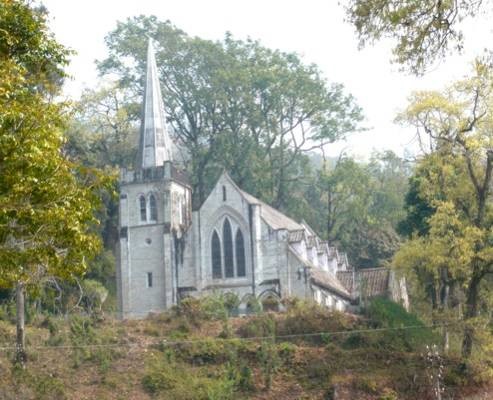
The Katherine Graham Memorial Chapel, in the grounds of the Dr Graham School and home, Kalimpong. Built in 1925, it looks to have materialised straight out of the Scottish Highlands. Dr Graham was a Scottish missionary, and built the home and school originally to educate the children of local tea estate workers. It now has a far broader intake.

twenty five

Lake Dal, Srinagar, Kashmir. Unfortunately, it is still probably unwise to visit most of Kashmir, and things will probably remain this way for some considerable time to come. A pity, because this really is a most beautiful part of India and Pakistan. I took these photos in 1989, a very short while before the area became off-limits to tourists.

twenty six

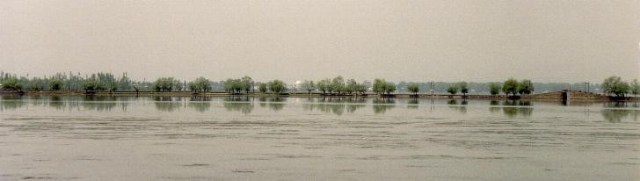
Panorama – Lake Dal, Srinagar, Kashmir). In the distance is the Hazratbal Mosque, a comparatively modern mosque, enshrining a hair of the prophet.

twenty seven

Hindu shrine. Near the shore of Lake Dal in Kashmir.

twenty eight

Houseboats around the shore of Lake Dal, Shrinagar, Kashmir. In the nineteenth century, the British, who first developed Srinagar as a hill station to get away from the stifling heat of the Indian Plains in the summer, found that the then Maharajah refused to sell them land to build houses. The solution? They built boats to live on…great, elaborate, ornate carved and decorated houseboats. These same boats, with many more recent editions, now function as floating hotels to tourists. The majority are moored not on the actual shore, but a little way off, often on the edge of small islands. This gives the local shakira (a type of small boat unique to Lake Dal) owners a chance to clean up, as a taxi service.

twenty nine

Shakira moored on Lake Dal.