
A Bit Of Family History

As I have mentioned previously, I am sporadically tracing my family tree, something I’ve only really become interested in recently. Perhaps it is mainly an older person’s interest, although I don’t think I’ll explore that now. But I’m keen to pass on the information to my children and grandchildren especially, so they can do further research if they feel like it.

As well as the family connection, though, much of my interest is both the exercise of solving a puzzle – it has much in common with a detective story – and to attempt to ‘see’ something of the person behind a list of dates and names. It is comparatively straightforward to accumulate lists of these folk with no more information than a sort of ‘Fred Bloggs born 1750, married Mary Smith 1770 died 1820’ which is really of little interest to me.

But if you know where to look (and how to search) there is often more information available about our ancestors, although you also need a very large slice of luck to dig up interesting details of the lives of the average person. In my research, then, I have found a few folk, of whom I knew absolutely nothing to start with, not even their names, and have been able to build up a bit of a picture of their lives.

That’s what it’s all about, I reckon.

Here, then, is an example:

My Great Great Grandad was Frederick John Platt. He was born in 1826 or 1827; I cannot find his birth record, but all other documents are consistent in his age.

A couple of census entries:

1851 the family are at 2 Wilmot Street, Bethnal Green. They were: William Platt, 49, Handloom weaver, Ann, 59, Frederick J, 24, Sarah Susanah, 22, also William James Platt, 26, his wife Sarah, 28, and William James 4. All bar William James Junior are Handloom weavers.

1861 at 1 Green Street, Bethnal Green. They are: Frederick J Platt, 34, Broad silk weaver, Louisa S, 30, Broad silk weaver, Louisa M, 6, Frederick W, 5, Henry G, 1, George W, 1 month. All were born in Bethnal Green.

So far so good, but then there is a Crisis.

In 1861 Louisa Sarah Platt of 1 Green Street, age 30, died. It must have been very soon after the census was taken (on 7th April) as she was buried on 21st April. I obtained a copy of her entry in the Death Register, and it tells us she died on 14th April 1861 – ‘Found dead at 1 Green Street, Twig Folly Bridge, Bethnal Green’. She was aged thirty and the cause of death was given as ‘exhaustion after her confinement’. You can see on the 1861 census the youngest, George W, is recorded as one month old.
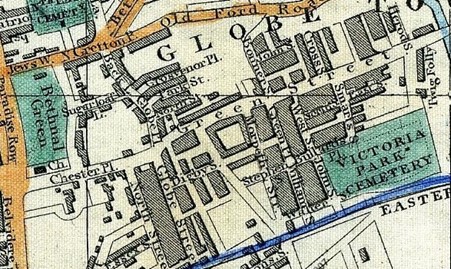
Green Street, Bethnal Green, from Cross’ Map of London 1851. Twig Folly on the right of the map gave its name to the bridge where Green Street crossed Regents Canal.

Then on May 8th 1861 we find the following Poor Law Removal judgement:

Frederick Platt, 34, of 1 Green Street, 5 years last 25 Jan, 3 Parliament Street, Cambridge Road, Mile End, B G (Bethnal Green). Weaver.

Was born at no. 10 Geo. Gardens B G never (ye?) has lived in B G all his life father before him. Had married at St. James the Less 1853, 12 June Co produced to Louisa Sarah, who died 3 weeks ago, Louisa 7, Frederick 5, Henry 17 mos, George 5 weeks, – B G

And then in another hand:

Father pd taxes Harts Lane B G Road about 17 yrs ago and Cranbrook St. about 2 yrs. He lives at 2 Cranbrook St.

I am unclear what the ‘removal’ part of the judgement refers to and can only assume it either means the children were taken from him, or they were all evicted from the property. The final paragraph about his father having paid taxes, I am guessing meant the authorities were then willing to provide some sort of support for the children. He had married Louisa Sarah Whalley sometime between April and June 1853, in Bethnal Green – June 12th according to the Poor Law Judgement – and after she died eight years later, his world seems to have fallen apart. And it seems to have happened so quickly! Less than three weeks after Louisa is buried, this judgement is passed upon the family.

But I suspect the family may already have been in some trouble.

Bethnal Green saw a huge influx of Huguenot immigrants during the late seventeenth and early eighteen centuries, almost exclusively silk weavers. Although I cannot find any evidence to back it up, I was told in my childhood that Mum’s ancestors were Huguenots, and that would suggest the Platts were the ones referred to. Whether Platt is an Anglicized version of a French name, or a Platt had married into a Huguenot family, though, I have not been able to determine. Over the years from the Huguenots’ arrival in Britain, though, various laws were put into effect to protect the British silk industry from foreign competition. However an 1860 treaty with France allowed silks to be imported duty free and very soon the industry was in freefall. Unable to compete in price with the imported cloths, huge numbers of weavers were thrown into poverty.

The next definite sighting of Frederick John Platt is in 1877 when his son, Frederick William, is married. On the form, Frederick John’s occupation is given as undertaker, and Frederick W is a commercial clerk. Clearly, they were no longer part of the weaving community. It is worth noting here that Frederick J’s older brother, William James Platt, has his occupation recorded as undertaker in the 1871 census, having also been a silk weaver prior to this date. It seems probable that Frederick either worked for him, or they were in partnership for a while. William then continues working as an undertaker for the rest of his life

After this, Frederick J seems to again drop off the radar for a while. I have a couple of other possible sightings but cannot find any census record for 1881 that I can be sure are his.

But then on September 15th 1884 Frederick John Platt, widower, 57, marries Sarah Mansfield, widow, 45, at St James the Less, Bethnal Green. By now he is described as a provision merchant of 40 Cranbrook Square.

One way or another, it seems he had managed to rebuild his life.

The 1891 census records a Frederick Platt, 65, ice cream vendor, and Sarah, 52, at 33 Quaker Street, Spitalfields.

And then? A Frederick Platt aged 74 died in Whitechapel, July – September 1899. That seems to be him. If it was, then he seems to have fallen upon hard times again. In January and February 1892 and then frequently from February 1895 through to February 1899 a Frederick Platt, widower, is recorded as being in and out of the workhouse at Stepney. His profession is given variously as wood chopper, labourer, or blacksmith’s assistant, and cause of admission each time as bronchitis or rheumatism.

We don’t realise how lucky we are.

International Women’s Day

Today, on International Women’s Day, it seems appropriate to re-post this piece I put up several years ago. It seems that nothing has changed.

salt-workers

It would be impossible to document all of the humiliations, injustices and degradations that women throughout the centuries have had to put up with in almost every part of the world. That they should continue to do so, even in the 21st century, is an absolute disgrace. The way the Taliban treat and regard women is well documented and needs little further comment. They routinely deny women education, healthcare or any freedoms. They can be bought and sold and married against their will. They have no legal rights. They can be killed with impunity. It is difficult to imagine how a society in which women are actually treated worse could ever be constructed.

However, the so-called Islamic State go one step further than this, and are happy to buy and sell captured women in slave markets as sex slaves, surely the ultimate degradation.

Yet, over a huge part of the globe, women are subject to treatment little better than this, and there is probably no country where they can be said to be genuinely equal to men. Certainly in the west, we like to think of ourselves as modern, liberal, forward looking and fair, so how can it be that such a situation still exists?

There are three basic reasons why men have always been able to regard and treat women as inferiors:

1) They have controlled and governed communities and societies through their greater physical strength. This, in turn, has led to their creation and codifying of the rules surrounding and governing these societies, and, in turn, the creation of their religious books that gave an even greater authority for the subjugation of women. This strength also effectively prevents any ‘rebellion’ by women.

2) Men’s stronger sexual urges. This (the ‘testosterone effect’ in male teenagers, for example), coupled with their greater strength, has allowed men to both physically dominate women and also to subject them to almost constant pregnancy and motherhood.

3) Women bear children. Neither pregnancy nor motherhood are helpful in resisting men’s dominance.

In the west, centuries of brainwashing have led to a situation where, although women no longer daily face a physically perilous existence, inequality lives on in other, often demeaning, ways. Although no longer in danger of being burnt as witches, being sold into servitude or (generally) forced into marriage, they are still way behind men when it comes to the labour market. It is comparatively recently that they have been allowed to train as front line troops in the army or join the clergy in the Church of England, and still encounter stiff resistance if they wish to do so. The Catholic Church still forbids them to hold any post and so we see an exodus of many ‘traditional’ members of the Church of England to the Catholic fold, which has enterprisingly created a ‘special’ niche for those who cannot bear to see women treated as equals.

There are still comparatively few women in high-powered jobs, and those who are still struggle to earn pay similar to a man in a comparable job. Interestingly, the reason often given for that is that ‘market forces’ dictate these pay scales. This is, naturally, a male-dominated market. Women are vastly over-represented, however, in low-paid and part time jobs.

Centuries of brainwashing have also trained them for a role as mannequins, or Barbie dolls; putting on make-up is essential before they go to work, attend meetings, go on a date or almost anything else. Their natural selves are not fit to show men. And if there is anyone who might be in any doubt about this, they need only take a glance at the blizzard of adverts on television or in magazines. And high heels are the obvious descendants of oriental foot-binding; a painful, dangerous and degrading practice designed solely to appeal to men and make running away impossible. I do not understand why any woman still falls for it. And those magazines; the ones aimed at women still manage to create the impression that life is all about make-up and home-making.

In many other parts of the world, though, life as a woman is not only demeaning but can still be ‘nasty, brutish and short’. One of the most common ways to control women, is to deny them the right to work. This might be justified as being degrading for the woman and her husband, or that she must be kept away from other men (because she will ‘stray’), or that she needs to be at home to raise children. This effectively means that she is then working full-time at home, but obviously without any financial reward or freedom. Along with refusing females education, this is another way to force them to remain at home in a state of virtual slavery. Commonly, they will have to work on any land that the family have – weeding and planting, looking after animals, etc – yet will be denied the chance to earn a wage.

This segregation is invariably justified on the grounds that women are sexually provocative and evil. They are temptresses that must be kept away from the eyes of all men except the husband. Hence they are dressed from head to toe in all-enveloping clothing, they are not allowed to speak to any males except close relatives, they are locked up in Zenana – women’s quarters, where they have to peer out at the world through heavily carved screens, whilst men are free to go around at will. Even in more humble dwellings, they are largely confined to the house, having to hide when male visitors come. Hence they cannot go out and work within the society. And this attitude, that women are naturally evil, tempting men against their will, is reflected in the punishments that many societies mete out to those that break their taboos.

The most extreme example is that where, in one or two societies, if a man is accused of rape, the woman is commonly held to be culpable since she must have tempted the man concerned, otherwise the incident would not have happened. The woman then is sometimes executed, although being the victim, whilst the perpetrator is either set free or given a minimal sentence. Rape, also, is frequently used in war situations to ‘control’ a population. Another medieval survival is the practice of confining women to their quarters during menstruation, on the grounds that they are ‘unclean’. Although the ‘punishment’ is not particularly onerous, the insult is that it further demeans women for simply being women. And then, while it tends to be perfectly permissible for men to walk around with bare arms and head, and frequently torso and legs, women that do not cover up from head to foot will feel the full rigour of society’s displeasure – usually physical punishments such as lashing or incarceration.

Suttee – who would still believe that the practice still exists? Yet there have been cases comparatively recently of women being forced onto the funeral pyres of their deceased husbands, possibly due more to the family not wanting an inconvenient daughter in law in the house, than to any religious urges. There are also still cases of bride murders, when the dowry has not been up to the expectations of the groom’s family. That the dowry system still exists at all is an insult; the bride’s family having to pay the groom’s family for taking an ‘unproductive’ woman into the household.

Then there is the lack of healthcare, education or voting rights, the forced marriages, the child brides purchased by the old men, the genital mutilation, the sexual trafficking…the list seems depressingly endless. 1975 was designated International Women’s Year by the United Nations – 44 years ago. Not much seems to have changed since then.