Words Words Words

Words are abstractions. The word ‘leaf’ can conjure up a million different images, but fails to describe any single one of them. One needs a hundred – a thousand – or more words to just come close to a perfect description, but even then it falls short.

In the well-known phrase, a picture paints a thousand words, but you would need many more than that to accurately describe said picture. We still think largely in pictures – naturally, we would have evolved that way. In the days before we had language our thoughts would inevitably have been composed of images. We may put words to these images as we think them, but they are still there. When we think through a plan of action, or instructions, for example, we tend to accompany those words with visual imagery. Even if we are engaged in mathematical reasoning or language learning, I think we tend to visualise those figures or words as we work. And when we dream, our dreams are overwhelmingly visual.
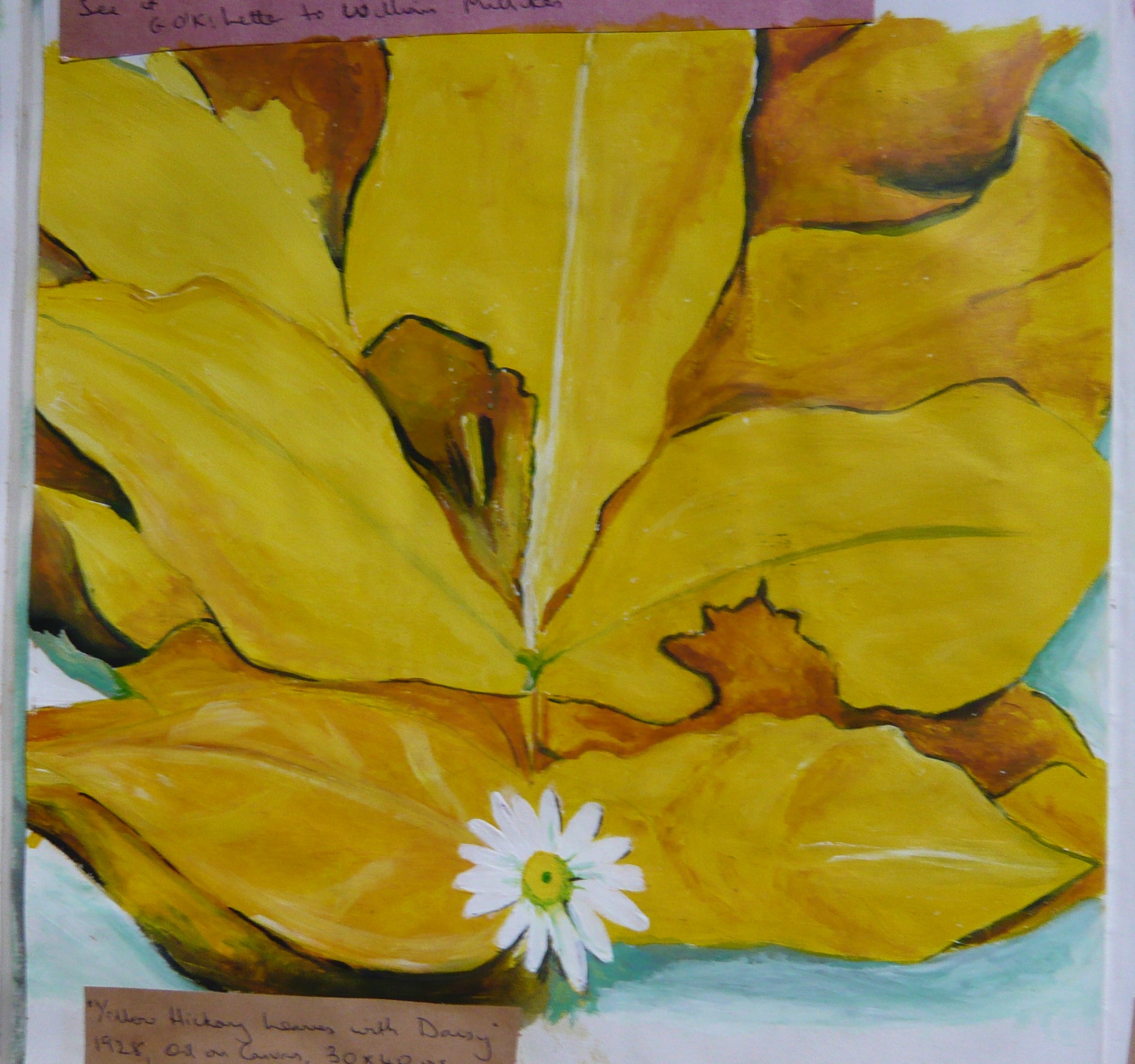
My copy of the Georgia O’Keeffe Painting Yellow Hickory Leaves with Daisy

But sometimes, even as a writer and compulsive note taker, I can get so absorbed into a landscape that I have no wish to try to describe it, no matter how many words I might use. I just want to observe it, to be in it. Words feel redundant. And I’ve said this before, but this sort of compulsion to record things, or photograph them, feels like a way to try to own them.

And words are noise. More than noise. They get in the way and distract from what they are representing. They are like the finger pointing at the moon in the Buddhist parable, where ironically attention is drawn to the finger, rather than the moon which the finger is attempting to draw our attention to. The famous painting by Rene Magritte The Treachery of images pictures a pipe with the writing: ‘Ceci n’est pas une pipe’ beneath. But it is this very caption which names it.

Conversely, though, a single word can suggest an entire world. Sometimes their power isn’t so much in their ability to define something, but their ability to conjure images and memories seemingly from nothing. Like an incantation. And each word contains maybe hundreds of meanings and nuances, different meanings to different people. I am reminded of two of Borges’ short stories: The Mirror and the Mask, and Undr. In the first story, a court poet reduces the literature of Ireland to a single line, and in the second a fictional Nordic people have a poetry that consists entirely of one seemingly mystical word, Undr (although, naturally, it’s not quite as simple as that…). And this makes me think of the importance of the spaces between the notes in music, and the rests – we need the spaces between the words to think. To listen properly.

Over the years I have been drawn to painting or photography, or to writing, depending on what I want to say. To draw attention to the way the dawn light strikes the tops of the trees, for example, undoubtedly the visual arts are best. But to describe the anguish experienced before taking an important decision then clearly words are required. But note that in each case, it would be possible to get results with the other forms. And poetry frequently straddles them all.

And then there is the myth that God has a name not known to anyone – His real name, from which all His power is derived, and which must remain secret. For once a name is known, it loses its power.

Words are illuminating, words are abstractions, words are dangerous, words are treacherous.

Words are overused, like this…
Sound The Retreat!

My reader will probably not be too surprised to learn that I have been on retreats a couple of times.

After all, someone who gripes about the rush and noise and pressures of the modern world, and who has anxiety issues, tends to spend quite a lot of time yearning for silence and solitude. Because there are, quite frankly, times when everything just gets too much to cope with.

Obviously there are many ways this might be achieved; perhaps I could commit a serious crime and then misbehave in gaol – that would probably lead to a good long spell in solitary, although I can think of several reasons why this might not be the ideal solution.

I could lock myself in a room and refuse to come out – from experience, though, that just leads to unpleasantness and tears. It worked tolerably well when I was a child, but as an adult I can see why it might not look so good.

Whenever I get the opportunity I go for a long walk. Unfortunately, if it is near my home I tend to be surrounded by dogs and dog walkers – not that’s there’s anything wrong with them, I hasten to add, but it’s hardly peaceful. There are several dog owners around here whose voices can not only be heard several counties away because of the sheer volume, but can also smash windows by pitch alone. And I soon get back to roads and so-called civilisation, no matter which route I take.

Then there are lots of other walkers bellowing into mobile phones: ‘Yes, it’s lovely and peaceful out here! Now, let me just yell a few personal and private details at you and anyone else within earshot! What? Yes, I’m still a complete tosser! Why do you ask?’

Going further afield takes more time, and that’s no good if I need a quick fix of silence, so generally I’m stuck with the dog walkers and the tossers.

So, retreats. Other than the meaning of legging it from a superior military force, a retreat is defined as withdrawing to a quiet / peaceful place. There is also the implication of it being a place to indulge in contemplation.

Yes, that’s exactly what I had in mind. Don’t mind if I do.

My first retreat was at an abbey not terribly far from where I live. Although I am not a Christian, I enjoyed a short week of taking quiet walks in the grounds of the abbey and the countryside beyond, reading, rising early and taking a silent breakfast with the monks, and even attending one of the services each day.

foxglove

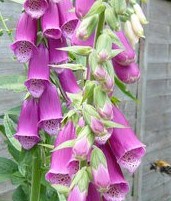
Some of the time I spent painting watercolours which I have long lost. Since at least one was of foxgloves, here’s a photo of some just so you can imagine how incredibly good the paintings were!

The other retreat was in the North of England, and consisted of a week-long period of meditation with a Buddhist group. This was very hard work, but I did finish the week feeling refreshed.

Of course, it is perfectly possible to organise one’s own retreat by finding somewhere quiet and secluded and staying put for a week or however long one fancies (a year, perhaps?).

Perhaps I should do that soon.

The Enduring Lie of a Golden Age – Part 2…This is Personal

Two weeks ago I wrote of the idea so many people have that somewhere in the past there was a ‘Golden Age’ when everything was so much better than today.

I am now going to post what might seem a bit of a contradiction to what I wrote then.

121a

More and more, we are losing our connection with the natural world.

Everyone would have a different opinion on what is meant by the phrase ‘quality of life’, but for me if I am surrounded by concrete structures, with a lack of trees and flowers and birds, animals and insects, if the building I am in consists of electronic devices, plastic, steel, and artificial floor coverings, if my engagement with the day to day tasks of this building consists of pressing buttons, then I feel my own quality of life is much diminished.

A common post appearing on Facebook is of a picture of a cabin or cottage in the wilderness somewhere, with the caption ‘Could you live here for a month without TV or phone signal or internet for $25,000?’

Could I do it? I’d bite your hand off for the chance to do it. And I wouldn’t even need the money as an incentive.

No press-the-button entertainment. Setting and lighting a log fire instead of switching on the heating. No dishwasher. No constant barrage of emails, texts and phone calls. No street lights – or streets.

I’d bite yer hand off.

Whether I am at home, working, or walking in the country, always there seems to be the sound of aircraft passing overhead. Day and night. Constantly.

And unless you’re in the middle of a national park, there always seems to be traffic noise. Even when I’m walking in the midst of woodland, or through fields, it’s always present as a background noise.

And anywhere near a road or street, it is just constant. And I find that extremely stressful.

This is one reason why I love being amongst mountains. Usually, they are remote enough that the traffic noise is finally silenced. Frequently, they are away from air routes. And, of course, there are far fewer people around. And those that are there don’t usually seem to be glued to mobile phones or playing music.

And I’m nostalgic. Well, I’m in my sixties now, I’m allowed to be. And that brings us back to the post about a supposed golden age. Nostalgia is a yearning for the past, with the inference that it was better than the present day. There are, of course, many things about today that are much less than perfect – I’ve called out a few of the things I don’t like earlier in this post – but only a fool would deny that huge medical advances have improved all our lives for the better, social security has largely alleviated the horrors of abject poverty and, at least in the affluent west, our lives are not subject to the whims of despots.

But although I can expect to live to a greater age than my forebears – at least in theory – I would be willing to trade some of that for a time when life was less complicated, a life where I didn’t feel constantly bombarded by social media and advertising. A life that was lived more slowly.

Not a Golden Age, certainly, but one I would happily live in.

Southern India (1)

Southern India differs from the north in several respects. The first difference that the visitor tends to notice, once they have got away from the typical Indian maelstrom of airport, traffic, city centre, etc, is that with the less densely concentrated population comes a somewhat more laid-back atmosphere and attitude than in the north. The hassles and pressures, the touts, are still there, but seem somehow less intense.

The second real difference is in the culture. Southern India was never really assimilated into the Mogul empire, and only ever partly conquered, so there is a huge wealth of Hindu architecture and a proportional lack of Islamic, with next to no Buddhist remains and no continuing tradition of Buddhism at all. At times, it seems as though the visitor has entered a different country, but India has a way of reasserting itself on the senses…

trichy stall

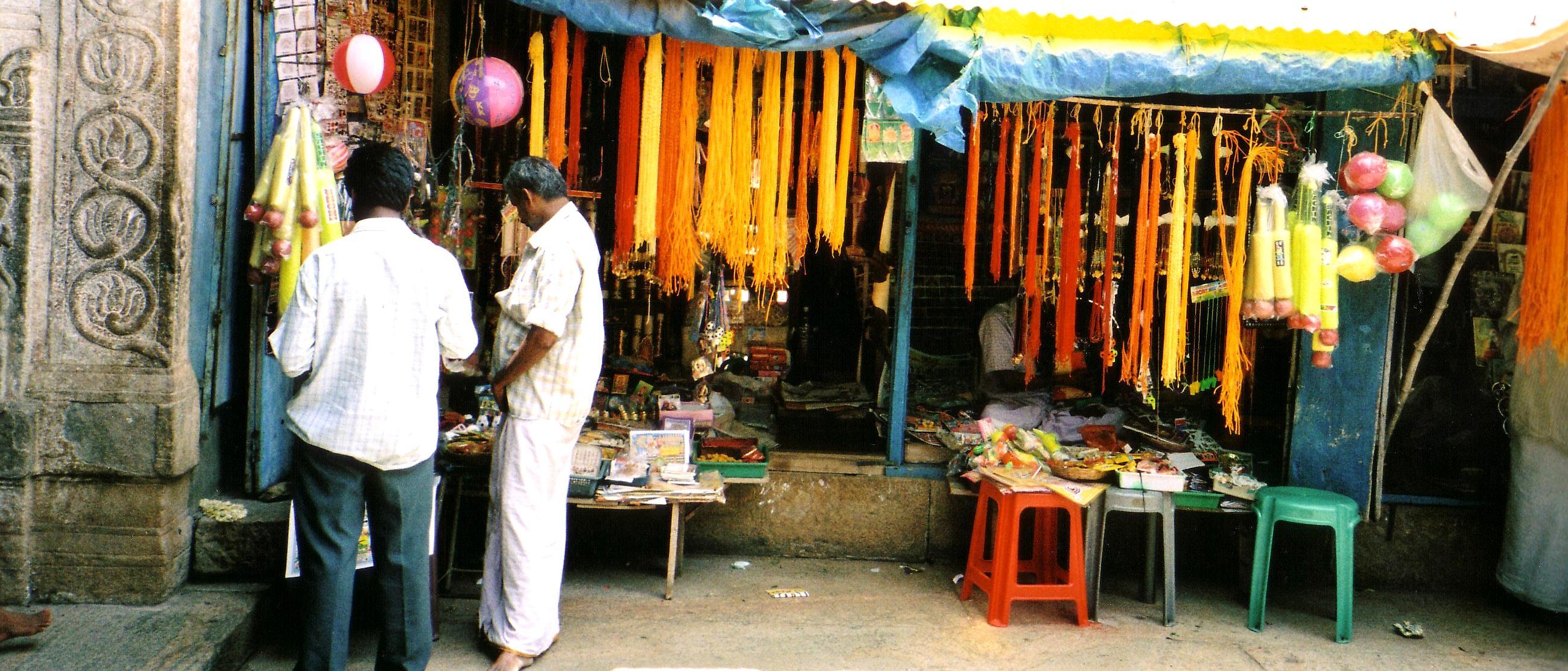
Stall outside Sri Ranganathaswamy Temple, Tiruchirappalli (Trichy), Tamil Nadu State. All over India, amongst the heat, dust and drabness that pervades the majority of the population’s day to day life, one finds colour.

trichy garland seller

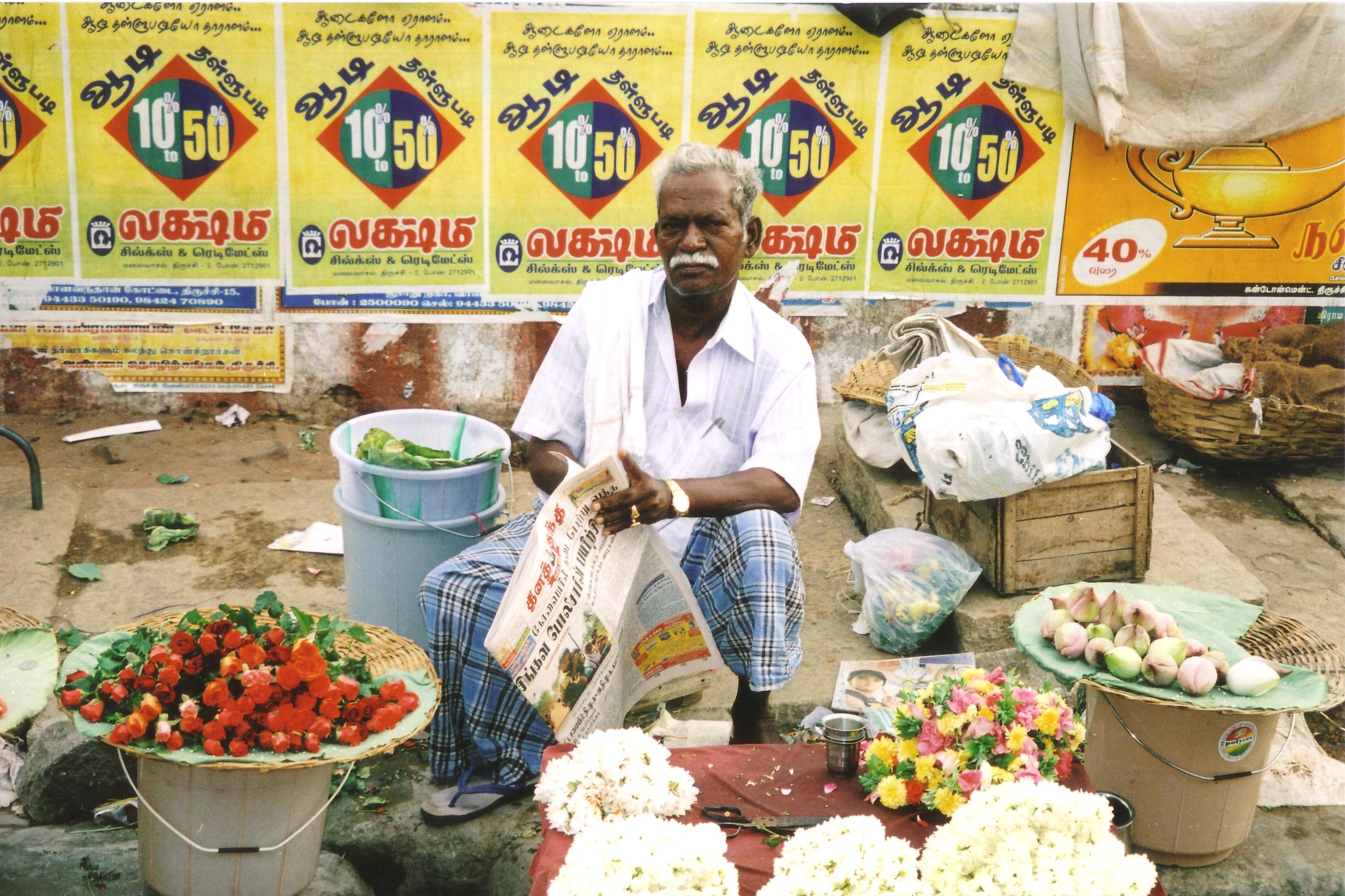
Garland seller outside Rock Fort Temple complex, Trichy. The garlands will be used to decorate statues of gods during pujas (ceremonies) conducted in the Temples.

rock fort temple

Rock Fort temple, Trichy.  A view of the main temple from the pathway that leads to the tiny temple at the top of the rock. Non Hindus are not allowed into the main temple, dedicated to Shiva, or the temple at the top dedicated to Ganesh…although for a small donation, the priest is willing to waive this rule…

From my journal:

‘The trip is not particularly uncomfortable. It is a typical five hour trip through India – dust, buffaloes, half a dozen schoolchildren stuffed into an autorickshaw, wait-till-the-other-guy-blinks over-taking, temples large, medium and small, huge dry river beds, The Cauvery full of water, trees, strange crops, broken down trucks, train lines stretching arrow-straight into the distance, rows and rows of stalls with neat piles of fruit and vegetables, rows of hanging water bottles from the roof, biscuits, samozas, cigarettes and crisps, a child squatting in the dirt, mum feeding the family beneath the tree, Tiffin Ready signs, smart petrol stations, mud huts, cement buildings, palm shacks, huge residences surrounded by high walls – all concrete, police traffic blocks (ignored), it all blurs into one.’

trichy temple 2

Part of Sri Ranganathaswamy Temple complex. This is the largest of all temple complexes in India, covering a staggering 60 hectares, and is dedicated to Vishnu. The Gopuram (tower) on the left is painted white, as a symbol of purity, and is one of the buildings that non-hindus are not permitted to enter.

white goporam trichy

The White gopuram, in all its glory.

trichy puja 2

Pillar in Sri Ranganathaswamy Temple, liberally decorated with coloured powders and with offerings of incense, rice and flowers. Devotees of the god concerned will conduct their own personal pujas to ensure health and prosperity, or perhaps for some more specific purpose, such as to request the birth of a son or success in a particular undertaking. Although this temple is dedicated to Vishnu, other gods are represented there and prayed to.

trichy puja 1

Another, nearby, pillar in the same temple. Although in the same temple and close to the pillar in the previous picture, this shrine will be to another, different, god. Its use, however, will be the same.