A Warning To Other Writers

Oh, this sodding book.
I…no, first, a little bit of context.

Those of us who call ourselves creatives, why do we create? Why do we have this need to make things? I know the usual answer is we write / paint / carve / whatever it is we do, because we have to, because there is something inside of us that needs to find an outlet. But what is that something? In my case, as well as a storyline it is frequently a place where I have spent some enjoyable time. It provides me with a comfortable setting in which to tell a story.
Most of what I do, certainly the work I feel is my best, my most successful (in the sense of expressing what I want to express), falls into that category. My long poem The Night Bus, for example, was the result of a thirty year (admittedly intermittent) search for a way to record my experience of a long bus ride across Northern India into Nepal. I attempted prose and paintings without success, although through this I did develop a style of painting I went on to successfully use on many Indian paintings, and had long given up on the project when chance showed me a way into the poem. The poem I completed succeeds in conjuring up (for me) the impressions and feelings I had on that journey; I can relive the journey again by re-reading the poem. Whether it conveys anything of that to other readers, I naturally cannot know.

And my stories, too. I look through Making Friends With The Crocodile, and I am in rural Northern India again. I re-read The Last Viking and can easily feel myself on an island off the west coast of Scotland. This is not to imply any intrinsic merit to my writing, other than its ability to transport myself, at least, into the setting I am attempting to describe.

These stories are a composite of three basics: a setting, as mentioned already, a storyline – and again this needs to be something important to me, or I find it pretty well impossible to put my heart into it, and strong, convincing, characters.

It is useful, then, to know where lots of my writing comes from, and what shapes it, what drives it. I have long suspected that this is frequently nostalgia and, recognising that, have wondered whether this might be a bad thing. Nostalgia, after all, has a rather bad press…does it just mean I am living in the past because I am viewing it through rose-tinted spectacles? As a way of not addressing issues of today I should be tackling?

This yearning for nostalgia, though, is a desire for something we see as better than what we have now. To write passionately about something it needs to be something I feel strongly about. Obviously this can also be something we find frightening or abhorrent – dystopian warnings about the future or anger about injustices, for example – but even in those cases the familiar provides a cornerstone of safety, even if only by way of comparison.

This is also true when I paint. I am not someone who can paint to order – if I’m not inspired, it does not work. A number of difficult commissions have proved that point to me. I paint what I like, what moves me. After all, whatever I am creating, it should be foremost for myself.

That book, then…

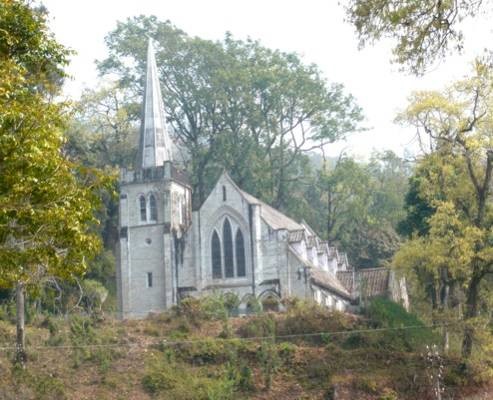
I began writing it about five years ago for all the wrong reasons. I had self-published Making Friends With The Crocodile and decided my next story should also be set in India, and as a contrast decided to write about British ex-pats living in a hill station in the foothills of the Himalaya. I wanted to write about India again. The trouble was, I had no idea what story I was going to tell. I had no stories that might slot into that setting I felt in any way driven to write; it just seemed to feel appropriate at the time. I was pleased by the reception the first book had and felt I ‘should’ write this one.

What could possibly go wrong?

I spent time putting together a plot, with which I was never wholly satisfied, and began writing. Really, I should have seen the obvious at that point and bailed out. But I carried on, and twice reached a point where I thought I had the final draft.

My beta reader then proceeded to point out all the very glaring faults.

So twice I ripped out a third of it and chucked it away, then re-plotted the second half of the book and got stuck into the re-write. I’m sure you can see part of the problem at this point – I wanted to hang onto as much of the story as I could, instead of just starting completely afresh. And now here I am trying to finish the final draft for the third time, as my February project for this year. And it’s just not working for me. But at this point, after well over a hundred and fifty thousand words (half of which I’ve discarded) I just feel I’ve invested too much time and effort in it to abandon it now. Somehow, it has to get finished. I do have an idea for a couple of quite drastic changes which I’ll try this week, but unless I feel I’m making some real progress I’ll then happily put it aside for a while and concentrate on next month’s project: painting and drawing.

And, to be honest, if it eventually ended up as a story of less than ten thousand words, and if I felt satisfied with it, then I’d take that as a result, now.

And the moral of all this? I’m sure there was a point after a couple of months when I knew I shouldn’t have been writing this book. I should have binned it there and then and saved myself a lot of fruitless trouble, but stubbornly ignored the warning signs.
Five o’clock

I’ve been away from the computer for most of the last week, but now I’m back with a slightly longer poem than I usually write.

072a

At five o’clock the fire is lit.

Around the table we all sit,

With buttered bread and eggs and ham,

With cups of tea and cake and jam.

The idle talk is of the day,

The work now done, the latest play,

And ‘Anything to watch tonight?’

Or in the warmth and soft lamplight,

Perhaps we’ll read and play a hand,

Of whist, or bridge, you understand.

And ‘Don’t forget, at half past nine,

The radio – it’s music time.’

Then bank the fire, put out the lights,

The household settles for the night.


The heat blasts out in every room,

And lights and games and TVs soon

Take over so completely that

It’s pointless even trying to chat.

The sounds of gunfire, screaming cars,

Exploding buildings, and on Mars

The aliens armed with laser beams,

Are killed on several different screens

In different rooms by different boys,

With highly deadly killing toys.

The evening mealtime’s such a treat,

With pizza, chocolate, crisps and sweets.

Although it seems they all are eating

Different things at different sittings.


‘A cup of cocoa? I don’t think

That that will do, an energy drink

Is what I need, the evening’s young,

And there’s still much that’s to be done.

And if I cannot concentrate,

Upon this game, it’ll be too late,

The zombies will have won and then

I’ll go back down to level ten.’

It’s one o’clock, they still can’t sleep.

There’s not much point in counting sheep,

‘cause they’re all battery-powered toys,

Just so much electronic noise

And moving parts all running round,

And round and round and round and round.


I’m standing now beneath night skies,

Pale silver light from fresh moonrise.

I’ve walked for almost half a day,

It takes that long to get away

now, searching for a quiet place

Where I can pause and have some space.

I’m thinking how it used to be,

At five o’clock, the time for tea.

It seems to me that what we’ve gained,

Is not worth any of the pain.

And even more what we have lost,

We should have saved at any cost.

But anyway, now it’s just me

I have my flask, I’ll pour my tea.


No Going Back

In a somewhat pensive mood, today.

Untitled-Scanned-05


We all try to do it in our own way.

Me, I walk the woods and hills, trying to recapture

That half-remembered birdsong from my childhood.

Looking for the clear nascent sunlight,

And the cool morning breath of a magical wild rose.


Others revisit old haunts,

Tread half-forgotten streets and peer in shop windows,

Leaf through foxed and fragile pages

Of Peter and Jane, hold china dolls,

And gaze wistfully at black and white seasides.


It’s more than elusive,

But what they have in common,

Is leaving today behind.

Maybe, what I’m really searching for,

Is a different me,

Although I wouldn’t want to be a teenager again.


And if you haven’t tried it,

If you haven’t caught the sound of yesterday,

Or smelt the stale cooking and damp mothballs

Of a long-dead indulgent aunt,

Then perhaps you’re still too young.

The Enduring Lie of a Golden Age – Part 2…This is Personal

Two weeks ago I wrote of the idea so many people have that somewhere in the past there was a ‘Golden Age’ when everything was so much better than today.

I am now going to post what might seem a bit of a contradiction to what I wrote then.

121a

More and more, we are losing our connection with the natural world.

Everyone would have a different opinion on what is meant by the phrase ‘quality of life’, but for me if I am surrounded by concrete structures, with a lack of trees and flowers and birds, animals and insects, if the building I am in consists of electronic devices, plastic, steel, and artificial floor coverings, if my engagement with the day to day tasks of this building consists of pressing buttons, then I feel my own quality of life is much diminished.

A common post appearing on Facebook is of a picture of a cabin or cottage in the wilderness somewhere, with the caption ‘Could you live here for a month without TV or phone signal or internet for $25,000?’

Could I do it? I’d bite your hand off for the chance to do it. And I wouldn’t even need the money as an incentive.

No press-the-button entertainment. Setting and lighting a log fire instead of switching on the heating. No dishwasher. No constant barrage of emails, texts and phone calls. No street lights – or streets.

I’d bite yer hand off.

Whether I am at home, working, or walking in the country, always there seems to be the sound of aircraft passing overhead. Day and night. Constantly.

And unless you’re in the middle of a national park, there always seems to be traffic noise. Even when I’m walking in the midst of woodland, or through fields, it’s always present as a background noise.

And anywhere near a road or street, it is just constant. And I find that extremely stressful.

This is one reason why I love being amongst mountains. Usually, they are remote enough that the traffic noise is finally silenced. Frequently, they are away from air routes. And, of course, there are far fewer people around. And those that are there don’t usually seem to be glued to mobile phones or playing music.

And I’m nostalgic. Well, I’m in my sixties now, I’m allowed to be. And that brings us back to the post about a supposed golden age. Nostalgia is a yearning for the past, with the inference that it was better than the present day. There are, of course, many things about today that are much less than perfect – I’ve called out a few of the things I don’t like earlier in this post – but only a fool would deny that huge medical advances have improved all our lives for the better, social security has largely alleviated the horrors of abject poverty and, at least in the affluent west, our lives are not subject to the whims of despots.

But although I can expect to live to a greater age than my forebears – at least in theory – I would be willing to trade some of that for a time when life was less complicated, a life where I didn’t feel constantly bombarded by social media and advertising. A life that was lived more slowly.

Not a Golden Age, certainly, but one I would happily live in.

The Enduring Lie of A Golden Age

It seems that huge numbers of people have an impression that there was a ‘Golden Age’ at some previous point of their, or some other, society.

They may not define it in those words, or even acknowledge it as such, but it seems to be very common for people to yearn for another time. Sometimes, this is nostalgia – for the days of their youth – but frequently it is for some far-off time that they feel to be somehow better than the time they live in.

Untitled-Grayscale-01

Fantasy books frequently encourage this sort of thinking. Regardless of the actual storyline, the heroes and villains and cast of other odd characters tend to run around and fight and go on quests and sit around in quaint thatched inns quaffing head-splitting alcoholic drinks and everyone is jolly and no one ever dies of dysentery or bubonic plague in misery and agony and squalor.

The Lord of the Rings is a fine example of this. It is a favourite of mine, but it is very noticeable how no one dies of disease, but mostly lives to an exceedingly old age unless chopped into pieces by Orcs.

Hollywood, too, plays its part in this. To take a film at (almost) random, an old version of ‘Robin Hood’ (set in medieval England, remember) depicts a group of merry men dressed in very strange attire living in the depths of a forest and merrily ambushing the Bad King’s men, merrily dining at long tables out beneath the spreading branches of merry oak trees under starry skies and everyone looks clean and clean shaven and everyone is merry, and it never rains.

Pah!

This is meant to be medieval England. Life expectancy at the time was around 30 years. Huge numbers of people died of dysentery, mainly because there was no concept of hygiene. Occasional plagues carried off massive numbers of people, emptying entire towns and villages. There were no antibiotics or anaesthetics. Disease was sent by God and the only way to cure it was considered to be prayer. Or witchcraft. Women routinely died in childbirth, in great pain. The majority of children never reached their teens. Every peasant in every village was effectively a slave under the command of the local lord, who held the power of life and death over them, and might exercise this on a whim at any moment. The threat of famine was ever present.

Pain and misery was a given.

The majority of people lived, too, in a very real terror of the Devil and the threat of eternal damnation.

The list of horrors is almost endless. The phrase ‘life was nasty, brutish and short’ is an apt description of those times. Certainly, I would not wish to live under those conditions.

There are plenty of other ‘Golden Ages’, of course. Almost any time in history can exercise a fascination on us, if certain aspects of it appeal to us and there are things we dislike about the society we live in. And it is natural to yearn for something better; something more than we have.

And this is not to suggest that every age was a living hell for everyone in that society, but that life in most of these times was reasonably decent for the very few on top of the pile, and pretty miserable for the rest. In fact, the measure of how ‘Golden’ an age was, tends to be the conditions of the upper echelons of that society, and perhaps those of a middle class, if such existed.

There is much wrong with our world today. But the huge advances seen over the last hundred years or so, especially in medicine, have meant that our lives have been improved out of all recognition. No longer does surgery equate to filling the patient with a quart of whisky and then sawing off a leg or an arm. No longer do those patients routinely die of infections after surgery, thanks to antibiotics. High blood pressure is controlled, rather than routinely killing. Children usually survive all the diseases of childhood, rather than being most likely to die. Women rarely die in childbirth, and the pain can be somewhat controlled.

Women and children are no longer the legal chattels of men.

Work conditions are hugely improved. Children do not go down mines or work at dangerous looms 14 hours a day. Instead, most receive a proper education. Adults, too, work fewer hours and under far better conditions than previously. When they are too old or frail to work, the state provides a certain amount of dignified support. People do not as a rule die these days of starvation. We do not execute children for stealing sixpence, or poaching rabbits on the Lord’s estate.

In most cases, for most people, today is the Golden Age.