
Words are abstractions. The word ‘leaf’ can conjure up a million different images, but fails to describe any single one of them. One needs a hundred – a thousand – or more words to just come close to a perfect description, but even then it falls short.
In the well-known phrase, a picture paints a thousand words, but you would need many more than that to accurately describe said picture. We still think largely in pictures – naturally, we would have evolved that way. In the days before we had language our thoughts would inevitably have been composed of images. We may put words to these images as we think them, but they are still there. When we think through a plan of action, or instructions, for example, we tend to accompany those words with visual imagery. Even if we are engaged in mathematical reasoning or language learning, I think we tend to visualise those figures or words as we work. And when we dream, our dreams are overwhelmingly visual.
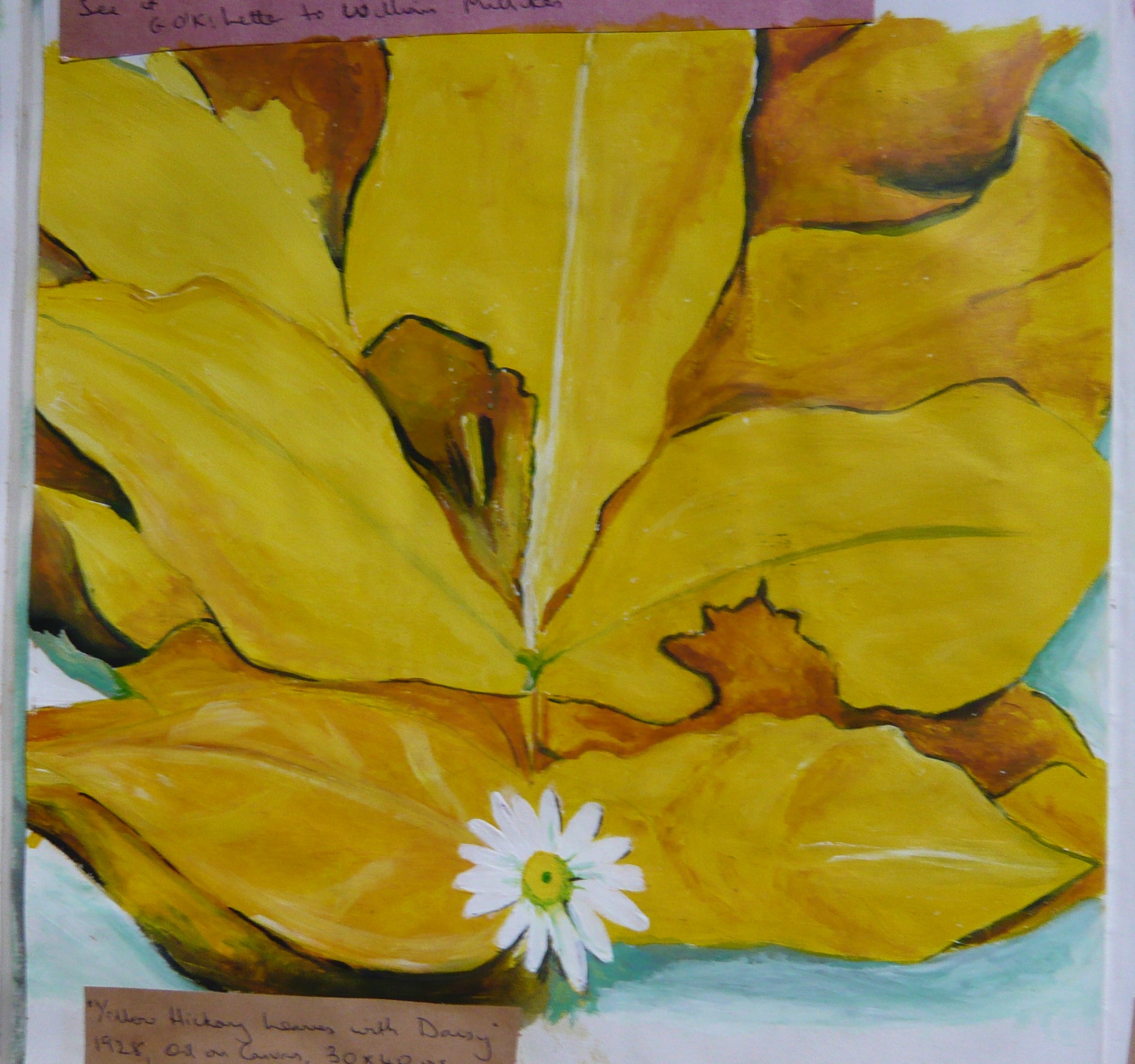
My copy of the Georgia O’Keeffe Painting Yellow Hickory Leaves with Daisy
But sometimes, even as a writer and compulsive note taker, I can get so absorbed into a landscape that I have no wish to try to describe it, no matter how many words I might use. I just want to observe it, to be in it. Words feel redundant. And I’ve said this before, but this sort of compulsion to record things, or photograph them, feels like a way to try to own them.
And words are noise. More than noise. They get in the way and distract from what they are representing. They are like the finger pointing at the moon in the Buddhist parable, where ironically attention is drawn to the finger, rather than the moon which the finger is attempting to draw our attention to. The famous painting by Rene Magritte The Treachery of images pictures a pipe with the writing: ‘Ceci n’est pas une pipe’ beneath. But it is this very caption which names it.
Conversely, though, a single word can suggest an entire world. Sometimes their power isn’t so much in their ability to define something, but their ability to conjure images and memories seemingly from nothing. Like an incantation. And each word contains maybe hundreds of meanings and nuances, different meanings to different people. I am reminded of two of Borges’ short stories: The Mirror and the Mask, and Undr. In the first story, a court poet reduces the literature of Ireland to a single line, and in the second a fictional Nordic people have a poetry that consists entirely of one seemingly mystical word, Undr (although, naturally, it’s not quite as simple as that…). And this makes me think of the importance of the spaces between the notes in music, and the rests – we need the spaces between the words to think. To listen properly.
Over the years I have been drawn to painting or photography, or to writing, depending on what I want to say. To draw attention to the way the dawn light strikes the tops of the trees, for example, undoubtedly the visual arts are best. But to describe the anguish experienced before taking an important decision then clearly words are required. But note that in each case, it would be possible to get results with the other forms. And poetry frequently straddles them all.
And then there is the myth that God has a name not known to anyone – His real name, from which all His power is derived, and which must remain secret. For once a name is known, it loses its power.
Words are illuminating, words are abstractions, words are dangerous, words are treacherous.
Words are overused, like this…


