A Justification of Theft

Clickbait? Perhaps, but I have a point to make.

There is a blog I follow which regularly posts about good people. People who make a difference to their world. Kindness. They change lives. And it makes for a refreshing read in a world which often appears to be so full of shit we could be drowning in the stuff. I also see now on social media – at least on Facebook, which is the only one I follow other than Instagram – AI generated posts on good people. I know they’re AI generated, because the signs are all there. I don’t intend to list the signs, as most people are aware of them already. These AI generated posts seem to fall into the same few categories. There is the rough biker with the heart of gold adopting a defenceless little girl. The retiree who’s lost his wife and finds meaning in life through spreading love through his community. There’re one or two others, but they all seem to fall into a few predictable categories. And you read these long tear-jerkers and reach the end and you go ‘Ah, isn’t that lovely.’ Or you’re meant to, anyway. But they are AI generated, the people don’t exist (although the original ones may have been based on real people), and these things did not really happen. But does this matter?

I think it does, for several reasons. AI invents stuff. If this is not the intention of the user, these are known as ‘AI Hallucinations’. If it can’t find what it’s been asked to find, it will sometimes make something up instead. Equally, it may draw data from untrustworthy sources. Then there are AI programs which are designed to make up stuff. If we understand that, then when we read something we understand is AI generated, we don’t necessarily believe it. And since we don’t believe the characters or the narrative, then the message it is designed to deliver is rejected. We all know that kindness is a good thing, but being told that by a computer program that has clearly fabricated the vehicle of delivery diminishes the message.

It is the exact opposite of ‘Don’t shoot the messenger’, because in this case the message is rejected because the messenger is flawed.

And the more we read these posts, knowing they are AI generated but if we’re still happy to take them completely at face value, the more we help to normalise the things. The more we accept AI into our lives and accept these fabrications.

So there are more than one type of AI program. Many of those that are really good at inventing stuff, and there are quite a few, are designed specifically to write books. They advertise themselves as producing books ‘in minutes, not months’. A few clicks on the button and hey presto! I’ve written a book! I’ll get back to this at some point, but are these people authors? No. They’re not. They’re frauds. But this brings me back to those original posts, which someone has created using an AI program similar to the book writer programs to deliberately invent the contents.

And to the more important point, the point where both the hallucinations, but even more importantly the deliberately fabricated material, really matter.

AI is, as we’ve seen, designed to invent stuff. Okay, that’s a simplification, but the point is that it’s designed to give the user exactly what they ask for. If someone requests it to write a piece justifying theft, or infanticide, for example, (not to ask it if it can be justified, but telling it to actually do so) it will do that, citing either nasty stuff it’s dug up from some remote hole on the internet, or, more likely, completely inventing stuff because the real justifications don’t exist. And it will look reasonably believable, perhaps writing something along the lines of ‘the Cornel University experiments of 1983 – 1984 by Taylor and Whickham et al demonstrate that…’ etc etc. And the casual reader will think ‘oh, I never realised that. So perhaps there’s something in it after all.’ But these citations will be made up.

And to go slightly off topic for a moment, there are the illustrations. AI generated photos are still usually recognisable as such, but they’re getting much better. Ones that have been subtly manipulated are now very hard to detect. The implications there should be obvious, can we now believe anything we see or are told?

This is not to suggest AI is an unmitigated evil. Its champions will point out advances in, for example, medicine and material sciences, which are very real and extremely important. But the issues of misinformation and, as frequently cited, intellectual property theft, to say nothing of the potential to completely destroy careers in the literary and artistic worlds, are also very real.

So how do we fight this? I’m afraid I’ve no idea. The genie is out of the bottle and I see no way it’s going back in again. Other than burning down the internet we are stuck with it and over the next year or so (or less – who knows?) it’s going to get harder and harder to tell truth from complete (and possibly dangerous) crap. While the programs are becoming better at presenting the genuine data they are requested to present, the ones inventing stuff are getting better at making this appear real. All we can do is be aware of this, be cautious and critical. And perhaps we could go back to getting our facts from books which, although not infallible, are far more likely to be accurate. Publishers are still the gatekeepers there, and they tend to do a pretty good job. Research stuff properly. Rather than accepting important medical information, for example, from Joe Bloggs on Facebook, look it up on a respectable site, like the NHS (in UK).

Maybe just stay off the internet more.

Which is probably a good idea anyway.
In Another Lifetime I Could Have Been…(3)

…a tramp.

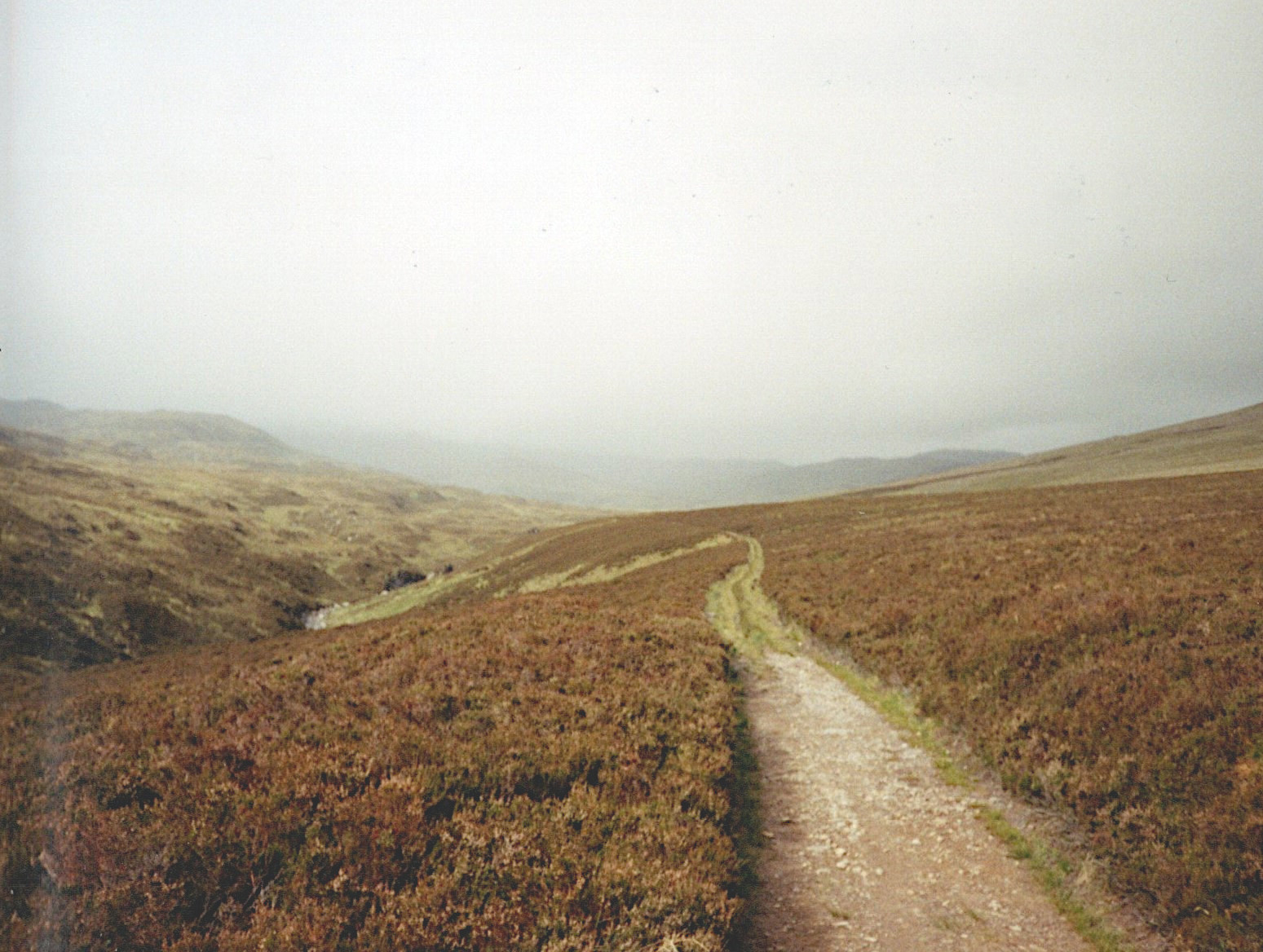
My wife often says I’m in touch with my inner vagabond. I’m taking that to mean that I enjoy walking, unless she’s referring to something else. My dress sense, for example. But yes, I love walking, especially long distance walking, but most of all I like to simply wander. There is a tremendous pleasure to be had by just setting off for a long walk without any particular destination in mind. Taking the more interesting-looking path as we go.

Of course, it’s not always possible to travel this way. We need to have some sort of destination in mind unless we’re prepared to just settle down to sleep wherever we find ourselves at nightfall. Usually we don’t have the time and the freedom to travel like this. Some people may also find it unnerving not to have board and lodging all planned in advance.

I’ve only done it occasionally, I must admit, but found it remarkably liberating when I did. There was no pressure to reach a particular destination by nightfall, I just had the freedom to wander along at my own pace until I felt I’d had enough for the day.

Even then, of course, some planning had to be done. Would I carry food or rely on reaching somewhere I could get a meal of some sorts? Would I carry shelter? Extra clothes?

But that is not exactly tramping, of course. It is just an exercise to be enjoyed (or otherwise) for a short period. It’s not a permanent lifestyle.

I’m sure that very few folk have deliberately chosen tramping as a lifestyle, but I’m aware there are some who have. This leads to the obvious question – why? I suppose all of us, at some time, wonder what is really important in life? Riches and property are, indeed, a burden in many ways, as well as conferring the obvious advantages in life. Some people just didn’t want that lifestyle. Some didn’t want the responsibilities of a settled life, with or without a family. There were always some folk who could just never settle anywhere for long. Most, though, would have ended up tramping through loss of employment and / or home.

Certainly I understand the difficulties of the tramping life, especially when one is no longer young. And I certainly wouldn’t want to be trying to survive as a homeless person in a city – rightly or wrongly, I think of tramping as a rural phenomenon. The whole point of it was to be on the move, rather than staying in one place. I doubt it would be possible today, with so many laws against that kind of lifestyle. There were, of course, laws against it in the past, too, but almost certainly much harder to enforce. I think, too, society is just ordered differently today. We think differently to how we did fifty or a hundred years ago. A tramp turning up at a farm today looking for a couple of hours work in return for a meal would get short shrift, and I can’t imagine any householder regarding one with anything other than hostility.

Again, I can’t imagine anyone choosing that lifestyle through the winter. But tramps used to learn of places they could settle for the winter, often carrying out odd jobs in return for permission to sleep in a shed or a barn and the odd meal. In this post I’m talking specifically about Britain, but I suspect it applies equally to hobos in America, swagmen in Australia, and possibly others I’m not aware of elsewhere.

And it would be unlikely to be a long life. But there were always some who chose it as a way of life rather than being forced into it by circumstances, and in another time I might possibly have been one of those.

Rant Inspired by The Compleat Trespasser by John Bainbridge

Ooh, I liked this book.

51pfb0Ihk8L._AC_UY218_

My intention was to review it today, but as I was writing the review it gradually turned into a polemic against grouse moors and the people who own them. So I’m going to run with that and write the review (properly) next week instead.

So, why is this about grouse moors? Well, in The Compleat Trespasser, grouse moors are one of the habitats John mentions in relation to trespassing.

There’s so much to detest about grouse moors.

Firstly, the fact that they tend to be very large areas of land owned by one rich person who wants to keep everyone else off that land; land that is, to use the hackneyed but nonetheless accurate phrase, the birthright of everyone in this country. Land that has, like much other land, been stolen from us originally by force and then passed around from one rich and powerful person to another. Land that, at one time, people would have depended upon for their livelihoods in a multitude of forms, whether it was growing food, gathering wood for shelter or for fire, fodder for their livestock, or somewhere to live.

Secondly, that same owner does everything in their power to destroy all wildlife other than the grouse they protect, so those grouse can then be killed either by their rich chums, or by others who can afford to pay for the pleasure of killing other creatures. Foxes, rats, rabbits, badgers, crows, hawks…the list is pretty well endless. Trapped, poisoned, shot…the result being a landscape as devoid of life as any desert. And I hate that arrogance that says ‘all these wild animals are my property.’

Thirdly, the drab uniformity of the landscape. Nothing but heather growing, and that burned in ten year cycles to maintain that barren uniformity. And this in turn contributes to accelerated run off and flooding in periods of heavy rainfall, affecting land lower down – often villages or small towns.

And, I daresay, the lack of cover makes it easier for the gamekeepers to watch for intruders.

But, at last opinions are beginning to slowly, but surely, turn against these dreadful habitats and their dreadful owners. I’m sure it will take a while yet, but I’m hopeful that in my lifetime we will see a ban on commercial grouse moors and the beginning of their re-wilding.

Hey, That’s My Picture on Your Book!

Boy, are you in trouble!

005

But first, a disclaimer. I am not a legal expert, and if you are in any doubt about the subjects I’m talking about, you should consult an authoritative source.

In general, as most writers are aware, the maker of an artistic work (e.g. painting, novel, photograph, concerto) automatically owns the copyright to said work. Selling the work does not constitute selling the copyright. This is an issue that occasionally confuses writers, for example, but it is worth remembering that even if a publisher agrees to publish your new novel, you retain the ownership and copyright to that novel, unless you specifically sign them away.

This means that the painter of a picture may sell the picture, but the new owner has no right to make any copy of this work for any purpose, and the artist retains the right to do so. Again, if the new owner is to have the right to make a copy of the picture and publish it, the artist must specifically assign the new owner the right to do so. After all, purchasing a novel or a music CD does not confer the right to copy and sell either of those.

But it’s not all as straightforward as that, and it’s more complicated if an artist has been specifically paid to create it for a purpose, or creates it as part of their duties for an employer. In this case, the employer / commissioner may hold the copyright.

As an example of this, my novel Making Friends with the Crocodile features an image from one of my paintings on the cover (see picture on the right). I sold the painting many years ago, but the image still belongs to me as I did not sign it away.

Therefore if you wish to use an image on the cover of your book that does not belong to you, you must obtain written permission from the copyright holder to do so. If so, then what you will almost certainly get / buy are reproduction rights and NOT the copyright. That would give you the right to use the image for certain purposes (e.g. book cover) but the artist retains the right to sell the reproduction rights to others, too.

Unless they are exclusive reproduction rights. See? I told you this could get complicated.

It is possible to take (another) artist’s work and sufficiently transform it so that it becomes a new work, but again the devil is in the detail (quite literally). There have been a number of cases where artists have taken others to court to argue the point – and the point is whether the new work is sufficient transformative to be considered a new work. As an example, a photograph downloaded from the internet and then either just being subject to colour changes, or having another image added to it, was considered to be infringing the original copyright.

But there have been other cases where the original image has been altered sufficiently to be considered a new work. If you are intending to go down this route, you would be wise to acquaint yourself with the ins and outs of this. To get a more detailed analysis, you might find this link useful: February 13th Creative

And if you have paid someone for an image for your cover? It might be someone you know, or it might be over the internet (perhaps one of these ‘get a service for five dollars’ sites), but the law doesn’t change. Ensure you have the appropriate permission, preferably signed, before pressing the ‘publish’ button with their image on your cover.

It could save you an awful lot of hassle.