Kent’s Standing Stones

Although not perhaps the first county one would think of when discussing ancient standing stones, Kent does have its share. There are two main sites approximately equidistant on either side of the river Medway in north Kent. The eastern site consists of the remains of two burial chambers (Kit’s Coty House and Little Kit’s Coty House) and the White Horse Stone, all within a kilometre of each other, while the western site consists of the Coldrum Stones (burial chamber) and Addington Long Barrow and Addington Burial Chamber.
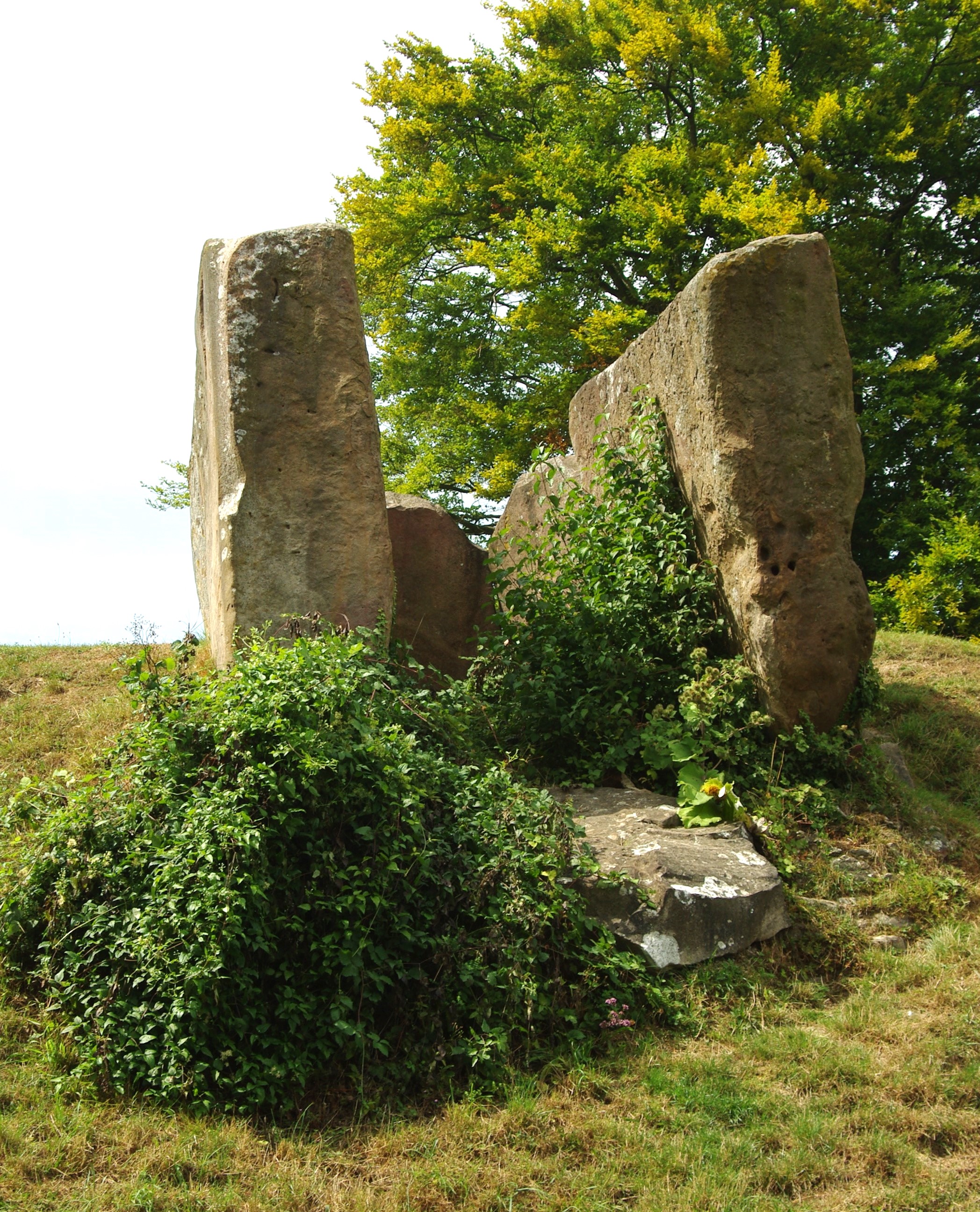
The Coldrum Stones

At Little Kit’s Coty House in a light drizzle, I counted seventeen stones, although Donald Maxwell writing in The Pilgrim’s Way in Kent, a short guide published in 1932, claims twelve to fourteen. Various other authorities suggest between nineteen and twenty-one. This is one of those sets of remains that comprise such a jumble of stones it is supposedly impossible to accurately count them – and just to make it harder, they are also supposed to move around (presumably when no one is looking). Thus they are also known by the name The Countless Stones. The largest ones I reckoned were about four meters by two and about three and a half meters by three. The shapes are very irregular, and since they are in a collapsed state there might have been serious damage to some of them. I immediately wondered whether it had originally been the same shape as Kit’s Coty House, a Neolithic chambered long barrow, just a few hundred meters to the north, where the stones are in the form of a dolmen, which would have been a burial chamber at one end of an eighty-four meter mound.

The Countless Stones, or Little Kit’s Coty House

William Stukeley, writing in 1722, recorded that he was told local people remembered a chamber at Little Kit’s Coty House. It had had a covering stone and was pulled down in about 1690.

Both Kit’s Coty House and Little Kit’s Coty House are reckoned to be just under six thousand years old.
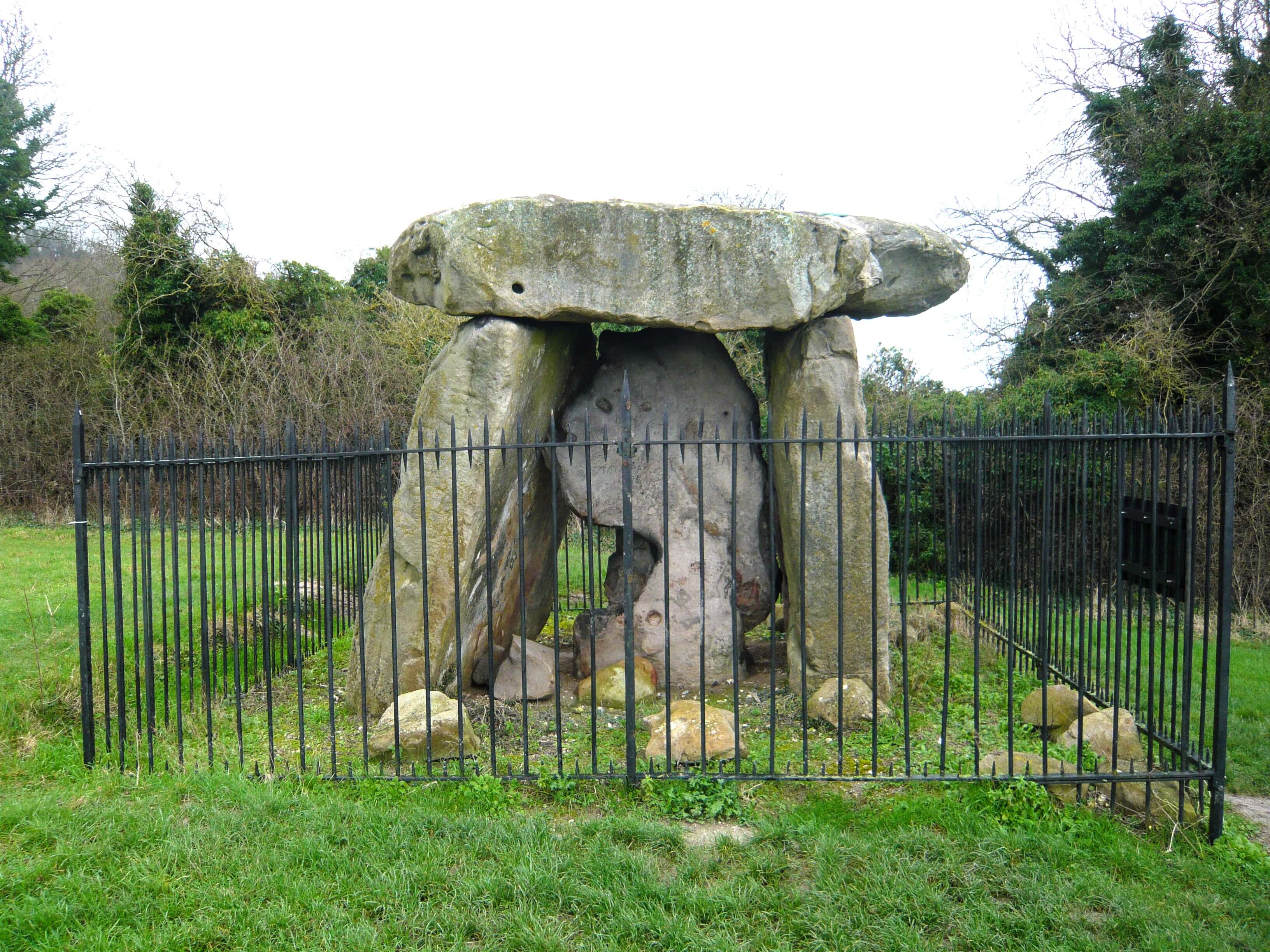
Kit’s Coty House

Some nine or ten kilometres away across the Medway Valley are the Coldrum Stones, or Coldrum Long Barrow, dated to between 3985 and 3855 BC. These ones, looked after by the National Trust, are also a burial chamber. Donald Maxwell claimed that there were forty-one stones and that a further fifteen were broken up at an unspecified date during quarrying work. Maxwell also reported a tradition ‘amongst the country people’ that an avenue of stones stretched across the valley from Coldrum to Kit’s Coty, although there is no evidence it ever existed. But coincidence or not, both of these chambers are situated at the same height, about eighty five meters above sea level.

All three burial chambers, then, have been dated to the same period, a thousand years before Stonehenge was built. It seems reasonable, then, to assume they were produced by the same society.

Coldrum has been proved to be a family tomb, the remains of at least 22 people being interred there, with DNA analysis proving their likely close family relationship. Yet amongst these kinsfolk, recent isotopic analysis has shown that maybe the chamber also contained the remains of individuals interred in the fifth to seventh centuries AD.

The White Horse Stone

I say maybe, as there is a very strong caveat connected to this research, and that is that when the human remains were removed in the early twentieth century they were not only not labelled very thoroughly, but they were also passed around several museums and the possibility exists that some bones ended up mis-accredited. Yet it has been proven that some neolithic burial chambers were re-used for burials in the early Anglo-Saxon period.*

The land here has been sculpted by man. Of course, we sculpt the land more and more violently and obviously in the twenty first century, but here, from all these thousands of years ago, are these simple shapes built by ancient folk to inter and celebrate their dead. And these were interactive places. Evidence from other sites shows that some of the bones of these ancestors would be removed at times, although whether as a simple reminder of their elders, or whether for magic or sacred purposes, can only be conjecture. But I like the thought that these bones might be invested with power, that they could be brought into the everyday for protective or ritual purpose.

Now, we view them in a different light, and their sacredness has evaporated. Like a deconsecrated church, but without ever having been formally deconsecrated. It is possible our ancestors would view our visits there as desecration.

But I’m never sure whether you can take any arrangement of stones for granted; they’ve been dismantled in the past, could they have been reassembled?

Incidentally, for those who enjoy Ley Lines, it is worth mentioning that the Ley Line hunter Paul Devereux has described a line passing through The Coldrum Stones and aligning with six nearby churches. Although just to put a dampener on that, perhaps it is also worth mentioning that students at Cambridge University investigated this particular line using computer simulations based on the Ordnance Survey details and concluded that it wasn’t statistically significant – that it was almost certainly just a chance alignment. You takes your pick.

*Research carried out by members of Durham University, Oxford University School of Archaeology and British Geological Survey (Isotope Facility) 2022
Pilgrimage

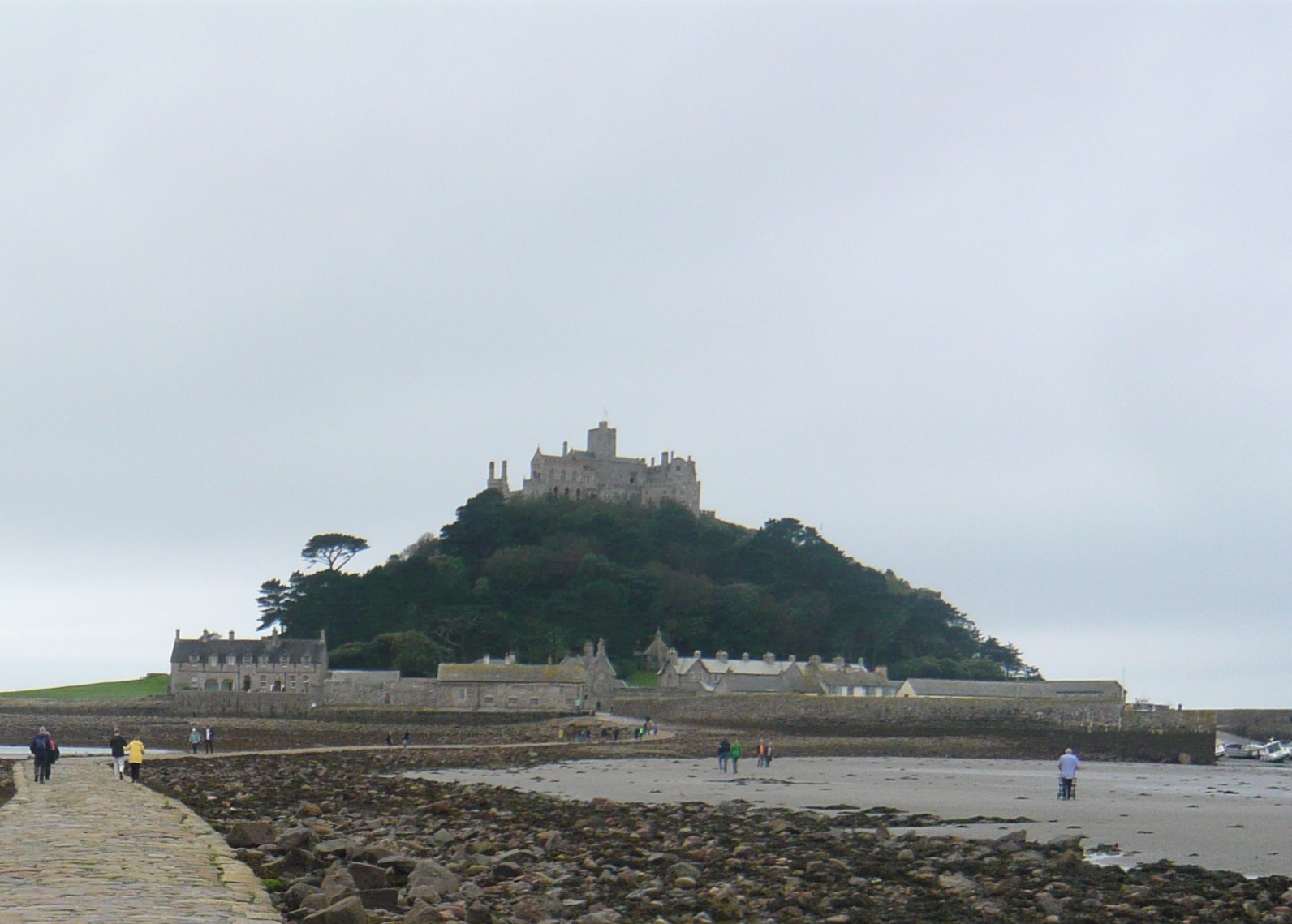
We recently returned from a week in Cornwall, and where we stayed was close to the end of a pilgrim route, St Michael’s Way. This is a short twelve and a half mile walk from the North Cornish coast to St Michael’s Mount, in Mount’s Bay on the South coast. Although the route is such a short one – a day’s walk for most people – it still apparently qualifies for a pilgrim ‘stamp’ on the official pilgrim passport for the very much longer long-distance Camino pilgrimage, since in the Middle Ages many pilgrims walked this route to the Benedictine monastery on the island, then took a boat to France to continue on towards Santiago de Compostela.

I am interested in learning – as far as it is possible for the staunchly non-religious person to learn – what the religious get out of pilgrimages. In the past, they were generally viewed as a way of gaining merit, of putting a few points in the bank when it came to whether you were headed for heaven or hell in the afterlife. Frequently, they were also undertaken in the hope of cures from diseases; various remnants of saints such as bones or clothing were held to have miraculous properties, and the touch of these might cure whichever disease ailed you.

Personally, I view pilgrimage as a spiritual thing, rather than a religious one. Something that puts the pilgrim in touch with their ‘finer’ feelings – a way of understanding what is important in life; relationships, simplicity, art maybe, minimal possessions – we will all have a different interpretation of this. In the past I have considered attempting one of the Camino routes – through France and Northern Spain to Santiago de Compostela. These are long, serious, routes, hundreds of miles long. Had I done so, I would have walked these for pleasure, as well as a personal challenge, rather than as a pilgrimage. Now, though, I am curious to see how much of the ‘religious’ experience I might have.

Whether visiting a church or a standing stone, a ‘holy’ well or a Sufi shrine, all are invested with spirituality. All are invested with meaning to many people and although I know I will never be able to experience the feelings of, say, a Christian at a site they consider holy, I might experience something akin to it. I’m not suggesting I might feel awe at the shrine of a saint, more that I might get an impression of the feelings of the visitors who do. And because I cannot quite find the words to express what I might hope to find, I reckon that’s an indication it’s an experiment worth making.

May Day Mayhem

The May Day festival, Beltane, is a survival, or revival, from the Iron Age, celebrated in Celtic communities – Scotland and Ireland particularly – and revived as a full festival in Scotland in the 1980’s by the Beltane Fire Society. Beltane was a fire festival, although nothing of that remains in the festivities carried out in England. Beltane was first mentioned by name in Irish writings from the late 800’s / early 900’s.

The English version of this festival involves cutting flowers and greenery and dancing around a maypole, which things are also carried out during Beltane, celebrating the beginning of Summer which begins on May 1st. When I was a child, dancing around the maypole was the chief, possibly only, activity carried out on May Day. I have a photograph of my brother, my cousin, and myself, dressed up for the May Day Fair at which there was maypole dancing, but no obvious indication of surplus greenery. Past generations in England celebrated May Day with a day of celebrations which while including maypole dancing as an important manifestation of encouraging the fertility of the soil (and the festival-goers!) would also have included plenty of food and drink and general gaiety.

Mayhem, if you like.

This year, I managed two May Day days out.

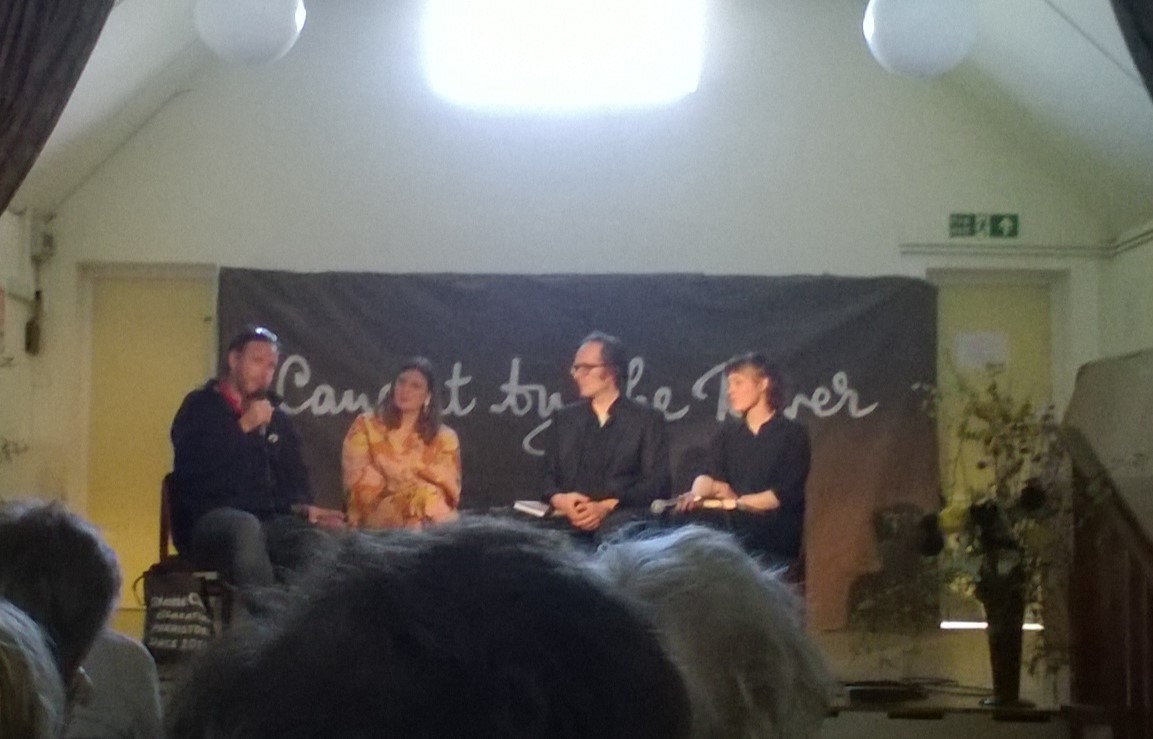
On Saturday, two days before May Day, I visited Kingston near Lewes, in Sussex, for the Caught by the River Mayday event. Caught by the River describe themselves as an arts/nature/culture clash and you can read all about them here. I have followed them now for several years, and this seems as good a time as any to mention that their coverage of arts, nature, and culture are second to none and if you’re not yet following them, well, you should be.

There was mask-making to begin with, especially to involve the children, the makers encouraged to incorporate flowers and greenery into their masks, and almost inevitably a certain amount of folk-horror found its way into some of these.

Nice, Richard.

This was followed by a promenade around the maypole, after which the activity moved indoors.

There were films, talks, and discussions, subjects including rivers, village life in the early eighteenth century, art, standing stones and the like, and the environment. After which, in the late afternoon, we all promenaded up the hillside to the Gurdy Stone.

This is the Gurdy Stone, a modern standing stone on a hillside overlooking Kingston. Here, Local Psycho (Jem Finer and Jimmy Cauty), held a gathering to encode the music of their Hurdy Gurdy song into the stone “To mark the 50,000 year return of the Green Comet and release of The Hurdy-Gurdy song on Heavenly Recordings.”

Throughout the day, naturally, we all had access to the pub.

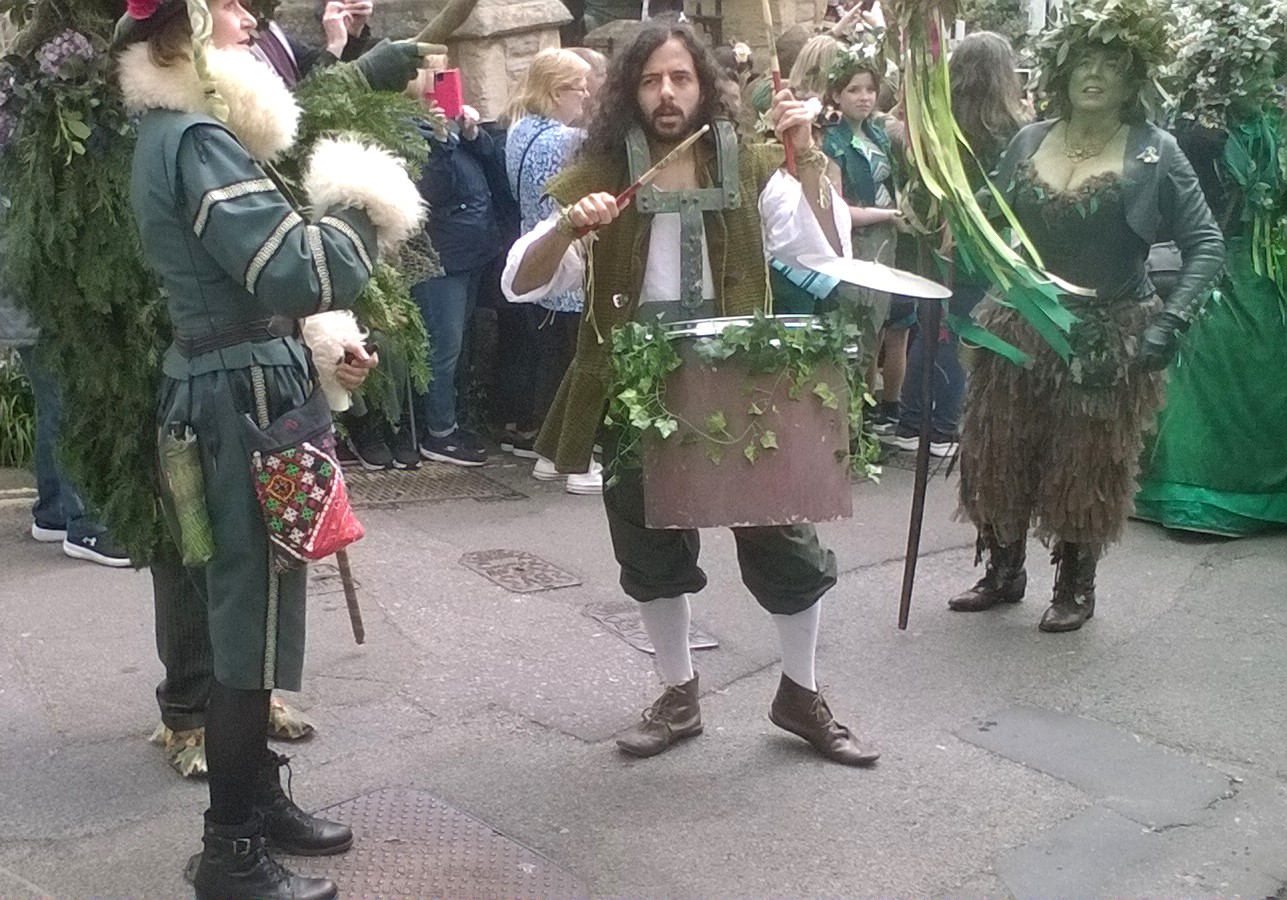
And then on Monday, which was May Day, we went down to Hastings. It rather felt as though everyone in South East England must be in the town, either at the Jack in the Green festivities or watching blokes on motorbikes roaring up and down the seafront for no discernible reason. I don’t much like crowds, and some of this was very difficult. But away from the huge horsepower and testosterone nonsense, amongst the Jack in the Green celebrations the atmosphere was brilliant and the large numbers of people perfectly acceptable. Jack in the Green is a manifestation of the spirit of spring, related to the Green Man, a dancing figure covered in greenery.

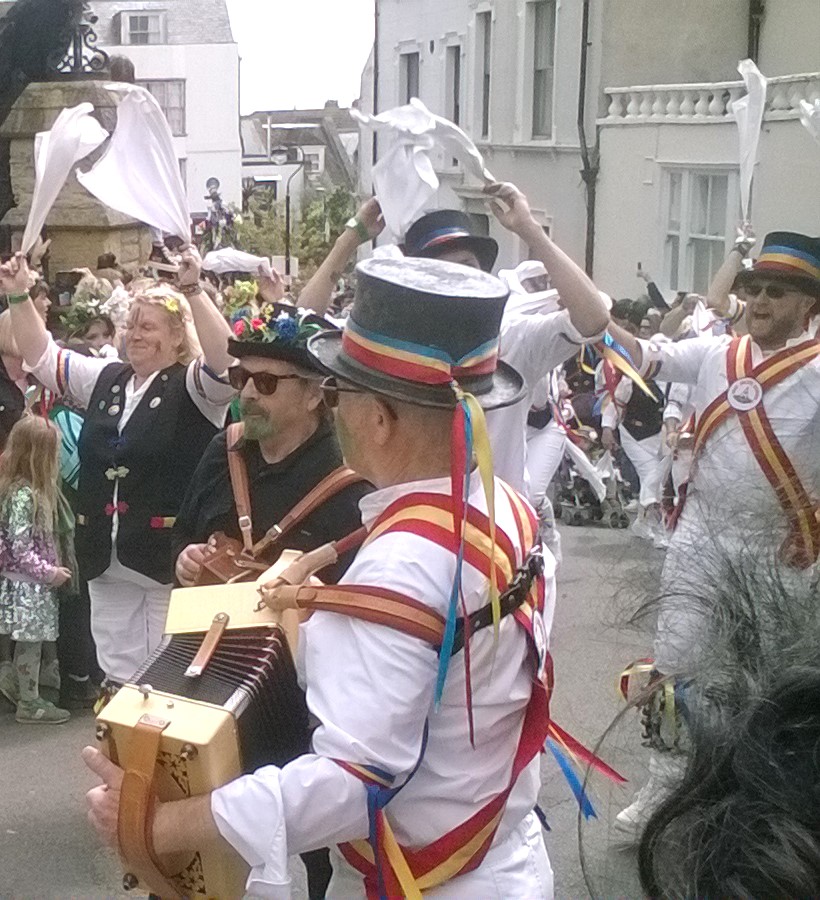
The festival in Hastings has grown over the years into a large event involving musicians, dancers, Morris sides, huge figures in addition to Jack in the Green such as the Queen of the May, a witch, and others, plus any number of people joining in the procession around the town, all decorated with as much, or as little, greenery and/or flowers as they feel suitable.

There you go, a Morris side.

Followed by a large witch with a cat. Why the witch? I’ve no idea. Why not? I suppose.

And there you have it. Music. Drumming. Greenery. Crowd involvement. Summer is icumen in and winter’s gone away-o.

And there was beer again, of course.

On Windover Hill and The Oddness of Time

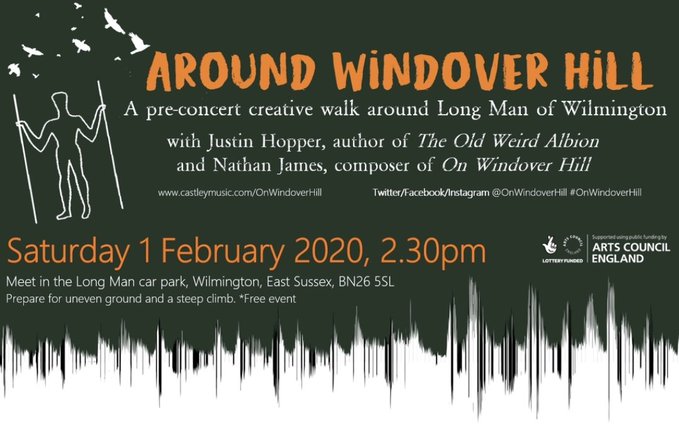
Yesterday, we joined a walk to the Long Man of Wilmington, on the South Downs in Sussex. The walk was led by composer Nathan James, and Justin Hopper, the author of The Old Weird Albion.

EPrcQenWoAQWbeb

The Long Man is a chalk figure etched through the grass into the hillside, below the summit of Windover Hill, revealing the chalk that lies beneath. When and why it was first cut is the subject of myth and speculation – and that brings us neatly to Nathan’s new composition.

P1060405a

On 7th March, Nathan will premier his fantastic new choral work On Windover Hill at Boxgrove Priory, Chichester, Sussex. This has been inspired by the Long Man, its mythology, and the art that has arisen around it, as well as the written history and the geography of the surrounding land. It has a very English feel to it, in the tradition of Vaughan Williams or Holst.

Full details of the work and the performance can be found here. Tickets can also be bought by clicking ‘The Premier’ link in the sidebar there. We have ours, and it would be great to see it sold out!

This walk was by way of a taster for the concert, with a mixture of history and mythology imparted along the way, a poem from Peter Martin, read by himself, and extracts from stories read out by Justin, all of which referenced the Long Man. Also  Anna Tabbush sang two folk songs, one of which was the only song known about the Long Man, appropriately enough called The Long Man and written by the late Maria Cunningham.

P1060395a

I’m not sure How many people I expected to see, but we were around forty, with a surprisingly large number being artists of one sort or another.

The weather was so much better than we had a right to expect – the forecast had been for clouds and rain, but the clouds cleared during the morning, and we had plenty of sunshine as we ascended, although it rather lived up to its name at the top, with more than enough wind for everyone.

P1060404a

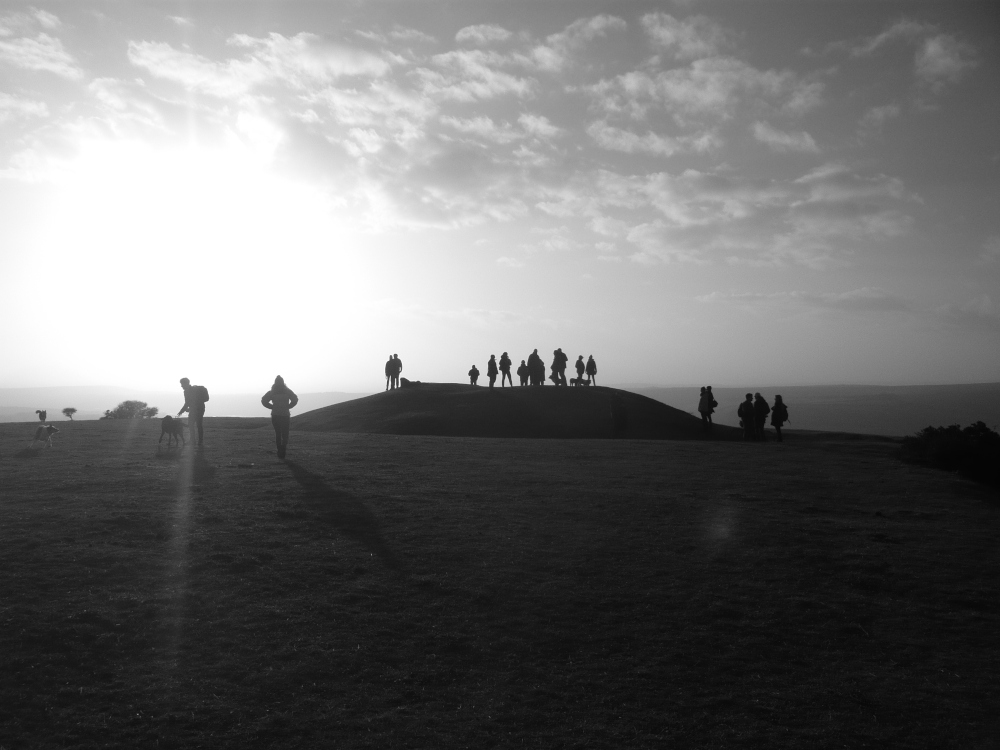
Here, the remains of prehistoric burial mounds sit overlooking the Long Man, and the rest of the surrounding countryside.

P1060403a

Some landscapes seem to muck around with your perception of time, and Downland seems especially prone to this. I’m not entirely sure why this should be, but suspect it is a combination of factors.

It is a very open landscape, and other than the contours of the land and a few trees, frequently the only features that stand out are prehistoric ones, such as barrows and chalk figures. Due to the uncertainty around their origins, these have a timelessness about them, a fluidity when it comes to grasping their history. We see the long view, which perhaps works on our sense of time as well as space. The more recent additions to the landscape are usually in the form of fences, which can easily seem invisible as we look around for something less ephemeral than the open sky to fix our eyes on.

The Downs are an ancient landscape, in any case. When human beings recolonised what is now Britain after the last Ice Age, at first they kept to the higher ground which gave less impediment to travel and settlement than the marshy and thickly wooded lowlands. Most standing stones and burial mounds from the Neolithic or earlier are found on these higher areas.

I do not get these feelings in more recent landscapes. At a medieval castle or manor house, it is easy to imagine the inhabitants baking bread or sweeping corridors; activities as natural to us today as they were then. I feel a comfortable mixture of the old and the new, a recognisable timeline connecting the past with me.

But barrows, standing stones and hillside figures have a purpose alien and unknown to us. Step on the ground near these remains and you can feel the presence of the unknown. No wonder the belief in the past in faeries and elves who inhabited the underground, and who lived essentially out of time.

They offend our carefully erected sense of order and belonging and, perhaps, still pose a barely acknowledged threat to us today.

I might be imagining it, of course, but listening to the extracts from On Windover Hill on the website, I think I recognise that feeling in places, an unexpected musical response to my own feelings. And then Nathan’s description of his creative process on the website echoes some of this too.

I’m hooked!