Remnant #2 – It’s Just Not Cricket

Another piece from the hard drive that was intended to become part of a novel set partly in India and partly in the UK in the nineteenth century. Although an entirely fabricated event, all the cricketers here of both teams were actual cricketers of this time. The England team is made up of players from South East England counties, and the Indian team with players from the first Indian tours to England in 1886 and 1888. This match, though, is entirely fictional.
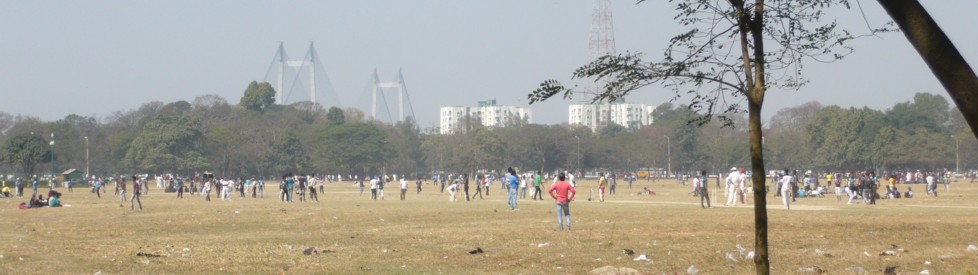
Image: cricket matches in progress on the Maidan, Kolkata.

It was the 13th August 1887, and a cricket match was in progress on the Higher Ground at Tunbridge Wells. It had begun two days previously, with a forecast of fine weather for the whole of its three-day duration and the visiting team, on losing the toss, had been asked to bat first. So far, the match had gone perfectly according to script. The touring Indian team had been bowled out for 117 under sunny skies, the United England XI, under The Honourable G R C Harris, the Kent County Captain, had scored 293 in reply, Harris himself top scoring with a magnificent 109, then the Indians had rallied to 236 in their second innings, a lead of exactly 60. The watching citizens of Tunbridge Wells had applauded politely and dutifully, expecting the openers to knock off the required runs before tea.

It was then that the weather changed.

As the United England openers walked out to bat, the skies suddenly darkened and a few drops of rain began to fall. The umpires looked up, Square Leg umpire wandered across to consult with his colleague, then the rain ceased. The clouds, although fat and dark, refused to release any more rain, so Square Leg umpire wandered back to his mark and the opening batsman took his guard. As he marked out his crease, a light wind whisked away the dust from his scratching bat and the crowd immediately noticed that they had begun to sweat. It was a warm, humid wind, blowing from left to right across the square from the opening bowler’s perspective. The old India hands amongst the spectators looked around in an unconscious, puzzled recognition.

M D Kanga, opening bowler for the touring Indian team, was not particularly fast, but he possessed the ability to swing the ball into the right hander. As he ran in to bowl the first ball of the innings, the wind strengthened slightly. He reached the crease, banged down into his delivery stride and released the ball, which started towards the batsman’s off stump, then curved through the muggy air and struck the batsman on the pad dead in front of leg stump. The batsman, back in his crease and looking to play to cover, was clearly LBW. Kanga and the rest of the Indian team went up in unison to appeal and the umpire, sheepishly, had no choice but to give the Honourable G R C Harris out, first ball. There was a scattered applause from the spectators, which was followed by an appalled silence as Arthur Shrewsbury, England Captain, was clean bowled by Kanga’s second delivery. The England IX were 0 for 2 and Kanga was on a hat trick.

To the relief of the spectators, the Sussex batsman and fast bowler J B Hide kept out the hat trick ball, blocked the next two deliveries, and then opened the scoring with a beautifully struck four back past the bowler. Tunbridge Wells heaved a collective sigh of relief and the world jerked back into motion.

Alec Hearne, Kent opening bat, had watched this carnage from the other end, and played the first ball of the next over carefully back to the bowler. Dhunjishaw Patel, the Indian Captain, bowled old-fashioned, fast underarm – surprisingly difficult to bat against, with its variations in pace, line and length, and with pitches still often fairly uneven. His second and third balls, too, were defended back, until a looser delivery popped up in front of the batsman, asking to be put away. Gratefully he walloped it towards the boundary and called Hide through for a couple of runs. A misfield handed them a third run, however, and the fifth ball was faced by Hide, who also defended carefully. A single off the last ball meant that Hide had kept the strike for the next over. 8 for 2.

Kanga’s next ball went for four, while the second was blocked. As the score went into double figures and the batsmen carefully pushed the score on towards the sixty-one needed for victory, the crowd began to smile again around the boundary edge. 12 for 2 became 14 for 2 and as Kanga came in to bowl the last ball of the over, Hide raised his bat in anticipation and began the pace forward towards the pitch of the ball. As he did so, and exactly at the point at which the bowler released the ball, a small boy in the crowd jumped up directly behind the bowler’s arm. There was no time to call a halt and as Hide quickly tried to refocus his attention on the ball and adjust the stroke, the ball took the edge of the bat and dropped into the waiting hands of first slip. 14 for 3.

Hide stamped off furiously, to be replaced by the number five, W A Humphreys of Sussex. The steady procession of returning batsmen continued then as Hearne decided to take the fight to the Indians, aiming a huge hit at the first ball of Patel’s next over, only to pick out the man at deep mid off. 14 for 4. Henderson, in at number six, survived the rest of Patel’s over, leaving Humphreys to face his first ball from Kanga; straight and fast, kept out. The second swung in sharply – blocked. The third on off stump and edged through slips for two. The fourth blocked. The fifth swung out, again taking the edge but this time taken at second slip. One ball left and the new batsman, Ford of Middlesex, was able to leave one that was too wide. 16 for 5.

The next six overs saw a recovery that saw the score climb to 36 for 5 when, off the last ball of the over, Ford mistimed a drive and was bowled off his legs. 36 for 6.

F Hearne, brother of Alec, usually opened the batting for Kent and was down at number eight for this match, as he had been used as the opening bowler. With only twenty-five needed to win, he decided to swing the bat after taking a couple of balls to get his eye in. The first went for four, the second took the edge and the wicket keeper took a fine catch diving away to his right. 40 for 7.

Pentecost, the English wicket keeper, often batted down the bottom of the order for Kent. In fact, between himself, W Hearne (another brother) and A B Hide of Sussex, there was fierce competition for the number eleven spot. The crowd had begun to get nervous again. He survived the last two balls of Patel’s over, then for the next over Patel took off Kanga and brought on Shaparjee Bhedwar. Bhedwar began by sending down a bit of a loosener which Henderson, playing completely down the wrong line, allowed to cannon into his pads for another LBW decision. W Hearne kept out the next ball, but played all around the third and looked back to see middle and off stump knocked back. A B Hide came in last, to a deafening silence, and kept Bhedwar at bay for the rest of the over. 40 for 9.

All at sea against Patel, Pentecost attempted to block the first ball of the next over, only to see it miss off stump by a whisker and his bat by a country mile. He therefore slogged at the next one, which shot away through cover enabling them to run two. The next one clipped his off stump, the bails came off and it was all over. United England IX second innings all out for forty-two and the Indian tourists had won by eighteen runs. There was a little polite clapping around the ground, but the general feeling was one of anger. The reporter from the local paper sat writing and then crossing out lines in his notebook, his mouth a thin line. The spectators were leaving faster than was usual, but in the refreshment marquee there were heated voices raised.
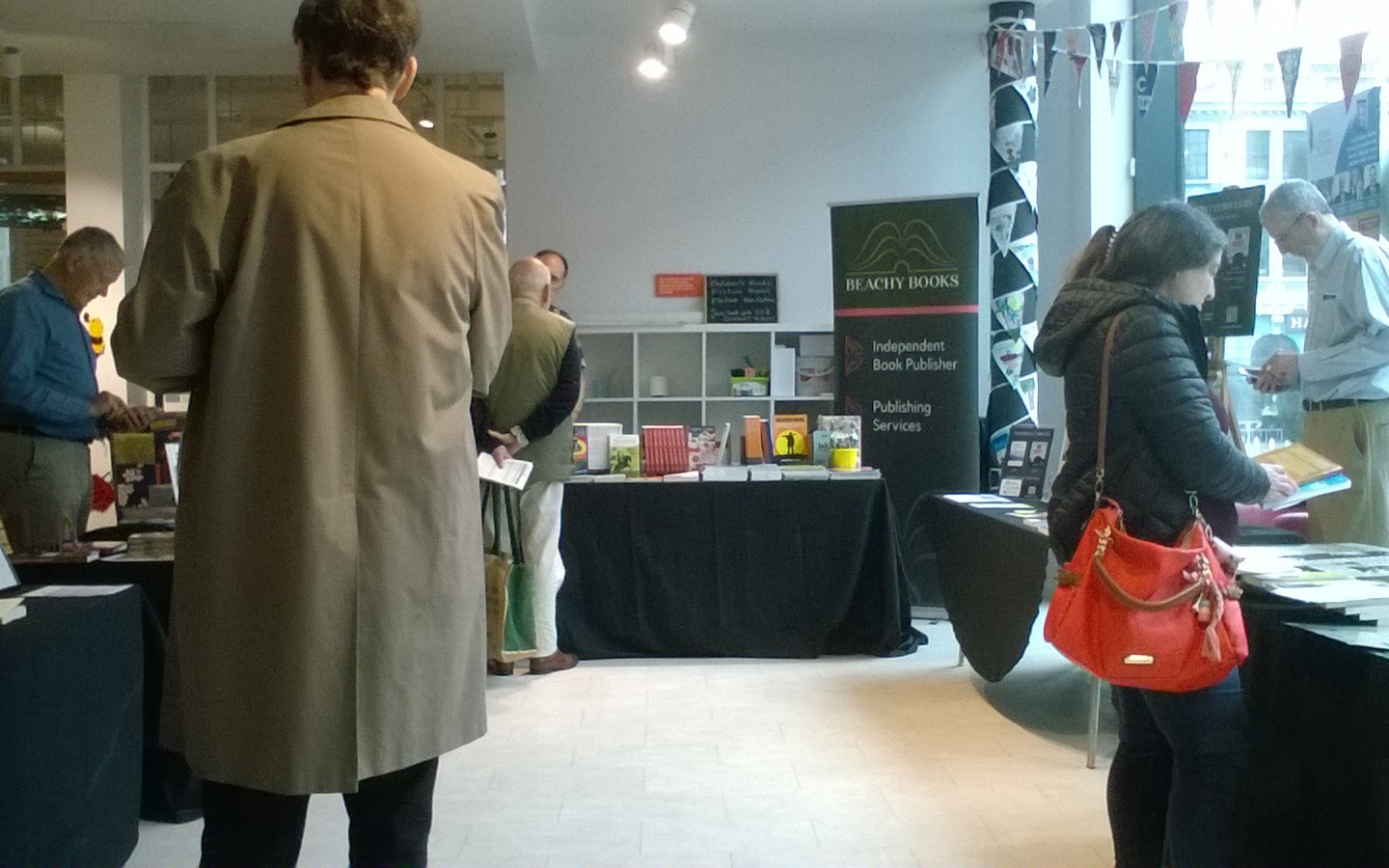
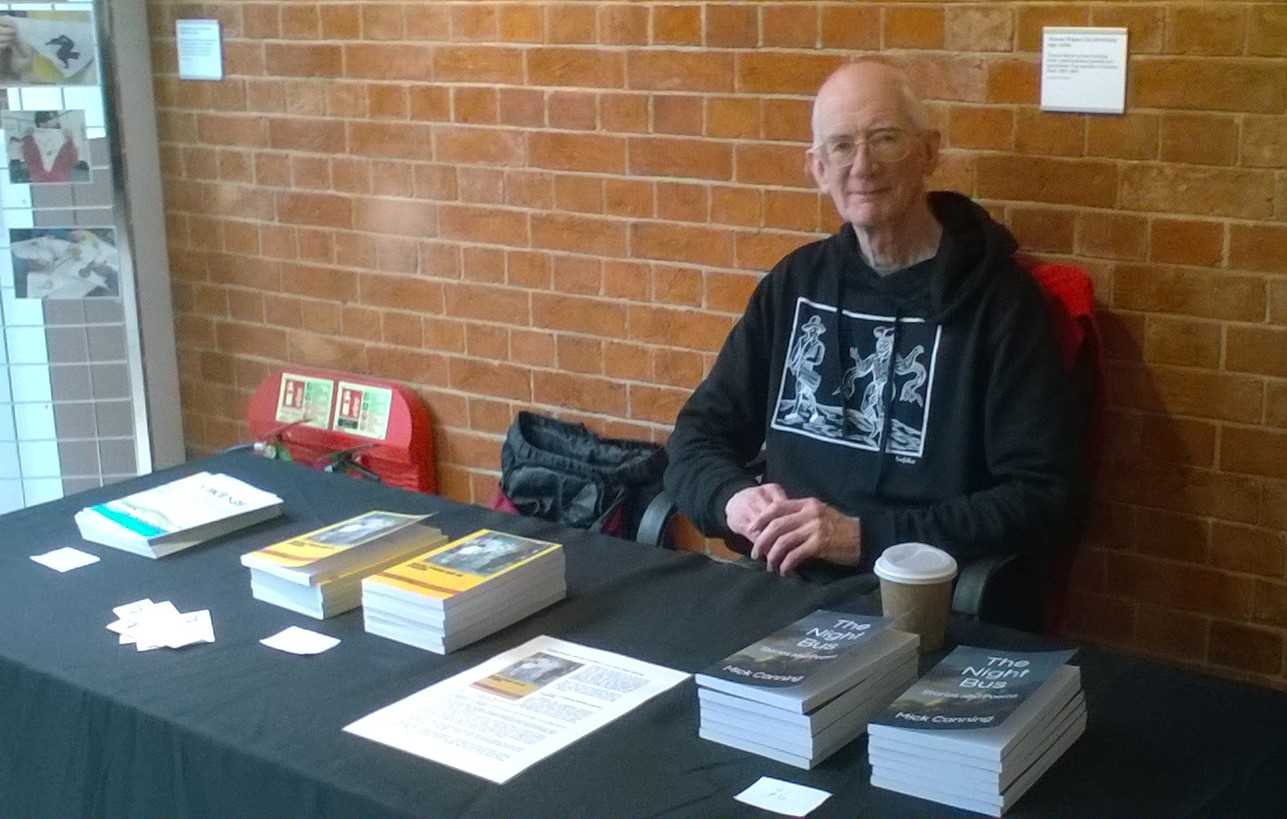
At Tunbridge Wells Literary Festival

Tunbridge Wells now boasts a literary festival. Over four days this year it hosts talks from well-known writers such as Michael Rosen, Michael Parkinson and Sheila Hancock. But not just the big names.

Yesterday was the day local writers could book a table and hawk their wares. It’s been some time since I’ve taken part in one of these, in fact, I’ve only done it once before, I think. When I used to regularly have paintings in exhibitions, I spent a lot of time essentially doing the same thing – chatting to other painters, talking to members of the public who might buy a painting and generally ‘networking’ (I still find that a slightly silly word). Although talking about Making Friends with the Crocodile did have another effect – it reminded me again that I’m beginning to feel I ought to take one final trip to India, sometime.

Anyway, I think I should probably do one of these more often. Did I sell armfuls of books? No, but I sold a few. I had some good conversations with members of the public and other writers, It also seems to have the effect of energising my commitment to writing, which is something that happened to my painting at exhibitions, too. Talking about my books and projects encourages me to focus afresh on them and, basically, get my finger out and get on with it, which can’t be a bad thing.

So, I’d better get on with it.

A Christmas Carol – 2

Another attempt at perverting rewriting a Christmas carol for 2017:

(Bob has a lot to answer for!)

315a

Once in Royal Tunbridge Wells

Stood a lowly shopping mall.

Where a horde of frenzied shoppers

moved like locusts through it all.

Searching for their Christmas loot,

Trampling others underfoot.


Finding bargains at the poundshop,

Cheap old tat that falls to bits.

Plastic toys all made of poison,

Tiny parts to choke their kids.

And the Christmas Trip will be,

An ambulance to A & E.


Spending fortunes on their own folk,

Presents that could sink a ship.

One month’s food to last just two days

Enough booze to float that ship!

Heed the message of our song,

Selfish greed just can’t be wrong!


Launch of ‘The Happy Bus’ by Louisa Campbell

Last night I was lucky enough to attend a great evening of performance poetry at The Java Bean cafe in Tunbridge Wells, for the launch of the new pamphlet by Louisa Campbell, a member of my local writing group.

Supported by published poets Ira Lightman and John McCullough, both of whom gave great performances, Louisa’s was easily the standout set for me.

A natural performer, she read a selection of poems from The Happy Bus, Published by Picaroon Poetry, which is a collection she describes as ‘charting the journey through anxiety and depression and on to peace and joy’.

007

This is not to suggest that her poetry is all dark, for that is certainly not the case. Each one bristles with hope and determination, and frequently humour – for Louisa does humour very well – and had the audience frequently chortling (we chortle a lot in Tunbridge Wells. We also chunter about stuff, but there was none of that last night).

And, let’s face it, how often do you get to see a poet declaiming a couple of their poems in a wolf onesie?, or getting an audience in Tunbridge Wells to yell out a chorus of ‘Bugger!’?

Below, an extract from the pamphlet:

005

To get your copy, click on either of the links below.

Amazon UK

Lulu


The Past is Another Country…

…they do things differently there (L.P.Hartley )

Almost 20 years ago I was a care-worker, paying visits to support elderly folk who were, for various reasons, unable to cope on their own. I would provide support in a number of ways – cooking, washing and dressing,and cleaning, for example.

One man I visited quite often would talk a lot about his younger days – as is natural. He had a wealth of stories, and I always told him he should get someone to write them down. It is the ordinary person’s stories that are frequently the most interesting, and the ones that we usually don’t hear. Famous politicians, sports stars, movie stars…well, they write autobiographies, or have them written for them, and we hear all about the other famous people they knew and the hotels they stayed in…yawn, yawn, yawn.

But we hear far less about the family in the village 80 years ago, their day to day life and how the outside world impacted upon them.

Below, there is a photo of London Road, just outside of Tunbridge Wells, taken earlier today.

005

My client told me that during his youth, he would walk back along this road after an evening out in town, describing how there was nothing but open fields on both sides for much of the walk. Looking at it now, it is hard to picture that, since I have never known it any way other than how it looks now.

But prior to this, in his childhood, he lived in the village of Groombridge, on the other side of Tunbridge Wells, and he told me how, as a schoolboy during the First World War, he and his classmates ran out of the class one day and across a field, to see a German Zeppelin airship that had just been shot down.

It is stories like this, that are the genuinely interesting stories that come out of the past.

And for my large Work In Progress, the past really is a foreign country. Much of it is set in Persia and India, in a time frame that covers some 300 years up until the late 19th century.

Now, I was about to write that if it is difficult for me to picture the main road near where I live as it was some 50 to 75 years ago, then it is far more difficult for me to picture the places in India and Persia where and when I have set my novel, but then I realised that this is not actually true.

And so this post is now taking a turn that I had not expected when I sat down to write it.

The Indian capital at the time was at Fatehpur Sikri, which today is just the remains of those buildings – it was only occupied for some 22 years, and then abandoned. I have visited the site and walked around it, and it is quite easy to imagine it occupied by Akhbar, his court, and the general population.

I have never been to Persia (modern day Iran), so my impressions are formed only at second hand. And much of what I have read consists of works about the 1500’s, and I am familiar with many of the paintings of the period, so again it seems almost natural to imagine it as it was then.

And then when I have travelled in India, as well as in the Middle East, I have spent a lot of time visiting the old parts of the towns and cities, and many rural areas where life follows the same patterns that it has for hundreds of years, and so, again, it seems more natural to picture the settings for my book in those time periods that concern me.

Finally, researching these areas, I often come across old black and white photos of places of interest to me, and since I have not been there, they are the only impression of these places that I have.

Of course, Tunbridge Wells in the Victorian era is much harder for me to visualise. All of the modern buildings get in the way of my imagination. All of the roads are surfaced with tarmac, the open spaces have largely gone, and many parts of the common that used to be open and windswept are now covered in trees.

On a slightly different note….

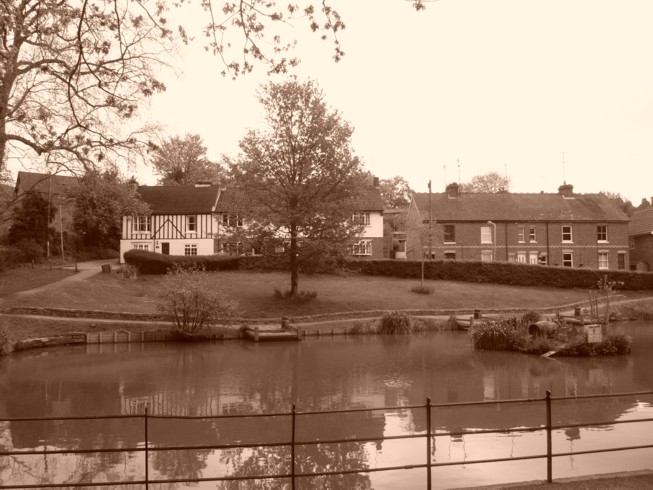
As a project, I occasionally take photos in sepia of the area around where I live, as though they might have been taken about 80 years ago – around the time that my elderly client was walking along the London Road, winds blowing across the fields either side of him, and the only light from the moon. Each photo that I take has something in it to show that it was taken recently though, rather than a long time ago, such as a modern vehicle, a modern street lamp, road markings, or modern windows. The shot below is an example.

Holden Pond

Easy to feel that it might be taken in 1930.

The Expedition Report

As promised in my last post, I attach here a report of my expedition.

On Saturday 30th January 2016, the morning sky cleared and the sun came out. It would be a good walking day.

P1050080

I had thought long and hard over the various logistical challenges of this expedition, and decided eventually, albeit reluctantly, that it would be wise not to attempt it alone. As much as I was loathe to share the glory of this journey, the sensible traveller realises his or her own limitations, and assesses the difficulties and dangers that they are likely to meet. And so I decided that I would take a companion; not only to make the journey more amenable, but also to help with the navigating, act as a safety back-up, and who could act in need as a porter.

We decided to split the tasks. ‘You’re leader,’ my companion Bob said, ‘so you take the big pack with the emergency stuff, and I’ll navigate. It will make life easier for both of us.’ Somehow, that wasn’t quite what I’d planned.

We picked up our packs, said our goodbyes, and set off down the path to the road. ‘We go left here.’ Bob said, turning right. I hesitated. ‘What are you waiting for?’ He asked irritably, turning round.

‘You said left.’

‘Yes. Are you going to stand there all day?’ I shrugged, and then followed him. The first part of our journey presented few difficulties. We turned left at the next junction (‘I said right!’) and followed the road until we had left the town far behind and were surrounded by a sparsely inhabited landscape. Now we needed to find our way down the hill on the other side of the road.

‘It’s not safe to cross here.’ opined Bob.

‘There’s hardly any traffic!’

‘It comes round the corner really quickly. Let’s go on a bit further and find somewhere better.’

‘The corner’s half a mile away! I’m crossing here!’

‘You cross then.’ He sounded sulky. ‘I’ll catch you up.’ He turned away and stomped slowly along the pavement.

I crossed the road, found a bench, and settled down to wait. Minutes passed, and I took out a chocolate bar and ate it. I had a drink of water. I pulled out the guidebook and went over our route again, and then got side tracked and began reading about the dreadful earthquake of 1734 that destroyed so much of Tunbridge Wells. I had another drink of water. I found a newspaper in the side pocket of my pack and did the crossword. As I finished, I looked up, and my companion arrived.

‘Where have you been?’ He looked sheepish.

‘I turned left by accident. Never mind that, I’m here now.’ He sat down beside me. ‘Sorry, I need a drink.’ He took out a flask and poured a little of the contents into the cup.

‘What’s that?’

‘Oh, just a drop of whisky.’

‘That was meant to be for emergencies only!’

‘This is an emergency!’

When we set off again, we were fortunate to find a track that seemed to be going in the right direction. It was no more than twenty foot wide in places, surfaced with a smooth, black layer, and showing occasional white markings roughly in the middle, as if left to guide travellers. Following this, we worked our way down from the ridge and found ourselves in a fairly steep-sided valley. The road bent around to the right and ran along the bottom the valley, following a stream on one side of the road, and an old railway track on the other. There was a signpost beside us, a pub on the left, and a farm on the right. In front of us a church tower showed clearly above the trees.

Bob took out the map and compass, handed me the map and then carefully lined up the edge of the compass with the side of the map. For a moment or two his eyes flickered between the map and route ahead of us, and then he clicked his tongue irritably.

‘I think we’re lost.’

‘Er, the compass needle isn’t pointing north.’

‘Eh? What…’ he fiddled with the compass for a moment. ‘Oh, you had the map upside down, you fool. No wonder!’ He snatched it from my hands, looked at it suspiciously, glanced up at the signpost quickly when he thought I wasn’t looking, and then handed the map back to me. ‘This way. Come on!’

Half a mile along the road, a track turned off to the left and ran under the railway and into a little wood.

‘This way,’ I said.

‘Are you sure?’

‘Yes.’ I went under the bridge and into the woods, to find that the path was a morass of mud. This area is renowned for enjoying (or otherwise) what can be regarded as fiercely localised weather. Even though it was pouring with rain today in the Lake District and in Southern Hungary, the sun stubbornly shone throughout the afternoon on our little expedition. But it seemed as though that hadn’t always been the case recently. This part of our journey should only have taken us about ten minutes, but it was almost half an hour before we crossed the stile in the fence that marked the boundary between where we were at the time and somewhere else.

The next section of the trail took us down a steep and uncertain track, ankle deep in autumn leaves and with little sections of mud here and there underfoot. It proved necessary to watch our footing carefully, and now and again we had no choice but to hold onto the guard rail for a moment. After a minute or two, however, we reached the foot of the slope safely and paused to catch our breath and have a snack.

We checked the map, noticing that we would have to navigate the next section very carefully.

‘I’ll lead this.’ Bob said, starting to take the map from my hands. I slapped him.

‘No, you won’t.’

We passed under the old railway bridge, which incorporates parts of a still older construction. All that remains now is one end of a medieval banqueting hall, complete with shields. In places it is still possible to glimpse traces of what appear to be the original wall paintings. Judging by what remains of the inscriptions, they possibly depict Saint Darren, patron saint of nearby Tonbridge.

P1050081

It is a glorious place in the spring, when the wild marsupial trees are in blossom, but now it was a gloomy place. But still it was with reluctance that we dragged ourselves away from this important historical site, and tramped onwards through the woods.

For the next leg of our journey, the path took a great, sweeping loop around a mysterious and secretive area of pipes and tanks and low buildings. The trees creaked ominously overhead. Was it just the wind? Yes, of course it was. It has always had an evil reputation, though. In medieval times, it was a place of alchemy, and rumours still persist that it was in some dark chamber beneath the ground, at this exact location, that an evil sorcerer discovered a magical substance that turned real beer into lager, or false beer as it is properly called, threatening to plunge the whole kingdom into a new dark age.

And at times the traveller of today can almost fancy that a whiff of sulphur or some such odour still overhangs this dreadful place. Several years ago someone tripped over a protruding tree root nearby and hurt themselves, and the rooks call their depressing calls overhead in the gloomy trees.

We were glad indeed to get away from such a terrible place.

P1050085 (2)

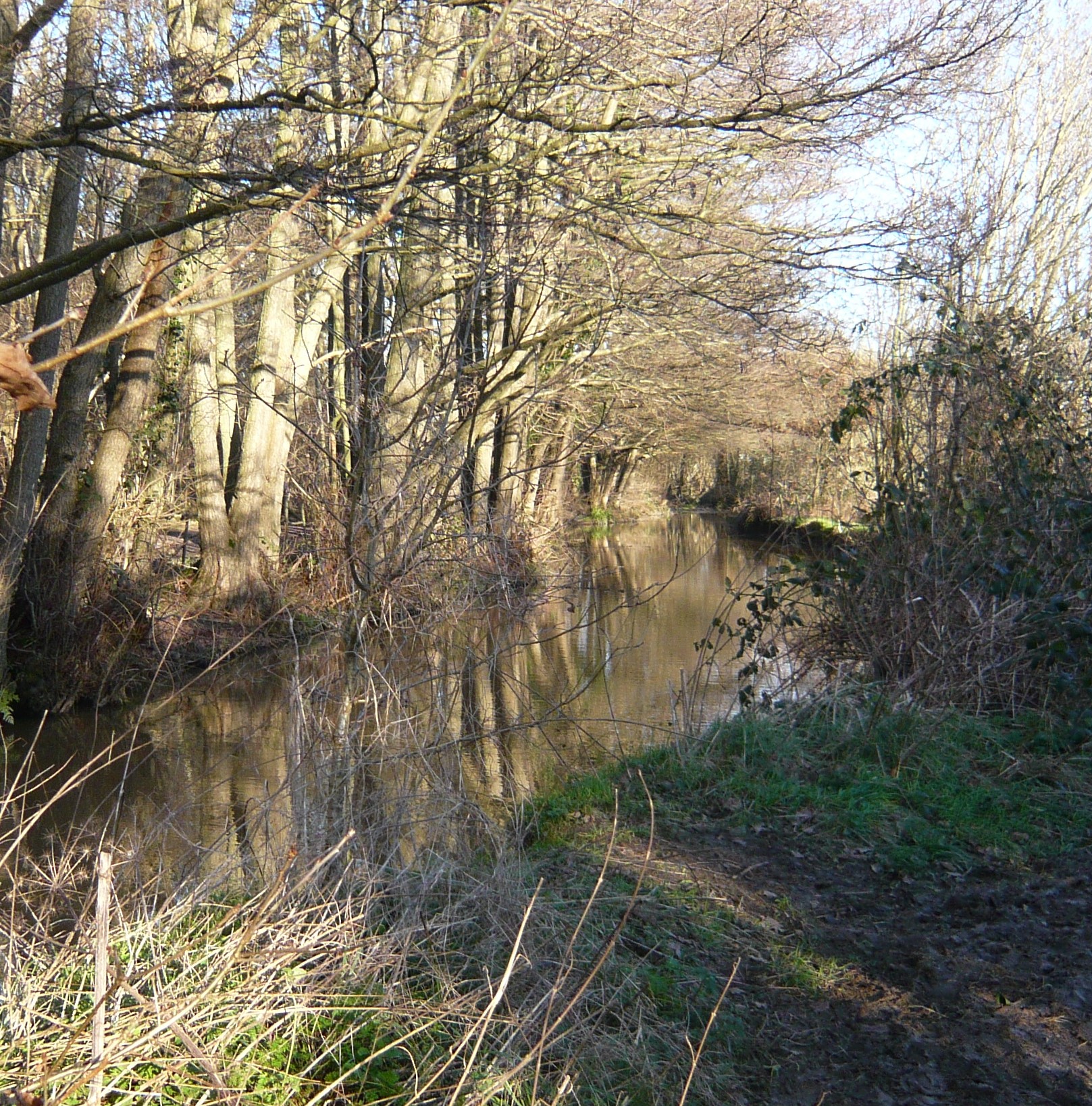
Now, on almost the last leg of our journey, our path ran along south-facing hillsides, through one of the small tea gardens that produce our famous Sussex tea, and then dropped down lower to meet the overgrown and largely clogged up remnants of the Bristol to Tunbridge Wells canal. It was still being used to transport coal and gin from Bristol to Tunbridge Wells, with a return cargo of young slaves, as recently as sixty years ago, after which it fell into disrepair as demand for these products fell off.

P1050087 (2)

Care has to be taken along this stretch, as the old towpath along the edge of the canal is quite obvious, but on the other side lies the Great Groombridge Swamp, which has been known to swallow up unwary travellers. Bob was leading at this point, and we were both keen to reach the end, now. I noticed him straying slightly towards the swamp so I called out ‘Just go right, a bit.’

Oops.

A quarter of an hour later I was enjoying a pint of Black Cat Ale, before catching the bus back home to write up my notes and then make a tricky phone call to Bob’s wife.

Still, all expeditions, like life itself, throw up challenges that have to be faced up to.

Disclaimer:

Please note that an expedition of this nature is not one to be undertaken lightly. Should you wish to follow in my footsteps, you are strongly advised to ensure that you have adequate training and suitable equipment for the journey.