It’s mid February 2008, and I am in Sarnath.

Formerly a deer park, Sarnath lies 10km outside Varanasi and is the place where the Buddha came after his enlightenment at Bodhgaya, to seek out his former companions who were living there in huts and give his first sermon, on the turning of the Wheel of Dharma. This comprises the Buddha’s path to Enlightenment: the Four Noble Truths, the Eightfold path and the Middle Way.

This altar is still used by pilgrims for pujas – not just Buddhists, but also Jains, for whom Sarnath is also sacred.
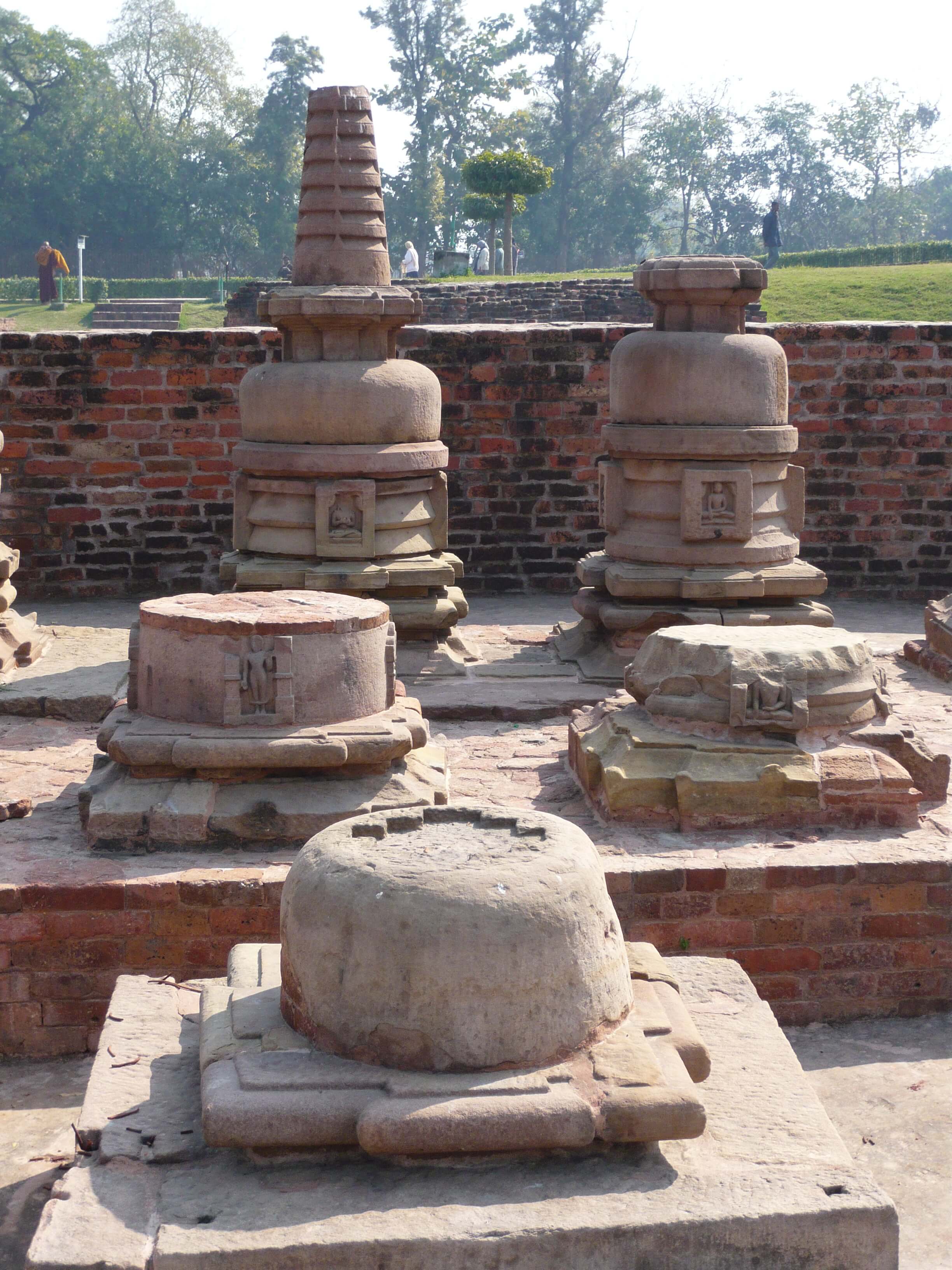

A monastic tradition flourished at Sarnath for over 1500 years after the Buddha. Many monasteries and two great stupas were built, which survived until the end of the 12th century when they were destroyed during the Muslim invasions and not rediscovered until 1834 by a British archaeological team. Amongst these ruins were a stone column 15.25m high with four lions as its capital, erected by the emperor Ashoka, a convert to Buddhism after witnessing the terrible carnage of a war he had unleashed in the 3rd century BC. This capital was adopted as the symbol of the modern Indian republic.
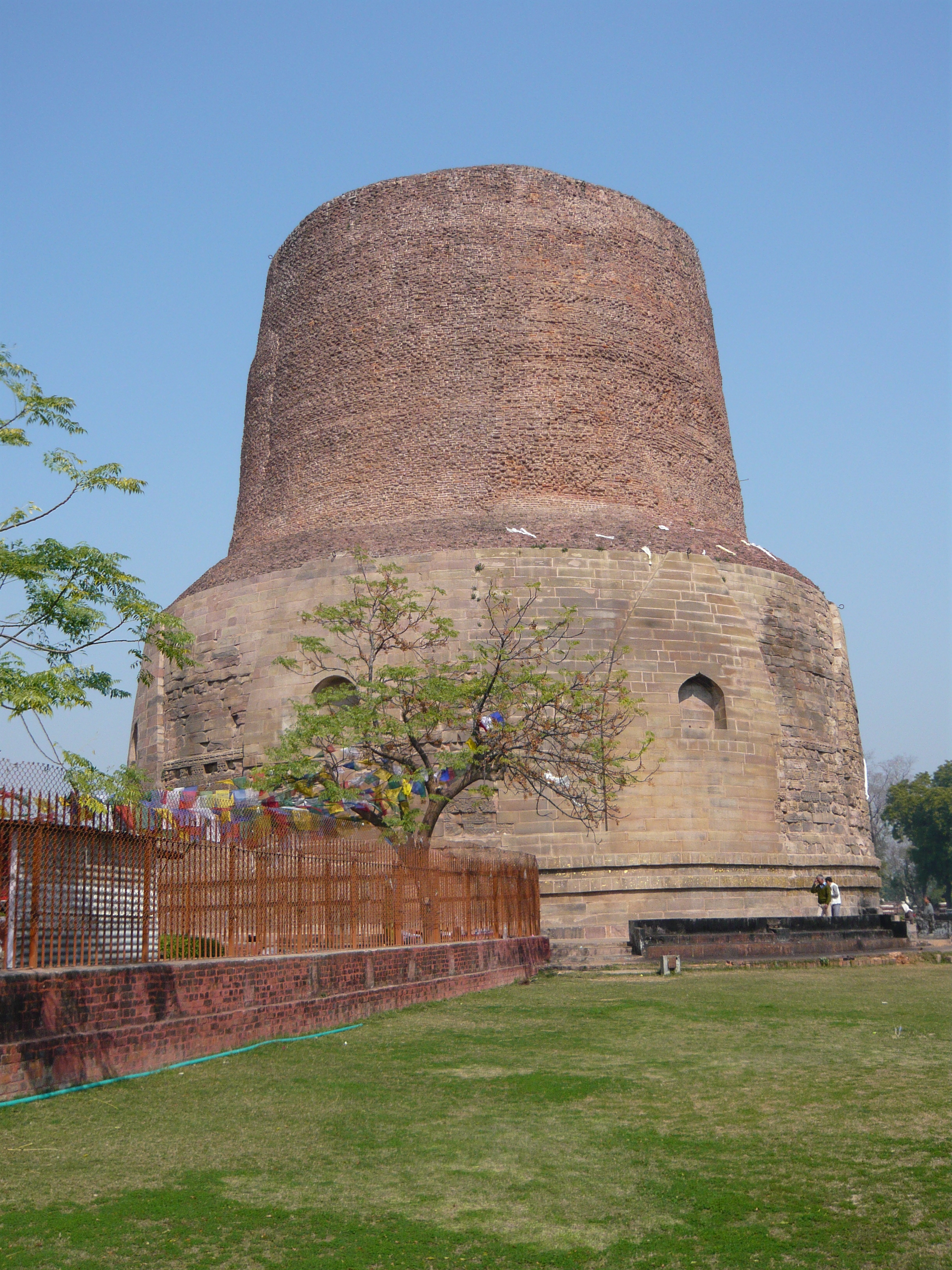
The Dhamekh Stupa. Built in the sixth century, this solid cylindrical tower, 33m high, consists of a stone base with the upper part made of brick, and was virtually the only building to survive the Islamic destruction, perhaps because of its sheer size and bulk. It marks the spot where the Buddha supposedly gave his first sermon. The five former companions, who became his first disciples on hearing him speak, had deserted him when he gave up his ascetic vows. On achieving enlightenment, he determined to follow the ‘Middle Way’, avoiding both luxuries and asceticism. This is the basis of its appeal to me personally – nothing to do with religion, but a sensible lifestyle avoiding extremes, with kindness at its heart. A philosophy of life.

Delicate carvings on the base of the Damekh Stupa.

Just outside the Deer park, there are a number of modern Buddhist monasteries, attracted to the site because of its history. This particular spot was a beautiful peaceful place, but I can’t remember exactly where it was! I think it was outside the Japanese Temple…

Inside the Dharmachakra Japanese monastery

Mulagandhakuti Vihara built by the Mahabodhi Society in 1931
 Mick Canning
I had to pull out the dictionary for this one, but now I know more about pujas, stupas, and such. I really enjoyed seeing the delicate carvings, and that last photo is great. Structurally, it reminded me of the Taj Mahal.
LikeLiked by 2 people
Ah, I’m glad I run a good seminar! I’ll probably post a follow up to this one soon, so keep that dictionary handy!
LikeLiked by 1 person
Just beautiful, Mick, and great history lesson. I had no idea. I am always so struck by how readily invading armies are to destroy such magnificent architecture. It really stumps me how soulless some people can be.
LikeLiked by 3 people
Sadly, there’s a long history of it, Pam.
LikeLiked by 1 person
😞
LikeLike
I really enjoyed this tour of Sarnath and the Buddha history, the Dhamekh Stupa and other worship structures. I’m really glad you included the close-up of the carvings too. How wonderful that you had the opportunity to tour this area, thanks for sharing it with us, Mick.
LikeLiked by 2 people
My pleasure, Jet. It was definitely a great trip.
LikeLiked by 1 person
Thanks for taking us along, Mick.
LikeLiked by 1 person
You’re welcome, Rupali.
LikeLiked by 1 person
Thank you for the tour, Mick. Such an ancient place! The stupa carvings are beautiful. It’s interesting that various traditions have established monasteries nearby. I’d love to visit but I doubt I’ll get there in this lifetime!
LikeLiked by 2 people
Never say never!
LikeLiked by 1 person
Interesting place. Thanks for the tour!
LikeLiked by 1 person
My pleasure, Jan.
LikeLike
What a fascinating and interesting place, Mick. How lovely to have been able to visit all these sites. I, too, had to look some words up in the dictionary, so I have learned some new things today. Your photos are fabulous – I can’t imagine being as far away as this in a million years. My longest journey was when I took myself off to Southend in 2018/19! No comparison, of course. The Dhamekh Stupa is quite some building and I’m not surprised it was hardly damaged during the Islamic Destruction, as it seems to be so solidly built. What a shame old buildings are damaged so badly during wars, though. Thank you for taking me on your journey with you.
LikeLiked by 2 people
It was a lovely place, Ellie – very peaceful, especially as I had just come from Varanasi which is pretty hectic in so many ways! I’ll probably write another post on a similar place, soon, as just writing this one brought back those feelings of calm and peace.
LikeLiked by 1 person
This post has been very illuminating!
LikeLiked by 1 person
Thanks, Damyanti.
LikeLike
Interesting place. In the west, they’d probably monetize it and you’d be fighting off tourist hordes.
LikeLiked by 1 person
It might be a bit busier now, of course. But most tourists concentrate on Varanasi, nearby.
LikeLiked by 1 person
Lovely
LikeLiked by 1 person
Thank you.
LikeLike
HI Mick, thanks for sharing this fascinating history.
LikeLiked by 1 person
You’re welcome, Robbie.
LikeLiked by 1 person
For once I thought you were in India. This place always brings the sighs away from the cosmic chaotic sights of Banaras. Thanks Mick. Images from so long ago feels closer and cleaner.
LikeLiked by 1 person
No, not in India, unfortunately. Hopefully will get back there sometime.
LikeLiked by 1 person
I have never been to Sarnath. I remember you having written about this place in one of your previous posts.
LikeLiked by 1 person
Yes, I went there from Varanasi and wrote about both of them a few years ago. This has expanded the bit about Sarnath, somewhat.
LikeLiked by 1 person
Great
LikeLiked by 1 person
You managed to get beautiful photographs of Sarnath, Mick. It was too sunny when we went in March this year. I just took pics from the outside. Thank you for sharing these.
LikeLiked by 1 person
It’s a lovely place, isn’t it?
LikeLike
It is Mick – very peaceful.
LikeLiked by 1 person