Another piece from the hard drive that was intended to become part of a novel set partly in India and partly in the UK in the nineteenth century. Although an entirely fabricated event, all the cricketers here of both teams were actual cricketers of this time. The England team is made up of players from South East England counties, and the Indian team with players from the first Indian tours to England in 1886 and 1888. This match, though, is entirely fictional.
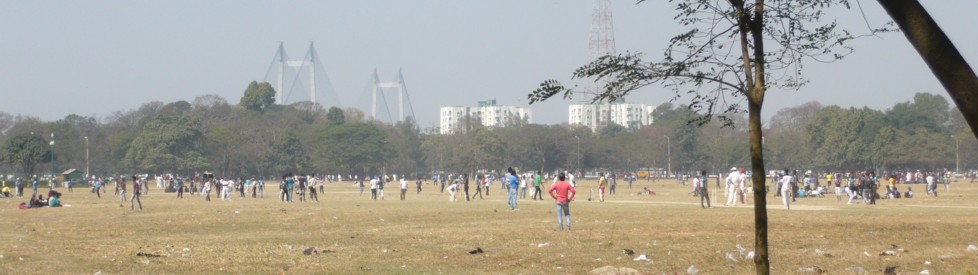
Image: cricket matches in progress on the Maidan, Kolkata.
It was the 13th August 1887, and a cricket match was in progress on the Higher Ground at Tunbridge Wells. It had begun two days previously, with a forecast of fine weather for the whole of its three-day duration and the visiting team, on losing the toss, had been asked to bat first. So far, the match had gone perfectly according to script. The touring Indian team had been bowled out for 117 under sunny skies, the United England XI, under The Honourable G R C Harris, the Kent County Captain, had scored 293 in reply, Harris himself top scoring with a magnificent 109, then the Indians had rallied to 236 in their second innings, a lead of exactly 60. The watching citizens of Tunbridge Wells had applauded politely and dutifully, expecting the openers to knock off the required runs before tea.
It was then that the weather changed.
As the United England openers walked out to bat, the skies suddenly darkened and a few drops of rain began to fall. The umpires looked up, Square Leg umpire wandered across to consult with his colleague, then the rain ceased. The clouds, although fat and dark, refused to release any more rain, so Square Leg umpire wandered back to his mark and the opening batsman took his guard. As he marked out his crease, a light wind whisked away the dust from his scratching bat and the crowd immediately noticed that they had begun to sweat. It was a warm, humid wind, blowing from left to right across the square from the opening bowler’s perspective. The old India hands amongst the spectators looked around in an unconscious, puzzled recognition.
M D Kanga, opening bowler for the touring Indian team, was not particularly fast, but he possessed the ability to swing the ball into the right hander. As he ran in to bowl the first ball of the innings, the wind strengthened slightly. He reached the crease, banged down into his delivery stride and released the ball, which started towards the batsman’s off stump, then curved through the muggy air and struck the batsman on the pad dead in front of leg stump. The batsman, back in his crease and looking to play to cover, was clearly LBW. Kanga and the rest of the Indian team went up in unison to appeal and the umpire, sheepishly, had no choice but to give the Honourable G R C Harris out, first ball. There was a scattered applause from the spectators, which was followed by an appalled silence as Arthur Shrewsbury, England Captain, was clean bowled by Kanga’s second delivery. The England IX were 0 for 2 and Kanga was on a hat trick.
To the relief of the spectators, the Sussex batsman and fast bowler J B Hide kept out the hat trick ball, blocked the next two deliveries, and then opened the scoring with a beautifully struck four back past the bowler. Tunbridge Wells heaved a collective sigh of relief and the world jerked back into motion.
Alec Hearne, Kent opening bat, had watched this carnage from the other end, and played the first ball of the next over carefully back to the bowler. Dhunjishaw Patel, the Indian Captain, bowled old-fashioned, fast underarm – surprisingly difficult to bat against, with its variations in pace, line and length, and with pitches still often fairly uneven. His second and third balls, too, were defended back, until a looser delivery popped up in front of the batsman, asking to be put away. Gratefully he walloped it towards the boundary and called Hide through for a couple of runs. A misfield handed them a third run, however, and the fifth ball was faced by Hide, who also defended carefully. A single off the last ball meant that Hide had kept the strike for the next over. 8 for 2.
Kanga’s next ball went for four, while the second was blocked. As the score went into double figures and the batsmen carefully pushed the score on towards the sixty-one needed for victory, the crowd began to smile again around the boundary edge. 12 for 2 became 14 for 2 and as Kanga came in to bowl the last ball of the over, Hide raised his bat in anticipation and began the pace forward towards the pitch of the ball. As he did so, and exactly at the point at which the bowler released the ball, a small boy in the crowd jumped up directly behind the bowler’s arm. There was no time to call a halt and as Hide quickly tried to refocus his attention on the ball and adjust the stroke, the ball took the edge of the bat and dropped into the waiting hands of first slip. 14 for 3.
Hide stamped off furiously, to be replaced by the number five, W A Humphreys of Sussex. The steady procession of returning batsmen continued then as Hearne decided to take the fight to the Indians, aiming a huge hit at the first ball of Patel’s next over, only to pick out the man at deep mid off. 14 for 4. Henderson, in at number six, survived the rest of Patel’s over, leaving Humphreys to face his first ball from Kanga; straight and fast, kept out. The second swung in sharply – blocked. The third on off stump and edged through slips for two. The fourth blocked. The fifth swung out, again taking the edge but this time taken at second slip. One ball left and the new batsman, Ford of Middlesex, was able to leave one that was too wide. 16 for 5.
The next six overs saw a recovery that saw the score climb to 36 for 5 when, off the last ball of the over, Ford mistimed a drive and was bowled off his legs. 36 for 6.
F Hearne, brother of Alec, usually opened the batting for Kent and was down at number eight for this match, as he had been used as the opening bowler. With only twenty-five needed to win, he decided to swing the bat after taking a couple of balls to get his eye in. The first went for four, the second took the edge and the wicket keeper took a fine catch diving away to his right. 40 for 7.
Pentecost, the English wicket keeper, often batted down the bottom of the order for Kent. In fact, between himself, W Hearne (another brother) and A B Hide of Sussex, there was fierce competition for the number eleven spot. The crowd had begun to get nervous again. He survived the last two balls of Patel’s over, then for the next over Patel took off Kanga and brought on Shaparjee Bhedwar. Bhedwar began by sending down a bit of a loosener which Henderson, playing completely down the wrong line, allowed to cannon into his pads for another LBW decision. W Hearne kept out the next ball, but played all around the third and looked back to see middle and off stump knocked back. A B Hide came in last, to a deafening silence, and kept Bhedwar at bay for the rest of the over. 40 for 9.
All at sea against Patel, Pentecost attempted to block the first ball of the next over, only to see it miss off stump by a whisker and his bat by a country mile. He therefore slogged at the next one, which shot away through cover enabling them to run two. The next one clipped his off stump, the bails came off and it was all over. United England IX second innings all out for forty-two and the Indian tourists had won by eighteen runs. There was a little polite clapping around the ground, but the general feeling was one of anger. The reporter from the local paper sat writing and then crossing out lines in his notebook, his mouth a thin line. The spectators were leaving faster than was usual, but in the refreshment marquee there were heated voices raised.
 Mick Canning
This was an interesting read. I know a little about cricket as Greg played for a few years in junior school.
LikeLiked by 2 people
Thanks, Robbie.
LikeLiked by 2 people
The culture gap was a little too large for me to cross this time! When I hear the word ‘cricket,’ I think only of the insect that roams around making noises. That said, it’s still good to see you posting these so-called remnants, and I’ll look forward to the next.
LikeLiked by 2 people
I don’t think there are many Americans who ‘get’ cricket, Linda. You’re certainly not alone. On the other hand, I don’t understand the first thing about baseball.
LikeLiked by 2 people
Guess what? There are plenty of Americans who understand balls and strikes, but nothing else when it comes to that game (yours truly included).
LikeLiked by 2 people
Equally, many Brits who don’t understand cricket!
LikeLiked by 2 people
Mick, superb writing and I loved the drama of what I always think of as a very sedate and slow game! I felt the tension building and the physicality as each ball thrown and hit!
LikeLiked by 1 person
Thanks, Annika. Success, then.
LikeLiked by 2 people
Prepare for heresy, Mick! I don’t follow cricket, never have, since the day when, at school, aged 11, I faced the sports teacher as I stood in front of the wickets. The bat was too big for me, I wore shorts but no pads, the bowler fired a ball at me and hit my shin. I tossed the bat on the ground and stamped off the pitch with the words, ‘I’m never playing this stupid game ever again!’ And I didn’t.
All the same, I managed to gather some of the message in the story, though any finer points will definitely have evaded me. I’m enjoying your dig into the past, and look forward to more of your discovered remnants.
LikeLiked by 3 people
Well, I don’t know whether we can still be friends, Stuart…😁
I’d better look for something you might be more likely to identify with!
LikeLiked by 1 person
I know, Mick. An Englishman unable to like, let alone follow, cricket. It’s an oxymoron. But a potent reminder of how teachers can form lasting bias in their students!
LikeLiked by 2 people
Presumably not the intended bias!
LikeLiked by 1 person
Difficult to know the man’s mind. Suffice it to report that when that year’s sixth formers left, they took his Mini apart, carried it up to the flat roof of the school and put it back together up there. A sign, I think, of the general opinion of the man as a teacher!
LikeLiked by 2 people
They’d learned something about mechanics, then, it seems!
LikeLiked by 1 person
Oh, way back in those days, as you’ll no doubt recall, it was almost essential to be able to fix your car yourself, and school lessons for some included what we called ‘metalwork’ and, apparently, included some basic mechanical training. I never did metalwork, but used the woodworking class to build a pipe wrack for my dad’s pipes! How things do change, eh?
LikeLiked by 2 people
Same here (although without the pipe rack). I did some woodwork, but metalwork never appealed to me. Although later, naturally, I spent many frustrating and sweary hours trying to fix my cars.
LikeLiked by 1 person
Just noticed my typo on ‘wrack’ for ‘rack’!
I should have been great with cars as my biological dad was a brilliant mechanic. Unfortunately, he died before I was born, and I don’t seem to have inherited his gift. Mind you, I did strip an old Ford Popular side-valve engine down and rebuild it in my teens after another lad in the RAF had given it to me.
LikeLiked by 2 people
I was never any good with cars. If I could ever afford to pay a mechanic or con a friend into doing the work I always would.
LikeLiked by 2 people
We have a weekly cricket match in the village where I live, here in England. Very traditional and probably quite rare nowadays 😀
LikeLiked by 2 people
We still have them where I am, too, in S E England. I think there are still quite a few village teams going.
LikeLiked by 1 person
I know this is an English sport, but you might as well be speaking Greek…
LikeLiked by 2 people
😁 I think I’m right in saying we spoke of cricket before, Dave, with you saying you’d been on an aircraft with a few guys having a bit of a game with a tennis ball (was it you?). Did you not pick up the rules from that?
LikeLike
Air New Zealand, Dec 1988, inaugural flight between Auckland and Cairns. Guess they served too much free booze, I can’t remember any ad hoc rules… 😉
LikeLiked by 1 person
Sounds like my kind of flight!
LikeLiked by 1 person
You set the scene perfectly, Mick. Historical fiction is something I love, and this invented match works beautifully; it reads almost like a lost report from the sports pages of the day. Even for someone who only half‑understands the finer points of cricket (OK, perhaps even less…), the momentum shifts and rising tension come across. Reminds me of the American football playoffs coming this weekend, and my team, Seattle, is playing, so fingers crossed!
LikeLiked by 1 person
Thanks, Randall. I think you’re the first American I’ve come across who claims to even half understand cricket! I’m glad it works, it was fun to write and it’s a shame I’ll never get around to using it in a novel. And as I’ve noted elsewhere in the comments, I know nothing of the rules of baseball or American football (or a host of other sports, come to that!)
LikeLike
During my years in Hong Kong, I was introduced to rugby (the 7s tournament being a highlight for me, such a great game), and then cricket as well. I was on my way to understanding cricket more, but… it’s a strange game 😂. It really is a great story, and to integrate in in a novel would be something (maybe a small novella?!?). Cheers!
LikeLiked by 1 person
It’s always possible. I have some other pieces of experimental writing – none of which would really work as a remnant on here – which might conceivably fit with it. Time will tell!
LikeLike
Love the cricket theme, what inspired you to set part of the novel in India? 🏏
LikeLiked by 1 person
India is a favourite place of mine – many visits over the years!
LikeLike