Creative writer, blogger, and painter, with two novels and one collection of poems and short stories available on Amazon or through my Etsy shop. Also on Etsy, my 'zines: Echoes and Imaginings issues #1 - #3 and An Atheist Buddhist.
Amidst the unfolding horrors from Ukraine, please do not forget – or allow the world to forget – the equally terrible horrors still being perpetrated in Syria, in Yemen, in Ethiopia, in Afghanistan, and the human rights abuses taking place across the globe in too many places to mention.
Show compassion and voice anger about the Russian actions in Ukraine, but save also some compassion and anger for these other countries, and do what you can to bring aid to their peoples. Petition your government and contribute towards humanitarian aid.
Those of us who call ourselves creatives, why do we create? Why do we have this need to make things? I know the usual answer is we write / paint / carve / whatever it is we do, because we have to, because there is something inside of us that needs to find an outlet. But what is that something? In my case, as well as a storyline it is frequently a place where I have spent some enjoyable time. It provides me with a comfortable setting in which to tell a story.
Most of what I do, certainly the work I feel is my best, my most successful (in the sense of expressing what I want to express), falls into that category. My long poem The Night Bus, for example, was the result of a thirty year (admittedly intermittent) search for a way to record my experience of a long bus ride across Northern India into Nepal. I attempted prose and paintings without success, although through this I did develop a style of painting I went on to successfully use on many Indian paintings, and had long given up on the project when chance showed me a way into the poem. The poem I completed succeeds in conjuring up (for me) the impressions and feelings I had on that journey; I can relive the journey again by re-reading the poem. Whether it conveys anything of that to other readers, I naturally cannot know.
And my stories, too. I look through Making Friends With The Crocodile, and I am in rural Northern India again. I re-read The Last Viking and can easily feel myself on an island off the west coast of Scotland. This is not to imply any intrinsic merit to my writing, other than its ability to transport myself, at least, into the setting I am attempting to describe.
These stories are a composite of three basics: a setting, as mentioned already, a storyline – and again this needs to be something important to me, or I find it pretty well impossible to put my heart into it, and strong, convincing, characters.
It is useful, then, to know where lots of my writing comes from, and what shapes it, what drives it. I have long suspected that this is frequently nostalgia and, recognising that, have wondered whether this might be a bad thing. Nostalgia, after all, has a rather bad press…does it just mean I am living in the past because I am viewing it through rose-tinted spectacles? As a way of not addressing issues of today I should be tackling?
This yearning for nostalgia, though, is a desire for something we see as better than what we have now. To write passionately about something it needs to be something I feel strongly about. Obviously this can also be something we find frightening or abhorrent – dystopian warnings about the future or anger about injustices, for example – but even in those cases the familiar provides a cornerstone of safety, even if only by way of comparison.
This is also true when I paint. I am not someone who can paint to order – if I’m not inspired, it does not work. A number of difficult commissions have proved that point to me. I paint what I like, what moves me. After all, whatever I am creating, it should be foremost for myself.
That book, then…
I began writing it about five years ago for all the wrong reasons. I had self-published Making Friends With The Crocodile and decided my next story should also be set in India, and as a contrast decided to write about British ex-pats living in a hill station in the foothills of the Himalaya. I wanted to write about India again. The trouble was, I had no idea what story I was going to tell. I had no stories that might slot into that setting I felt in any way driven to write; it just seemed to feel appropriate at the time. I was pleased by the reception the first book had and felt I ‘should’ write this one.
What could possibly go wrong?
I spent time putting together a plot, with which I was never wholly satisfied, and began writing. Really, I should have seen the obvious at that point and bailed out. But I carried on, and twice reached a point where I thought I had the final draft.
My beta reader then proceeded to point out all the very glaring faults.
So twice I ripped out a third of it and chucked it away, then re-plotted the second half of the book and got stuck into the re-write. I’m sure you can see part of the problem at this point – I wanted to hang onto as much of the story as I could, instead of just starting completely afresh. And now here I am trying to finish the final draft for the third time, as my February project for this year. And it’s just not working for me. But at this point, after well over a hundred and fifty thousand words (half of which I’ve discarded) I just feel I’ve invested too much time and effort in it to abandon it now. Somehow, it has to get finished. I do have an idea for a couple of quite drastic changes which I’ll try this week, but unless I feel I’m making some real progress I’ll then happily put it aside for a while and concentrate on next month’s project: painting and drawing.
And, to be honest, if it eventually ended up as a story of less than ten thousand words, and if I felt satisfied with it, then I’d take that as a result, now.
And the moral of all this? I’m sure there was a point after a couple of months when I knew I shouldn’t have been writing this book. I should have binned it there and then and saved myself a lot of fruitless trouble, but stubbornly ignored the warning signs.
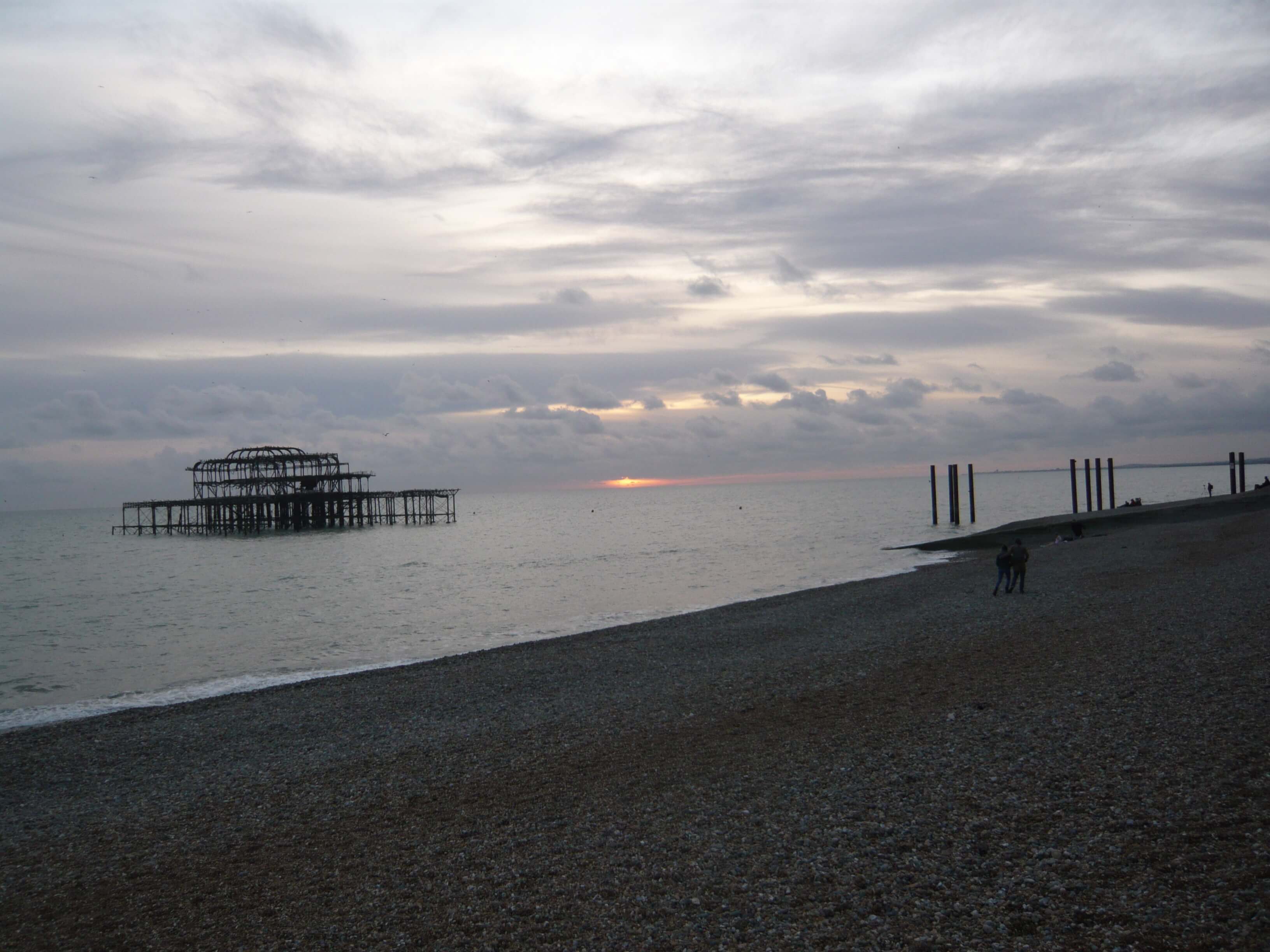
We went down to Brighton for the weekend. Staying two nights there gave us a chance to watch the starling murmurations that regularly put on amazing displays around the old pier. It also gave us the chance to get up onto the South Downs for a good walk.
On the first evening we walked down to the seafront to await the starlings. It was a lovely sky, but with an extremely keen wind blowing in off the sea. After about half an hour our wait was rewarded with a brief but great display as the starlings whirled and dipped and soared in formation around the Old Pier. But guess who’s camera decided to stop working because of the cold? So, no murmuration photos, I’m afraid.
Next morning we caught the bus up to Ditchling Beacon. We were to walk from there to Devil’s Dyke, then catch another bus back down to Brighton. It was very cold and windy in Brighton, and all the way up gusts of wind buffeted the bus. Not a good omen. Anyway, the bus arrived at the top of the Downs and stopped. We got off the bus.
My God, it was bloody cold!
It was extremely tempting to turn around and get straight back on the bus again, but we (just) resisted it.
‘No, really, it’s lovely. Quite refreshing. Why do you ask?’
When we last passed this dew pond four or five years ago, the weather was deteriorating and a few wavelets wrinkled the surface, while the sky was largely blue but with a few clouds rolling in. Today the sky was greyer and waves were careering wildly across the water. Does it look cold? It was bloody cold! I may have mentioned that already.
After an hour or so, we dropped down to the village of Pyecombe and had a quick look around the lovely old church. Then the long, slow walk back up onto the Downs on the other side of the valley. At this point on our previous walk the rain had been pouring down and the clouds getting lower and lower. This time, despite the cold (I have mentioned that, haven’t I?) it was clear and sunny. And by this time, thankfully, we had warmed up somewhat.
Our route took us down a lovely sheltered holloway to another valley, where we began the final walk up to Devil’s Dyke.
By now it was sunny and despite the wind it was lovely. We felt we could have stood there and just looked at it all day. However, we had a pub with hot soup and cold beer to get to before our bus trip back down to Brighton, so we hurried on.
We’ve had rain recently, and everywhere was muddy again. Much more like I would expect February to be. The ground had dried out quite a lot over January, but the soil was still saturated just beneath the surface and it doesn’t take much for it to turn back to thick, claggy, mud. But the weather was better than had been forecast; and as I set out the sun was glinting on the stubble fields and in the shadows there was just the faintest blue hint of frost. It felt so Spring-like. Everything was suddenly green and growing.
Soon, I was much too warm in all my layers. Mornings like this inevitably remind me of other favourite walks; long walks on sunny, clear days. I walked through a valley which was filled with birdsong – blackbirds, robins, blue tits, the demented cackle of a green woodpecker, and the determined drumming of a greater spotted one. In the future I will probably take walks that remind me of this one.
I must sometimes be a frustrating person to walk with – I like to stop frequently and just look around me. Absorb the landscape. The air smells fresh, now, but without the over-sharp coldness that stings the nostrils. Even though it is too early to smell flowers in the air, there is something on the breeze…Something evocative, much like the scent of woodsmoke causes me to instantly think of trekking in Nepal, or campfires closer to home in Sussex.
Suddenly there is a kestrel overhead…I never seem to get those shots of foxes or buzzards and don’t know whether I’m just too slow or if everyone else just walks along with their cameras in their hands, ready to take that photo.
At least flowers and trees tend to keep still. I do find my camera can be an unwanted distraction, though. If I am walking along looking for something to photograph, I feel I’m not really seeing the landscape around me. I’m just searching for a subject. For that reason, I often don’t take a camera with me on walks.
The first peacock, in fact the first butterfly of any kind I’ve seen this year. But talking of green woodpeckers and kestrels, I think there is a case for replacing all their somewhat dull modern names with the ones they used to have in the past: the green woodpecker was the yaffle, named for its wonderful manic call, the kestrel used to be called the windhover – how wonderful is that? And in the seventeenth century it was actually commonly known as the windf*cker. Perhaps the prudish Victorians banished that name the same as they changed the perfectly named white arse to the bland (and meaningless) wheatear.
I think we should reclaim the names; they add extra interest to a long walk.
Well, here we are again. A New Year. At least we’ve had a few sunny days, recently:
On Rye Harbour Nature Reserve, Sussex.
Heading up on to the South Downs from Clayton, Sussex.
‘Jill’ windmill, near Clayton, South Downs.
‘Jack’ windmill – no longer working, and now a private dwelling.
And another shot of ‘Jill’ – restored and now working
I don’t miss 2021 at all, although I’m sure I’m not alone in that. But I got off much easier than many people, of course. I’m still here, for a start. But I had a few health issues that I’m now stuck with, and these have slowed me down a bit and have forced me to alter my lifestyle in small (but annoying) ways. And I feel old. I am old. If you’re under twenty one, then I’m incredibly old!
And for various reasons I had a very unproductive year in that I found writing really difficult and just couldn’t get my head around any art. Although I don’t make New Year Resolutions as such, I’m tackling the uninspired non-productivity by setting myself, well, not exactly goals, but projects for each month of the year.
I have been researching my family tree, and instead of nice neat charts and tables, I have reams of scrap paper with partly legible duplicated notes (and a few charts and tables). For January, then, I am sorting all of those out and making those nice neat charts and tables, and trying to fill in some of the many gaps I’m discovering as I do so. It’s only halfway through the month and it’s going well, so that’s a success so far. But the rest of the year will comprise creative projects. For the next one – February – I intend to fill all the gaps left in my work in progress, A Good Place (the novel I’ve been working on for four or five years). I won’t get around to editing it, but I intend to complete what I am determined will be the final draft.
And then for March, I shall…well, I’ll tell you that in February.
Today the intention is to take it as easy as possible.
Loch Duich
Last night, after a fruitless search for treats I cooked myself some supper and then decided to walk on for another half a dozen miles or so with a view to just leaving a token walk into Kyle of Lochalsh. But I’d already done a good twenty miles already, and it was a really stupid move. Eventually I bivvied just off the side of the road, with the weather closing in rapidly. Clouds were rolling down the mountainsides and coming up the loch. By the time I was in my sleeping bag all hell broke loose. I don’t think I’ve ever heard anything like it. The wind howled and shrieked and at times it screamed. And the rain that accompanied it absolutely hammered down. It seemed to go on for most of the night and I lay there unable to sleep for the noise.
Castle Eilean Donnan
But by six the rain had stopped and the wind dropped, although it was still having a good old blow. I got up, packed up, then walked a mile or so back up the road to get a photo of Castle Eilean Donnan which I’d passed in semi-darkness the previous evening.
Through the rest of the morning I walked along the side of the loch through alternate rain and sun and constant gusting winds. Or perhaps ‘limped’ would be a better description, since I was now extremely footsore, and perhaps that contributed to a slight sense of let down when I got to Kyle. Still, that was my target and I’ve achieved it in around three and a half days. I will have covered around eighty to eighty five miles and since a lot of it was over steep hills and bog, I’m quite pleased with that.
Looking down Loch Aish towards the Isle of Skye
I think it’s important to state here that even if I still enjoyed the same levels of fitness and stamina I enjoyed almost thirty years ago, and was able to repeat this walk, I would not do it this way.
I’ve no wish to set records and, really, I did not wish to do so then, but there is a sort of perverse pride that says ‘Look, I can walk thirty miles a day’, although that is not the only reason I covered so much ground each day. It was the middle of summer in Scotland, with very long daylight hours. The temptation to use them to do ‘just another couple of miles’ was too much at times.
Skye from Kyle of Lochalsh
And now I’m in a cheap guest house and about to have a shower and go out to find a café. Or maybe even a pub.
It rained during the night, but when I emerge from my bivvi in the morning it has eased to an occasional drizzle. Down the valley to the east, the sun is glittering on the trees, while the hilltops are shrouded in cloud. Cotton grass and heather dance around me in the breeze, and it is warm.
Glen Coiltie, looking west.
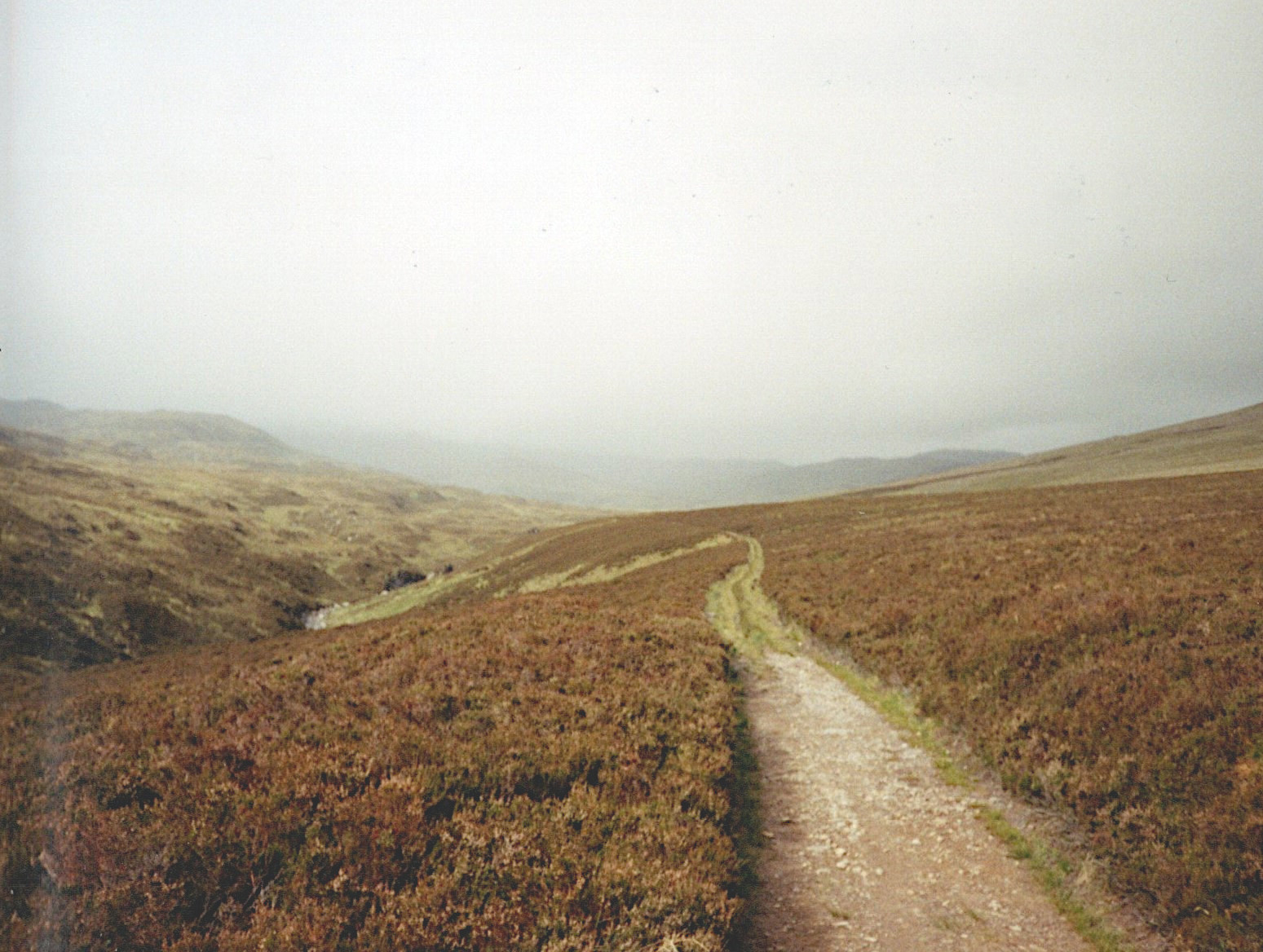
Through the morning, I work my way further west up Glen Coiltie, the wind slowly increasing in strength and the drizzle turning gradually to heavy rain. When I top a final ridge and begin to head down towards Loch Aslaich the wind positively howls. I plod along and gradually up onto a plateau where the path simply disappears. With the low cloud drifting across at ground level this becomes a good test of my navigational skills.
The weather worsens again. At times I stop just to retreat further into my waterproofs rather like a turtle withdrawing its head into its shell. It is a lovely landscape, desolate and wild, but just too wet and windy to enjoy, never mind even to think of taking any photos.
By the evening I am alongside Loch Beinn a Mheadhoin, after a long, wet, day. For a couple of miles I had been looking for somewhere to camp, but the path was through old pine forest and the ground was several feet deep in fallen logs and branches, all covered in moss and lichen. Eventually I find a spot near a waterfall amongst a few birches at one edge of the lake. It is a lovely spot, but I know what will await me in the morning.
21st April 1994
I unzip my bivvi and immediately a huge cloud of midges descends upon me. I forego breakfast for the moment and pack up as quickly as I can, flapping my arms around ineffectively and swearing my very bestest swears.
Not the best place to camp, beside open water with lots of tree cover
Soon enough, though, I am away from the water and ahead of me snowy peaks rear up above the trees. The thrill is upon me again! As I walk through the morning, the clouds are lowering and thickening again, but for now the rain holds off, for which I am thankful. It had been so wet the previous day the rain had managed to soak everything inside my rucksack. During the night I had gradually brought maps and clothes into my sleeping bag for my body heat to dry out. By the morning probably about half of it was dry.
It is colder than yesterday. The snowline looks to be lower here; I am at about three hundred meters and there are pockets of snow level with me on the mountains nearby. But with the improved weather as well as the scenery, my mood is much better and I am enjoying just being part of the environment. It reminds me of other walks and treks I have done – I keep thinking of Nepal! – and in this mood the miles seem to melt away as I walk. The previous day, at one point I had managed less than five miles in three hours up on the plateau in the atrocious weather, so this day is a huge improvement.
The Five Sisters in the distance and Creag a Chaorainn on the right,
I follow a river for a while, and where the water is moving slowly I can really appreciate how beautifully crystal clear it is, even though it has a deep brown hue from the peat. There are tiny orchids in the grass, although I don’t know their name, but few other flowers just here.
An Tudair on the left and Sgurr na Lapaich on the right
And now I pass a couple of walkers and we stop for a brief chat. These are the first people I have seen since leaving Inverness and although yesterday the weather was so bad that only idiots would have been out in it (or one idiot, anyway), in a world of five and a half billion people, to spend a whole day travelling without seeing another soul from dawn to dusk is an increasing rarity.
River Affric near Athnamulloch. The sheep track is so worn it has almost become a tunnel.
I stop for an early lunch and then soon after I set off again I find the path disappears in a particularly boggy area and, predictably, it begins to rain. I take a compass bearing and step forward cautiously. Half a kilometre later I find the path again and the rain stops. Now I go uphill again, over the Eionngleann (lots of these names sound as though they come from Lord of the Rings), down into a long valley where the weather comes in again, and down to the village of Carn-gorm. The village sits at the head of Loch Duich, which joins Loch Aish and this opens up to the Atlantic Ocean. I’m definitely in Western Scotland now. Now to see if there’s anywhere in the village to get a pizza or something more interesting than what’s left in my rucksack.
Eionngleann
Looking North West down Gleann Lichd, my route down to Carn-gorm
My coach got into Inverness at 8.10pm after almost twelve hours on the road, and I was more than ready to begin walking. With over two hours of daylight left, I aimed to get well clear of the city and find a good spot to camp for the night. I grabbed a bag of chips from a chippy, then followed the Caledonian Canal southwest for about four miles, left it and climbed a little more to the west to find somewhere to sleep. I filled my water bottle from a stream, then wandered into a little wood and got out my bivvi tent and settled down for the night, black clouds heading slowly towards me as I did so.
Altourie – rain clouds coming in from the west. Torr Mor in Foreground
19th June 1994
This morning is dry and bright, but quite windy. I boiled some water for coffee and set off as soon as I could, intending to make the most of the good weather. Today I intend to cover quite a few miles on side roads which I hope will be carrying very little traffic and so get a substantial fraction of the journey under my belt before the weather gets any worse. This is Scotland, after all. I‘m expecting rain. It should also break me in gently, being easier ground than much I expect to have to walk. So, I’m aiming for Urquhart Castle, which overlooks Loch Ness and will be a slight diversion from my route but I just fancy having a look at it, and from there I can leave the road and follow the river southwest through Glen Coiltie before turning further towards the west.
As soon as I set off, I was walking straight into the teeth of a strong wind. Long distance footpaths are usually walked from west to east, at least in Britain, and there is a strong argument for that; we get the majority of our weather from the west, so by doing that we have the wind (and whatever it brings with it) at our backs. I’m walking it in the opposite direction not just because I am naturally perverse – or not only for that reason, anyway – but because the more interesting and exciting scenery will be on the west side of the country, and hence my destination. Walking from west to east I feel I would arrive at my destination with a certain amount of disappointment, with all due respect to Inverness which is a delightful city, but I’m after the spectacular wilderness.
So, into the teeth of a strong wind. It is not long, though, before I am walking through Abriachen Forest and I stop for a rest sheltered from the wind.
Abriachen Forest
I rather think Abriachen Forest has changed a little since I passed through there in 1994. I remember it as a dark wood of densely planted conifers, typical of the conifer woodlands planted in the middle to late twentieth century with the intention of producing the maximum possible yield of wood. The trees allow so little light through that other than the trees themselves – Douglas Fir and Sitka Spruce, typically – these plantations (forest is the wrong word) house very little life. But in 1998 the community of Abriachen (a small village) purchased 540 hectares of the woodland and since then have been improving it – thinning the trees, reintroducing native species and creating footpaths and trails.
But on the edge of the forest, and beside the road, there are a multitude of flowers: vetches, Ladies smock, and violets, particularly catch my eye. I draw away from the forest and I am back amongst a more natural landscape, with banks of pepperminty smelling gorse, occasional rowan trees in blossom and heather beginning to flower.
In places, the ground is bright with cotton grass
Now, for the first time, as I leave the road and walk uphill along a track towards the farm of Achpopuli, I get my first good view of large snow-covered mountains to he west. Once past the farm, I am on a supposed footpath heading up towards a saddle between two hill crests but the ground is extremely boggy and proves to be a taste of much of the rest of the route. My feet sink about six inches into either water or soft moss and heather, slowing my progress significantly. But then I m over, and down to a small loch where I stop to refill my water bottle and have a wash. I am surprised by how warm the water is, and I brave a quick dip as well as a shave.
Loch Glanaidh
On, then, to Urquhart Castle and then a little further out of my way to visit Divach falls, a waterfall with a drop of about a hundred feet. And near the bottom, primroses were still out.
Urquhart Castle and Loch Ness
Following a track up Glen Coiltie looking for a suitable spot to make my camp and cook supper I am walking through old forest, such a contrast to the plantation I walked through earlier. The trees are so covered in mosses and lichen it seems at times almost a wonder they are still alive. The path winds up and down and left and right and feels at times like a high mountain trail. Far below I hear the roar of the river, and for almost the first time that day feel I am absolutely in my element.
Eventually I make camp in a small hollow just below Carn a Bhainne. There is a low ridge towards the west which should shelter me from the worst of the wind. After I have eaten, I sit with a mug of tea looking across the river towards a snow pocket that is probably a couple of hundred meters higher than where I am.
A rather nicer day today, although very cold. A day for double socks, a duvet jacket and hands thrust deep into pockets. The birds are into their winter silence, flitting low down between bushes and clumps of trees, although a blackbird does set up an aggrieved alarm call as I approach.
This holly tree keeled over some years ago, but life finds a way to hang in there. Now it throws out lateral branches that act like new trunks.
This holly nearby is laden with berries, which folklore claims is a sign of a harsh winter to come. It’s not, of course, it’s merely the result of the weather patterns we have had earlier this year. It may still be a harsh winter, but the berries are not a portent.
But it’s a very Novembery day, almost a Decembery day. The leaves have fallen and the sun is very low.
But where the sun strikes the trees the light is still glorious.