Historic Darjeeling

Digging into my (admittedly rather small) old postcard collection, I came across a few picturing Darjeeling.

imga

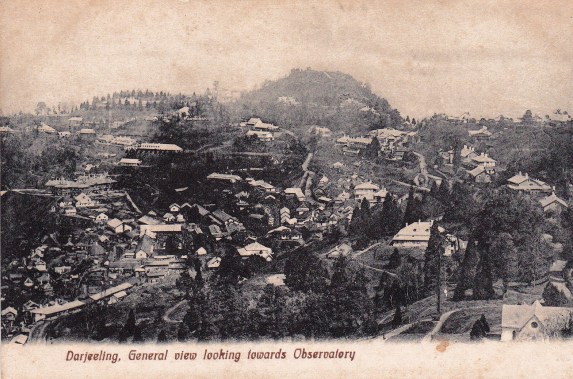
On this first one, other than the title, there is no information on the card. It is unused (as are the other two here), so I do not even have a postmark to help me guess what date the picture was taken. I would guess, however, that although the postcard was probably printed in the 1930’s, the photo could be ten or twenty years older than that. It looks as though the road on the right is The Mall, and the one running from left to right a little way below the skyline could be Hill Cart Road. Looking through a magnifying glass, it is possible to see that there are plenty of pedestrians, but I cannot make out a single vehicle. The photo would have been taken from a high spot on Dr Zakir Hussein Rd, near where the TV tower now stands.

img_0001

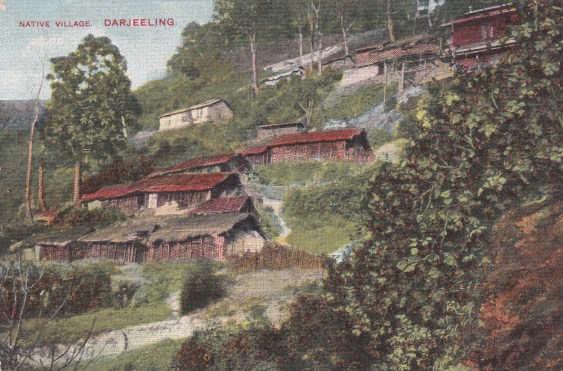
The second one is simply labelled ‘Native Village, Darjeeling’, and is the representation of a hand-tinted black and white photo. ‘Darjeeling’ is much more than the town, of course, and covers a large area all around it. Other than that, I could not hazzard more than a guess where this village lies. Searching through a few internet sites, however, I found another copy of this with a date of 1910.

img_0002

Finally, ‘The Railway Loop above Tindharia, Darjeeling’. Also hand coloured, this particular picture appears to be a copy of a photograph taken in 1880 by Bourne and Shepherd. Also known as ‘Agony Point’, this was built to enable trains to tackle the steep gradients by spiralling around instead of going straight up or down. It is renowned for being an incredibly tight loop.

Perhaps this is also a good place to slip in a link to my previous blog post:

My First Long Trip to India (5) in which I wrote about my impressions of Colonial era India when I visited Darjeeling for the first time.

Trapped!

It’s snowing here, and I fear we are completely cut off from civilisation.

002

Well, this is the UK; we don’t exaggerate a great deal, but our experience of bad weather, especially here in our little corner of the country, is not quite as extreme as in some other places, so cut us some slack, will you?

Now, if it was raining hard, we wouldn’t bat an eyelid. Or eyelids…there could be a grammatical issue here, but I’m not going to pursue it right now. This is the UK, so we do rain. We may not get a monsoon, but, hell, we get more than enough of the stuff. We get floods and high tides and days and days of it pouring out of leaden skies onto us. We get so much of it that if we ever get a period of more than a week without rain, we officially declare it a drought and order everyone not to use hosepipes and make it compulsory to take baths with a friend, and ration it so severely that all we have to drink is beer.

Actually, we should declare a drought most weeks, I reckon.

But back to the present. I had been planning to walk to the nearest large supermarket to do our regular shop for large items, but now this doesn’t look nearly so attractive. And, quite frankly, nor does the thought of the return trip with a rucksack full of catfood and soya milk and other heavy bulkies.

And what is worse, we are running low on essential supplies; eggs, bread, beer…you know, essentials.

Of course, we can get some of these round the corner at the little shops in our own little high street, but because of the severe arctic conditions prevailing outside, we have been reduced to glowering at each other and using psychological warfare;

‘I thought you wanted a newspaper.’

‘I do. I thought you might go and get it.’

‘I’ve got a blog post to write and, anyway, I’m not worried whether we get a newspaper or not.’

‘We’ve got no eggs. Don’t you want an omelette this morning?’

‘I’ve had cereal.’

‘You always have an omelette on Saturdays.’

‘Not always. We need milk soon, too. I only put a splash in my tea, you use much more than me.’

‘Grrr’

‘Snarl’

But you can get everything delivered, now. Perhaps we could get our eggs delivered by Amazon drone, since this is the coming thing. And Amazon sell everything in the world now, or will do soon.

‘That doesn’t sound a good idea,’ says my wife (we’re talking again, although we still haven’t gone to the shops) ‘perhaps they will just put a chicken on the drone, instead, and when it reaches the customer’s house the drone could automatically give it a hormone injection to stimulate egg laying, then return to base afterwards.’

Of course, the calculations would be quite complicated; they would have to take into account the weight and body mass of the chicken, the number of eggs required…heaven knows what else. But I like the idea of parachuting in emergency chickens.

I’m a little worried about the larger items, though. Crates of wine or sacks of rice might pose an altogether different and somewhat stiffer test. How big are the drones? It’s all very well in theory, but none of want drones the size of a 747 landing in our streets with a new refrigerator and a week’s worth of potatoes for the neighbours.

Oh, it’s stopped snowing, now.

4th February 2017

I was reading through my travel journal for 2005, yesterday.

IMG_0002

The Bodhi Tree at the Mahabodhi Temple, Bodhgaya

On 16th March I arrived at Bodhgaya, for my second visit to this lovely small town. Because I was going to be away from England for my eldest daughter’s birthday, she had asked me to write and send her a poem. I wrote this in the evening after visiting the Mahabodhi Temple, and after meeting with Indian friends I had not seen for a year, and thought it entirely suitable to dedicate to her and to send her.

There is a crazy wisdom here;

I am at the heart of all things Buddhist.

Good friends make life bearable.

Gentle people give me hope.

An unexpected friend gives me unlooked-for joy.

I am here,

This is the eye of the hurricane.

The still point in the centre of the universe.

My hope for the world,

My hope for you.

Unquenchable love.

I don’t write a great deal of poetry, because I don’t feel it is really my forte, but in the light of current events around the world, it seems worth posting here. I revised it a little before I sent it, but this was the original draft.

Sending everyone hopes and thoughts of friendship, peace and tolerance.


Three Weeks in Middle Earth

This is a re-post of something I put up not long after I had started this blog. Since I now find that I am read by many more people than I was then, I thought I’d revise it a little and bung it up again.

With grovelling apologies to J R R Tolkien…

***

Our holiday began with a couple of days home stay in Hobbiton, the only settlement of any note in the Shire. Unfortunately, this rather set the tone for the rest of the trip. Immediately, it proved impossible to pick up a mobile signal of any kind, a problem we were to encounter time and again throughout Middle Earth, which made trying to alter our travel arrangements extremely difficult.

img

Our host claimed that we had been given what he called ‘the best room in the house’. Hole, more like, in every sense. One could be forgiven for thinking that flush toilets had never been invented. Admittedly, it was pleasant in a rather rustic, bucolic sort of way, and the meals were everything that we could have wished for, but the beds were a nightmare – ours seemed to be made for a child, and Cheryl and I lost count of the number of times we banged our heads on the low door frames.

Then, looking for entertainment, we visited three of the bars in the village, all of which advertised themselves as gastropubs, and I’m afraid that each was full of tobacco smoke and were quite simply too noisy. Incidentally, it was in the third one that we visited, that this guy we spoke to slipped me some odd ring, and since then a whole lot of strange dudes seem to be following us around.

The courier seemed a little surprised at our complaints, the following day, claiming that for most tourists Hobbiton is one of the highlights of their holiday, but agreed that we should move on a day early, if he could not find better accommodation for us. As a result of this, we went on to Lothlorien, which could not have been a greater contrast. Two days there at least made us appreciate Hobbiton – where that had been rather rough and ready, noisy and dirty, Lothlorien was simply bland, boring and anodyne. Entertainment seemed to consist solely of rather highbrow concerts and book readings, restaurants were all rather expensive and uninteresting and we felt that we should be tip-toeing around the whole time, hardly daring to speak other than in whispers. At least, though, the oddballs that had been tailing us disappeared for the duration.

But forgive me if I say little of the journey from Hobbiton. Several days through a bleak, cold and windswept landscape, with nothing to see and no accommodation other than our tents. The last part was the worst part, though. We travelled through some ghastly, cold tunnel, where we felt threatened by attack from bandits at any moment, and all sorts of dreadful noises kept happening. It was simply awful, but the courier insisted that it was normal and quite safe. I will be putting in a strongly worded complaint about him after we return.

And the problems we then had at the border were simply unreal. It seemed at first that they were not going to let us into their wretched land. The ringleader appeared to be a particularly unpleasant and overweight, orange-haired elf who was waving his arms around in a strange fashion and shouting, with a horrible bright red face. ‘Were we Dwarves? Had we not just come from Moria, which was one of the restricted lands?’ Were it not that there happened to be a judge in our caravan, I don’t think they would have let us in. As it was, the red-haired elf muttered something about locking us all up and making Lothlorien great again and stared at us most aggressively until we were out of his sight.

However, I don’t want it to sound as though it has all been bad, and that we have done nothing but complain. Possibly the best part of the trip so far, certainly for Cheryl, was staying in the eco lodge in Rohan. She was delighted that we were so close to horses the whole time, and the lodges reminded her strongly of the yurt that she stayed in on a previous trip away. Our hosts were friendly and happy to indulge us in our whims – mine to sit outside the lodge at sundown with a glass or two of the local (admittedly rather rough) ale, and Cheryl’s to help with the mucking out in the stables.

Personally, I definitely preferred Gondor, a modern, forward-looking country with a booming economy. Although some border regions are still occasionally subject to unrest, the capital, Minas Tirith, is considered by the Foreign Office to be safe to visit, although I was less than impressed when our caravan was attacked by a lone Nazgul, which succeeded in killing two of the armed escort that the travel company had provided for us for this stretch of our journey. Our courier, however, assured us that this was an unusual occurrence and that all steps would be taken to ensure that there would be no repeat. It was after this, though, that they suggested we abandon the day trip to see the ruins at Osgiliath, which was rather a disappointment, and something that we had both been looking forward to.

It was equally disappointing to find that they absolutely refused to take us to Mordor. We met a number of folk in Gondor who assured us that it is completely safe to travel there now, and that visas could be easily obtained at the border crossings. So eventually we booked a couple of nights on a houseboat there, through one of them. We did do our research, and after speaking to several of these guys, we are happy that what we are paying is a reasonable sum. After all, it may not seem much to us, but it is a lot to people living in these third world places. This did entail us having to make our own way there, but it proved easy enough to book a place on a caravan leaving tomorrow morning, through a friend of the houseboat guy who we met in a nearby bar.

One great plus here, is that the authorities apparently consider it vitally important that a good signal is available for everyone, which is very welcome after a couple of weeks of mobile coverage that has been, at best, very patchy. I would have been in touch sooner, but that has proved impossible. One consequence of this is that it has taken us some twenty minutes or so just to update our profiles.

Ah, the guy on the front desk has just called to say that these caravan dudes are here to meet us. We are packed ready, and just need to slip away without being seen by the courier. We have left him a note. I’ll keep you updated what happens!

Darren

Sent from my iPhone, Minas Morgul.
‘Mr Business Brain’ or ‘Trying to blow my own trumpet without ever having learned how to’.

In today’s alternative ‘Alice in Wonderland: ‘When I use a word,’ Trumpty Numpty said in rather a scornful tone, ‘it means just what I choose it to mean — neither more nor less’.

Lewis Carroll obviously saw this fellow coming.

Just thought I’d share that with you. Anyway, back to the task in hand. After two ridiculously hectic weeks, I now have to do my best to catch up with everything. Onward!

***

I don’t have a business brain.

I look at my clutter of short stories and paintings, my carvings and photographs and think ‘I should be able to at least make a bit of a living out of all of these.’

ladakhi door 2            001

But I don’t. And then I wonder ‘how on earth I am going to do it?’ and go ‘aaargh!’ and run off into the distance.

It really doesn’t help.

And so, if I had to have made a New Year’s Resolution this year, it would have been to sort all this out. I didn’t, but that doesn’t mean I can ignore it for any longer.

To begin with, then, how about attracting new blog followers?

Dressed in a loincloth and brandishing a spear (not a sight that sensitive readers should try to picture in their minds), I go charging out onto the lightly wooded WordPress plains, hunting new blog followers.

‘Aha, there’s one!’ I think, spotting a potential follower grazing harmlessly beside the River of Inspiration. I sneak up on them, then hurl a ‘follow’ at them, hoping that they will respond in kind.

Er, no.

It’s just not me, unfortunately. As I have mentioned in the past, I find it incredibly difficult to blow my own trumpet. And I will not ‘follow’ someone just for the sake of getting a ‘follow’ back. I do understand that anti-social media make up the platforms I have to work with, but for some reason I have not yet got my head around using them properly. So for blogs, I shall carry on as I always have. I don’t hunt for followers, I let them find me. Then if they follow me, it is presumably because they like what I’m writing.

Of course, they might simply be after a follow in return, but that won’t happen unless I like what their site does.

I do need to be more professional, though. For a start, then, I have begun to properly update the information on each site I use – such as the ‘Author Profiles’ on Goodreads, Amazon and LinkedIn.

So please feel free to connect with me on those sites – Goodreads LinkedIn. I promise I will put up more book reviews on Goodreads, and try to work out just what the hell LinkedIn is for.

mosque      untitled-grayscale-01

I shall sort out the prices on the paintings and photography websites.

What? Oh, Paintings and Photographs – thanks for asking!

Making Friends with the -Crocodile

And I need to find new ways to promote my novel Making Friends with the Crocodile. 

And then, there is this blog. I must regularly update the information on the ‘About’ page and the ‘My Writings’ page.

Do I need to simply be bolder in my approach to all this? Should I put a ‘shop’ on my blog?

I don’t know. But, learning how to properly use the limited anti-social media I reluctantly and sporadically do take part in (other than blogging), is a priority for me.

But I’m damned if I will ever use Twatter, though.

Venice…a bit…

Call me arty. Call me something, anyway.

I’m in the middle of a ridiculously busy couple of weeks, so in place of one of my usual ‘witty’ and ‘well-argued’ posts, here are a small selection of pictures that I recently put up on my Picfair site.

I still don’t even have time to catch up with anyone else, but I will in a week or so. Honest!

041

Marionettes, masks and puppets in a shop window display.

185

Arches and columns reflected in floodwaters.

059

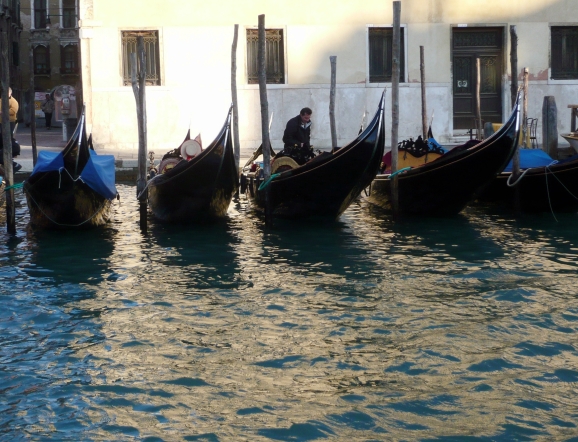
Gondolas. It’s Venice, there have to be gondolas.

154

Umbrellas. It’s raining. You get umbrellas.

166

Chairs in a rainy St Mark’s Square.

081

The Venetian version of a backstreet. Or backwater. Whatever.


Bodhgaya (2) – A Special Place

About six months ago, I put up a post on Bodhgaya (which you can find here if you wish to read it again), and promised I would find a few more photos to post another time.

This is another time.

img_0018

My first picture is of the entrance to the Mahabodhi Temple, which is built on the site where the Buddha achieved enlightenment. The first temple was built by Emperor Ashoka, in the third century BC, and the present one was erected in the fifth or sixth century AD. Visitors remove their shoes (or face a one hundred rupee fine) and descend the steps from the garden that surrounds the temple.

img_0020

Just before reaching the entrance itself, they will pass this small chorten – one of dozens surrounding the temple – garlanded with marigolds.

img_0019

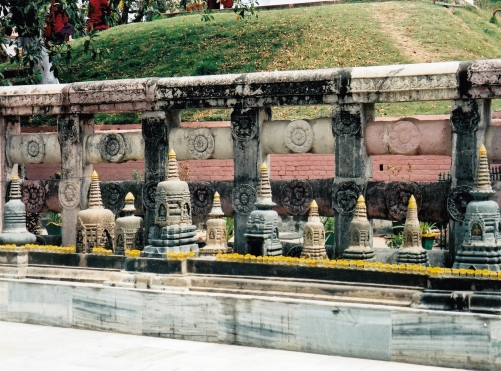
Many more chortens surround the temple and can be found around the gardens themselves, these ones beside a carved sandstone balustrade.

img_0024

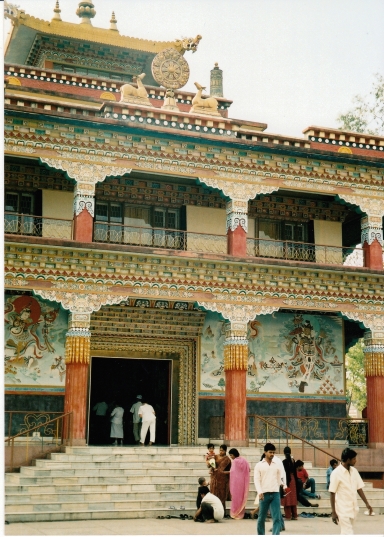
But the Mahabodhi Temple is by no means the only Buddhist temple in Bodhgaya. As the place where the Buddha attained enlightenment, it has naturally been the focus for many Buddhists from around the world, and there are many other temples built by those from the various different branches of Buddhism. This one is one of two Tibetan temples.

img_0017

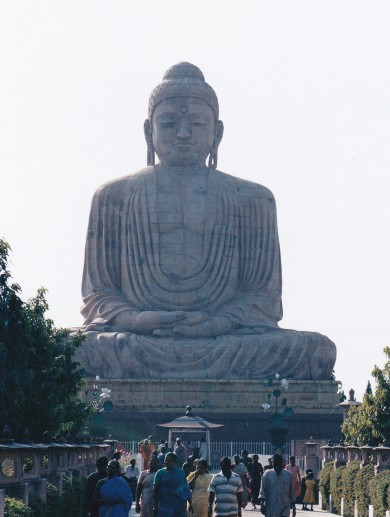
On the edge of Bodhgaya, this twenty five metre tall statue of the Buddha was erected in the grounds of the Japanese Daijokyo temple in 1989.

But Bodhgaya, naturally, is more than simply its temples. Although it is quite naturally a major tourist attraction, it is also home to many people, and daily life is not much different from other towns in Northern India.

img_0023

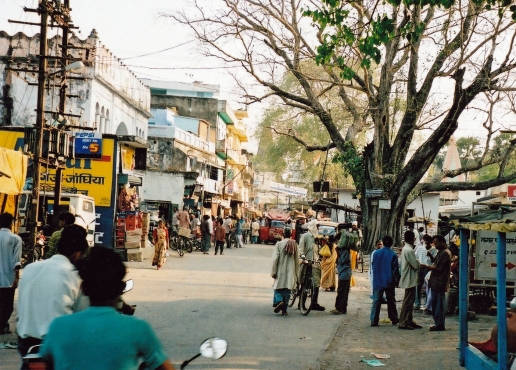
As you approach the temple areas from the northern side of the town, this is a fairly typical scene. In the distance, the share auto that plies between Bodhgaya and Gaya is filling up with passengers, and men and women shop for essentials.

img_0021

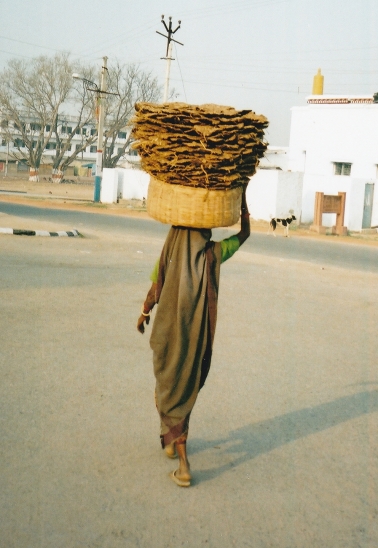
A woman carries a basket of dried cattle dung, which will be used to fuel the cooking fire.

img_0022

And on the edge of the town, the scene quickly becomes rural once again.

From Thursday I shall be away for a few days, but will catch up with comments and other blog posts once I am back.

Stereotypes and Misunderstandings

In countries such as India, there is frequently an impression that Western visitors and therefore, by extension, all Westerners, own vast wealth and have massive amounts of leisure time at their disposal.

After all, they arrive on holiday, perhaps for a month or more, and they go around staying in places that are far beyond the means of the average Indian, spend the equivalent of several month’s wages on souvenirs, often hop on an aircraft to take a journey that would be one hundredth of the price by rail, flaunting expensive cameras and watches and phones and designer clothes. So who wouldn’t think that?

011a

This is not helped by the impressions given by many Western films and programs, where work seldom seems to get in the way of whatever action the film is depicting.

This often affects how local people interact with visitors, and their feelings about them.

I suspect it even drives a certain amount of international migration, too.

And so I think it very important to highlight a few facts;

Basically, the differences in exchange rates of different currencies give the impression of great wealth which is not, in fact, true.

A few numbers:

The average annual wage in the UK is currently £28,000, or $34,400. This sounds a lot (even to me!) but that hides a huge variation, of course.

It is quite hard to find figures that agree about the average annual Indian wage, with estimates varying from around $600, up to around $3500, although this may well reflect the massive difference between the rural worker and a worker in, for example, the IT industry. For sake of argument, I’m going to use the figure of $2000, which could still be slightly on the high side, looking at some of the sites I’ve gone to.

This would give the average UK worker a wage 17 times higher than the Indian. Sounds good for us, but the average cost of a house in the UK is now some £300,000 – that’s $369,000, and it is now almost impossible for young people to buy their own house unless they are helped by well-off parents, and they have very well-paid jobs. The average rent, otherwise, is around $12,300 per year. About a third of the average wage.

To find an average cost to rent in India is also difficult (for me!). I scoured a lot of sites, and seemed to come up with a figure of somewhere around $1,200 a year, although there were massive variations, both between cities and within them. If I have got these figures correct, that is around a half of the average wage.

The prices of basic commodities such as foodstuffs or power vary a lot between India and UK, too. Whereas I have bought street food in India for a rupee or two, making a lunch for perhaps 15 or 20 cents, it would cost me at least $2.50 to $3 in UK for the equivalent.

This isn’t to draw up an accurate comparison between the two – it would be quite a study to do that – but to try to make the point that the average person in the UK is better off (materially) than the average person in India, but not by nearly as much as many might think.

India has more of a problem with poverty, but the West has quite a bit, too. And whilst the poor in the West are emphatically not as badly off as their cousins in India, they still endure considerable hardship. Even with the existence of the supposed safety net of Social Security. There is homelessness. There is malnourishment.

Incidentally, and I pose this as a question to my Indian friends, I frequently read articles that focus on aid and development in poor (especially rural) areas of India, highlighting the fact that a large percentage of the population have to survive on around two dollars a day.

In the light of the above, I wonder whether this isn’t a little disingenuous, since that figure may not be as far below the average wage as many in the West believe, and wonder what you think?

I think it matters, because I believe this might distract attention from where work is needed more, such as improving sanitation, work conditions and medical care.

Happy Christmas!

To all of my blogging friends.

If you celebrate Christmas, then I hope you have a marvellous, peaceful and happy one.

If you don’t celebrate Christmas, I hope that however you pass the time is productive and happy and that the world is kind to you.

ladakh 5 panorama

And thanking each and every one of you for the marvellous conversations and constructive and kind comments that I have enjoyed with you all over the past year, and looking forward to more of the same in 2017.

I won’t be on here much for the next week or so, so apologise now for the posts that I miss.

See you all in 2017.

Oh, so Happy New Year, too!

The Indian edition of my book is published!

Well, it’s taken me long enough, as I’m sure everyone will agree, but I have finally managed to publish Making Friends with the Crocodile as a Print on demand paperback in India! Hurrah!

It is published by Pothi, and is available on their site, here, and on Amazon.in and Flipkart.

pothi-advertising

It is still available as a Kindle e-book from Amazon, and is also available as an e-book from Kobo, worldwide, for those who do not favour Kindle.

I have been told plenty of times that I need to be more proactive promoting the book, but I’m not terribly good at that. However, this is me having another pathetic stab at it:

Buy it now! It’s great! Please…pretty please…

Oh well, I’m working on it.

Should you be kind enough to buy it, or, indeed, if you have already done so, please consider leaving a review. Reviews encourage others to buy the book, and, on Amazon, once a book has garnered a certain number, then Amazon list it a little more prominently – which is a tremendous help to the author!

And I have been lucky enough to garner some very complimentary and generous reviews, so far. A few excerpts:

‘This beautifully written story, set in a village in Bihar, draws you in from its first page.’

‘Making Friends with the Crocodile is a very fine book. And it takes us into the harsh reality of the life of women in rural India, much more effectively than any official report.’

‘The characters are depicted with obvious respect for a culture that is both beautiful and at times shocking. By the novels finale, though tragic, we are left with a very thought provoking and memorable story.’

‘This is a novel with depth and real emotional involvement. Told simply and with an honesty that defies disbelief at events and attitudes, it packs some serious punches. It’s a story that will live with me for a long time, and one that has materially altered my opinions about certain cultural norms. Researched in real depth and related in language that fits the narrator so well, it’s a very good read.’

‘Mick has delved into the mind of a middle- aged woman living in rural Bihar and has beautifully sketched the love – hate relationship she shares with her daughter in law. The book gives a lot of perspective on the mind-set and predispositions that prevail in the rural north Indian society (which apply, at large to many other parts as well).’

The blurb: ‘Siddiqa was only just into her teens when she was forced to leave her home to live with her new husband and his family in another village. The years have passed, and now Siddiqa has three children of her own. Her grown up son has brought his new wife, Naira, to live with them, so Siddiqa is no longer the lowliest in the household, for she has a daughter-in-law.

Life in rural India is particularly harsh for women. This novel explores themes of female oppression and tradition and asks whether the next generation will find life any easier.

I suppose that at least when I publish my next book, I should have a much better idea of how to go about it.