In Another Lifetime I could Have Been…(2)

…a monk.

Yes, you heard me correctly. a monk. Regular readers of this indulgence will know I pour scorn on organised religion, but also that I have a hankering for the simple life and for solitude. I would love to be disciplined enough to do without fripperies, but I never quite seem to get there. Obviously social media would also have to go if I was a monk. In fact, even if I didn’t become a monk, I think perhaps social media should go. That would be good for me.

But not books, of course. They’re Important.
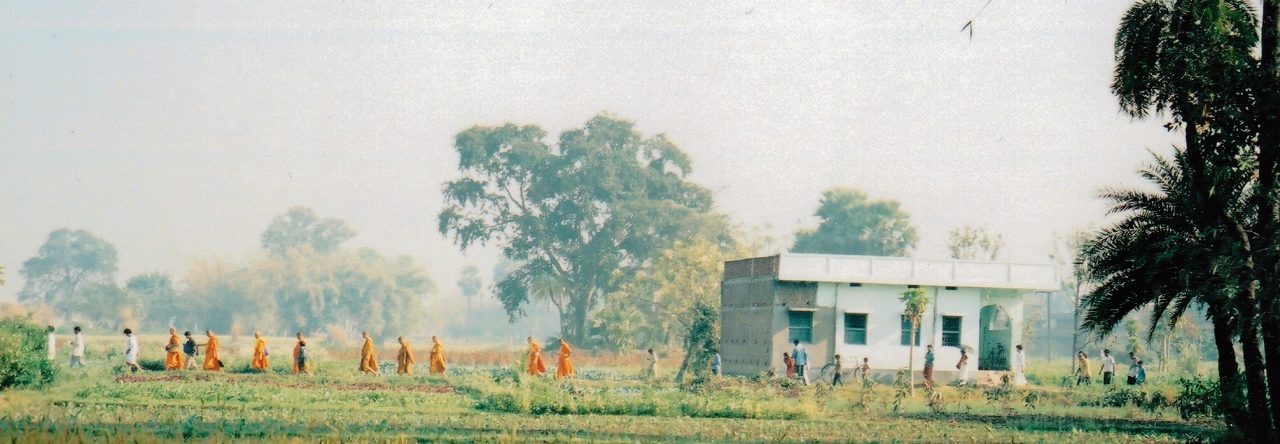
In another time, a time when belief in the predominant religion was a given, I would have had no problem in becoming a monk. But since I don’t have that belief, it sounds like a contradiction to say that to me the spiritual side of life is extremely important, but the spiritual is, to me, separate from religion. I view the spiritual side of me as being that part that yearns for simplicity, for art, for the minimum possessions required for life, and to be surrounded by nature. Incidentally, I also understand that monks are given a daily ration of beer or wine.

That also sounds good.

And because I was fortunate to have been born in an age of scientific enquiry when most people no longer blindly accept religious dogma, but are generally prepared to question it, I am free to make choices based on my own conscience and on what I consider important.
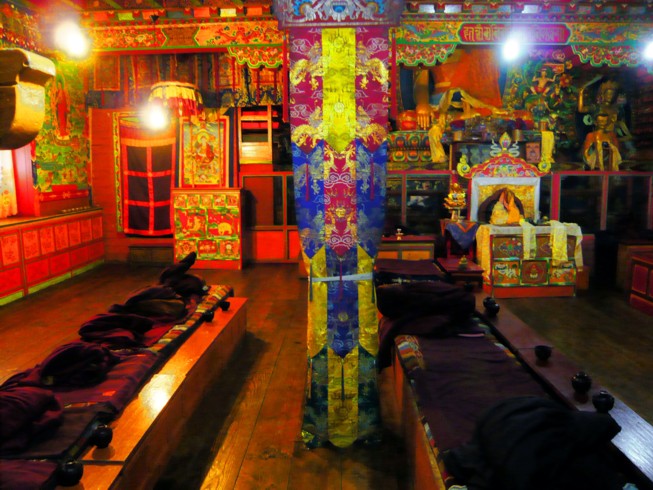
But I could almost, under certain circumstances, become a Buddhist monk, even in this life. I have said before how I am attracted to Buddhism, although as a philosophy rather than as a religion. I like the way the emphasis is on yourself to make your best life. Gods don’t have to be involved.
I have twice spent a week in that sort of environment – one time a week of Zen meditation, which was very hard work but left me with a great feeling of clear-headed calm, and once on a retreat at a Benedictine monastery where I made a point of attending a simple morning service each day and spending the rest of the day in thought and writing and painting and gently wandering around the extensive grounds. As a panacea for the stresses of modern life it was difficult to beat. I could, as I said, see myself in another life settling into the routine there on a permanent basis. But not in this life.
Belief Systems and Rain

I had a conversation with a blogging friend a few days ago, in the course of which she asked me if I knew why it was that so many Westerners seemed drawn to Eastern beliefs, especially the more ‘esoteric’ ones.

I briefly mentioned the fascination the East has held for Westerners throughout history, and the fact that many in the West have drawn away from traditional religion – specifically Christianity – in the last fifty or sixty years especially, and that leaves a void: when you have been brought up within a belief system, that needs to be replaced by something. The Beatles nudged a whole generation in that direction by visiting the Maharishi in Rishikesh in the 1960’s / 1970’s, and there followed a whole slew of books on the subject, many seeming to want to outdo the others in sheer weirdness. But even before that there had been a lot of interest in both Buddhism and Hinduism from the late Victorian period onward, with a number of popular books available.

I can’t claim to be immune to this, either. I also rejected Christianity long ago, but felt I needed something to take its place despite deciding the concept of gods had no place in my life. The world is a wonderful and incredibly beautiful and fascinating place, all of which is explained perfectly well by science. But I do need something to satisfy the spiritual part of me – a part that, surely, all of us have?

I have read a lot about Buddhism, and for a long while thought of myself as a Buddhist. In a way, I still do, although I can’t entirely buy into the belief sets of any of the three major schools of Buddhism. But I did read Buddhism Without Beliefs by Stephen Batchelor. I can’t remember the details of the book, but that is unimportant, it’s the message of the title in this case. I like Buddhism. I like its core message, which pared down to basics is simply to be kind to everyone and everything. It is the only religion I know that has no need for gods. Oh, sure, they’re there if you want them, but no one is ordering you to have one.

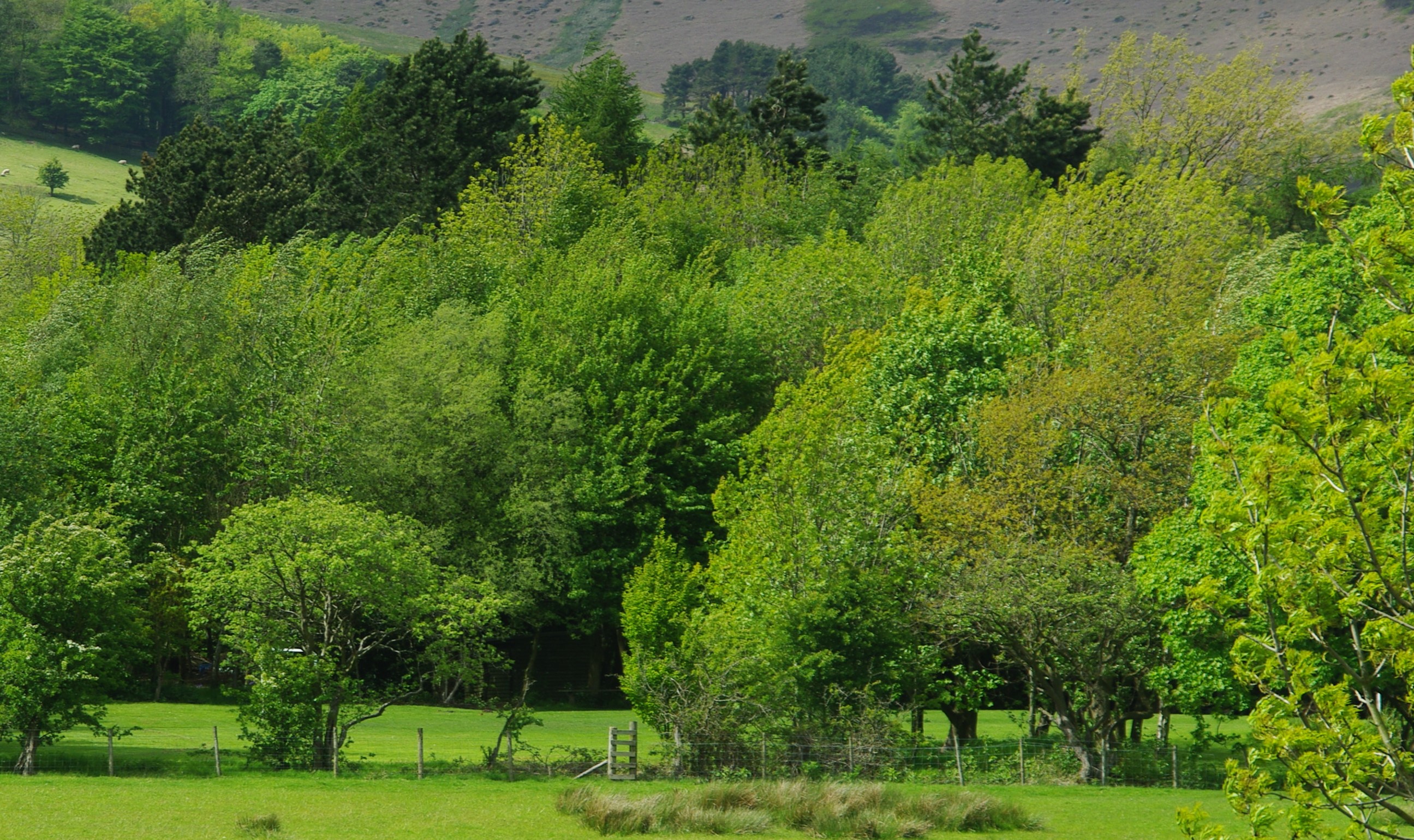
This doesn’t have to be ‘esoteric’ or ‘eastern’, either. It can apply just as well here in the west. And it doesn’t require sacred writings or rituals, I find poetry or a walk in the woods does just as well for me.

I’m listening to the heavy rain as I write this – which is something that seems to happen a lot at the moment, but is something I find particularly soothing. I wonder at the origins of this; is it something primeval, hidden deep in my DNA from the times we lived in caves or rough shelters and we could take comfort from the fact we were snug, and perhaps large sharp-toothed beasts were taking a similar break somewhere and not out looking for early humans to eat? Or is it perhaps just a forgotten memory of a very calming experience I once had, which my subconscious has decided to hang onto for my benefit, but without telling me why? I am aware of a few of the times I’ve experienced it, such as lying in a tent at night hearing the pounding of the rain on the canvas, with a wonderful feeling of warmth and snugness. Then there was another time in the mountains of Spain, coming across an abandoned cottage just as a rainstorm hit and spending the next half an hour or so just sitting on a bench and leaning against the wall, listening to the rain and thinking. I’m sure there must be many more.

In these rainstorms, I feel as though I’m immersed in nature – something that always makes me feel calm and relaxed, and which is but a step from what the Japanese call Forest Bathing. Forest Bathing is essentially taking a walk in woodland, using all your senses to connect with that environment. This reminds me strongly of meditation, especially meditation as I learned it in a Buddhist environment, which is where I’m going with all this rambling. If I have an actual religion now, it has to be nature. A belief in nature as something important, beneficial and precious. I wouldn’t ‘worship’ nature – ‘worship’, for me, has connotations of supplicants on bended knees with hands clasped together intoning religious dogma and praying, but I do have strong feelings of respect and admiration for nature, which I suppose you could call the same thing.

It just seems a pity that more people don’t seem able to accord it the same respect.

A Quiet Place

Hermits have long gone out of fashion, which is rather a shame. At one time I think I might have viewed it as a good career choice. It had its perks; accommodation was provided, usually in the form of a rude hut (that’s rude as in rudimentary, of course, not because there were obscene drawings on the walls. Although heaven knows what the hut’s occupant might have been driven to in the long winter months…) or a romantically ruined building, food was generally provided, although I suspect that within the job description for a hermit it would have been set out that nourishment came in the form of gruel and acorns rather than an a la carte menu, and people generally left you alone to get on with hermitty things. The downside, though, was what those hermitty things consisted of. There would have been long hours of prayer and contemplation, and I think even if the weather was crap, the hermit would be expected to be out in it praying and contemplating – probably contemplating a hot meal, a hot bath and a warm bed. The estate’s owners and guests would expect to view you hermitting, which you’d have to put up with whenever that might occur – probably every time you felt least like hermitting. The rude hut probably leaked and had an earth floor and nowhere to light a fire and you’d probably have to dig a hole in the woods every time you needed a crap and if the estate servants were late bringing the gruel or even forgot about it altogether, I doubt you’d be welcome going up to the Big House to complain.

I’ve no idea whether the terms and conditions of employment were ever open to negotiation, but if the position still existed today, I’m sure they would be. Hopefully, the profession would have been unionised and today’s hermit could look forward to comfortable lodgings with regular meals, well out of the way of the noise and hubbub of society.

But I didn’t intend to talk about hermits, it just kind of happened. We’ve finally got some decent weather here, and yesterday I was walking through a village in the sunshine and idly thinking there are two situations in which I reckon I could renounce the world. One is in somewhere like Kathmandu in the Buddhist temples there. I’ve always had such a profound feeling of peace and stillness in these places. Buddhism is the only set of beliefs I’ve ever really been attracted to, although more as a philosophy of life than as a religion. I can’t do religion. The world is beautiful and amazing enough without throwing imaginary beings into the mix. But Buddhism is more about being a better person and looking after the world and everyone and everything in it. I could melt into that environment without too much difficulty. At least for a while.

The other situation, especially on an English summer’s afternoon in the countryside, is to retreat to somewhere remote and live a simple life away from the world as much as is practical. I’ve probably told you that before. That’s where the hermit thoughts came in.

But sadly, as already mentioned, hermits aren’t a thing anymore. Not in this country, at least. There are openings available in various other countries, but I don’t think I’m ready to explore those options. Perhaps I’ll just go for another walk.

Sarnath

It’s mid February 2008, and I am in Sarnath.

Formerly a deer park, Sarnath lies 10km outside Varanasi and is the place where the Buddha came after his enlightenment at Bodhgaya, to seek out his former companions who were living there in huts and give his first sermon, on the turning of the Wheel of Dharma. This comprises the Buddha’s path to Enlightenment: the Four Noble Truths, the Eightfold path and the Middle Way.

This altar is still used by pilgrims for pujas – not just Buddhists, but also Jains, for whom Sarnath is also sacred.

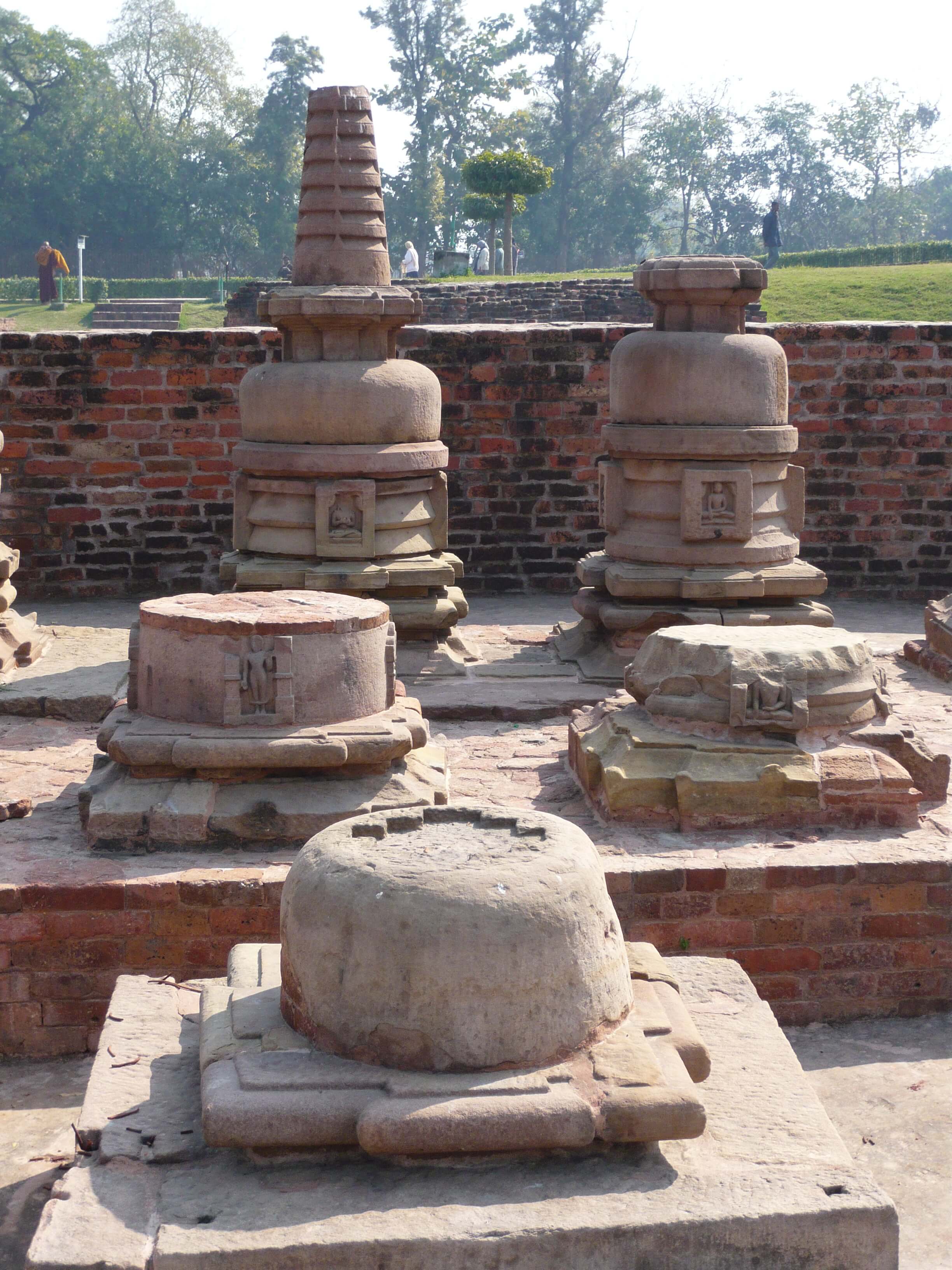
A monastic tradition flourished at Sarnath for over 1500 years after the Buddha. Many monasteries and two great stupas were built, which survived until the end of the 12th century when they were destroyed during the Muslim invasions and not rediscovered until 1834 by a British archaeological team. Amongst these ruins were a stone column 15.25m high with four lions as its capital, erected by the emperor Ashoka, a convert to Buddhism after witnessing the terrible carnage of a war he had unleashed in the 3rd century BC. This capital was adopted as the symbol of the modern Indian republic.

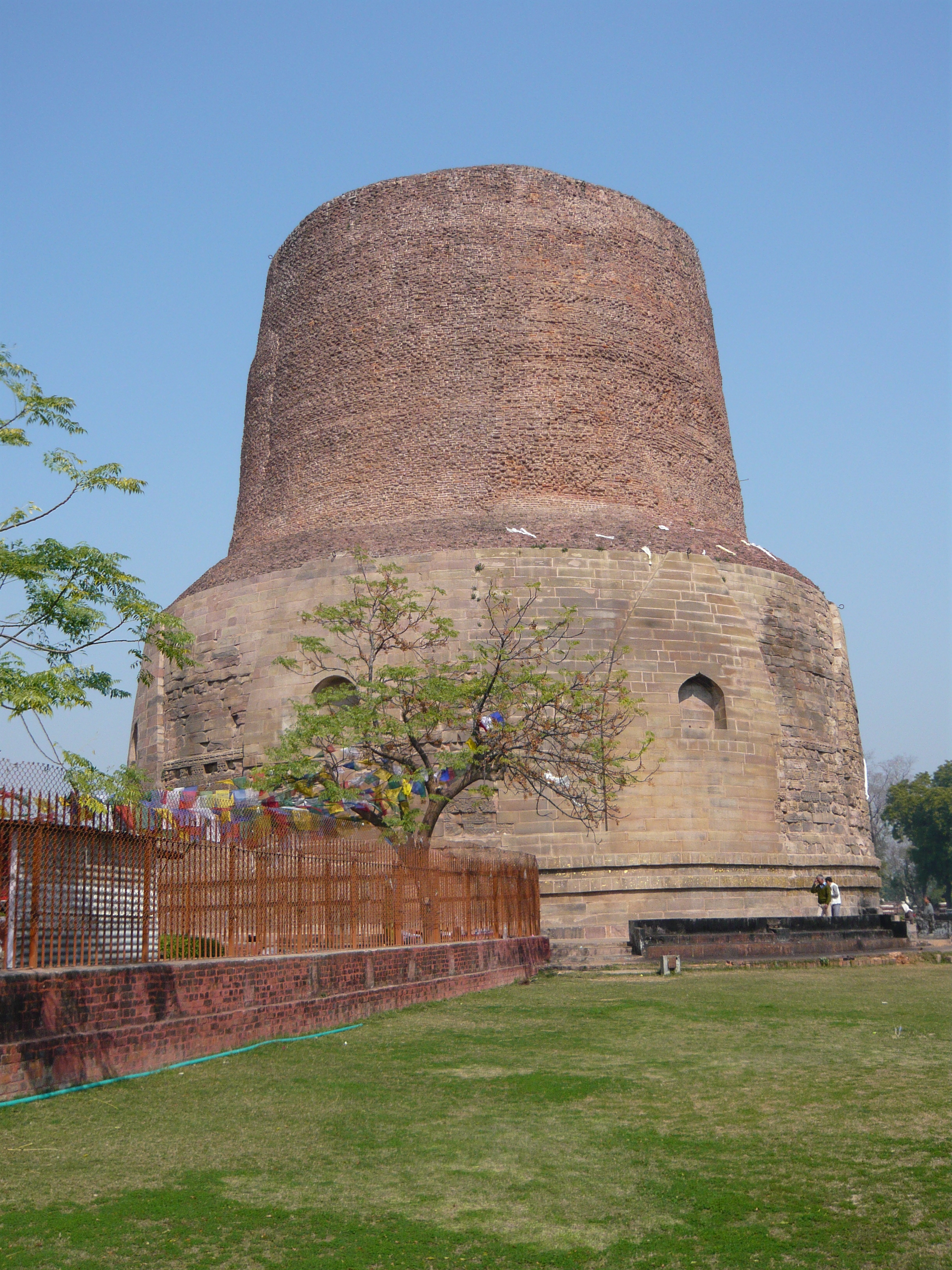
The Dhamekh Stupa. Built in the sixth century, this solid cylindrical tower, 33m high, consists of a stone base with the upper part made of brick, and was virtually the only building to survive the Islamic destruction, perhaps because of its sheer size and bulk. It marks the spot where the Buddha supposedly gave his first sermon. The five former companions, who became his first disciples on hearing him speak, had deserted him when he gave up his ascetic vows. On achieving enlightenment, he determined to follow the ‘Middle Way’, avoiding both luxuries and asceticism. This is the basis of its appeal to me personally – nothing to do with religion, but a sensible lifestyle avoiding extremes, with kindness at its heart. A philosophy of life.

Delicate carvings on the base of the Damekh Stupa.

Just outside the Deer park, there are a number of modern Buddhist monasteries, attracted to the site because of its history. This particular spot was a beautiful peaceful place, but I can’t remember exactly where it was! I think it was outside the Japanese Temple…

Inside the Dharmachakra Japanese monastery

Mulagandhakuti Vihara built by the Mahabodhi Society in 1931

Return To Tengboche…

…but not literally, unfortunately. I did say I would re-post another travel post from some while back, so here it is.

Four years ago I wrote four short posts about Tengboche. Here I’ve combined them into a single post and added some extra pictures and text to give a little more information about this lovely place.

Tengboche is a monastery complex and a couple of trekking lodges at 3860m on the route up to Everest Base Camp from Lukla, in Nepal. It sits high above the waters of the Dudh Khosi, the rapidly flowing river than runs alongside much of the Everest Trail.

The monastery complex. On arrival in the afternoon, the clouds are low. This seems to be the pattern most days – clear mornings and then the clouds coming in early afternoon. In a general sense, weather patterns in the Himalaya – certainly in some parts, and probably at certain times of the year – can be quite predictable. When I trekked the Annapurna Circuit, for example, we were told one evening that around ten o’clock the next morning there would be strong winds blowing in the valley we were to follow, because that was what happened every day. And blow they did. At ten o’clock.

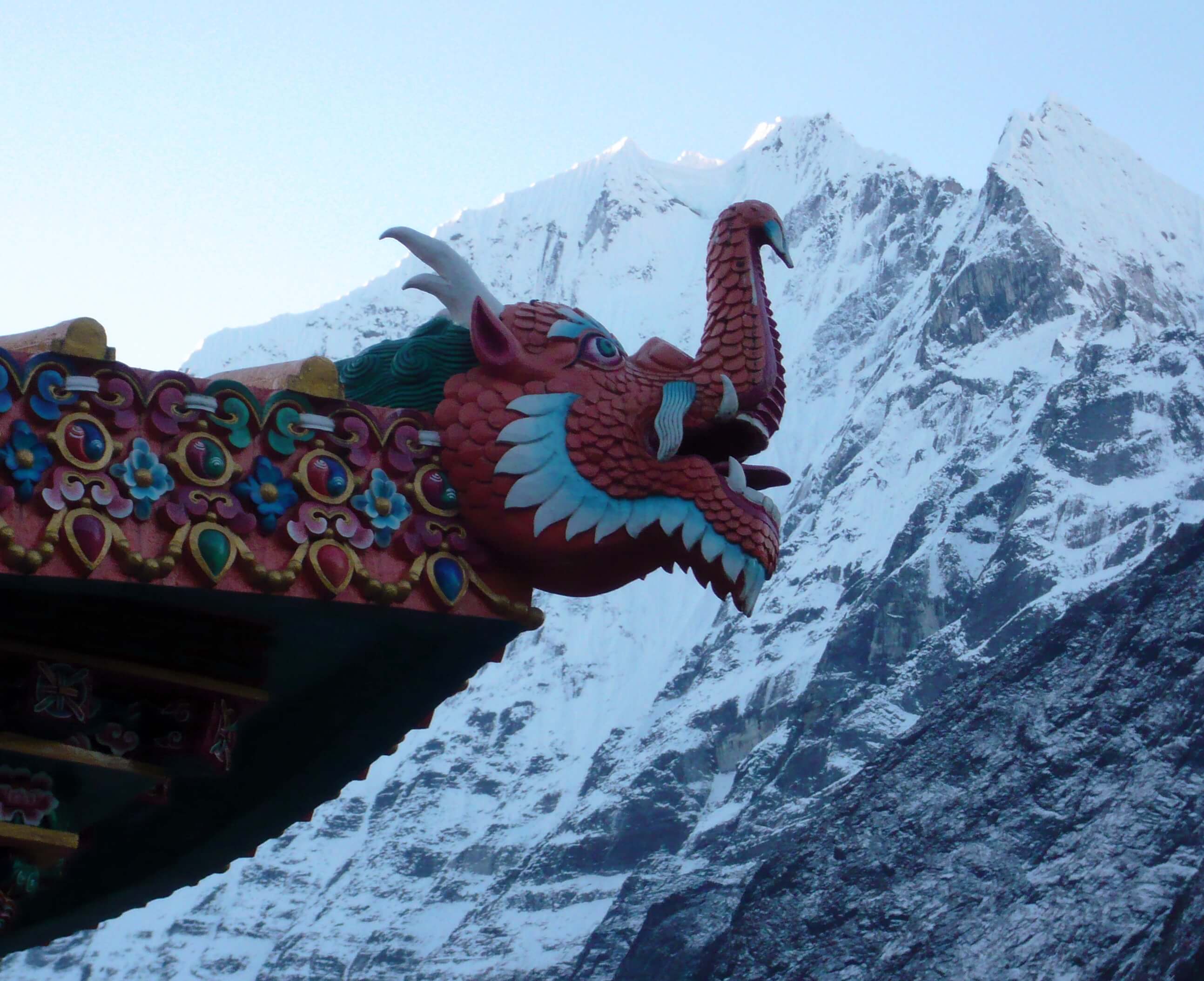
From inside the monastery grounds. The monastery is a Tibetan Buddhist complex, liberally decorated with the pictures, statues, and symbols to be found in every such place.

Roof decoration
145a

Inside Tengboche monastery following a puja (ceremony).

Rightly or wrongly, I don’t like taking photographs of pujas in monasteries. It feels intrusive and bad mannered. I would feel the same in a church, mosque or temple. This has nothing to do with any beliefs of my own, but is born of simple respect.

I noted in my diary: We have just sat in on a chanting puja, but my meditation failed dismally. I was completely unable to concentrate on my breath as all that I could think of were my freezing feet!

It was blooming cold!

198a

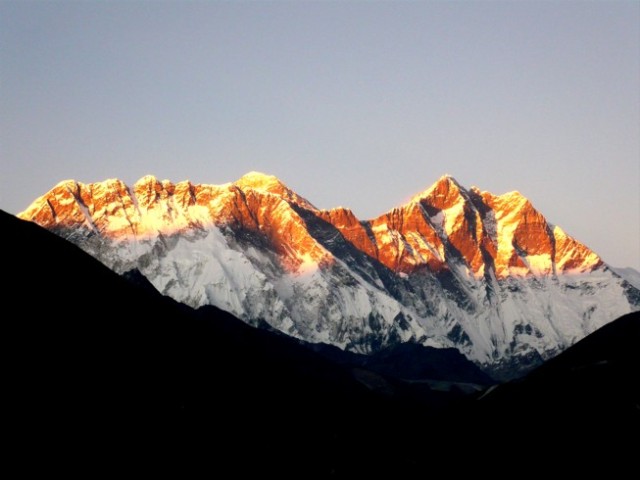
This view must have been photographed so many times, but how fantastic is it? Sunset on Everest (left) and Nuptse (right), photographed from Tengboche. This was taken on my third visit; the other two times the clouds failed to clear in the evening, so this was an unexpected treat.

212a

And this is the same view in the morning – but with the addition of Ama Dablam on the right of the picture. Ama Dablam is possibly my favourite mountain; the classic ‘mountain-shaped’ mountain, similar to the Matterhorn.

Close-up of window showing the dawn chorus orchestra.

We were awoken in the mornings by the harsh notes of conch shells and the clashing of symbols. This was part of the morning puja, rather than a summons for coffee and porridge. It does make for an excellent alarm call, though.

Prayer Flags

Prayer flags are found wherever Tibetan Buddhism is found. As they flutter in the breeze, they use this wind to send blessings out into the world. Through many parts of the Himalaya they adorn monasteries and humble homes, chortens and bamboo flagpoles. They are tied in their hundreds and thousands to bridges, above mountain peaks, and in the courtyards of every conceivable building.

Elsewhere, they are to be found wherever exiled Tibetans live, and wherever their school of Buddhism flourishes.

The makers of the flags intend the prayers and blessings that adorn them not for their own benefit, but for the benefit of all beings.

eleven

Prayer flags in the Yumtang Valley, Sikkim, India.

prayer flags

Prayer flags, Observatory Hill, Darjeeling, India.

IMG_0005

Prayer flags outside a monastery in Sikkim, India.

106a

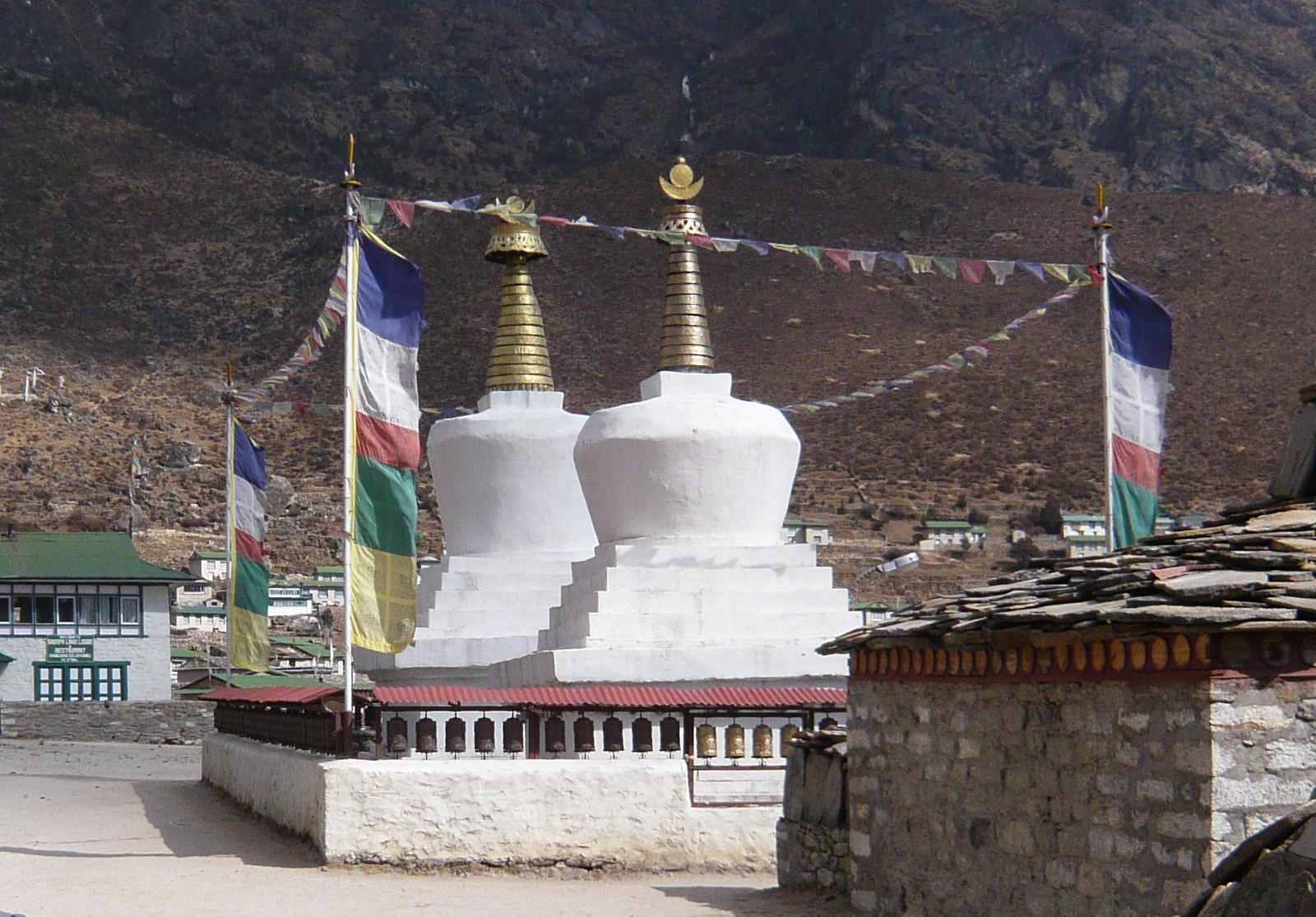
Prayer flags adorn a pair of chortens and walls of prayer wheels in Khumjung, Nepal.

139a

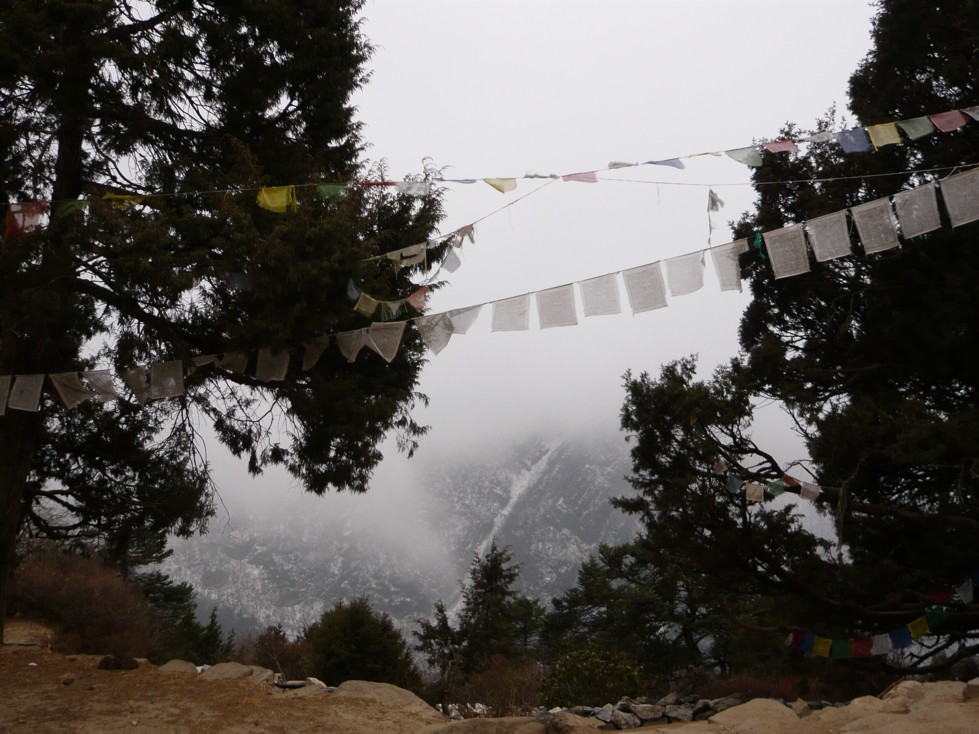
Prayer flags at Tengboche, Nepal.

141a

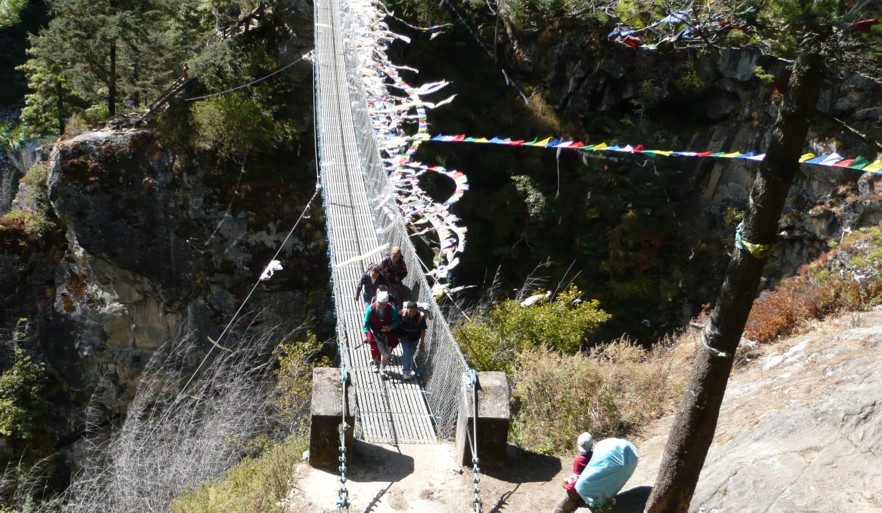
And adorning a bridge of the Dudh Khosi, again in Nepal.

Tengboche – 1

Tengboche is a monastery complex and a couple of trekking lodges on the route up to Everest Base Camp from Lukla, in Nepal. It sits high above the waters of the Dudh Khosi.

145a

Inside Tengboche monastery following a puja (ceremony).

Rightly or wrongly, I don’t like taking photographs of pujas in monasteries. It feels intrusive and bad mannered. I would feel the same in a church, mosque or temple. This has nothing to do with any beliefs of my own, but is born of simple respect.

I noted in my diary: We have just sat in on a chanting puja, but my meditation failed dismally. I was completely unable to concentrate on my breath as all that I could think of were my freezing feet!

It was blooming cold!