Remnant #2 – It’s Just Not Cricket

Another piece from the hard drive that was intended to become part of a novel set partly in India and partly in the UK in the nineteenth century. Although an entirely fabricated event, all the cricketers here of both teams were actual cricketers of this time. The England team is made up of players from South East England counties, and the Indian team with players from the first Indian tours to England in 1886 and 1888. This match, though, is entirely fictional.
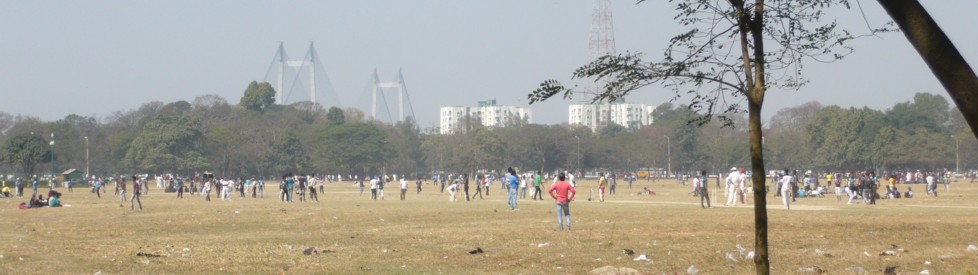
Image: cricket matches in progress on the Maidan, Kolkata.

It was the 13th August 1887, and a cricket match was in progress on the Higher Ground at Tunbridge Wells. It had begun two days previously, with a forecast of fine weather for the whole of its three-day duration and the visiting team, on losing the toss, had been asked to bat first. So far, the match had gone perfectly according to script. The touring Indian team had been bowled out for 117 under sunny skies, the United England XI, under The Honourable G R C Harris, the Kent County Captain, had scored 293 in reply, Harris himself top scoring with a magnificent 109, then the Indians had rallied to 236 in their second innings, a lead of exactly 60. The watching citizens of Tunbridge Wells had applauded politely and dutifully, expecting the openers to knock off the required runs before tea.

It was then that the weather changed.

As the United England openers walked out to bat, the skies suddenly darkened and a few drops of rain began to fall. The umpires looked up, Square Leg umpire wandered across to consult with his colleague, then the rain ceased. The clouds, although fat and dark, refused to release any more rain, so Square Leg umpire wandered back to his mark and the opening batsman took his guard. As he marked out his crease, a light wind whisked away the dust from his scratching bat and the crowd immediately noticed that they had begun to sweat. It was a warm, humid wind, blowing from left to right across the square from the opening bowler’s perspective. The old India hands amongst the spectators looked around in an unconscious, puzzled recognition.

M D Kanga, opening bowler for the touring Indian team, was not particularly fast, but he possessed the ability to swing the ball into the right hander. As he ran in to bowl the first ball of the innings, the wind strengthened slightly. He reached the crease, banged down into his delivery stride and released the ball, which started towards the batsman’s off stump, then curved through the muggy air and struck the batsman on the pad dead in front of leg stump. The batsman, back in his crease and looking to play to cover, was clearly LBW. Kanga and the rest of the Indian team went up in unison to appeal and the umpire, sheepishly, had no choice but to give the Honourable G R C Harris out, first ball. There was a scattered applause from the spectators, which was followed by an appalled silence as Arthur Shrewsbury, England Captain, was clean bowled by Kanga’s second delivery. The England IX were 0 for 2 and Kanga was on a hat trick.

To the relief of the spectators, the Sussex batsman and fast bowler J B Hide kept out the hat trick ball, blocked the next two deliveries, and then opened the scoring with a beautifully struck four back past the bowler. Tunbridge Wells heaved a collective sigh of relief and the world jerked back into motion.

Alec Hearne, Kent opening bat, had watched this carnage from the other end, and played the first ball of the next over carefully back to the bowler. Dhunjishaw Patel, the Indian Captain, bowled old-fashioned, fast underarm – surprisingly difficult to bat against, with its variations in pace, line and length, and with pitches still often fairly uneven. His second and third balls, too, were defended back, until a looser delivery popped up in front of the batsman, asking to be put away. Gratefully he walloped it towards the boundary and called Hide through for a couple of runs. A misfield handed them a third run, however, and the fifth ball was faced by Hide, who also defended carefully. A single off the last ball meant that Hide had kept the strike for the next over. 8 for 2.

Kanga’s next ball went for four, while the second was blocked. As the score went into double figures and the batsmen carefully pushed the score on towards the sixty-one needed for victory, the crowd began to smile again around the boundary edge. 12 for 2 became 14 for 2 and as Kanga came in to bowl the last ball of the over, Hide raised his bat in anticipation and began the pace forward towards the pitch of the ball. As he did so, and exactly at the point at which the bowler released the ball, a small boy in the crowd jumped up directly behind the bowler’s arm. There was no time to call a halt and as Hide quickly tried to refocus his attention on the ball and adjust the stroke, the ball took the edge of the bat and dropped into the waiting hands of first slip. 14 for 3.

Hide stamped off furiously, to be replaced by the number five, W A Humphreys of Sussex. The steady procession of returning batsmen continued then as Hearne decided to take the fight to the Indians, aiming a huge hit at the first ball of Patel’s next over, only to pick out the man at deep mid off. 14 for 4. Henderson, in at number six, survived the rest of Patel’s over, leaving Humphreys to face his first ball from Kanga; straight and fast, kept out. The second swung in sharply – blocked. The third on off stump and edged through slips for two. The fourth blocked. The fifth swung out, again taking the edge but this time taken at second slip. One ball left and the new batsman, Ford of Middlesex, was able to leave one that was too wide. 16 for 5.

The next six overs saw a recovery that saw the score climb to 36 for 5 when, off the last ball of the over, Ford mistimed a drive and was bowled off his legs. 36 for 6.

F Hearne, brother of Alec, usually opened the batting for Kent and was down at number eight for this match, as he had been used as the opening bowler. With only twenty-five needed to win, he decided to swing the bat after taking a couple of balls to get his eye in. The first went for four, the second took the edge and the wicket keeper took a fine catch diving away to his right. 40 for 7.

Pentecost, the English wicket keeper, often batted down the bottom of the order for Kent. In fact, between himself, W Hearne (another brother) and A B Hide of Sussex, there was fierce competition for the number eleven spot. The crowd had begun to get nervous again. He survived the last two balls of Patel’s over, then for the next over Patel took off Kanga and brought on Shaparjee Bhedwar. Bhedwar began by sending down a bit of a loosener which Henderson, playing completely down the wrong line, allowed to cannon into his pads for another LBW decision. W Hearne kept out the next ball, but played all around the third and looked back to see middle and off stump knocked back. A B Hide came in last, to a deafening silence, and kept Bhedwar at bay for the rest of the over. 40 for 9.

All at sea against Patel, Pentecost attempted to block the first ball of the next over, only to see it miss off stump by a whisker and his bat by a country mile. He therefore slogged at the next one, which shot away through cover enabling them to run two. The next one clipped his off stump, the bails came off and it was all over. United England IX second innings all out for forty-two and the Indian tourists had won by eighteen runs. There was a little polite clapping around the ground, but the general feeling was one of anger. The reporter from the local paper sat writing and then crossing out lines in his notebook, his mouth a thin line. The spectators were leaving faster than was usual, but in the refreshment marquee there were heated voices raised.

The Joy of Unknowing (1)

We have just returned from a few days away in Shropshire, which is one reason you haven’t heard from me recently.

We were incredibly lucky with the weather, and spent the time walking and reading and mooching around towns and villages. And finding time for the occasional meal and cold beer, of course.

Yes, we did some lovely walks. And I find it a natural thing to be constantly identifying and photographing whatever I see when out for a walk. I have always been interested in all aspects of the environment, be it the plants and animals, the geography and geology, the weather, or the historical impact of people on the environment in forms such as old trackways, deserted buildings, or ancient boundaries.

006a

And we have spent several fantastic days surrounded by an environment rich in all these things, as we have walked through woods, fields, and open hillsides, seen ancient settlements, butterflies, birds, and many wildflowers, and all this in an area of some of the most complex geology in the UK.

But sometimes I feel myself tiring of the constant need to identify and record everything; it is really a way of trying to own them.

And when you post on social media too, it can feel at times a little like a competition to put up the best pictures of this or that wildflower or bird or mountain, which naturally need to be identified and named. Especially on Twatter, whose format seems to encourage this.

017a

So, on our first morning away, as we walk up a track heading into the hills above Church Stretton, under early morning blue skies with the air crystal clear and beautifully cool, I decide that for now I am just going to exist in the moment.

Because by doing this, I am relieved of the constant necessity of deciding whether this bird is a rook or a crow, or whether that flower is greater stitchwort or lesser stitchwort.

018a

Because it doesn’t really matter.

And for now, instead of having to always know whether it is this or that bird singing, I can allow myself to simply think there is singing. There is birdsong.

Or, even better, there is a sound I find melodic, and it pleases me.

By doing this, I can relax and centre myself, which is something I feel has been badly lacking in my life recently. I have struggled with social media in any case, feeling a huge pressure to post new material and to read the many I follow, even when I don’t feel up to it.

It feels like a return to a much simpler time in my life. I can enjoy the views of the hills, the sounds of the streams and birds, and just concentrate on being.

This must have been part of the pleasure I felt as a child on every occasion when I could roam outdoors. Certainly, I was curious about what I saw, but since I knew so little about them, there was always an openness to the experience and the excitement of discovery. I would see butterflies I had not seen before, and I would just get the thrill of seeing them without having to know anything more about them. I would see wildflowers I didn’t recognise and just enjoy the shapes and colours.

Naturally, you cannot really unknow things in that way, just as you cannot really return to that point in your childhood, but it is possible, even if for only a short while, to let go of the need to identify and quantify (and therefore own) everything, and simply exist in the here and now.

Strolling in Sussex (1)

Yesterday, I went for a bit of a walk. The oppressive humidity of the previous day had lessened, fortunately, and it was an overcast morning with a cool breeze.

Just the way I like it.

I decided to take the train a few stops down the line, where I could get out at one of those stations that bears the name of a village a mile or so away but stands on its own in the middle of the countryside. The nearest building (other than the station itself) is a farm. Hopefully I could have a day’s gentle walking with nothing more demanding around me than birds, insects, trees and wildflowers.

I really, really, needed to do that.

It seemed a good start at the station. A good omen. While waiting for my train to draw in, my eye was drawn to a single large, white, bindweed flower in the tangle of brambles and vines and bushes, trees and garden plants escaped and gone native that serves as a barrier behind the platform.

Most gardeners hate bindweed. I suppose we do, really. Once it gets into the garden it grows at a ridiculously rapid rate and strangles any other plants in its way. And even pulling it up doesn’t get rid of it. It just regenerates. I tell you, come the end of days it will just be scorpions, cockroaches and bindweed left.

But this flower looked lovely. The largest, pure white, bindweed flowers often remind me of the calla lily, only a calla lily that is not so…let’s say…excited. One of my favourite artists is Georgia O’Keeffe. I’ve probably told you that before. But O’Keeffe was particularly known for painting large flower paintings, many of them more than a little ‘suggestive’. And the calla lily was one of her favourites. I’d show you one of hers but, you know, copyright and all that. I’ll leave you to look it up if you wish to.

040a

So, here’s the bindweed flower.

Anyway, I got on my train and later I got off at the correct station and began walking along the footpath and got shouted at by some sheep.

Really, there’s no other way to describe it. On one side of the footpath were a couple of dozen sheep in a field where the grass had been cropped very short and there seemed to be very little left for them to eat. As soon as they saw me, they came rushing over to the fence bleating loudly. Obviously demanding to be re-housed in the field on the other side of the footpath.

In that field, thick lush grass was being munched by a couple of dozen quite contented sheep. I didn’t hear a (Bo) peep out of them.

‘Really sorry,’ I told them. ‘I can’t help you.’ I walked on feeling oddly guilty.

But I got over it.


023a

For the rest of the morning I walked slowly through fields and along lanes, stopping frequently to look at flowers and insects and, really, just enjoying being where I was.

021a

011a

Bridge over the railway

016a

024a

010a

I was just beginning to think it must be lunchtime when my path took me through a field of long grass.

This field lay between a stream I had just crossed, and a wood where I was heading. The wood stood a little higher than the surrounding fields, and the long grass of the field I was to cross was thick and green. The breeze caught the top of the grass, so it waved like the sea or a large lake and as I began to wade through it, it really did feel as though I waded through water.

027a

And there was the drag of the grass against my legs, and the top of the grass sparkled a little in the breeze, just as wavelets would. And there was also the sense that I was not quite sure what I might suddenly step upon. Just to complete the illusion, there were also some lovely blue damselflies darting around.

Then I finally stepped ashore at the edge of the wood, walked up a slight sandy slope that might have been a beach, and sat down to eat my sandwich.

Now, I have to tell you that this was the best sandwich in the world, and I won’t brook any disagreement. Thick wholemeal bread, cheese, several large slices of raw onion, and several thick slices of tomato. Perhaps it was my mood, and the setting, but it was damned good.

And then it was time to explore the wood.

Sojourn on Dartmoor

I’ve been on Dartmoor. My goodness, it was nice to get away.

016a

Dartmoor is frequently misty and moody, as it was on one walk.

021a

Yet it can often be fine and sunny. But whichever it is, I always think of it as unfailingly beautiful.

049a

The sheep get everywhere, including on the top of old spoil heaps from derelict mine workings.

036a

Hooten Wheals is one such disused mine, with a plethora of remnants of old buildings and machine structures still extant. I believe the circular structures are the remains of buddles, circular shallow settling tanks used to extract the minerals from the rock.

056a

There are also plentiful remains of farms, houses and all sorts of settlements, from prehistoric times through to the recent past. These buildings at Swincombe are probably not particularly old.

052a

Old stone crosses are found all over Dartmoor. Their uses include marking the boundaries of the influences of various abbeys and waymarking paths. This one (and the one in the distance) are on Ter Hill.

042a

And because Dartmoor is so open, you get skies.

Wonderful skies.