Historic Darjeeling

Digging into my (admittedly rather small) old postcard collection, I came across a few picturing Darjeeling.

imga

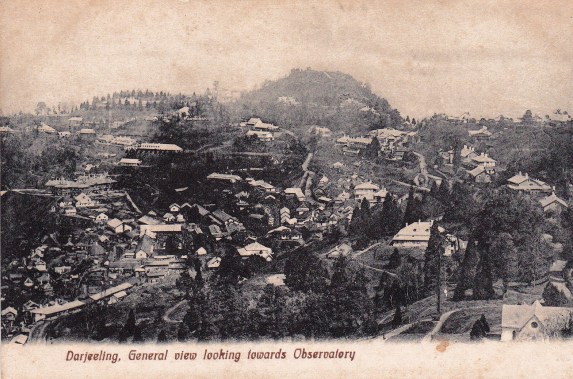
On this first one, other than the title, there is no information on the card. It is unused (as are the other two here), so I do not even have a postmark to help me guess what date the picture was taken. I would guess, however, that although the postcard was probably printed in the 1930’s, the photo could be ten or twenty years older than that. It looks as though the road on the right is The Mall, and the one running from left to right a little way below the skyline could be Hill Cart Road. Looking through a magnifying glass, it is possible to see that there are plenty of pedestrians, but I cannot make out a single vehicle. The photo would have been taken from a high spot on Dr Zakir Hussein Rd, near where the TV tower now stands.

img_0001

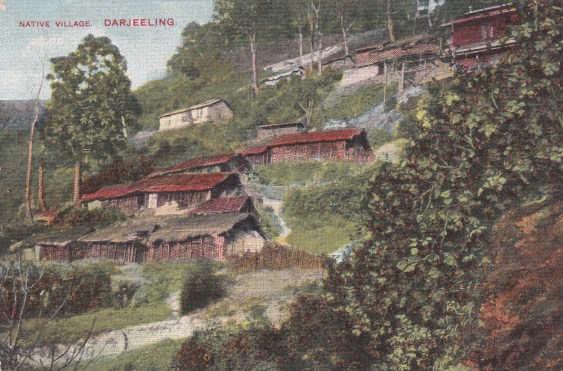
The second one is simply labelled ‘Native Village, Darjeeling’, and is the representation of a hand-tinted black and white photo. ‘Darjeeling’ is much more than the town, of course, and covers a large area all around it. Other than that, I could not hazzard more than a guess where this village lies. Searching through a few internet sites, however, I found another copy of this with a date of 1910.

img_0002

Finally, ‘The Railway Loop above Tindharia, Darjeeling’. Also hand coloured, this particular picture appears to be a copy of a photograph taken in 1880 by Bourne and Shepherd. Also known as ‘Agony Point’, this was built to enable trains to tackle the steep gradients by spiralling around instead of going straight up or down. It is renowned for being an incredibly tight loop.

Perhaps this is also a good place to slip in a link to my previous blog post:

My First Long Trip to India (5) in which I wrote about my impressions of Colonial era India when I visited Darjeeling for the first time.

Varanasi and Sarnath

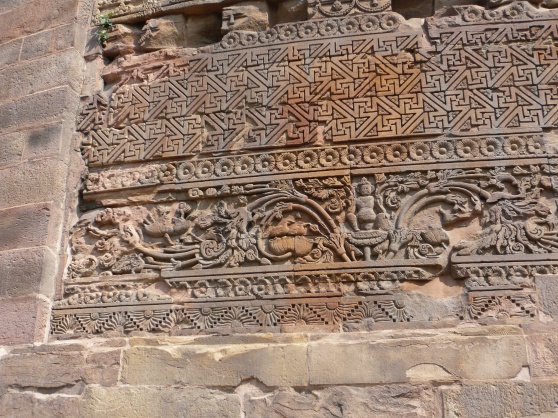
The city of Varanasi is probably the most important place in India to Hindus, whilst the ruins of Sarnath, some 10km away, mark the remains of a site of great importance to Buddhists. I stayed there for three days, some 8 years ago.
039
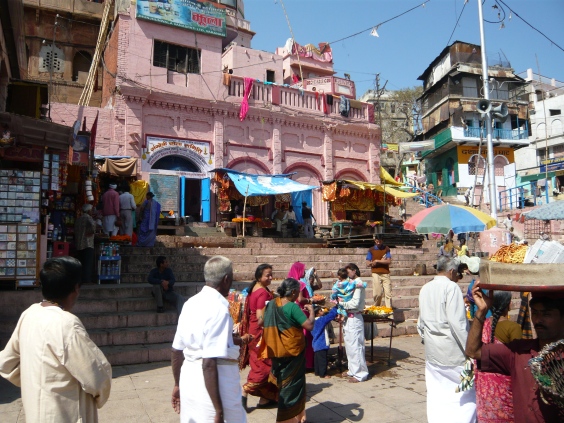
Dasaswamedh Ghat, Varanasi. Taken from the top of the steps (ghats). The River Ganges is the holiest river to Hindus, and Varanasi is the one of the holiest cities. Previously named Benares (and often so still called) and Kashi (City of Life), it is visited by Hindus in their millions who come to bathe in the Ganges to purify their souls. In a final journey, many are cremated here and their ashes cast into the river, believing that this will help to achieve liberation from rebirth.

040

The river Ganges from Dasaswamedh Ghat, Varanasi.

038

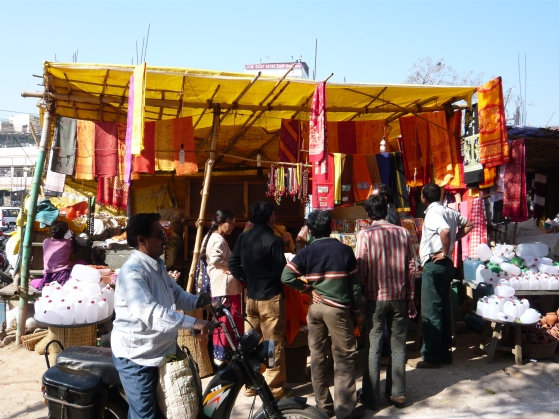
Stalls on the ghats at Varanasi. Varanasi never seems less than vibrant and colourful.

055

And another stall near the ghats.

049

Down at the ghats I was trailed by this cheerful young rogue demanding money to have his photo taken or to show me the sights or sell me souvenirs or lead me to stalls where I could purchase to my heart’s content or…whatever.

037

Street scene in Varanasi. The church in the middle distance is Saint Thomas’. This was taken quite early in the morning when I was on my way to the ghats. Early afternoon as I was returning, it was packed solid, traffic completely unable to move.

004

10km outside Varanasi lie the ruins of Sarnath. After the Buddha had achieved enlightenment at Bodhgaya, he came to Sarnarth – a walk of some 250kms or so, through what would have been highly dangerous country then – to seek out his former companions and in the Deer Park there he gave his first sermon, on the turning of the wheel of law. This comprises the Buddha’s path to Enlightenment: the Four Noble Truths, the Eightfold path and the Middle Way. In the 3rd century BC, the emperor Ashoka, a convert to Buddhism after witnessing the terrible carnage of a war he had unleashed, built stupas and monasteries here as well as an engraved pillar. These survived until the end of the 12th century when they were destroyed during the Muslim invasions and not rediscovered until 1834 by a British archaeological team.

008


This altar stone in the ruins of Sarnath) is still being used by pilgrims for pujas.

013.JPG

Dhamekh Stupa at Sarnath . This solid cylindrical tower, 33m in height, supposedly marks the place where the Buddha gave his first sermon. The base is stone, covered in delicate carvings, and the upper part brick.

016.JPG

Carvings adorning the base of the Dhamekh Stupa.

A Shared Humanity

‘The world knows nothing of its greatest men’ goes the old saying. Or women, of course, since it is men who tend to write these things. I may have alluded to this before.

017

I was reading a blog post by Rajiv earlier today, on the partition of India and Pakistan in 1947, and we swapped a couple of comments, the result of which decided me to write this short post. You can read Rajiv’s post here: Partition in the Punjab

Those of us who did not live through that time, cannot really imagine the full horror of it all. The figures alone are dreadful.

14 million people were displaced, forced to move from their homes to either what remained India or became East or West Pakistan, by any means of transport available, frequently on foot. Those that survived the journey, frequently one of tremendous hardship, carried memories that were often too dreadful to relate.

Most lost their possessions.

Families were split apart and separated, many of them never to meet again.

Millions of refugees.

Up to 1 million were killed in what were effectively religious killings – the actual figure is unknown. Trains were set on fire, men and women, adults and children, lost their lives in what became a frenzy of killing.

Much, of course, has been written of this over the years, and the blame placed on many shoulders. The British were extremely culpable in this case, mainly through neglect and thoughtlessness. Those that assumed power in India and Pakistan need to take their share of the blame, too.

But the world, as I remarked at the start of this post, knows nothing of its greatest men. Or, in this case, its greatest men and women, or at least very little of them.

On both sides of the new borders, whilst most people succumbed to fear and many to hatred, whilst innocent lives were taken and dreadful acts carried out, there were many, many people who sheltered and saved those of other religions who had been their friends and neighbours before, often at great personal risk.

They gained nothing from it, but simply displayed their common humanity.

I have read of a few examples of this, a few stories from both sides of that border, and I have seen it mentioned briefly in documentaries.

But now, before the last players in that tragedy finally pass away, it would be marvellous if there could be a concerted effort to collect these stories and record them, as an inspiring example of people reaching out to each other across what is, once again, becoming a depressingly familiar religious divide, and, most importantly, remembering and commemorating their bravery.

Pitfalls for Writers – no.6: Historical Accuracy


‘Dear Mr. Author.

Whilst reading your book ‘Oh what fun and laughter we had during the time the Black Death wiped out our village’ the other day, I was disappointed to notice that you mentioned July 23rd 1449 as having been a sunny day in your fictitious village. From the descriptions you provide, you have clearly located said village a little to the south of present day Norwich, and my extensive researches prove that July 23rd 1449 would have been a rainy day there.

Yours disgruntledly,

A Pedant.’

How accurate do you need to be, as a writer, with historical facts?

If you are writing a non-fiction book, you have to be scrupulously accurate, no matter what subject it is.

End of.

On the other hand, if you are writing fiction, you have a certain amount of leeway. First of all, though, it is worth saying that if you sell enough copies of your book you will eventually attract correspondents like the fellow above. Is that something to worry about? Only if they get to know where you live, perhaps. Otherwise, send them a nice reply, thanking them for their diligence, and assuring them that you will correct your dreadful fault in the next edition. On the other hand:

‘Dear Mr Author.

The Black Death was actually sweeping the country in 1349, not 1449.

Yours smugly,

A Historian.’

This time, you’ve screwed up.

And yes, it matters.

Very minor inaccuracies are bound to slip through, and very few people will notice them. And if they do, they will not think anything of them.

Except for Arthur Pedant, of course.

The big things are another matter. Imagine reading a novel set in the days around the Russian Revolution, and then the author tells you that the Bolsheviks rose up against the state in 1927 instead of 1917. Or that they were led in the beginning by Stalin. Immediately, the author’s credibility has evaporated, as has their story.

Because the reader no longer believes the author, and they no longer accept their story.

The moral here, then, is don’t skimp on the research!

It is possible to radically change the facts of history, but the difference is that to do this the author must present it as the whole point of the story. In steampunk novels, the whole history of Victorian Britain is altered, but the reader accepts this as it is the premise behind the genre. It is seen not as a mistake, but as a narrative invention.

In many science fiction novels, the premise is a future that is the result of a different history than that which actually happened. For example, the Germans won the Second World War, or of different worlds or dimensions in which history diverges from the accepted version. Again, this is accepted by the reader, as it is the premise that the story is set on.

It is possible to break this rule, but to do so the author has to break it in such a way that it is quickly obvious that they have done it deliberately, and not by mistake.

One might, for example, set a novel in Victorian England that is not steampunk – a detective story, perhaps – but in which Queen Victoria is assassinated in 1860. As this is something that no one could possibly put in by accident, it will be seen as part of the invented narrative and accepted.

Well, probably. Where is Arthur Pedant?

Libya – Leptis Magna

Libya certainly seems to have suffered more than its fair share of misfortune over the years.

I was there in 1988 for six months – not that I’m suggesting that was one of their misfortunes – which should have been a good opportunity to get to know one of those countries that chose to be rather secretive and closed off to the outside world. It didn’t work out that way, of course.

As Westerners, we found it very hard to penetrate Libyan society and, to be honest, we really didn’t try that hard. There were almost no opportunities for socialising with local people, we were regarded with great suspicion by the authorities (although so were most of the general population, of course), and so we ended up in our enclaves even more than is usual in most ex-patriot societies.

But despite that, I discovered that the majority of the Libyans I did meet were wonderful, warm-hearted people. A few were slimeballs, but the same goes for the Westerners – many were great folk, but a few of them were also slimeballs, including the so-called friend who amused himself one evening by spiking my drinks with near-neat alcohol, knowing I was driving home afterwards. If by any freak of chance you ever read this, Shaun, you really are a shit.

It was always said that, as unpleasant and bad as Gaddafi undoubtedly was, there were others around him who were even more seriously dangerous and unhinged. Unfortunately, it seems that a number of them and their colleagues are still wreaking havoc in the country, along with the twisted followers of Isis and various other militias.

But the purpose of this post is to put up some photos that I took in Leptis Magna, which was a huge Roman city a couple of thousand years ago, and is located on the Mediterranean coast near the town of al Khums, some 125 km east of Tripoli. It is the largest extant Roman city outside of Turkey, and is a Unesco designated World Heritage site. I had visited Rome in the past, and I was astonished to see the extent of the remains at this site, which easily dwarfed those in the Roman capital.

Libya was certainly a place where I generally felt uncomfortable taking photos, and so I took very few other than these ones. The quality of the photographs, though, are generally very poor, I’m afraid, since all I took with me was an incredibly cheap camera. I was warned that there was a good chance that anything you took into Libya might get confiscated or simply stolen. The prints have also faded badly over time, and so these are presented purely for general interest.

I do have some more photos of Leptis Magna somewhere, which might be in better condition, so I will try to hunt them out for another time.

Leptis Magna is another one of those ancient sites that is under threat of destruction by the fanatics of Isis, and although I have followed quite a few threads on the internet, I am unable to find out whether there has been any actual destruction there yet. What I do know is that a group of very brave Libyans have formed a kind of militia to protect the ruins. I can only hope that they, and the ruins, are all well.

IMG_0004

Roman  Amphitheatre

IMG_0001

Roman basilica – converted to a church in the fourth century AD

IMG

Roman baths

IMG_0002

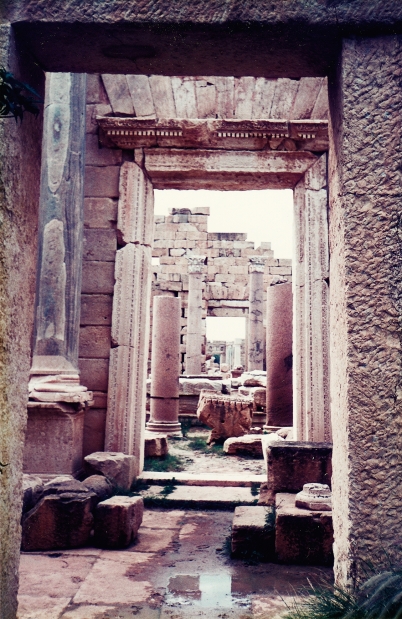
Along a Roman street…

IMG_0003

Through doorways and buildings…

IMG_0005

…and along another Roman street.

The Past is Another Country…

…they do things differently there (L.P.Hartley )

Almost 20 years ago I was a care-worker, paying visits to support elderly folk who were, for various reasons, unable to cope on their own. I would provide support in a number of ways – cooking, washing and dressing,and cleaning, for example.

One man I visited quite often would talk a lot about his younger days – as is natural. He had a wealth of stories, and I always told him he should get someone to write them down. It is the ordinary person’s stories that are frequently the most interesting, and the ones that we usually don’t hear. Famous politicians, sports stars, movie stars…well, they write autobiographies, or have them written for them, and we hear all about the other famous people they knew and the hotels they stayed in…yawn, yawn, yawn.

But we hear far less about the family in the village 80 years ago, their day to day life and how the outside world impacted upon them.

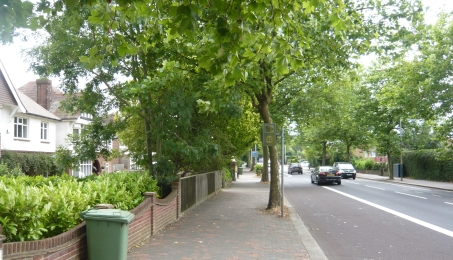
Below, there is a photo of London Road, just outside of Tunbridge Wells, taken earlier today.
005

My client told me that during his youth, he would walk back along this road after an evening out in town, describing how there was nothing but open fields on both sides for much of the walk. Looking at it now, it is hard to picture that, since I have never known it any way other than how it looks now.

But prior to this, in his childhood, he lived in the village of Groombridge, on the other side of Tunbridge Wells, and he told me how, as a schoolboy during the First World War, he and his classmates ran out of the class one day and across a field, to see a German Zeppelin airship that had just been shot down.

It is stories like this, that are the genuinely interesting stories that come out of the past.

And for my large Work In Progress, the past really is a foreign country. Much of it is set in Persia and India, in a time frame that covers some 300 years up until the late 19th century.

Now, I was about to write that if it is difficult for me to picture the main road near where I live as it was some 50 to 75 years ago, then it is far more difficult for me to picture the places in India and Persia where and when I have set my novel, but then I realised that this is not actually true.

And so this post is now taking a turn that I had not expected when I sat down to write it.

The Indian capital at the time was at Fatehpur Sikri, which today is just the remains of those buildings – it was only occupied for some 22 years, and then abandoned. I have visited the site and walked around it, and it is quite easy to imagine it occupied by Akhbar, his court, and the general population.

I have never been to Persia (modern day Iran), so my impressions are formed only at second hand. And much of what I have read consists of works about the 1500’s, and I am familiar with many of the paintings of the period, so again it seems almost natural to imagine it as it was then.

And then when I have travelled in India, as well as in the Middle East, I have spent a lot of time visiting the old parts of the towns and cities, and many rural areas where life follows the same patterns that it has for hundreds of years, and so, again, it seems more natural to picture the settings for my book in those time periods that concern me.

Finally, researching these areas, I often come across old black and white photos of places of interest to me, and since I have not been there, they are the only impression of these places that I have.

Of course, Tunbridge Wells in the Victorian era is much harder for me to visualise. All of the modern buildings get in the way of my imagination. All of the roads are surfaced with tarmac, the open spaces have largely gone, and many parts of the common that used to be open and windswept are now covered in trees.

On a slightly different note….

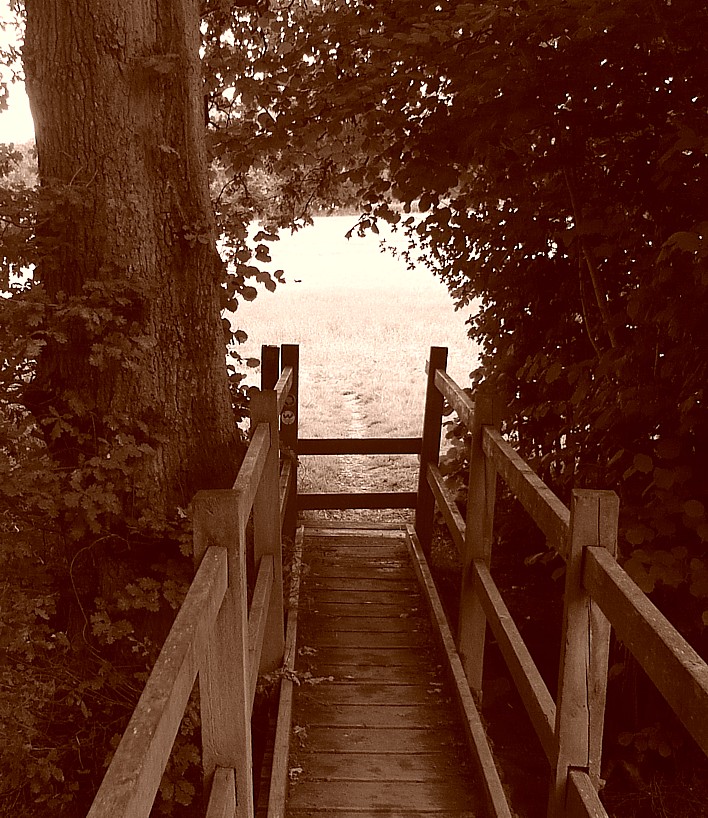
As a project, I occasionally take photos in sepia of the area around where I live, as though they might have been taken about 80 years ago – around the time that my elderly client was walking along the London Road, winds blowing across the fields either side of him, and the only light from the moon. Each photo that I take has something in it to show that it was taken recently though, rather than a long time ago, such as a modern vehicle, a modern street lamp, road markings, or modern windows. The shot below is an example.

Holden Pond

Easy to feel that it might be taken in 1930.
My Father in India

They didn’t talk about it.

It wasn’t as bad as the First World War, when men who had nervous breakdowns were frequently shot for cowardice, but the men of the generation who fought in the Second World War were still reluctant to talk about the hardships they had faced and the horrors they had seen.

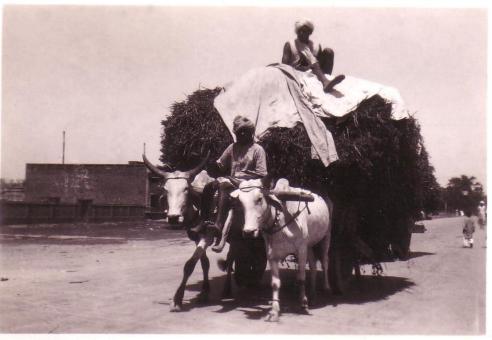
When my father did talk to me about it, and it was very rare that he would, it was generally to joke about the fun that he’d had on leave, or, after my first visit to India, to ask about places that he remembered from Delhi.

He had seen fighting in Burma, and stayed in India right up to the time of Partition. He certainly wasn’t going to talk about either of those. When pushed, he’d clam up about Burma, and would only say that what he’d seen in India at the time of Partition was horrible.

bullock cart

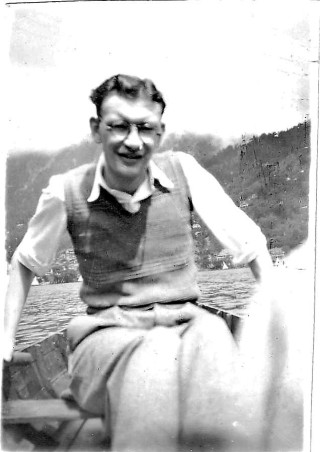
I daresay he told me one or two things that I have forgotten; things that didn’t mean much to me at the time. Perhaps he told me where he had been when he was on leave and was photographed rowing a boat on a lake in the hills; almost certainly in the North of India. Nainital, perhaps? I have been there myself, now, and I’m not certain. If he had told me before I’d been out there, the name would have meant nothing to me, and so I wouldn’t have remembered it.

And by then it was too late to ask him, because he died before I returned for my second visit.

dad 1

Once he had returned to England, he never went back to India, and I certainly never had the impression that he wanted to. I guess that the bad memories must have outweighed the good ones.

I have a dictionary that he bought in Delhi, stamped inside the cover ‘Cambridge Book Depot, New Delhi’ with the price scribbled in pencil; Rs 3/12, and his signature. I also had some old Indian coins, once, that he had given me, but I’m not sure where they are now. Other than the photographs, I’m not aware that he brought anything else back. Certainly, there were never any ‘curios’. Although a part of me wonders whether there might have been once, and whether my mother, a staunch Christian, might have thrown them out after they married. But that is pure conjecture.

hill station 4

And he was interested enough to read books on India’s history. I was surprised, occasionally, on the depth of his knowledge on the subject. He was, though, always interested in history, so I suppose that I shouldn’t have been really, and if he hadn’t have been born working class, I daresay that he might have had a university education, because he excelled at school.

Most of the photos are in fairly poor condition, although I have attempted to improve a couple of the ones that were particularly bad.

It seems strange to think of soldiers as tourists, but whilst they were on leave in India, that is, of course, exactly what they were. There are one or two photos in his collection that were taken of places I have been. One of them is of a view inside the Red Fort of Delhi that differs only in the size of the tree in the picture from one that I took in 1989.

He must have stood in exactly the same spot to take that picture, some 45 years before.

What does this small slice of family history mean for me?

mainstreet poona

It does mean that there is a slight family connection to India, if not in the way that usually comes to mind. He had no family there, and had no responsibilities beyond his army duties, but just the fact of his living out there for a number of years, gives me this connection. Or so I like to think of it.

In the end, India wove its magic over me – nothing much to do with Dad, I suppose, although I expect that was in the mix somewhere. I think that part of why I may have gone out there the first time, was to follow in his footsteps. And now my family can say that they have a connection to India through the time that I have spent out there as well.

Oman (1)

Prior to 1970, Oman was, in many ways, still a medieval country. There were no more than 3 miles of tarmac road in the whole country, the gates of the capital, Muscat, were still closed between the hours of sunset and sunrise, and it’s exports were largely confined to dates, limes and frankincense. Oil had first been discovered as far back as 1956, and then in commercial quantities in 1962. Production began in 1964 and led irrevocably to massive changes, although these would not come about until 1970.

boat

This launch (Omanis never use the word Dhow) was on the shore at Yiti, just east of Muscat. It would most likely have been used for trading and was probably still seaworthy when I took this photo.

Mindful of these changes that had happened virtually overnight to other Middle Eastern states when oil had been discovered, the then Sultan, Said, was determined that Oman would not go the same way. Unfortunately for everyone concerned, his solution was to stash the proceeds in the royal coffers, whilst the country and its people remained poor. It was a situation that could not last for long, and in 1970 his son, Qaboos, overthrew the old Sultan.

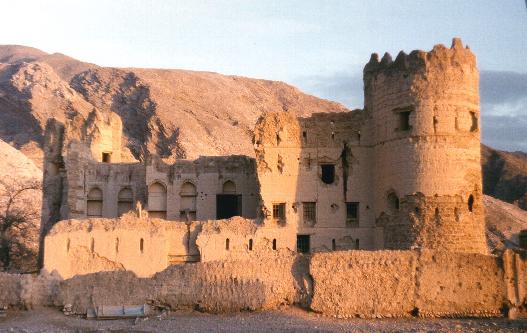
Baushar Fort

Old fort at the village of Baushar, near Muscat.
baushar door
Carved wooden door in Baushar Fort

I lived there between 1985 and 1988, during which time the country was making large strides towards being a modern state, although many parts of the country still felt as though they belonged in another century. Around Muscat and along the Northern coast, there were new towns springing up, modern shops and hotels, main roads, and much of the development that might be expected. There did appear to be an emphasis on the building of facilities such as schools and hospitals, however, along with a good deal of restraint, which was a refreshing change from the way that many other states used their oil wealth.

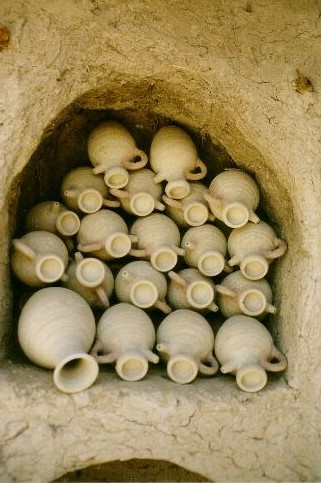
pottery kiln 1

Pottery kiln at Bahla.

Bahla has good quality clay and produces large numbers of pots, which are thrown on simple foot-operated slow wheels and fired in large mud-brick kilns, which are fueled with brushwood.

Pots at bala

Newly-fired pots

Away from the towns, to visit most of the villages was like stepping back in time. Buildings were often still mud brick and palm thatch, and many of the traditional cottage industries were still followed.

falaj

Falaj.

The Falaj system of irrigation originated in Persia and was spread throughout the Arab world. I have even seen examples in Spain. The system consists of a series of underwater channels bringing water from where it arises, usually in the mountains, to where it is needed, where it is distributed by overground channels. These channels, both underground and overground, have been built on a very gentle gradient and show astounding technical skill, being built only with primitive tools, often very deep underground. Many of the Omani Falajes are reckoned to have been built by 500 BC.

dates

Dates spread out to dry near the town of Quriyat.

Dates are an important crop in Oman and were the main export until the discovery of oil there. They are still dried in the traditional way – in the sun.

shark boy crop

Boy on a donkey with sharks. The sea has also traditionally been a major source of food for Omanis. I passed this boy just outside Quriyat.

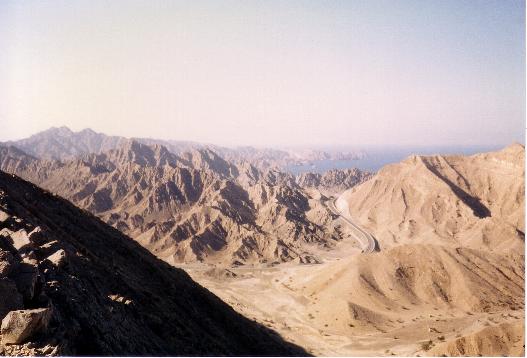
deserty desert

Coastal mountains, SE of Muscat.

For a long time after I finally left Oman, I harboured a strong wish to go back there. But recently I watched several videos on YouTube, which have cured me. Many of the places that I knew as small settlements with dirt roads and small houses, have become places of great wealth with wide boulevards, modern houses and cars, and tourist hotels. It is, no doubt, a development that is welcomed by the majority of the population, but it is not the Oman that I knew.

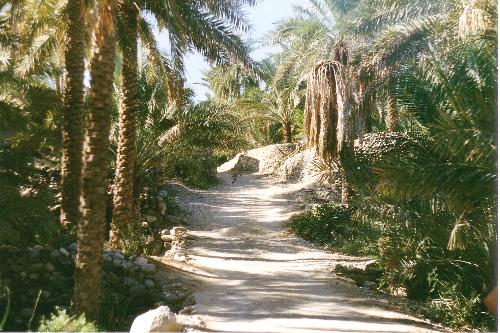
Oasis

There you go. A picture of an oasis.

Once Upon a Time

046

Are you sitting comfortably? Then I’ll begin.

It is a cliché that causes us to smile, yet variations of that phrase will have been used countless times in the distant past, when our ancestors gathered around the storyteller of the tribe to hear whatever tale he (or she) was about to tell.

And research http://rsos.royalsocietypublishing.org/content/3/1/150645  that was published this week, now tells us that the history of fairy tales turns out to be even longer than anyone suspected, going back to the times of prehistoric tribes. Not that this theory is entirely uncontested, of course.

But I would be surprised if it were untrue.

There have always been storytellers, who performed an important role, especially before the invention of writing. In those days, when all knowledge had to be memorised if it was to be of any use, then the skills of the storyteller in the tribe, someone who was used to organising their thoughts so that they could remember what was important and then recount it to the rest of the tribe, would have been vital for far more than simply entertainment; they would have been essential for the tribe’s survival.

They would have told stories about wild animals; either cautionary tales, or how to hunt them. Stories of skirmishes with other tribes; praising the bravery of their own warriors, and recounting how the other tribe was put to flight, but warning, still, of the danger these other tribes posed.

They must have always speculated on the origins of their world, and come up with the various creation myths. It would be important that all the tribe understood the appropriate rituals they would need to follow to appease the gods and ensure their own welfare.

So these stories would have been a way of sharing information with all the members of the tribe.

Much later, after the invention of writing, these tales began to perform a different function. They would still be used as cautionary tales, but now perhaps aimed more towards children (watch out for cross-dressing wolves and the like), or purely for entertainment.

But in a society where the majority were unable to read, they would remain important.

Throughout history, there has always been a borrowing and reinvention of stories; the myth of a flood that wipes out most of mankind, for example, is found virtually all over the world.

But the difference between a ‘myth’ and a ‘fairy story’ seems a little vague. I suppose the term ‘myth’ does seem to have a little more gravitas.

Many of these stories concern blacksmiths, which might be due to an early awe of those peoples who discovered how to work stronger metal, specifically iron, and fears that they might be using magical or supernatural means to do so. I’ll return to that shortly.

Now let’s take one well-known example of a fairy tale; the story of Snow White plays out both as a royal power struggle, something that has occurred time and again all over the world, and also the classic tale of the wicked stepmother, highlighting the insecurity a child may feel when a parent dies and is replaced by a stranger.

She flees an assassination attempt to find refuge with another people. The fact that they are depicted as dwarves (in the well-known European version) serves to emphasize the fact that they are not her own people.

There are further attempts on her life, but she is finally rescued by a passing prince and lives happily ever after.

Variations of this story crop up across Europe, Turkey, Africa, Asia and America. Whether these tales were passed from tribe to tribe and spread across the world that way, or were invented spontaneously in different parts of the world, it is unlikely we will ever know. It was probably a combination of the two. What is certain, is that they tend to be reinvented regularly.

Stories of mortals striking deals with supernatural beings (i.e. the devil) occur world-wide. What they all have in common is that either the human making it reneges on the deal, and usually finds a way to cheat the supernatural being, or, of course, the devil comes to collect his soul.

It is still a well-used device in literature. There is Goethe’s Faust, and since then many other popular novels on the subject, and we are still happily reinventing this story, as well as all of the other fairy tales, into new stories today.

In Britain, there are numerous folk-tales on this subject, usually concerning blacksmiths who either make pacts with the devil, or who are visited by him in disguise and realise who he really is (the comely maiden with the cloven hooves is often a bit of a giveaway). It usually ends with the devil being grabbed by the nose with red hot pincers and running off screaming. But again, these tales surface from all parts of the British Isles, and are set in times that are contemporary to the story teller. So the fellow telling the tale in an ale-house in a sixteenth century village would mention the blacksmith in a village twenty or so miles away – close enough to be particularly exciting to the listeners, but probably far enough away for there to be no one in his audience who might confidently denounce it as false.

And then, of course, they all lived happily ever after.

The Problem of Historical Truth

In my previous post about the pitfalls of online research, I began by alluding to the unreliability of newspaper reports. If you were to read reports on an important item of news in a number of different newspapers, you frequently might be forgiven for thinking that they were actually talking about completely different events. There will be political bias, of course, and the prejudices and agendas of reporters and editors alike. Are the individuals in an armed insurgency terrorists or freedom fighters? It is a point of view. Are strikers in an industry greedy mischief-making saboteurs, or victimised and mistreated victims of greedy corporations? Again, it is a point of view.

It can be very hard today to see through the fog of opinions and misinformation on any topic. How much more so when we delve back into time?

History is written by the victors. For example, what we know about Caesar’s campaigns in Gaul and Britain were written largely by the Roman conquerors, especially Caesar himself. Most of what we know of the reign of Ashoka, in India, comes from the edicts that he caused to be inscribed upon the remarkable number of rocks and pillars that are still in existence.

023 (2)

Even tales written by the vanquished are likely to be inaccurate, of course. The cruelty of the victors, their barbarity; all of their actions will be exaggerated.

The historian understands that information comes largely from primary and secondary sources. A primary source might be, for example, an account written at the time (Caesar, above) or Parish registers of births, marriages and deaths. These sources are considered to be most likely to be accurate, being compiled at the time of the events described, but clearly they might all be deliberately or accidently falsified. Secondary sources might be newspapers, which are largely made up of analysis and opinion, and therefore considered to be an interpretation of information that has been derived from another (hopefully primary!) source.

A primary source is also referred to as evidence, yet I wonder whether a better distinction would be made if ‘evidence’ referred only to unwritten sources; archaeological remains, buildings, pottery, jewellery and coins and their like, which, whilst needing interpretation, are unlikely to be prey to the kind of distortions that written sources might be. Caesar, after all, might have claimed to take ten thousand prisoners when he only took five hundred, yet pottery of a particular type that is found at a particular spot, tells a story that needs to be interpreted, yet is unlikely to be a falsehood.

We need to be careful, though, when it is interpreted in light of contemporary writing, to avoid the temptation of unconsciously corroborating those writings.

Having written the above, we do have to take a certain amount on trust, because it is not practical to question everything in the world that we come across.

Yet, just because we discover that Troy really does exist, does not mean that all of the stories of the Iliad are now, somehow, all true. That would be like an author writing an incredibly impossible fantasy tale, in which the city of Vienna still exists and features, yet claiming it must be true because Vienna is a real place.

During the first year of World War One, a fictional short story ‘The Bowmen’ was published in the London Evening News by Arthur Machen. In this tale, he describes a battle between English and German soldiers at Mons, in France, in which the beleaguered British were aided by the sudden appearance of phantom archers who intervened to keep the British safe. Although this was fiction, the story quickly ‘went viral’, as we might put it today, and was readily believed by many in Britain. Of course, there was a feeling then that the British were good and the Germans evil, and so it was natural that God might intervene to help and protect them. A far stronger belief in God, in those days, also contributed to the feeling that it was natural to find that a miracle had occurred.

Although Machen republished the tale in a book with a long introduction explaining that it was fiction, and examining reasons the public thought it was true, not only did the belief persist, but further reports of angels on the battlefield began to appear. As a child in the 1960’s, I remember reading an account of this in a comic, with it presented as the truth. In 2001, the Sunday Times reported that photographic evidence to support the story had been discovered, although this was proved to be a hoax.

The Sunday Times also published exerts from Hitler’s Diaries in 1983, until these, too, were proved to have been forged.

Memories are notoriously unreliable. I was reading just a few days ago of an experiment where a group of people were encouraged to discuss childhood memories, with selected members of the group feeding in deliberately false information. After an initial hesitation, it seemed that all of them accepted these false memories as real, even to the extent of agreeing that they had taken part in a balloon ride, when they had not, and describing what they had seen from the balloon, and their feelings during the ride. The point being that they came to believe these were their own, real, memories.

How reliable are our own memories, then? And what can we trust? Clearly, there must be a lot of historical narrative that has been honestly recorded, that is simply not true, and we are unlikely to ever know what it is.