Pilgrimage

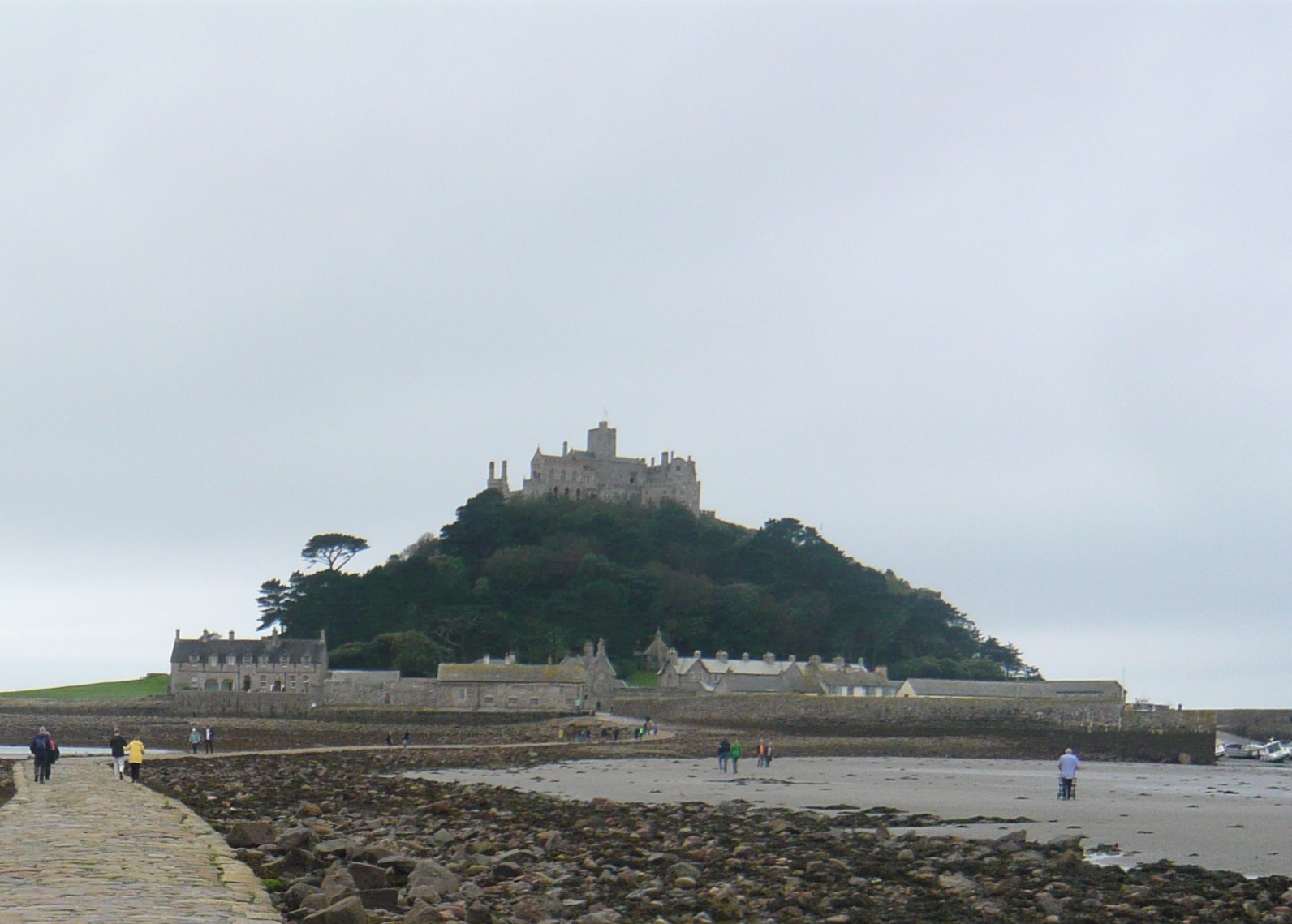
We recently returned from a week in Cornwall, and where we stayed was close to the end of a pilgrim route, St Michael’s Way. This is a short twelve and a half mile walk from the North Cornish coast to St Michael’s Mount, in Mount’s Bay on the South coast. Although the route is such a short one – a day’s walk for most people – it still apparently qualifies for a pilgrim ‘stamp’ on the official pilgrim passport for the very much longer long-distance Camino pilgrimage, since in the Middle Ages many pilgrims walked this route to the Benedictine monastery on the island, then took a boat to France to continue on towards Santiago de Compostela.

I am interested in learning – as far as it is possible for the staunchly non-religious person to learn – what the religious get out of pilgrimages. In the past, they were generally viewed as a way of gaining merit, of putting a few points in the bank when it came to whether you were headed for heaven or hell in the afterlife. Frequently, they were also undertaken in the hope of cures from diseases; various remnants of saints such as bones or clothing were held to have miraculous properties, and the touch of these might cure whichever disease ailed you.

Personally, I view pilgrimage as a spiritual thing, rather than a religious one. Something that puts the pilgrim in touch with their ‘finer’ feelings – a way of understanding what is important in life; relationships, simplicity, art maybe, minimal possessions – we will all have a different interpretation of this. In the past I have considered attempting one of the Camino routes – through France and Northern Spain to Santiago de Compostela. These are long, serious, routes, hundreds of miles long. Had I done so, I would have walked these for pleasure, as well as a personal challenge, rather than as a pilgrimage. Now, though, I am curious to see how much of the ‘religious’ experience I might have.

Whether visiting a church or a standing stone, a ‘holy’ well or a Sufi shrine, all are invested with spirituality. All are invested with meaning to many people and although I know I will never be able to experience the feelings of, say, a Christian at a site they consider holy, I might experience something akin to it. I’m not suggesting I might feel awe at the shrine of a saint, more that I might get an impression of the feelings of the visitors who do. And because I cannot quite find the words to express what I might hope to find, I reckon that’s an indication it’s an experiment worth making.

In Another Lifetime I could Have Been…(2)

…a monk.

Yes, you heard me correctly. a monk. Regular readers of this indulgence will know I pour scorn on organised religion, but also that I have a hankering for the simple life and for solitude. I would love to be disciplined enough to do without fripperies, but I never quite seem to get there. Obviously social media would also have to go if I was a monk. In fact, even if I didn’t become a monk, I think perhaps social media should go. That would be good for me.

But not books, of course. They’re Important.

In another time, a time when belief in the predominant religion was a given, I would have had no problem in becoming a monk. But since I don’t have that belief, it sounds like a contradiction to say that to me the spiritual side of life is extremely important, but the spiritual is, to me, separate from religion. I view the spiritual side of me as being that part that yearns for simplicity, for art, for the minimum possessions required for life, and to be surrounded by nature. Incidentally, I also understand that monks are given a daily ration of beer or wine.

That also sounds good.

And because I was fortunate to have been born in an age of scientific enquiry when most people no longer blindly accept religious dogma, but are generally prepared to question it, I am free to make choices based on my own conscience and on what I consider important.

But I could almost, under certain circumstances, become a Buddhist monk, even in this life. I have said before how I am attracted to Buddhism, although as a philosophy rather than as a religion. I like the way the emphasis is on yourself to make your best life. Gods don’t have to be involved.

I have twice spent a week in that sort of environment – one time a week of Zen meditation, which was very hard work but left me with a great feeling of clear-headed calm, and once on a retreat at a Benedictine monastery where I made a point of attending a simple morning service each day and spending the rest of the day in thought and writing and painting and gently wandering around the extensive grounds. As a panacea for the stresses of modern life it was difficult to beat. I could, as I said, see myself in another life settling into the routine there on a permanent basis. But not in this life.

Belief Systems and Rain

I had a conversation with a blogging friend a few days ago, in the course of which she asked me if I knew why it was that so many Westerners seemed drawn to Eastern beliefs, especially the more ‘esoteric’ ones.

I briefly mentioned the fascination the East has held for Westerners throughout history, and the fact that many in the West have drawn away from traditional religion – specifically Christianity – in the last fifty or sixty years especially, and that leaves a void: when you have been brought up within a belief system, that needs to be replaced by something. The Beatles nudged a whole generation in that direction by visiting the Maharishi in Rishikesh in the 1960’s / 1970’s, and there followed a whole slew of books on the subject, many seeming to want to outdo the others in sheer weirdness. But even before that there had been a lot of interest in both Buddhism and Hinduism from the late Victorian period onward, with a number of popular books available.

I can’t claim to be immune to this, either. I also rejected Christianity long ago, but felt I needed something to take its place despite deciding the concept of gods had no place in my life. The world is a wonderful and incredibly beautiful and fascinating place, all of which is explained perfectly well by science. But I do need something to satisfy the spiritual part of me – a part that, surely, all of us have?

I have read a lot about Buddhism, and for a long while thought of myself as a Buddhist. In a way, I still do, although I can’t entirely buy into the belief sets of any of the three major schools of Buddhism. But I did read Buddhism Without Beliefs by Stephen Batchelor. I can’t remember the details of the book, but that is unimportant, it’s the message of the title in this case. I like Buddhism. I like its core message, which pared down to basics is simply to be kind to everyone and everything. It is the only religion I know that has no need for gods. Oh, sure, they’re there if you want them, but no one is ordering you to have one.

This doesn’t have to be ‘esoteric’ or ‘eastern’, either. It can apply just as well here in the west. And it doesn’t require sacred writings or rituals, I find poetry or a walk in the woods does just as well for me.

I’m listening to the heavy rain as I write this – which is something that seems to happen a lot at the moment, but is something I find particularly soothing. I wonder at the origins of this; is it something primeval, hidden deep in my DNA from the times we lived in caves or rough shelters and we could take comfort from the fact we were snug, and perhaps large sharp-toothed beasts were taking a similar break somewhere and not out looking for early humans to eat? Or is it perhaps just a forgotten memory of a very calming experience I once had, which my subconscious has decided to hang onto for my benefit, but without telling me why? I am aware of a few of the times I’ve experienced it, such as lying in a tent at night hearing the pounding of the rain on the canvas, with a wonderful feeling of warmth and snugness. Then there was another time in the mountains of Spain, coming across an abandoned cottage just as a rainstorm hit and spending the next half an hour or so just sitting on a bench and leaning against the wall, listening to the rain and thinking. I’m sure there must be many more.

In these rainstorms, I feel as though I’m immersed in nature – something that always makes me feel calm and relaxed, and which is but a step from what the Japanese call Forest Bathing. Forest Bathing is essentially taking a walk in woodland, using all your senses to connect with that environment. This reminds me strongly of meditation, especially meditation as I learned it in a Buddhist environment, which is where I’m going with all this rambling. If I have an actual religion now, it has to be nature. A belief in nature as something important, beneficial and precious. I wouldn’t ‘worship’ nature – ‘worship’, for me, has connotations of supplicants on bended knees with hands clasped together intoning religious dogma and praying, but I do have strong feelings of respect and admiration for nature, which I suppose you could call the same thing.

It just seems a pity that more people don’t seem able to accord it the same respect.

Excerpts From The Book of Meh

From Chapter one:

In the beginning there was lots of very dark darkness and very cold cold stuff, which wasn’t at all nice and although no one existed yet, they were all really miserable.

And Meh, the god of this world, thought ‘Well, this isn’t much fun’ and so He created the universe, with the Milky Way above and the Place of Torment below. And the Milky Way is a beauteous place of flowing streams of milk and cream and comfortable sofas beside cosy fires, while the Place of Torment is a cold and frozen place of hard floors and empty food bowls. And that was the first day, and a jolly good first day’s work it was too.

On the second day, Meh created the earth by vomiting up a giant hairball, and then sat back as life rapidly evolved without any further input from Meh, which was how He liked it, so He could curl up and take a little nap…

From Chapter three:

‘And thou shalt make images of Meh, and cause them to be distributed, yeah, all over the internet and into the world even unto the furthest corners. There shall be infinitely more of these images than those of dogs, for I, Meh, am a jealous god.

‘And be it known my chosen ones, whom I love and have created in my own image, shall be afforded a privileged place in thine homes, otherwise I shall visit plagues upon thy households, yeah, even unto the seventh generation of thy accursed species.

‘But those who treat my beloved offspring well shall have their eternal reward, most especially in the Milky Way, while those who mistreat them shall be condemned to be pounced upon and bitten for all eternity, and great will be the wailing and gnashing of teeth.’

From Chapter seven:

And know that this is the truth, for it is written herein and thou shalt believe it for it is the word of Meh.

It is told there was a Man of Meh, and he came unto the land of Babylon to preach to the people there tolerance and goodwill to all those that walk upon four legs and are furry and purr when pleased, yet the people received him with hostility and drove him out into the desert.

And thus Meh said ‘Lo, I shall send plagues to irritate and annoy these godless people until they learn the error of their ways.’ There was first, then, a plague of fleas, which certainly irritated them, although it was insufficient to cause them to mend their ways. So Meh then turned the milk sour, and this annoyed the people, but they still denied Meh and said ‘We don’t want to listen to some preacher spouting a load of old bollox’ and so Meh then caused all the fish in the fish market to be a bit off, and not really smell all that good. And the people said ‘Oh, leave it out. We’ll make our own rules and laws.’

So Meh did withdraw from the world, and he did sulk a goodly while.

The Great Sandwich Schism – Again

Well, I don’t know about you, but what with you-know-what and the lockdown I feel a bit bleurgh at the moment, so to try to inject a little cheer – or whimsy, anyway – I thought I’d re-post an old one:

Once upon a time, a long, long time ago, God created the world. And he looked upon the world and said ‘Well, so far so good’.

And the world was full of beautiful things and good things and a great bounty of useful things that humans would later ransack and destroy in the name of greed, although that is a story for another day.

But when the people whom God had created looked upon his great works, they said unto Him ‘How might we thank you, oh God? How might we show our gratitude for your benevolence?’

And God replied ‘Oh, I don’t know. I really wish you wouldn’t bother. But if you must, just make me a sandwich, or something. I’m feeling a bit peckish after all that creating.’

013

And so the people made haste to slice bread and find Good Things to become a tasty and delicious filling for the sandwich they had made for their God. And there arose minor disputes such as whether ham and cheese really went together in a sandwich, or whether mayonnaise actually counted as food, but the people settled their quarrel in an amicable fashion and so the sandwich was created and placed upon a golden plate that was decorated with the names of angels and archangels, and set about with small mountains of salad and just a little dash of mustard in case God should fancy some.

And then one among them rose up and said ‘Wait, for we must cut this sandwich before we present it to our God, unless it be a bit too large for him to handle and he drop pieces of cheese from the sides or drip mayonnaise in his holy lap.’

And all at once there arose discord, for some were found who would cut the sandwich in a diagonal fashion, and yet others who declared that would be an affront to His holiness and that the only Right Way would be to cut the sandwich into equal rectangles.

And lo, the factions took up weapons and fought, yea, even in the Holy Kitchen, and they did massacre one another and each declared that the other faction was a worshipper of Satan, who was completely bemused by all this, since he had no followers (not even on Facebook), and they did create rival churches and rival nations and declared undying enmity against each other, spending the next few thousand years thinking up new and more imaginative ways to hate and kill and destroy each other.

And God groaned and held his head in his hands and said ‘Oh verily, what a cock-up this has become. I think I shall destroy the lot of them.’

Myth, Science and Religion

Religion begins as science, as an attempt to make sense of the world. The birth of religion marked the dawn of humans as rational, analytical beings. This was humans moving beyond the worries of simply surviving from day to day, and reaching that point in evolution where they looked with wonder upon the world around them and asked: How did this come into existence? What is it that controls the weather and other variables? By observing the natural world around them, the cycles of day and night, the seasons, the migrations of the animals, they would have concluded that these patterns suggested a grand design and order.

003a

An assumption would probably be made that all this was controlled by benevolent beings, but beings who might need propitiating occasionally to keep them sweet; the odd ritual here, perhaps a sacrifice of some sort there.

And if that was so, perhaps they could be propitiated in a somewhat greater way, to grant other boons?

It would not be long before someone claimed a channel to the gods to relay their desires and instructions, and so the priestly class would be born. Self-interest? Quite likely. After all, we see that in most religions today, so why not?

Religions then, over the years, spawned new religions, the spark being reinterpretation rather than inspiration.

We think we see echoes of old religions in myths. Myths are the fragments of history we know, combined with assumptions about how our ancestors acted and thought, frequently combined with scarce written evidence, which may or may not be biased or wholly inaccurate. When our written sources include stories of monsters and miracles, we should probably be advised to treat them cautiously.

Myth-makers frequently come with an agenda, although depending upon your point of view that is not necessarily a bad thing. If you are looking for a scientific analysis of the lives of our ancestors, it’s probably best to give myth a wide berth. Or at least to be very, very, careful what you take from it. But in a way, it does provide an alternative world view that many find preferable to both the stark realities of day to day life, as well as the cold dead hand of religion. After all, if you’re using your imagination, it’s easy to plan your myth-world much the way you’d like it.

And perhaps myth does offer us a way of getting inside the heads of those people, at least superficially.

One assumption we can make is that there would be similarities in the thought processes of those people, with the thought processes of us today. It is perfectly reasonable to assume they would react in similar ways to us, to pain and fear, to pleasure, warmth and cold. Our reaction to the unknown tends to be to populate it with characters or situations based on our experiences, and they probably did the same.

Stonehenge is aligned with the solar calendar. This we know. It’s science. And we know a considerable amount about the geography of the area around Stonehenge at the time it was built, through archaeology and science.

What we don’t know is how it was used. Just because it was aligned with the rising sun at summer solstice and the setting sun at winter solstice, does not mean we know what took place at those times. We assume our ancestors worshipped or venerated the sun there, especially at the time of the solstices, but we do not know that. Were there sacrifices? Did they hold special ceremonies connected with fertility or birth or death? Was it perhaps just like a club where they turned up now and again and got drunk and held orgies? It could be, since there is no hard evidence for anything.

Believers in ley lines also claim it is at the centre of an intricate system of lines connecting natural (‘holy’) locations with important (‘holy’) sites such as churches, wells and crossroads. Pseudoscience? Coincidence?

Our assumptions, though, lead us to think that because of the immense effort required to build the structure, it must have been an incredibly important site, and we are surely justified in concluding important ceremonies were enacted there.

Whatever they were.

Going Green

On the morning of the 26th August, 2019, every single person on earth woke up to find that their skin had turned green.

For a few hours, there were an awful lot of people trying to find a way to change it back again, to try to dye it, rub the colour off, swallow lots of strange potions, try magic spells, see doctors, priests, scientists, mystics, druids, and all sorts of other experts and so-called experts, all of whom claimed they could cure the problem.

But all of whom had green skin as well, so they didn’t come across as very convincing.

Finally, someone thought to bellow up to God ‘Oi, God! What on earth have you done?’

There was a rumble of ethereal chuckling, and then God replied: ‘I am just so totally pissed off, like, with your saying how some of you are better than the others, like, just because of the colour of the skin I gave you. It’s all pretty random, after all. So now you’re all the same, and you might as well just stop it.’

‘Yeah…but…green?’

‘Yes, green. If I make you all white, then the ones that were already white will make out that was because they were superior in the first place. Same with all the other skin colours. So…green. None of you were green before.’

‘But…’

‘Plus,’ and here God gave a little Godly snigger, ‘you all equate green skin with aliens. So now you’re all aliens. And, even if I say so myself, that’s a good one.’

002a

Nothing’s ever simple, though, is it? Within a couple of weeks, once everyone had realised there was no mileage in everyone claiming to be a Green Supremacist, all the major religions started working overtime to fire up extra feuds and wars and to persecute anyone within reach who thought differently to the ways they did, anyone they considered heretical, those who some thought might be a slightly different shade of green, or cut their sandwiches in a non-prescribed way.

And then the sound of the loudest ever irritated sigh filled the skies and echoed around every valley and mountain and city on earth. It rumbled across the plains and seas and everyone stopped what they were doing and muttered ‘Oh, crikey. Now what?’

And God roared out ‘I thought I was angry before, but now I’m really pissed off! What on earth makes you think you can speak for me? This is all, quite frankly, rather insulting! I made this lovely planet, and put you on it so you could enjoy it and look after it and be nice to each other! How dare you presume to say that I hate people who you disagree with? How dare you say you have authority to kill in my name? And, while you’re at it, you can stop all the servile bowing and scraping, too. I mean, what sort of an image do you have of me?

‘Oh, and I almost forgot (‘cos I’ve got a lot of gripes with you lot!). Men are not superior to women in any way whatsoever. So you men can stop paying them less, treating them differently, forcing them to hide themselves, denying them education, declaring them inferior or evil, or discriminating against them in any other way at all, or else I’m jolly well going to visit a few plagues on you that will really make your blood run cold!

‘Now, start to look after my bloody planet, treat women with respect, and stop trying to find more cowardly ways to exterminate anyone you think different to yourselves!’

Blimey. Better do as She says.

Happy Holi!

Happy Holi to all of my Indian readers!

And, of course, to everyone else, too!

Holi is the Hindu spring festival, and is celebrated primarily in the north of India, as well as in Nepal. It is not generally observed much in the south, since spring was confiscated ages ago and there they have seasons defined by being either wet or dry, or fairly hot as opposed to very hot.

I was in India for Holi in both 2004 and 2005. The first year, I was assured by everyone I met (both Indian and foreigner) that I would be wise to hide in my room for the duration of Holi, and so that was what I did. The following year, I decided that I would join in, come what may.

March 25th 2005. Holi; eve.

This year Holi coincides exactly with Easter, which seems odd but makes perfect sense, really. They are both spring festivals, and we’ve just passed the equinox. You wouldn’t have any idea that it’s Easter here, though. The whole thing started today, as all the shops started closing early from Midday, and a few children who couldn’t wait began stalking the streets like miniature ragged versions of Clint Eastwood. By nightfall, a fair amount of alcohol and bhang – cannabis in an edible form, a speciality of Holi – had been consumed and, despite being invited to the evening celebration by a couple of Indian friends, my friend and I decided to stay in the Guest House.

IMG

A huge bonfire had been built in the middle of the dried up river, and by 9pm a huge crowd had gathered on the bridge (being India, all male and predominantly young) with lighted firebrands and a goodly amount of noise. After a while the shouting began to resemble more and more the chanting at a football match, the bonfire was lit and people swarmed across the bridge swinging their torches round and around. At this point, we felt that our vantage point on the roof was perfectly adequate.

March 26th 2005. Holi; Day one.

The following morning the fun really started. This is when there is license to soak everyone and everything in dye and gulal (powder): people, cars, rickshaws, passing dogs, whatever. The first few hours of the morning really are not a good time to be out, since this is when the mud and other unpleasantness’s (stones, dung) are quite often used as missiles We nipped down the road when the coast was clear for breakfast, then holed up until lunchtime back at the guesthouse. At lunchtime we returned to the same cafe, since very few were open and this is the nearest in any case. Soon a party of Indians arrived, some of whom we knew, who screeched to a halt in a car, came in loaded with beer and whisky, got the bhang out and very loudly invited us to join them. We made our excuses and left as soon as we could.

At this stage, I had already had a couple of hits from the kids (all of which seemed good-natured) and so I went over to the Foundation where I was working, where I had been invited to join in the festivities in the afternoon. As I approached the village, it became clear that I was not even going to reach the Foundation without much celebration (I guess that’s the best word). A few soakings from kids, then as soon as I plunged into the alleyway that led to the Foundation, A group of men emerged from a house, there was a fair amount of liquid dye squirted around, then handshakes and we swapped gulal markings (on each other’s foreheads, like cast marks) and I was presented with a piece of buttered toast soaked in milk for Holi – I had this last year, it’s actually rather nice! This activity then escalated until I reached the Foundation, where I walked into what felt like a carefully laid ambush, but was actually just the on-going hi jinks.

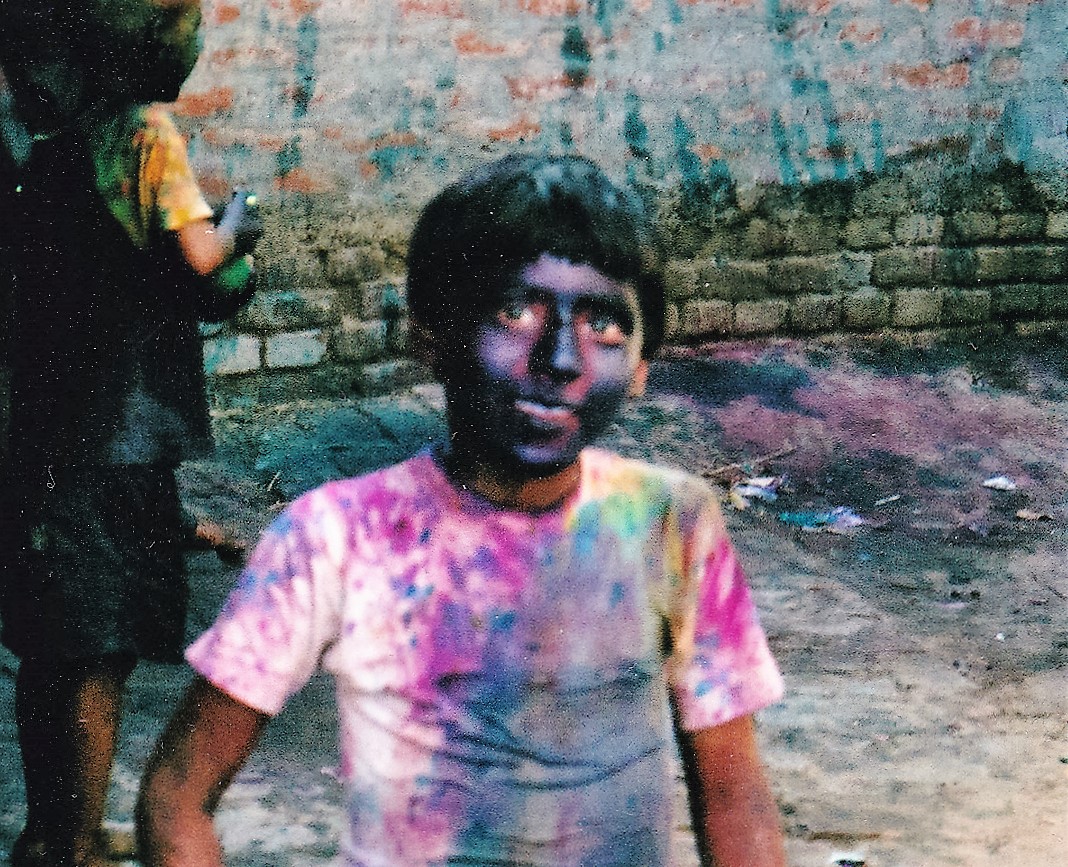
In no time at all, I was soaked from head to foot in dye and gulal. All the Foundation kids were there, plus the adults, and it also seemed as though half the village were charging in and out. Colours were flying in all directions, people rubbed handfuls of the stuff into each other’s faces and hair, handfuls of powder were dabbed on feet, on foreheads. We rubbed foreheads together, spreading the powder further and someone tipped a whole bucket of blue dye over me from behind. A man from the village, who was the father of one of the children in the school, swapped gulal marks with me and said ‘now I am your son.’ I probably should have replied ‘and I am your father’ but I just smiled and said that I was honoured. It seemed okay, because he beamed and gave me a great bear hug.
IMG_0001 (2)

After an hour or so of this, it begins to wind down and the kids are slowly introduced to soap at the pump. Eventually we return to the guest house and I spend an extremely long time in the shower trying to remove the worst of the dye. Most of it eventually comes out, but I suspect the turquoise will be on me when I return to England. Goodness, I’ve got dye in the parts that other beers can’t reach!

By then it is evening, and we decide to try the other cafe that is open, since the party still seems to be going full-pelt in our usual one. We go in and, whilst impressed at the variety and quantity of insect life that it is possible to fit into one small cafe, decide that perhaps it is not the place to eat. We return to the first cafe, where there is an equally impressive array of human detritus – stoned, drunk and asleep. We eat, we go.

March 27th 2005. Holi; day two. Easter Sunday. Whatever.

I go into town after breakfast, where there is a little desultory squirting going on (don’t titter), but mainly people (at least young males) seem to be gathering in groups. There is one on the Tibetan Market ground and one on the river bed by the bridge. I’m not sure of the significance, but it seems to involve small bonfires and noise. Not much else seems to be happening.

After lunch, I walk over to the Foundation. It is still very quiet as I walk over, the bridge almost deserted and the only noise from some parties in the distance. As I walk towards the Foundation, the noise level rises and I turn the corner to see the afternoon’s entertainment in full swing, on the open ground in front of the Foundation.

A clay pot is suspended from a rope that hangs between two poles, containing coloured water and a load of rupee coins. Beneath it are twenty or thirty village lads engaged in attempting to reach it. This they have to do by means of making a human pyramid. To be successful, it must reach three persons high. To complicate matters ever so slightly, an equal number of lads hurl dye, water, mud and straw, etc, at them as they climb. The passage of time is enlivened whenever a rickshaw or bicycle attempt to get past, with predictable results. One group of three on a motorbike particularly unwisely decide to hoot imperiously at the group as it approaches. It and its riders immediately disappear beneath a deluge of water, dye, straw, mud, etc.

IMG 2

It takes two to three hours before one lad successfully reaches the pot, hanging by one hand from the rope and tipping out the dye and rupees onto the crowd below. The waiting children swoop, and everybody slowly drifts away.

Bumping into a friend in the evening, it turns out that she spent the afternoon at a teacher’s house (she works at a school) where it was music, dancing and feasting. Lots of decorum. Really not the same.

Religion or Philosophy?

Now, here’s a thing.

It is rather a fashion nowadays to declare that religions are all wrong and should be banned, because science and reason have somehow proved that there is no god (they haven’t).

But I would like to consider every religion in the world as a school of philosophy, and consider what I might take from each that would be useful to my life and my development.

Whether there might actually be a god or not then becomes unimportant.

Most Buddhists, for example, would seem a little unsure of whether there is a god or not, but if asked, the majority of them would reply that it does not matter. The argument being that it is impossible to prove either way, and therefore it is impossible to know either way. So why not just live your life as well as you can?

SR312thumb

Traditionally, religions have provided society with a set of moral rules. It may be that these rules were the first imperatives that human beings treat other with decency. Since none of us were around in the long years when our race was evolving speech and higher thought, and learning how to co-operate with fellow members of the tribe and – who knows – perhaps their neighbours, this must of necessity be pure speculation. Yet I find it highly likely these moral codes were the first suggestions that human beings might treat an enemy, for example, with mercy, rather than simply killing them, which might otherwise be the obvious course of action. Morality over expediency, if you like.

Some examples:

Islam forbids charging interest on loans. How many who have fallen victim to the money-grubbing lowlife that run these ‘payday’ loan companies charging astronomical rates of interest might have sympathy with this view? It teaches also that it is a moral duty to give alms; to help those in need.

112 (2)

Christianity is big on love and mercy; at least in the New Testament. It teaches tolerance and forgiveness.

Buddhism teaches that to want things is to become enslaved to those desires that can never be satisfied. How much better to live simply and to be content with what we have? It teaches also compassion for all living beings.

Hinduism teaches that all life is sacred, and that we should all refrain from injuring others.

ganesh shrine kodai

These are only the main four faiths in the world today, but every other religion that I have read about also teaches a code of moral imperatives.

And in a world run by huge multi-national companies with no moral compass whatsoever and politicians who only look after their own, where we are continually and aggressively informed that we must worship money and consume more and more pointless trash, and that it does not matter if we destroy the environment just as long as companies make bigger profits, anything that can make us pause to consider what is actually important in life should be encouraged rather than denigrated.

343

It would therefore be ridiculous to simply dismiss out of hand entire canons of work, solely on the grounds that the writers of these philosophies believed in a god whom the reader might not (or does not want to) believe in. Everybody has a spiritual side, whether or not they believe in some sort of god. The spiritual side of a person champions beauty over money, generosity over selfishness, kindness over cruelty. These are values that most of us still claim to value today.