Silbury Hill

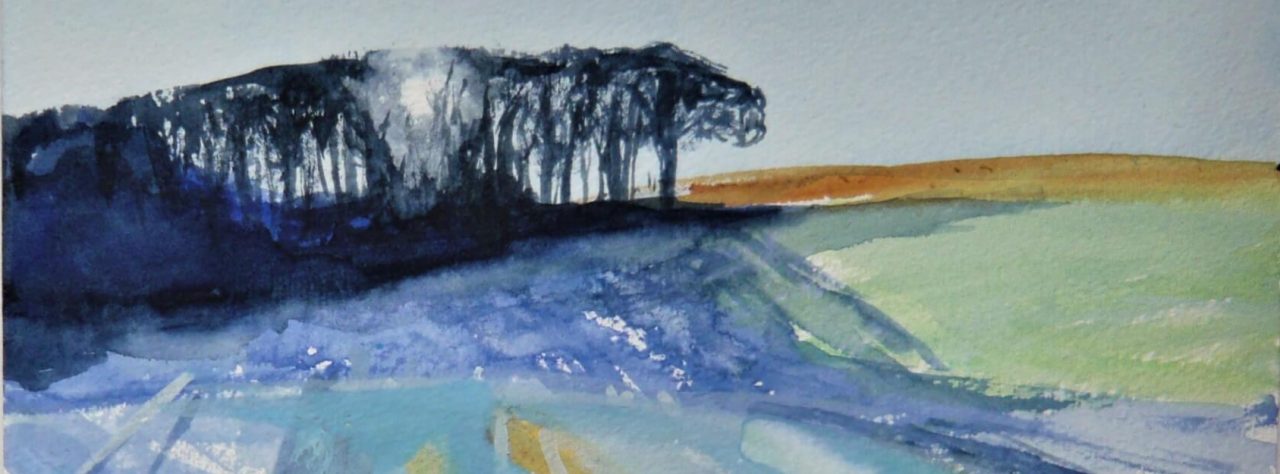
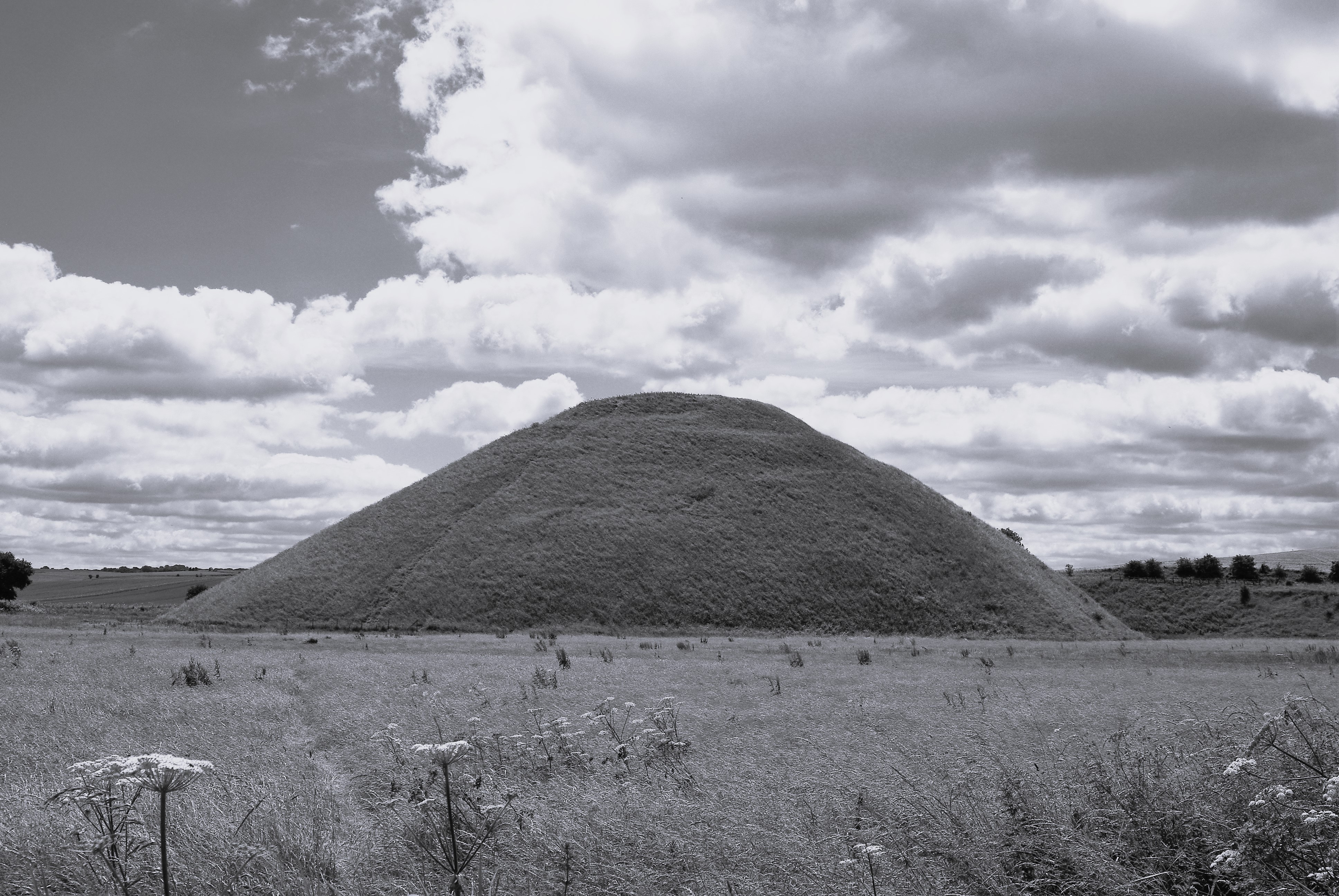
Silbury Hill, located a few miles from Avebury in Wiltshire, is the largest artificial mound in Europe, roughly the same size as the contemporaneous Egyptian pyramids, although it puts me more in mind of the Mexican pyramids. At 39m high and 160m wide and built of chalk, it was a colossal undertaking for the time – it was completed approximately four thousand four hundred years ago. Yet its purpose remains unknown; apparently it contains no burial, although folklore ascribes to it the final resting place of King Sil. Other theories connect it with the Goddess, and others yet suggest it as an observatory or sundial, although since Stonehenge was already in existence at the time of its construction, albeit in an earlier form as a henge monument, it seems highly unlikely that so much effort would have been put into the building of a mere mound, no matter how huge, if that was intended as its sole purpose.

Archaeological evidence suggests it was constructed over around a hundred years and there was probably a track spiralling around the hill to the top – used both in its construction and then afterwards to access the top of the hill which appeared to originally be flat. And that there was a constant tweaking of the shape over the following years, as though succeeding generations each felt the need to make their mark on the site.

Allowing for the fact it would have been a little higher due to the effects of weathering over the last four thousand years, it would have been as high as the nearby hills, Waden Hill and Knoll Down, but the difference would have been striking, since this perfectly shaped mound would have been dazzlingly white. The effect of the hill on anyone approaching would have been remarkable. Imagine it gleaming like a snow-covered mountain in the sunshine, or glowing mysteriously at night in a thin moonlight.

This isn’t something a tribe decided to do because they had some time on their hands – they’d had a good day’s hunting and the roof had been fixed, so why not? And not something just done on a whim – ‘You know, I like this place, but I really rather fancy putting a large hill just over there.’ This was a long term project, literally a lifetime’s work. And it was intended as one heck of a statement. Like a Medieval cathedral or Trump Tower, it was intended to be seen from a long way away and admired and talked about, although which of those two did it resemble? Was it the narcissistic project of an egotistical power-hungry madman or was it intended to glorify something greater than them?

On balance, I suspect the latter. Even if the project was begun by one strong-minded individual intent on somehow making a name for himself, it wouldn’t have been completed until long after his (or her) death, suggesting there was still a strong driving-force to complete the project.

But this is an area absolutely heaving with ancient monuments. Although Stonehenge is some twenty miles to the south, West Kennet long barrow is less than a mile away, Avebury Henge and stone circles only slightly further, and within the immediate landscape there are any number of burial mounds and standing stones. By any standard, this is a prehistoric landscape, and the visitor here must be looking at the evidence of ancient societies for whom memory and ritual were of great importance and significance.

I said earlier that there is no evidence of burials in the hill, yet all that means is that surveys have not revealed any chambers within the mound, or back-filled tunnels that might have been used to access the same. Yet I do wonder whether the entire structure might have been raised over the burial of an important personage. Perhaps future generations will find out.

Sickness and Diseases

I’ve mentioned that I’ve been researching my family tree, and a few days ago I was looking for details of one of my ancestors who lived in what was then a small village just outside Norwich. Looking on the parish records not only did I find the entry for his burial, but then noticed that the rector at that time had begun noting down what each person had died of. It was by no means complete, though, because he had added these notes for a year or so and then just stopped. Whether he’d got fed up with it or been told to stop for some reason, I obviously have no idea. But as I glanced through them, I became fascinated by them. I felt they left quite a lot of information about the place and time (rural England in the 1850’s) and thought a bit of it worth sharing.

My ancestor was on page 5 of these records, and the burials had all been conducted by the same rector from the first entry on page one. He added these notes from entry number two, through to twenty nine, then again for number thirty three, and then stopped. This is a summary of the relevant entries:

1   Male     5 weeks   Dec 1851

2   Male       44         Dec 1851      paralysis

3   Male       14         Jan 1852       consumption

4   Male       53         Jan 1852       consumption

5   Male         6         Jan 1852       scarlet fever

6   Male         3         Jan 1852       scarlet fever

7   Female    17         Feb 1852      typhus fever

8   Male        33         Feb 1852      consumption

9   Female    3¾        Jan 1852      scarlet fever

10 Male        53         Feb 1852      liver complaints. Publican.

11 Male        61         Mar 1852      paralysis, consumption

12 Male        19         Mar 1852      consumption 2½ years

13 Female    62         Apr 1852       cancer

14 Female    78         May 1852      old age

15 Male        33         Apr 1852      consumption

16 Male        55         May 1852     decline and heart disease

17 Female    69         Aug 1852      old age

18 Female      5         Aug 1852      inflammation of bowels

19 Female    13         Aug 1852      typhus fever

20 female     21         Aug 1852     consumption

21 Female    76         Aug 1852     coroner’s inquest. Verdict died by visitation of God

22 Male        63        Sep 1852     coroner’s inquest. Verdict died from injury in the head caused by fall

23 Female     71        Feb 1853      paralytic stroke and old age

24 Male         49        Apr 1853      labourer. Decline

25 Female     71        Feb 1853      coroner’s inquest. died by visitation of God, She dropped down dead when in perfect health

26 Male        85         Apr 1853      labourer. Paralysis

27 Male      infant      May 1853      jaundice

28 Female    64         Jun 1853      drowned herself in 11 inches of water. Morbid religious depression. A dissenter. Verdict temp insanity

29 Female   infant     Jun 1853      thrush

After this there are no further comments from the rector, other than:

33 Male        72        Sep 1853      disease of heart

There is quite a lot that is of interest here, and just from a statistical point of view we can see that nine of the burials were children under sixteen – just under a third of the total. Of those six were five or under. Lots of children died in those days. Yet somewhat surprisingly, fourteen of them – roughly half – were over fifty, with four in their seventies and one of eighty five. A very good age for the time. There doesn’t seem much difference in the average ages males and females lived to, although this is a tiny sample, of course. All the rural poor had tough lives, both male and female, which brings us to the comments added by the rector.

Number twenty six really caught my eye. Male, aged 85, a labourer, died of what the rector calls paralysis. No old age pension for them, they worked until they dropped. Number twenty four is also described as a labourer. Obviously the rector felt it worth mentioning, although why just those two, who knows?

Then we have the common diseases we’ve pretty well consigned to the past, now. Scarlet fever. Typhoid. Consumption – properly called tuberculosis. They killed frequently, especially the young.

And when the cause of death couldn’t be determined, even by inquest? ‘Visitation of God’. Although why those ones weren’t just put down to old age I can’t imagine. Unless somebody saw something…

Two more comments I have to mention, though. Number ten, male, age 53, died of liver complaints. The rector had to mention he was a publican, of course.

And then there is number twenty eight. Female, aged 64, drowned herself in 11 inches of water. Morbid religious depression. A dissenter. Verdict temp insanity. The rector belonged to the Church of England, and I’m sure he relished the suggestion that dissenters were mad. All the different denominations of the church seem to regularly go to war with the others, which, if you fancy a bit of a giggle, I satirised here some while ago.

Let’s Rid the Internet of Kittens

What is it about the internet and kittens, for goodness’ sake? There are far too many pictures of them.

Okay, that’s too provocative. Let’s move on.

005

She Who Dislikes Being Referred To This Way has been away for a few days. I had presumed that I would sleep better without the snoring, and the duvet being constantly pulled off me, but I was wrong.

For some reason, I’ve not slept particularly well at all.

Perhaps it was the wild parties I’ve no idea why not.

I had intended to begin a painting, maybe even get it finished, but although I carefully planned said painting, even finding a few resource pictures to use, once I sat down in front of the paper, it just refused to happen. My mind went completely blank and my enthusiasm kicked the wall sulkily for a few moments and then ran out of the house sobbing.

Oh well, back to the writing.

I did have a few ideas for short stories and, because I know how to use my time both productively and wisely, immediately started writing two of them, as well as continuing with both the novels I’m writing. That’s what you’re meant to do, right? Isn’t it?

Oh, and a poem.

And, of course, I need to do research for all the various Tales In Process. Isn’t it amazing what a little bit of research throws up?

Here are just a couple of little snippets, a few gobbets of curiosity, that I have come across recently while researching topics in medieval Persia and India, for use in my #1 Novel In Progress, The Assassin’s Garden.

All of the prostitutes in Fatephur Sikri, India, during the short time that it was Akhbar’s capital, were kept in an area just outside the city called ‘The Devil’s Quarter’.

You do get sidetracked, of course, but perhaps that will be an integral part of the plot? Possible spoiler alert?

I wouldn’t like to say.

And at one point, there is a long journey undertaken in my book, by caravan.

‘Caravan’ is a Persian word, I discover. That seems appropriate. In some parts of Persia they would travel by day and rest by night.

In others, the reverse was true. Something to do with the temperature, I expect.

In the nineteenth century, there were caravans that existed just to transfer corpses to holy cities for burial. These disappeared in the early twentieth century, largely due to better understanding of how diseases spread!

And, obviously, I mean the caravans that are chock full of camels and traders and an ill-assorted collection of ne’er-do-wells, not the wretched giant metal boxes blocking ninety percent of our roads as soon as the weather shows even the faintest promise of a few hours of sunshine.

But enough of caravans, for now, I’ve got some words to beat into shape.

Oh, and there are still people who would prefer pictures of kittens?