David Nash and Impermanence

A few days ago we went to the Towner Gallery in Eastbourne, Sussex, specifically to see the Eric Ravilious paintings and prints on permanent exhibition there. There was also a large exhibition by the sculptor David Nash, who works with wood on a large scale. The fact that the whole exhibition, which also included a gallery of paintings, prints and a couple of small installations, and was intended to highlight the effects of the Climate Crisis, was the first one ever curated by Caroline Lucas M.P. of the Green Party was an added bonus for me.
007a


002a

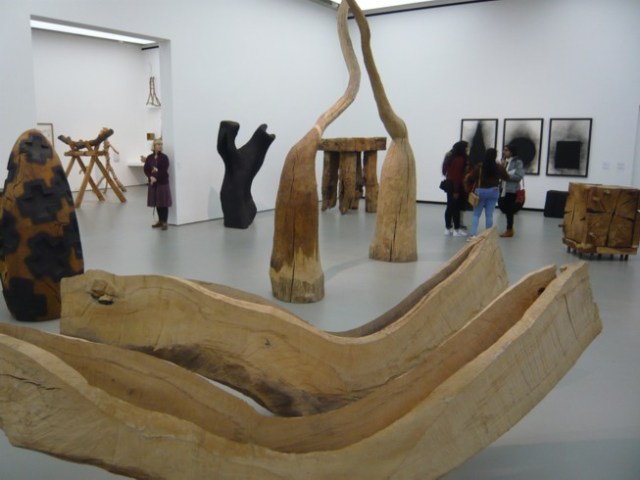
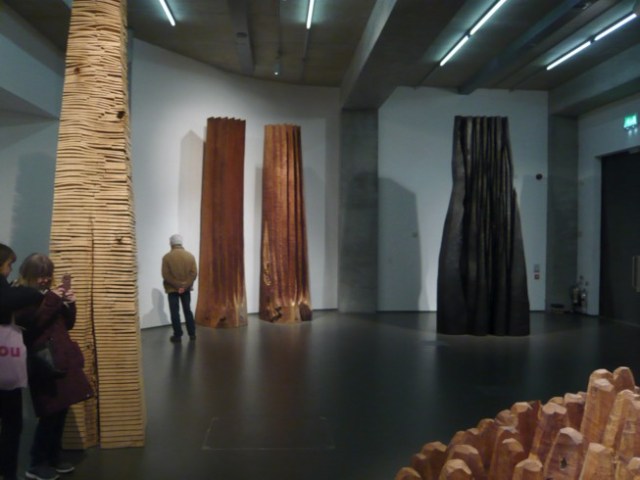
As much as I enjoyed the Ravilious, I was blown away by Nash’s sculptures. To see wooden sculptures on that scale is unusual in itself – usually that would be the preserve of stone or metal – but that very scale plays tricks with the mind and the eye. Boxes and bowls many times larger than one would expect meet the eye as you walk around the galleries, and many of the pieces also deceive where perhaps one looks to be made from several separate pieces of wood, but on closer inspection are carved from a single block like the boat shapes in the top picture, or the ‘stack’ in the one below that.

Much of the work is left rough-hewn, but even this can be deceptive. Some pieces have been carefully finished to give that appearance.

Sculpture is the art form that seems to exist to interact with the natural world. A number of the works here are based on natural forms, but there are also stories of projects Nash has undertaken where his sculpture is either living, in the form of carefully planted and managed groves of trees, or interact in other ways.
004a

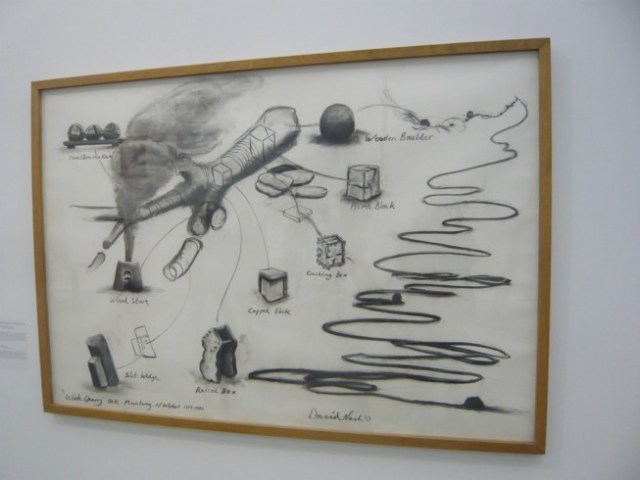
‘Boulder’ is one such project. One of the first large-scale pieces Nash made was to cut a boulder-shaped chunk from a tree (illustrated at the top of Nash’s charcoal drawing above) in 1978. This was then transported to a stream near to where he lives and works, in the Welsh hills, and rolled into the water. Since then, it has slowly made its way downstream until it reached the estuaries and inlets of the sea, where it finally disappeared in 2015. Nash documented its travels in a series of photographs and films made regularly all the while, and presented in the exhibition as a film.

006a


003a


003b

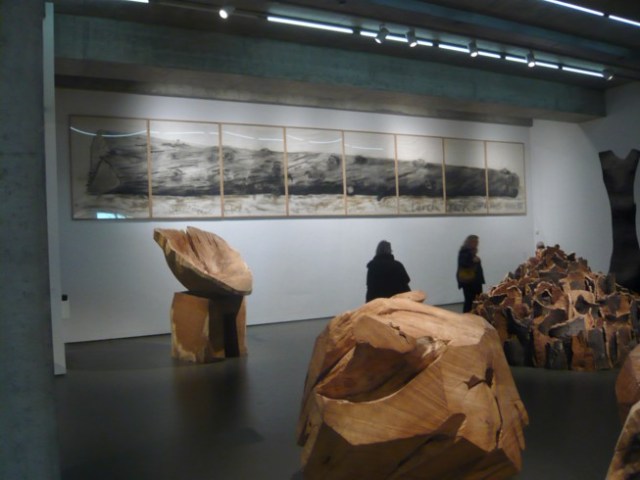
Nash’s sketch of a Larch trunk

It feels as though there is something of this meeting of art and the natural world in old ruins overrun with scrub and grass. They frequently seem to have a sculptural quality that complements the landscape around them, in a way that more pristine buildings do not.

And I like the sense that an artwork, like a ruined building, is not permanent and that eventually the natural world will absorb it back into itself. That it will reclaim it. Perhaps the artist and the environmentalist in me merge here.

My own sculptures are in wood, and some of them are set out in our garden where they gradually degrade over the years through the action of sun and rain, until they appear strangely like some weird plants that have sprouted unexpectedly there.

Review of The Old Weird Albion

The Old Weird Albion, by Justin Hopper.

download

The viewer sees a painting that appears to be composed of watercolour and charcoal, of a winding road or track, possibly even a river, leading towards a line of downland hills, the whole created entirely in black and shades of grey, with the title and author scrawled into the picture in brilliant white, as though it were a prehistoric figure etched into the Downs themselves.

And that’s just the cover.

This is a book quite unlike any I have read before, in that it is a book about the south of England, especially the South Downs of Sussex, but it is far more than geography and the associated disciplines such as geology and biology, rural history and architecture, and folklore. Psycho-geography was not a term I had come across before, but there is an aptness to it that becomes apparent as you read.

The book opens at Beachy Head, a beautiful piece of Sussex with a dark reputation for suicide, as a woman throws herself off the edge. Quickly, we learn that this woman was the first wife of the grandfather of the author, Justin Hopper. And we learn that this book is in part a chronicle of his efforts to discover this person and learn something of her life and, consequently, her motives for such an act.

In so doing, he needs to revisit parts of his earlier time in Sussex and examine his own relationship to the area as well as the relationship of other players, not just his grandfather and other members of their family.

He has a gift for sifting and selecting the weird in these relationships, not just at sites that might be naturally expected to encourage the weird, such as Chanctonbury Ring, high on the Downs above Steyning or in old ruined buildings, but also in humdrum blocks of flats in modern developments. He references modern phenomena like crop circles and throughout there is the presence of ‘magic’, in the sense of a natural force. Many of the people he meets are an eccentric mix of the weird, too, although I choose this description carefully, largely in the old, original meaning of the word of ‘fate’ or ‘destiny’.

A strength of this book is its intensity, and I feel impelled to look at the pictures it references and read the books it quotes. So much so that upon finishing the book, I spent some time tracking down an old copy of one of those books, which I am now reading, and which holds my interest in just the way Justin implied it would.

On a personal level, this book came just at the right time for me, in that I am reacquainting myself with the geography and history, and the plants and animals, of the South of England, where I grew up and which formed my love of the natural world, and the book has encouraged me to look at this in a new way.

It is most certainly a five star book for me.

The Weald of Kent and Sussex

South East England is my area. It is where I was raised and, other than a few years spent abroad, it is where I have lived my whole life. In particular, the Weald and the Downs. Not so much the coastline, which has never particularly attracted me, but the hills and valleys, the woodlands and rabbits, the hidden crags and open downland, the land of streams and foxes and badgers, birds and villages and butterflies.

039a

On the Sussex Downs

There is a curious fact about the wooded areas of South east England, which is that there is more woodland, covering a greater area now, than was the case four hundred years ago.

032a

Back then, South East England was the industrial heartland of Britain. This was before the discovery of the coal seams of the North and the Midlands, and the various factors which would eventually lead to the greatest impact of the Industrial revolution being in those areas.  Instead, the modest iron deposits of the Weald were mined and worked into firedogs and nails, cannon and cooking pans, as the wealth of words such as hammer and forge in place names still bear witness.


037b

Huge numbers of trees were cut down to feed the fires of these forges, and huge numbers also for charcoal burning, for building, and near the coast the great Kent and Sussex oaks were in huge demand to build the large number of ships the navy demanded. But then from the mid eighteenth century onwards, industry began to shift northwards.

Despite the pressures on the land for building and for farming in this crowded corner of our crowded island, there is actually more woodland now than there was during the fifteenth and sixteenth centuries. And that is not something that can be said of many parts of Britain or, I suspect, many parts of the world at all.

010a

The Weald is an area whose underlying rocks are sandstone and clay, which means that the unimproved soils are inevitably either light and sandy or thick and claggy. In some parts there are old sunken tracks known as ‘Summer Roads’, so-called because they became impassable in the winter months, when they might have had a foot or more of thick, wet, muddy, clay on their surface. When these were in use, journeys between villages that might take an hour or two in summer, could became almost impossibly long during the winter.

037x

At the moment, all everything in the news seems depressing and unpleasant and so, this post is an indulgence. Just a smattering of information, and a few photos of places I love, largely to improve my mood.

More Random Stuff; this time, Artworks

Creatively, for me this week has been rather a damp squib.

I have managed a little writing and research on ‘The Assassin’s garden’, but I’ve not had a very good week, one way or the other, and am just not up to writing a blog today.

So, the easy way out.

This is a somewhat random mix of some of my paintings from the last 10 or 15 years.

rock-no1

An oil pastel painting of a rock structure a few miles away from where I live – it looks to be a heavily abstracted painting, but is actually reasonably accurate!


chestnuts

A watercolour – chestnuts in autumn.


summer-medway

A chalk pastel – alongside a nearby river, The Medway, in summer.


nepalese-village-door

Another oil pastel – a door in a house in a village in the Khumbu region, Nepal.


007

Charcoal on paper – Musician.


dusk

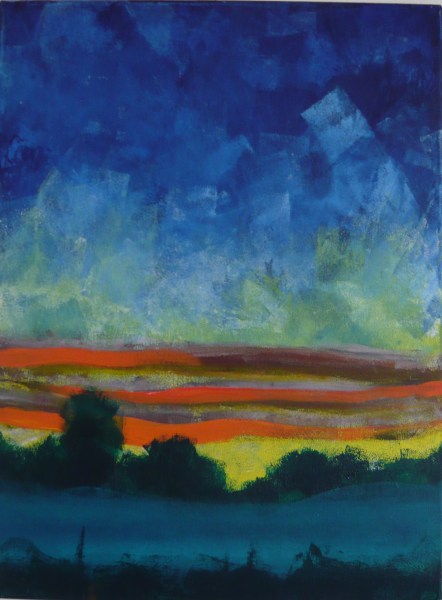
Acrylic on canvas – Dusk.

I think that’s suitably random; I’d be surprised if anyone could find a theme there, other than ‘paintings’.

Have a good weekend, everyone.