An Alien Culture?

More people travel for leisure purposes today than have ever done so in the past. And many work abroad on short- or long-term contracts, often with a certain amount of leisure time available to experience the culture that surrounds them there.

And this will result in these travellers meeting the people that make up the indigenous society where, for a while, they find themselves. Will there then be a meeting of minds?

Having lived in an ex-pat society, as I have referred to on here before, I am familiar with the laager mentality that often pervades it. I won’t go into all the permutations, but there is frequently a combination of arrogance and fear that leads to a strong feeling of ‘us and them’.

Many travel with the firm conviction that their own society is superior to any other, and are unwilling to see any good at all in any others. Some who go away to work resent being uprooted, and arrive with that resentment packed in their baggage. Some find the experience to be fearful, if they do not understand the language being spoken around them or assume that this alien society has values that somehow threaten them.

And they can either lock themselves away and peer over the barricades, or they can embrace the experience and learn from it.

137 (2)

Travel broadens the mind, it is said, but sometimes it seems to just cement prejudices more firmly in place.

And how easy it is to travel around just looking for things to justify prejudices!

One of the more infuriating things that I come across occasionally is a bigoted and ignorant letter or article in a local newspaper (it often tends to be the local ones) where someone’s idiot views are justified by the phrase ‘I know; I was there’. I imagine them living their entire time in a foreign country in a compound that they rarely leave, yet thinking that they now know exactly how the society functions beyond their walls.

I’ve met one or two of them, over the years.

I spent three years in Oman, working, and I’ve travelled fairly extensively in India, but I do not imagine or pretend that I really have much more than a superficial experience of these places. I knew little of the local culture in Oman beyond what I could see in the streets and villages and markets that I visited. I didn’t know anyone well enough to spend time at their homes or in their social circles. I went with groups of other westerners to places of interest. I did spend a lot of time exploring the desert and the nearby towns on my own, but I was effectively still inside my own little bubble. It is a huge regret that I never got deeper under the surface.

I have, perhaps, managed to learn a little more about the real India, especially through spending time on a project in a village, although I cannot pretend, even to myself, that I really have any idea of what it is like to actually live in an Indian village.

During the later days of the British Raj, the rulers took the approach that their civilisation was naturally superior, and that there was nothing in Indian civilisation worthy of their consideration. The irony of this is that around the end of the eighteenth century, and the first years of the nineteenth, many of the British in India had taken a keen interest in Indian history and culture, themselves doing a tremendous amount to unearth much of the history that had been lost and forgotten. For that comparatively brief period, it would seem that many of the British treated Indians and their culture with a deep respect.

The reasons that this changed are probably deeper than my understanding, but two things stand out. Firstly, that from the beginning of the nineteenth century, many British women came to India in search of husbands, bringing with them what we tend to think of as Victorian attitudes, and secondly, there was an upsurge of evangelism in Britain, which translated itself in India as a movement to convert the ‘heathens’ to Christianity. These combined as a new feeling of superiority, and contempt for a society that was now seen as inferior, especially when much of it resisted their overtures.

With this, the British as a whole seemed to become more intolerant and arrogant, and less respectful of sensibilities. This culminated in the horrors of 1857, which could be said to be caused directly by these attitudes.

To return to the present day, it seems that many travellers have attitudes no better than their Victorian predecessors’. I wrote a post a few months back that mentioned a number of westerners I came across in a Himalayan hill resort, https://mickcanning.co/2015/10/25/the-mad-woman-of-the-hill-station/  should you wish to view it, whose behaviour and attitudes were just downright arrogant and disrespectful. They were doing no more than confirming their prejudices as they travelled, and at the same time I daresay they were confirming many people’s views of western travellers.

Yet there are many people who travel with open ears, open eyes and an open mind, and their rewards are far greater than those of the blinkered traveller. They have the wonderful opportunity to experience and learn about different cultures at first hand, speak to people who hold different beliefs and ideals to them, and perhaps learn a little of what drives them. In return, they have an opportunity to enlighten others, perhaps, to things in their own society that might not be understood by those others. In a small way, each and every one of them can choose to contribute either to different societies coming to understand and become more tolerant, or to the further spread of tensions, mistrust, and misunderstandings.

And all of these little interactions, added together, are as important and influential as the contacts between politicians and diplomats.
My Father in India

They didn’t talk about it.

It wasn’t as bad as the First World War, when men who had nervous breakdowns were frequently shot for cowardice, but the men of the generation who fought in the Second World War were still reluctant to talk about the hardships they had faced and the horrors they had seen.

When my father did talk to me about it, and it was very rare that he would, it was generally to joke about the fun that he’d had on leave, or, after my first visit to India, to ask about places that he remembered from Delhi.

He had seen fighting in Burma, and stayed in India right up to the time of Partition. He certainly wasn’t going to talk about either of those. When pushed, he’d clam up about Burma, and would only say that what he’d seen in India at the time of Partition was horrible.

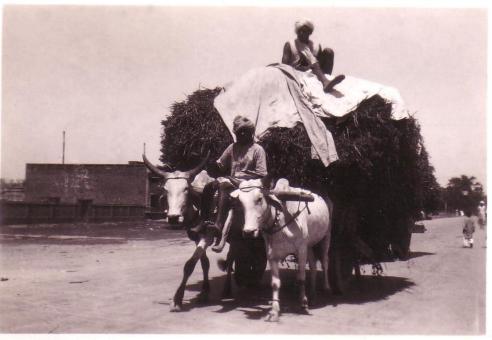
bullock cart

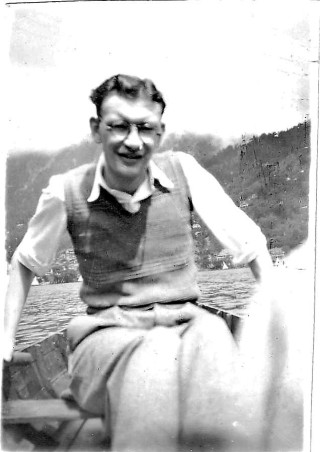
I daresay he told me one or two things that I have forgotten; things that didn’t mean much to me at the time. Perhaps he told me where he had been when he was on leave and was photographed rowing a boat on a lake in the hills; almost certainly in the North of India. Nainital, perhaps? I have been there myself, now, and I’m not certain. If he had told me before I’d been out there, the name would have meant nothing to me, and so I wouldn’t have remembered it.

And by then it was too late to ask him, because he died before I returned for my second visit.

dad 1

Once he had returned to England, he never went back to India, and I certainly never had the impression that he wanted to. I guess that the bad memories must have outweighed the good ones.

I have a dictionary that he bought in Delhi, stamped inside the cover ‘Cambridge Book Depot, New Delhi’ with the price scribbled in pencil; Rs 3/12, and his signature. I also had some old Indian coins, once, that he had given me, but I’m not sure where they are now. Other than the photographs, I’m not aware that he brought anything else back. Certainly, there were never any ‘curios’. Although a part of me wonders whether there might have been once, and whether my mother, a staunch Christian, might have thrown them out after they married. But that is pure conjecture.

hill station 4

And he was interested enough to read books on India’s history. I was surprised, occasionally, on the depth of his knowledge on the subject. He was, though, always interested in history, so I suppose that I shouldn’t have been really, and if he hadn’t have been born working class, I daresay that he might have had a university education, because he excelled at school.

Most of the photos are in fairly poor condition, although I have attempted to improve a couple of the ones that were particularly bad.

It seems strange to think of soldiers as tourists, but whilst they were on leave in India, that is, of course, exactly what they were. There are one or two photos in his collection that were taken of places I have been. One of them is of a view inside the Red Fort of Delhi that differs only in the size of the tree in the picture from one that I took in 1989.

He must have stood in exactly the same spot to take that picture, some 45 years before.

What does this small slice of family history mean for me?

mainstreet poona

It does mean that there is a slight family connection to India, if not in the way that usually comes to mind. He had no family there, and had no responsibilities beyond his army duties, but just the fact of his living out there for a number of years, gives me this connection. Or so I like to think of it.

In the end, India wove its magic over me – nothing much to do with Dad, I suppose, although I expect that was in the mix somewhere. I think that part of why I may have gone out there the first time, was to follow in his footsteps. And now my family can say that they have a connection to India through the time that I have spent out there as well.

Oman (1)

Prior to 1970, Oman was, in many ways, still a medieval country. There were no more than 3 miles of tarmac road in the whole country, the gates of the capital, Muscat, were still closed between the hours of sunset and sunrise, and it’s exports were largely confined to dates, limes and frankincense. Oil had first been discovered as far back as 1956, and then in commercial quantities in 1962. Production began in 1964 and led irrevocably to massive changes, although these would not come about until 1970.

boat

This launch (Omanis never use the word Dhow) was on the shore at Yiti, just east of Muscat. It would most likely have been used for trading and was probably still seaworthy when I took this photo.

Mindful of these changes that had happened virtually overnight to other Middle Eastern states when oil had been discovered, the then Sultan, Said, was determined that Oman would not go the same way. Unfortunately for everyone concerned, his solution was to stash the proceeds in the royal coffers, whilst the country and its people remained poor. It was a situation that could not last for long, and in 1970 his son, Qaboos, overthrew the old Sultan.

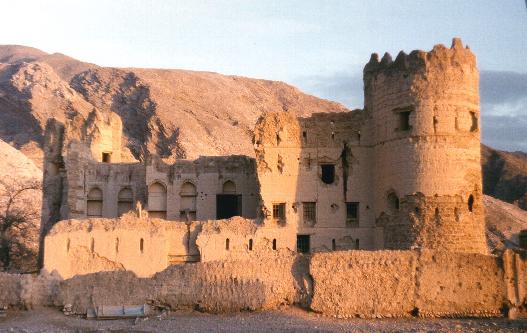
Baushar Fort

Old fort at the village of Baushar, near Muscat.
baushar door
Carved wooden door in Baushar Fort

I lived there between 1985 and 1988, during which time the country was making large strides towards being a modern state, although many parts of the country still felt as though they belonged in another century. Around Muscat and along the Northern coast, there were new towns springing up, modern shops and hotels, main roads, and much of the development that might be expected. There did appear to be an emphasis on the building of facilities such as schools and hospitals, however, along with a good deal of restraint, which was a refreshing change from the way that many other states used their oil wealth.

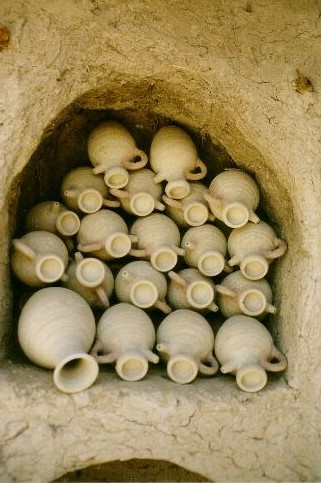
pottery kiln 1

Pottery kiln at Bahla.

Bahla has good quality clay and produces large numbers of pots, which are thrown on simple foot-operated slow wheels and fired in large mud-brick kilns, which are fueled with brushwood.

Pots at bala

Newly-fired pots

Away from the towns, to visit most of the villages was like stepping back in time. Buildings were often still mud brick and palm thatch, and many of the traditional cottage industries were still followed.

falaj

Falaj.

The Falaj system of irrigation originated in Persia and was spread throughout the Arab world. I have even seen examples in Spain. The system consists of a series of underwater channels bringing water from where it arises, usually in the mountains, to where it is needed, where it is distributed by overground channels. These channels, both underground and overground, have been built on a very gentle gradient and show astounding technical skill, being built only with primitive tools, often very deep underground. Many of the Omani Falajes are reckoned to have been built by 500 BC.

dates

Dates spread out to dry near the town of Quriyat.

Dates are an important crop in Oman and were the main export until the discovery of oil there. They are still dried in the traditional way – in the sun.

shark boy crop

Boy on a donkey with sharks. The sea has also traditionally been a major source of food for Omanis. I passed this boy just outside Quriyat.

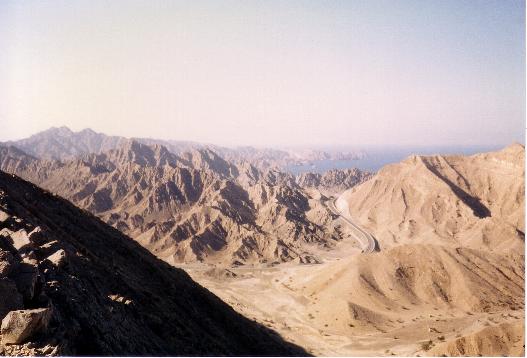
deserty desert

Coastal mountains, SE of Muscat.

For a long time after I finally left Oman, I harboured a strong wish to go back there. But recently I watched several videos on YouTube, which have cured me. Many of the places that I knew as small settlements with dirt roads and small houses, have become places of great wealth with wide boulevards, modern houses and cars, and tourist hotels. It is, no doubt, a development that is welcomed by the majority of the population, but it is not the Oman that I knew.

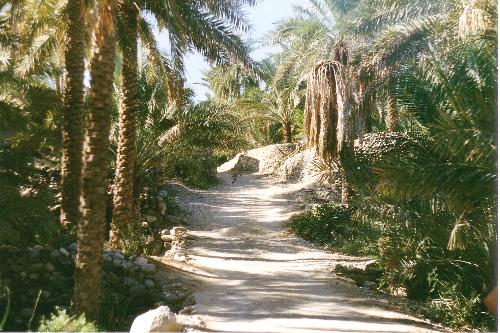
Oasis

There you go. A picture of an oasis.

The Expedition Report

As promised in my last post, I attach here a report of my expedition.

On Saturday 30th January 2016, the morning sky cleared and the sun came out. It would be a good walking day.

P1050080

I had thought long and hard over the various logistical challenges of this expedition, and decided eventually, albeit reluctantly, that it would be wise not to attempt it alone. As much as I was loathe to share the glory of this journey, the sensible traveller realises his or her own limitations, and assesses the difficulties and dangers that they are likely to meet. And so I decided that I would take a companion; not only to make the journey more amenable, but also to help with the navigating, act as a safety back-up, and who could act in need as a porter.

We decided to split the tasks. ‘You’re leader,’ my companion Bob said, ‘so you take the big pack with the emergency stuff, and I’ll navigate. It will make life easier for both of us.’ Somehow, that wasn’t quite what I’d planned.

We picked up our packs, said our goodbyes, and set off down the path to the road. ‘We go left here.’ Bob said, turning right. I hesitated. ‘What are you waiting for?’ He asked irritably, turning round.

‘You said left.’

‘Yes. Are you going to stand there all day?’ I shrugged, and then followed him. The first part of our journey presented few difficulties. We turned left at the next junction (‘I said right!’) and followed the road until we had left the town far behind and were surrounded by a sparsely inhabited landscape. Now we needed to find our way down the hill on the other side of the road.

‘It’s not safe to cross here.’ opined Bob.

‘There’s hardly any traffic!’

‘It comes round the corner really quickly. Let’s go on a bit further and find somewhere better.’

‘The corner’s half a mile away! I’m crossing here!’

‘You cross then.’ He sounded sulky. ‘I’ll catch you up.’ He turned away and stomped slowly along the pavement.

I crossed the road, found a bench, and settled down to wait. Minutes passed, and I took out a chocolate bar and ate it. I had a drink of water. I pulled out the guidebook and went over our route again, and then got side tracked and began reading about the dreadful earthquake of 1734 that destroyed so much of Tunbridge Wells. I had another drink of water. I found a newspaper in the side pocket of my pack and did the crossword. As I finished, I looked up, and my companion arrived.

‘Where have you been?’ He looked sheepish.

‘I turned left by accident. Never mind that, I’m here now.’ He sat down beside me. ‘Sorry, I need a drink.’ He took out a flask and poured a little of the contents into the cup.

‘What’s that?’

‘Oh, just a drop of whisky.’

‘That was meant to be for emergencies only!’

‘This is an emergency!’

When we set off again, we were fortunate to find a track that seemed to be going in the right direction. It was no more than twenty foot wide in places, surfaced with a smooth, black layer, and showing occasional white markings roughly in the middle, as if left to guide travellers. Following this, we worked our way down from the ridge and found ourselves in a fairly steep-sided valley. The road bent around to the right and ran along the bottom the valley, following a stream on one side of the road, and an old railway track on the other. There was a signpost beside us, a pub on the left, and a farm on the right. In front of us a church tower showed clearly above the trees.

Bob took out the map and compass, handed me the map and then carefully lined up the edge of the compass with the side of the map. For a moment or two his eyes flickered between the map and route ahead of us, and then he clicked his tongue irritably.

‘I think we’re lost.’

‘Er, the compass needle isn’t pointing north.’

‘Eh? What…’ he fiddled with the compass for a moment. ‘Oh, you had the map upside down, you fool. No wonder!’ He snatched it from my hands, looked at it suspiciously, glanced up at the signpost quickly when he thought I wasn’t looking, and then handed the map back to me. ‘This way. Come on!’

Half a mile along the road, a track turned off to the left and ran under the railway and into a little wood.

‘This way,’ I said.

‘Are you sure?’

‘Yes.’ I went under the bridge and into the woods, to find that the path was a morass of mud. This area is renowned for enjoying (or otherwise) what can be regarded as fiercely localised weather. Even though it was pouring with rain today in the Lake District and in Southern Hungary, the sun stubbornly shone throughout the afternoon on our little expedition. But it seemed as though that hadn’t always been the case recently. This part of our journey should only have taken us about ten minutes, but it was almost half an hour before we crossed the stile in the fence that marked the boundary between where we were at the time and somewhere else.

The next section of the trail took us down a steep and uncertain track, ankle deep in autumn leaves and with little sections of mud here and there underfoot. It proved necessary to watch our footing carefully, and now and again we had no choice but to hold onto the guard rail for a moment. After a minute or two, however, we reached the foot of the slope safely and paused to catch our breath and have a snack.

We checked the map, noticing that we would have to navigate the next section very carefully.

‘I’ll lead this.’ Bob said, starting to take the map from my hands. I slapped him.

‘No, you won’t.’

We passed under the old railway bridge, which incorporates parts of a still older construction. All that remains now is one end of a medieval banqueting hall, complete with shields. In places it is still possible to glimpse traces of what appear to be the original wall paintings. Judging by what remains of the inscriptions, they possibly depict Saint Darren, patron saint of nearby Tonbridge.

P1050081

It is a glorious place in the spring, when the wild marsupial trees are in blossom, but now it was a gloomy place. But still it was with reluctance that we dragged ourselves away from this important historical site, and tramped onwards through the woods.

For the next leg of our journey, the path took a great, sweeping loop around a mysterious and secretive area of pipes and tanks and low buildings. The trees creaked ominously overhead. Was it just the wind? Yes, of course it was. It has always had an evil reputation, though. In medieval times, it was a place of alchemy, and rumours still persist that it was in some dark chamber beneath the ground, at this exact location, that an evil sorcerer discovered a magical substance that turned real beer into lager, or false beer as it is properly called, threatening to plunge the whole kingdom into a new dark age.

And at times the traveller of today can almost fancy that a whiff of sulphur or some such odour still overhangs this dreadful place. Several years ago someone tripped over a protruding tree root nearby and hurt themselves, and the rooks call their depressing calls overhead in the gloomy trees.

We were glad indeed to get away from such a terrible place.

P1050085 (2)

Now, on almost the last leg of our journey, our path ran along south-facing hillsides, through one of the small tea gardens that produce our famous Sussex tea, and then dropped down lower to meet the overgrown and largely clogged up remnants of the Bristol to Tunbridge Wells canal. It was still being used to transport coal and gin from Bristol to Tunbridge Wells, with a return cargo of young slaves, as recently as sixty years ago, after which it fell into disrepair as demand for these products fell off.

P1050087 (2)

Care has to be taken along this stretch, as the old towpath along the edge of the canal is quite obvious, but on the other side lies the Great Groombridge Swamp, which has been known to swallow up unwary travellers. Bob was leading at this point, and we were both keen to reach the end, now. I noticed him straying slightly towards the swamp so I called out ‘Just go right, a bit.’

Oops.

A quarter of an hour later I was enjoying a pint of Black Cat Ale, before catching the bus back home to write up my notes and then make a tricky phone call to Bob’s wife.

Still, all expeditions, like life itself, throw up challenges that have to be faced up to.

Disclaimer:

Please note that an expedition of this nature is not one to be undertaken lightly. Should you wish to follow in my footsteps, you are strongly advised to ensure that you have adequate training and suitable equipment for the journey.

Once Upon a Time

046

Are you sitting comfortably? Then I’ll begin.

It is a cliché that causes us to smile, yet variations of that phrase will have been used countless times in the distant past, when our ancestors gathered around the storyteller of the tribe to hear whatever tale he (or she) was about to tell.

And research http://rsos.royalsocietypublishing.org/content/3/1/150645  that was published this week, now tells us that the history of fairy tales turns out to be even longer than anyone suspected, going back to the times of prehistoric tribes. Not that this theory is entirely uncontested, of course.

But I would be surprised if it were untrue.

There have always been storytellers, who performed an important role, especially before the invention of writing. In those days, when all knowledge had to be memorised if it was to be of any use, then the skills of the storyteller in the tribe, someone who was used to organising their thoughts so that they could remember what was important and then recount it to the rest of the tribe, would have been vital for far more than simply entertainment; they would have been essential for the tribe’s survival.

They would have told stories about wild animals; either cautionary tales, or how to hunt them. Stories of skirmishes with other tribes; praising the bravery of their own warriors, and recounting how the other tribe was put to flight, but warning, still, of the danger these other tribes posed.

They must have always speculated on the origins of their world, and come up with the various creation myths. It would be important that all the tribe understood the appropriate rituals they would need to follow to appease the gods and ensure their own welfare.

So these stories would have been a way of sharing information with all the members of the tribe.

Much later, after the invention of writing, these tales began to perform a different function. They would still be used as cautionary tales, but now perhaps aimed more towards children (watch out for cross-dressing wolves and the like), or purely for entertainment.

But in a society where the majority were unable to read, they would remain important.

Throughout history, there has always been a borrowing and reinvention of stories; the myth of a flood that wipes out most of mankind, for example, is found virtually all over the world.

But the difference between a ‘myth’ and a ‘fairy story’ seems a little vague. I suppose the term ‘myth’ does seem to have a little more gravitas.

Many of these stories concern blacksmiths, which might be due to an early awe of those peoples who discovered how to work stronger metal, specifically iron, and fears that they might be using magical or supernatural means to do so. I’ll return to that shortly.

Now let’s take one well-known example of a fairy tale; the story of Snow White plays out both as a royal power struggle, something that has occurred time and again all over the world, and also the classic tale of the wicked stepmother, highlighting the insecurity a child may feel when a parent dies and is replaced by a stranger.

She flees an assassination attempt to find refuge with another people. The fact that they are depicted as dwarves (in the well-known European version) serves to emphasize the fact that they are not her own people.

There are further attempts on her life, but she is finally rescued by a passing prince and lives happily ever after.

Variations of this story crop up across Europe, Turkey, Africa, Asia and America. Whether these tales were passed from tribe to tribe and spread across the world that way, or were invented spontaneously in different parts of the world, it is unlikely we will ever know. It was probably a combination of the two. What is certain, is that they tend to be reinvented regularly.

Stories of mortals striking deals with supernatural beings (i.e. the devil) occur world-wide. What they all have in common is that either the human making it reneges on the deal, and usually finds a way to cheat the supernatural being, or, of course, the devil comes to collect his soul.

It is still a well-used device in literature. There is Goethe’s Faust, and since then many other popular novels on the subject, and we are still happily reinventing this story, as well as all of the other fairy tales, into new stories today.

In Britain, there are numerous folk-tales on this subject, usually concerning blacksmiths who either make pacts with the devil, or who are visited by him in disguise and realise who he really is (the comely maiden with the cloven hooves is often a bit of a giveaway). It usually ends with the devil being grabbed by the nose with red hot pincers and running off screaming. But again, these tales surface from all parts of the British Isles, and are set in times that are contemporary to the story teller. So the fellow telling the tale in an ale-house in a sixteenth century village would mention the blacksmith in a village twenty or so miles away – close enough to be particularly exciting to the listeners, but probably far enough away for there to be no one in his audience who might confidently denounce it as false.

And then, of course, they all lived happily ever after.

A Short History of Blogging

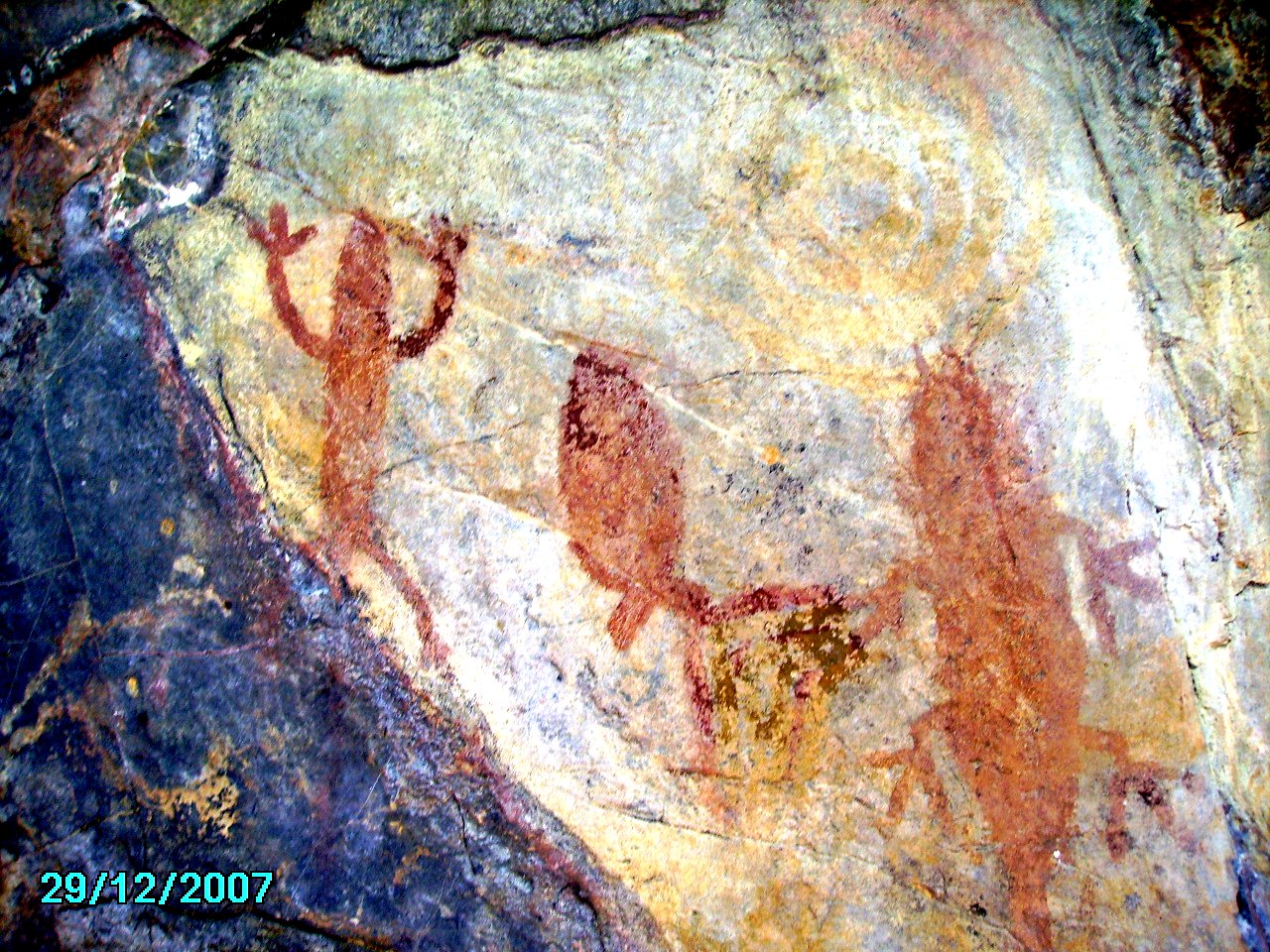
Blogging has always been about self-promotion. The first known blogs were on cave walls, although they were pretty crude, to be honest, and it is often really difficult to make out what the bloggers were on about. There is speculation, indeed, that to refer to them as ‘blogs’ might be a little misleading. The fact that they tend to be short and that it is very hard to make out what they mean, leads some experts to assume that they were an early form of Twitter. And then the fact that they frequently depict crude human figures, especially exaggeratedly female ones, and various animals, suggest that even in these early times, social media were largely the preserve of young person

cave paintings

‘Share if you think these babes are hot.’

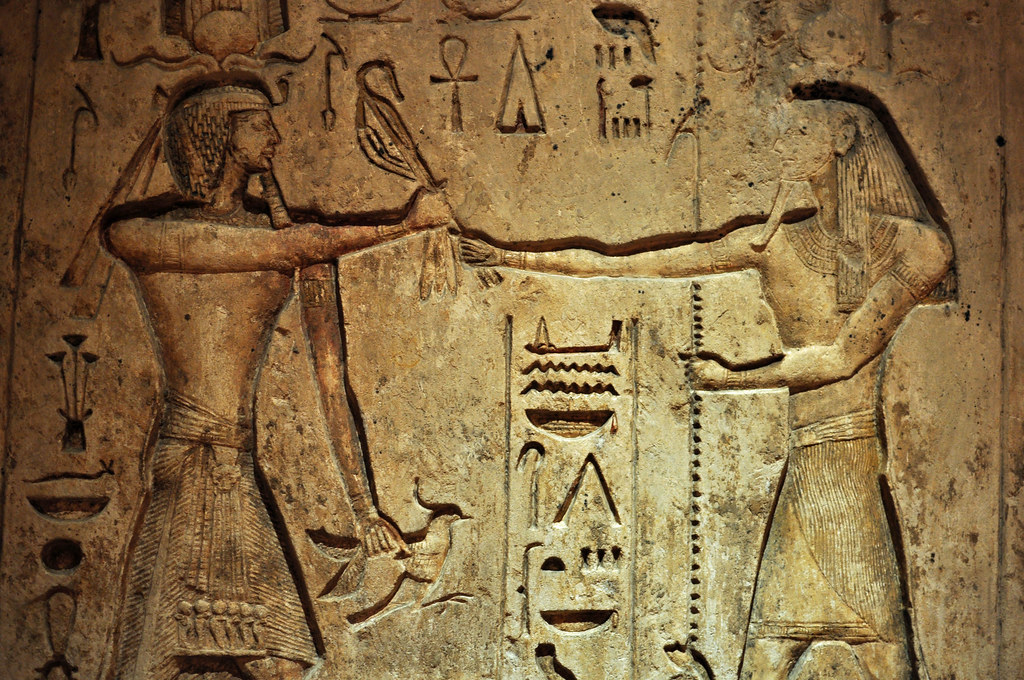
By the time of the rise of the first true civilisations in Egypt, they were beginning to get the hang of it. They have left massive numbers of inscriptions all over walls and columns and pretty well anything else that they could get a hammer and chisel near.

Egyptian carvings

‘Amenhotep snubbed in Big Brother Pyramid game – LOL’

Some even see the Rosetta Stone as a forerunner of Google, but others don’t.

The first English blogger was The Venerable Bede. His blog is one of the main sources of our knowledge of Saxon times, which is a bit of a bugger really, when you consider how reliable social media are today as a source of modern history. He probably missed out most of the good stuff. But he blogged in Old English, anyway, which no one can understand nowadays so it probably doesn’t matter.

bede

Leonardo da Vinci did a wicked selfie, but would probably be criticised nowadays for how few he produced. To be anyone on social media, it is probably necessary to post a minimum of twenty selfies in any twenty four hour period, but Leo was never up to that. But most of his blogs were all about what would then be science fiction and art and politics…so he’d have fitted in quite well with today’s bloggers really.

Samuel Pepys’ diaries are, of course, just the notes he took for his blogs. They are a mix of politics and news and what his family were up to, and his ‘conquests’ of various ladies. Wisely, he wrote most of this in shorthand and, even more wisely, put the more salacious bits in code. Nowadays, it is unnecessary to use code, since language is now changing so fast that no one can understand anything that was written more than six months ago anyway.

The Puritans thought blogging might be fun so they banned it, along with just about everything else, except breathing and praying. Well, praying, anyway.

A little later, newspapers were invented. These were not really blogs, since they were filled with news, rather than self-promotion, and it took a number of years before newspaper owners and editors realised that. Once they did, however, they worked very hard to make up for lost time, and now there are very few newspapers in the world that print mainly news.

And quite a lot that do not print any news at all.

In fact, they tend to be full of primitive opinion and often depict crude human figures, especially exaggeratedly female ones, and various animals.

And thus life turns full circle.


Photo credit (picture 1): jmarconi via VisualHunt.com / CC BY         

Photo credit (picture 2): PMillera4 via Visualhunt / CC BY-NC-ND


The Problem of Historical Truth

In my previous post about the pitfalls of online research, I began by alluding to the unreliability of newspaper reports. If you were to read reports on an important item of news in a number of different newspapers, you frequently might be forgiven for thinking that they were actually talking about completely different events. There will be political bias, of course, and the prejudices and agendas of reporters and editors alike. Are the individuals in an armed insurgency terrorists or freedom fighters? It is a point of view. Are strikers in an industry greedy mischief-making saboteurs, or victimised and mistreated victims of greedy corporations? Again, it is a point of view.

It can be very hard today to see through the fog of opinions and misinformation on any topic. How much more so when we delve back into time?

History is written by the victors. For example, what we know about Caesar’s campaigns in Gaul and Britain were written largely by the Roman conquerors, especially Caesar himself. Most of what we know of the reign of Ashoka, in India, comes from the edicts that he caused to be inscribed upon the remarkable number of rocks and pillars that are still in existence.

023 (2)

Even tales written by the vanquished are likely to be inaccurate, of course. The cruelty of the victors, their barbarity; all of their actions will be exaggerated.

The historian understands that information comes largely from primary and secondary sources. A primary source might be, for example, an account written at the time (Caesar, above) or Parish registers of births, marriages and deaths. These sources are considered to be most likely to be accurate, being compiled at the time of the events described, but clearly they might all be deliberately or accidently falsified. Secondary sources might be newspapers, which are largely made up of analysis and opinion, and therefore considered to be an interpretation of information that has been derived from another (hopefully primary!) source.

A primary source is also referred to as evidence, yet I wonder whether a better distinction would be made if ‘evidence’ referred only to unwritten sources; archaeological remains, buildings, pottery, jewellery and coins and their like, which, whilst needing interpretation, are unlikely to be prey to the kind of distortions that written sources might be. Caesar, after all, might have claimed to take ten thousand prisoners when he only took five hundred, yet pottery of a particular type that is found at a particular spot, tells a story that needs to be interpreted, yet is unlikely to be a falsehood.

We need to be careful, though, when it is interpreted in light of contemporary writing, to avoid the temptation of unconsciously corroborating those writings.

Having written the above, we do have to take a certain amount on trust, because it is not practical to question everything in the world that we come across.

Yet, just because we discover that Troy really does exist, does not mean that all of the stories of the Iliad are now, somehow, all true. That would be like an author writing an incredibly impossible fantasy tale, in which the city of Vienna still exists and features, yet claiming it must be true because Vienna is a real place.

During the first year of World War One, a fictional short story ‘The Bowmen’ was published in the London Evening News by Arthur Machen. In this tale, he describes a battle between English and German soldiers at Mons, in France, in which the beleaguered British were aided by the sudden appearance of phantom archers who intervened to keep the British safe. Although this was fiction, the story quickly ‘went viral’, as we might put it today, and was readily believed by many in Britain. Of course, there was a feeling then that the British were good and the Germans evil, and so it was natural that God might intervene to help and protect them. A far stronger belief in God, in those days, also contributed to the feeling that it was natural to find that a miracle had occurred.

Although Machen republished the tale in a book with a long introduction explaining that it was fiction, and examining reasons the public thought it was true, not only did the belief persist, but further reports of angels on the battlefield began to appear. As a child in the 1960’s, I remember reading an account of this in a comic, with it presented as the truth. In 2001, the Sunday Times reported that photographic evidence to support the story had been discovered, although this was proved to be a hoax.

The Sunday Times also published exerts from Hitler’s Diaries in 1983, until these, too, were proved to have been forged.

Memories are notoriously unreliable. I was reading just a few days ago of an experiment where a group of people were encouraged to discuss childhood memories, with selected members of the group feeding in deliberately false information. After an initial hesitation, it seemed that all of them accepted these false memories as real, even to the extent of agreeing that they had taken part in a balloon ride, when they had not, and describing what they had seen from the balloon, and their feelings during the ride. The point being that they came to believe these were their own, real, memories.

How reliable are our own memories, then? And what can we trust? Clearly, there must be a lot of historical narrative that has been honestly recorded, that is simply not true, and we are unlikely to ever know what it is.

The Mad Woman of the Hill Station

A few years ago I was staying in a town in the Indian Himalaya; one of those towns that would have been described as a ‘hill station’ in the days of the British Raj, where the climate is tolerably similar to that found in Britain, and the Colonial masters were able to retreat for that half of the year that the temperatures on the plains became just too hot for them to endure. When that happened, they would load up themselves and their possessions, even down to plants in plant pots, so that native servants could drive them or carry them for weeks on end, on the long journey up into the hills. Nothing would be too much bother…for the servants and ‘coolies’, that is. At that time, the Westerners considered themselves to be utterly superior to the ‘native peoples.’

       coolie 1

Of course, that kind of attitude has been consigned to history, now, hasn’t it?

Anyway, it is a lovely town, this town that I am referring to, full of historical buildings associated not only with the British, but also with Indians (of course), Nepalese, Tibetans, and several other races. For this reason, amongst others, it attracts a goodly number of tourists, Western and otherwise.

hill station 2

One day I sat eating breakfast in a restaurant there, when a group of five other Westerners entered and sat down at a table nearby. Within about half a minute, they had begun to complain bitterly to each other about their travels. They appeared to think that the whole world was a freak show, put on for their benefit as they travelled around viewing it, but everyone that they met in these backward places (‘I don’t miss Western civilisation at all.’ Remarked one of them, whilst playing with his i-phone) were either out to fleece them, or to thwart their plans in some way or another by pretending not to have what they were asking for, or by taking ages to do what was demanded of them.

However, I was distracted from listening to their conversation and wondering how best I could kill them all without being arrested, by the arrival of another Western lady, aged, I would think, about sixty, dressed in a slightly odd mix of Indian and Western dress. She had appeared the previous morning in the restaurant, and had a shouting match with the same group of Westerners, although I had been on the other side of the restaurant that morning and could not understand what it was about.

Today, she popped her bag down on the table next to mine, disappeared for a while, and then returned, with a loaf of sliced bread that she had obviously gone out especially to buy. She took out four slices, turned to me and said ‘Try these; they are much nicer. Are you a priest?’

‘Thank you.’ I replied (I was in t-shirt and trousers, nothing particularly priestly). ‘No, I’m not.’ Our conversation continued for about ten minutes. She was a Plantagenet royal, brought to 2013 by a time machine, which the CIA discovered in 2000. That is why so many people are unhappy; they have been sent away from their proper times. She apologised for not being able to hear very well, although I could see no problem in that respect, but she had been hypnotised. Then she wished me goodbye and went out again.

What a splendid woman. She was a breath of fresh air, and unknowingly saved the lives of five other Westerners that day just by being there.

Unfortunately for me, though, that same evening I chose to eat in a restaurant that was empty when I arrived, so that when a couple of girls came in and sat down two tables away from me, I could hear every word that they said, whether I wanted to or not. There was a Swiss girl, whose role in the conversation was to say ‘yes’ and ‘no’ and very little else, whilst the other girl, who was British, just spouted on and on and on…

It appeared that she was travelling around the world. If I was a relative, I would have given her the money and said ‘go off for a few years. Enjoy yourself.’ And then moved house. She had been to Marrakesh. To Cairo. Thailand, Cambodia, Australia…I forget where else. Almost everywhere, she hated the food. It generally made her sick. She hated the people. They were horrible. Rude. She was excited because someone was shot in a bar in Cambodia whilst she was in the bar. It seemed to have been the highlight of her travels so far. ‘Was he killed?’ ‘Of course!’ she said, excitedly. And on and on and on…

Perhaps we should all be made to stay at home.