Pilgrimage

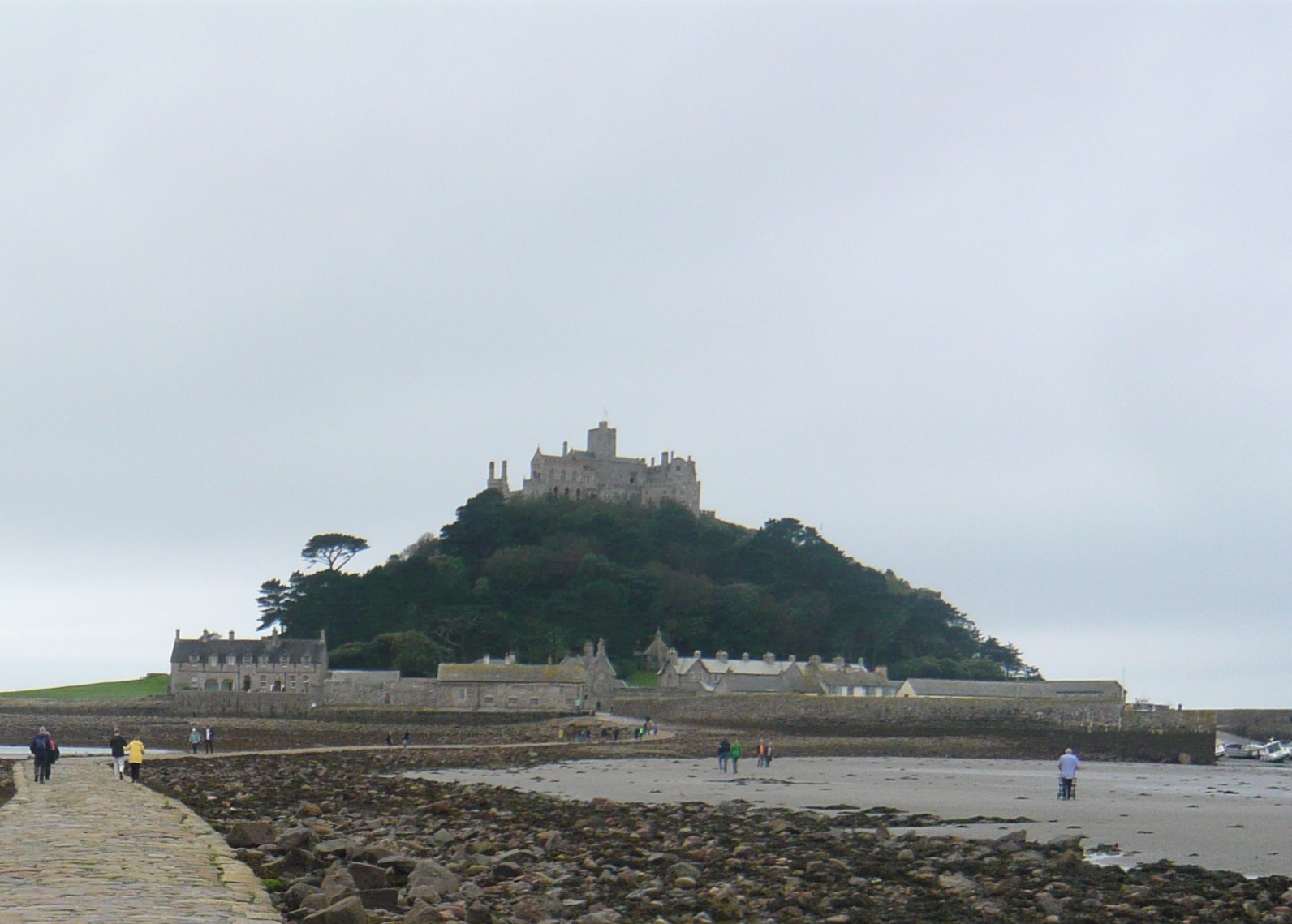
We recently returned from a week in Cornwall, and where we stayed was close to the end of a pilgrim route, St Michael’s Way. This is a short twelve and a half mile walk from the North Cornish coast to St Michael’s Mount, in Mount’s Bay on the South coast. Although the route is such a short one – a day’s walk for most people – it still apparently qualifies for a pilgrim ‘stamp’ on the official pilgrim passport for the very much longer long-distance Camino pilgrimage, since in the Middle Ages many pilgrims walked this route to the Benedictine monastery on the island, then took a boat to France to continue on towards Santiago de Compostela.
I am interested in learning – as far as it is possible for the staunchly non-religious person to learn – what the religious get out of pilgrimages. In the past, they were generally viewed as a way of gaining merit, of putting a few points in the bank when it came to whether you were headed for heaven or hell in the afterlife. Frequently, they were also undertaken in the hope of cures from diseases; various remnants of saints such as bones or clothing were held to have miraculous properties, and the touch of these might cure whichever disease ailed you.

Personally, I view pilgrimage as a spiritual thing, rather than a religious one. Something that puts the pilgrim in touch with their ‘finer’ feelings – a way of understanding what is important in life; relationships, simplicity, art maybe, minimal possessions – we will all have a different interpretation of this. In the past I have considered attempting one of the Camino routes – through France and Northern Spain to Santiago de Compostela. These are long, serious, routes, hundreds of miles long. Had I done so, I would have walked these for pleasure, as well as a personal challenge, rather than as a pilgrimage. Now, though, I am curious to see how much of the ‘religious’ experience I might have.

Whether visiting a church or a standing stone, a ‘holy’ well or a Sufi shrine, all are invested with spirituality. All are invested with meaning to many people and although I know I will never be able to experience the feelings of, say, a Christian at a site they consider holy, I might experience something akin to it. I’m not suggesting I might feel awe at the shrine of a saint, more that I might get an impression of the feelings of the visitors who do. And because I cannot quite find the words to express what I might hope to find, I reckon that’s an indication it’s an experiment worth making.

Myth, Science and Religion

Religion begins as science, as an attempt to make sense of the world. The birth of religion marked the dawn of humans as rational, analytical beings. This was humans moving beyond the worries of simply surviving from day to day, and reaching that point in evolution where they looked with wonder upon the world around them and asked: How did this come into existence? What is it that controls the weather and other variables? By observing the natural world around them, the cycles of day and night, the seasons, the migrations of the animals, they would have concluded that these patterns suggested a grand design and order.

003a

An assumption would probably be made that all this was controlled by benevolent beings, but beings who might need propitiating occasionally to keep them sweet; the odd ritual here, perhaps a sacrifice of some sort there.

And if that was so, perhaps they could be propitiated in a somewhat greater way, to grant other boons?

It would not be long before someone claimed a channel to the gods to relay their desires and instructions, and so the priestly class would be born. Self-interest? Quite likely. After all, we see that in most religions today, so why not?

Religions then, over the years, spawned new religions, the spark being reinterpretation rather than inspiration.

We think we see echoes of old religions in myths. Myths are the fragments of history we know, combined with assumptions about how our ancestors acted and thought, frequently combined with scarce written evidence, which may or may not be biased or wholly inaccurate. When our written sources include stories of monsters and miracles, we should probably be advised to treat them cautiously.

Myth-makers frequently come with an agenda, although depending upon your point of view that is not necessarily a bad thing. If you are looking for a scientific analysis of the lives of our ancestors, it’s probably best to give myth a wide berth. Or at least to be very, very, careful what you take from it. But in a way, it does provide an alternative world view that many find preferable to both the stark realities of day to day life, as well as the cold dead hand of religion. After all, if you’re using your imagination, it’s easy to plan your myth-world much the way you’d like it.

And perhaps myth does offer us a way of getting inside the heads of those people, at least superficially.

One assumption we can make is that there would be similarities in the thought processes of those people, with the thought processes of us today. It is perfectly reasonable to assume they would react in similar ways to us, to pain and fear, to pleasure, warmth and cold. Our reaction to the unknown tends to be to populate it with characters or situations based on our experiences, and they probably did the same.

Stonehenge is aligned with the solar calendar. This we know. It’s science. And we know a considerable amount about the geography of the area around Stonehenge at the time it was built, through archaeology and science.

What we don’t know is how it was used. Just because it was aligned with the rising sun at summer solstice and the setting sun at winter solstice, does not mean we know what took place at those times. We assume our ancestors worshipped or venerated the sun there, especially at the time of the solstices, but we do not know that. Were there sacrifices? Did they hold special ceremonies connected with fertility or birth or death? Was it perhaps just like a club where they turned up now and again and got drunk and held orgies? It could be, since there is no hard evidence for anything.

Believers in ley lines also claim it is at the centre of an intricate system of lines connecting natural (‘holy’) locations with important (‘holy’) sites such as churches, wells and crossroads. Pseudoscience? Coincidence?

Our assumptions, though, lead us to think that because of the immense effort required to build the structure, it must have been an incredibly important site, and we are surely justified in concluding important ceremonies were enacted there.

Whatever they were.

A Christmas Carol – 1

I haven’t seen much of Bob, recently.

To be fair to Bob, he’s been rather busy. But he came round to my house the other day. Well,  the other evening, really. He was carol singing. And it was only just December.

‘What on earth are you doing?’ I asked him. He look puzzled.

‘Carol singing, of course. Why?’

‘Why? It’s only just turned December, that’s why.’

‘Well, all the shops have their decorations up now.’

‘I suppose so.’

‘And some have had, for the last few months.’

307a

‘True, but…’

‘And they’re all playing Christmas songs.’

‘Unfortunately true…’

‘And half the kittens on social media are dressed in red and white and chasing Christmas baubles around on the floor and then batting them with their cute little paws…’

‘Stop it, Bob!’

‘So why can’t I go round carol singing?’

‘Because there’s only one of you and it sounds awful!’

‘Oh…sorr…eee!’

‘And what are you collecting for?’

‘Huh?’

‘That tin you’re rattling. What’s it in aid of?’

‘Our Christmas lunch.’

‘Bob! You can’t do that! You’re supposed to be collecting for charity!’

‘Am I? Who says so?’

‘I…er…I don’t know. You just are, that’s all.’

‘Well, I’m collecting for our Christmas lunch!’ He rattled the tin meaningfully towards me. ‘Silent Night…’ he began again, his voice rising suddenly about two and three sevenths octaves. I shuddered. The kittens left their baubles and ran for cover. ‘Holy Night!’

‘Shut your bloody racket!’ Came my neighbour’s voice – slightly muffled, but carrying a clear threat of violence.

Bob left quickly.


In other years, I’ve written a few short stories for Christmas, but not this year.

Bob has inspired me to re-imagine a few Christmas Carols for the twenty first century.

Here is the first one.

Strident night,

Angry night,

Down cheap booze,

Get into a fight.

Punch and scratch and kick and bite.

Tell the other bloke he’s just a shite.

Sleep in a prison cell…oh!

Sleep in a prison cell.

For those of my readers who do consider Christmas to be a holy festival, I must point out that these little offerings are intended as my rant against the excesses and the commercialisation of Christmas today. I hope you will not take any offence, for none is intended!