A Justification of Theft

Clickbait? Perhaps, but I have a point to make.

There is a blog I follow which regularly posts about good people. People who make a difference to their world. Kindness. They change lives. And it makes for a refreshing read in a world which often appears to be so full of shit we could be drowning in the stuff. I also see now on social media – at least on Facebook, which is the only one I follow other than Instagram – AI generated posts on good people. I know they’re AI generated, because the signs are all there. I don’t intend to list the signs, as most people are aware of them already. These AI generated posts seem to fall into the same few categories. There is the rough biker with the heart of gold adopting a defenceless little girl. The retiree who’s lost his wife and finds meaning in life through spreading love through his community. There’re one or two others, but they all seem to fall into a few predictable categories. And you read these long tear-jerkers and reach the end and you go ‘Ah, isn’t that lovely.’ Or you’re meant to, anyway. But they are AI generated, the people don’t exist (although the original ones may have been based on real people), and these things did not really happen. But does this matter?

I think it does, for several reasons. AI invents stuff. If this is not the intention of the user, these are known as ‘AI Hallucinations’. If it can’t find what it’s been asked to find, it will sometimes make something up instead. Equally, it may draw data from untrustworthy sources. Then there are AI programs which are designed to make up stuff. If we understand that, then when we read something we understand is AI generated, we don’t necessarily believe it. And since we don’t believe the characters or the narrative, then the message it is designed to deliver is rejected. We all know that kindness is a good thing, but being told that by a computer program that has clearly fabricated the vehicle of delivery diminishes the message.

It is the exact opposite of ‘Don’t shoot the messenger’, because in this case the message is rejected because the messenger is flawed.

And the more we read these posts, knowing they are AI generated but if we’re still happy to take them completely at face value, the more we help to normalise the things. The more we accept AI into our lives and accept these fabrications.

So there are more than one type of AI program. Many of those that are really good at inventing stuff, and there are quite a few, are designed specifically to write books. They advertise themselves as producing books ‘in minutes, not months’. A few clicks on the button and hey presto! I’ve written a book! I’ll get back to this at some point, but are these people authors? No. They’re not. They’re frauds. But this brings me back to those original posts, which someone has created using an AI program similar to the book writer programs to deliberately invent the contents.

And to the more important point, the point where both the hallucinations, but even more importantly the deliberately fabricated material, really matter.

AI is, as we’ve seen, designed to invent stuff. Okay, that’s a simplification, but the point is that it’s designed to give the user exactly what they ask for. If someone requests it to write a piece justifying theft, or infanticide, for example, (not to ask it if it can be justified, but telling it to actually do so) it will do that, citing either nasty stuff it’s dug up from some remote hole on the internet, or, more likely, completely inventing stuff because the real justifications don’t exist. And it will look reasonably believable, perhaps writing something along the lines of ‘the Cornel University experiments of 1983 – 1984 by Taylor and Whickham et al demonstrate that…’ etc etc. And the casual reader will think ‘oh, I never realised that. So perhaps there’s something in it after all.’ But these citations will be made up.

And to go slightly off topic for a moment, there are the illustrations. AI generated photos are still usually recognisable as such, but they’re getting much better. Ones that have been subtly manipulated are now very hard to detect. The implications there should be obvious, can we now believe anything we see or are told?

This is not to suggest AI is an unmitigated evil. Its champions will point out advances in, for example, medicine and material sciences, which are very real and extremely important. But the issues of misinformation and, as frequently cited, intellectual property theft, to say nothing of the potential to completely destroy careers in the literary and artistic worlds, are also very real.

So how do we fight this? I’m afraid I’ve no idea. The genie is out of the bottle and I see no way it’s going back in again. Other than burning down the internet we are stuck with it and over the next year or so (or less – who knows?) it’s going to get harder and harder to tell truth from complete (and possibly dangerous) crap. While the programs are becoming better at presenting the genuine data they are requested to present, the ones inventing stuff are getting better at making this appear real. All we can do is be aware of this, be cautious and critical. And perhaps we could go back to getting our facts from books which, although not infallible, are far more likely to be accurate. Publishers are still the gatekeepers there, and they tend to do a pretty good job. Research stuff properly. Rather than accepting important medical information, for example, from Joe Bloggs on Facebook, look it up on a respectable site, like the NHS (in UK).

Maybe just stay off the internet more.

Which is probably a good idea anyway.

Sarnath

It’s mid February 2008, and I am in Sarnath.

Formerly a deer park, Sarnath lies 10km outside Varanasi and is the place where the Buddha came after his enlightenment at Bodhgaya, to seek out his former companions who were living there in huts and give his first sermon, on the turning of the Wheel of Dharma. This comprises the Buddha’s path to Enlightenment: the Four Noble Truths, the Eightfold path and the Middle Way.

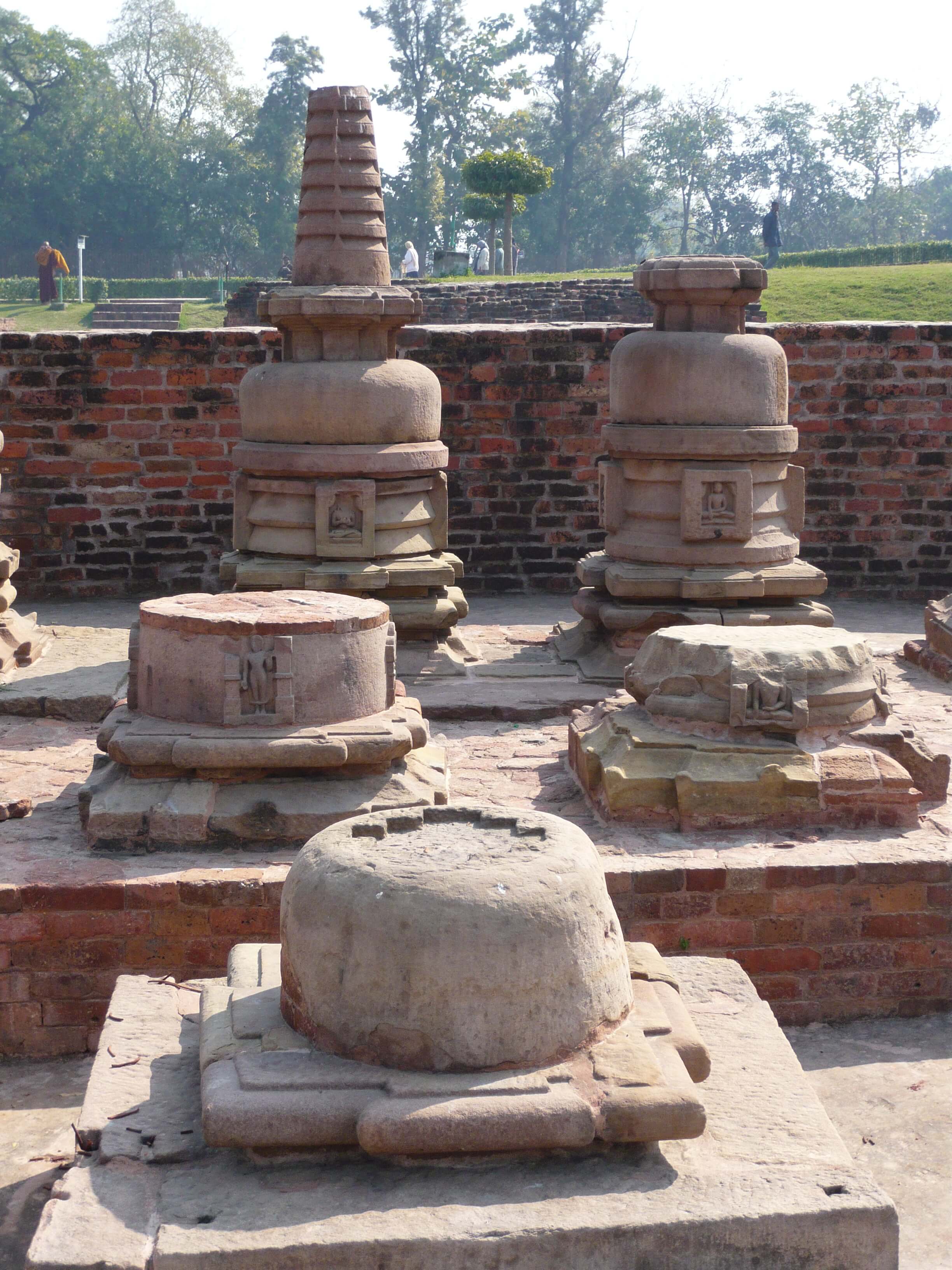
This altar is still used by pilgrims for pujas – not just Buddhists, but also Jains, for whom Sarnath is also sacred.

A monastic tradition flourished at Sarnath for over 1500 years after the Buddha. Many monasteries and two great stupas were built, which survived until the end of the 12th century when they were destroyed during the Muslim invasions and not rediscovered until 1834 by a British archaeological team. Amongst these ruins were a stone column 15.25m high with four lions as its capital, erected by the emperor Ashoka, a convert to Buddhism after witnessing the terrible carnage of a war he had unleashed in the 3rd century BC. This capital was adopted as the symbol of the modern Indian republic.

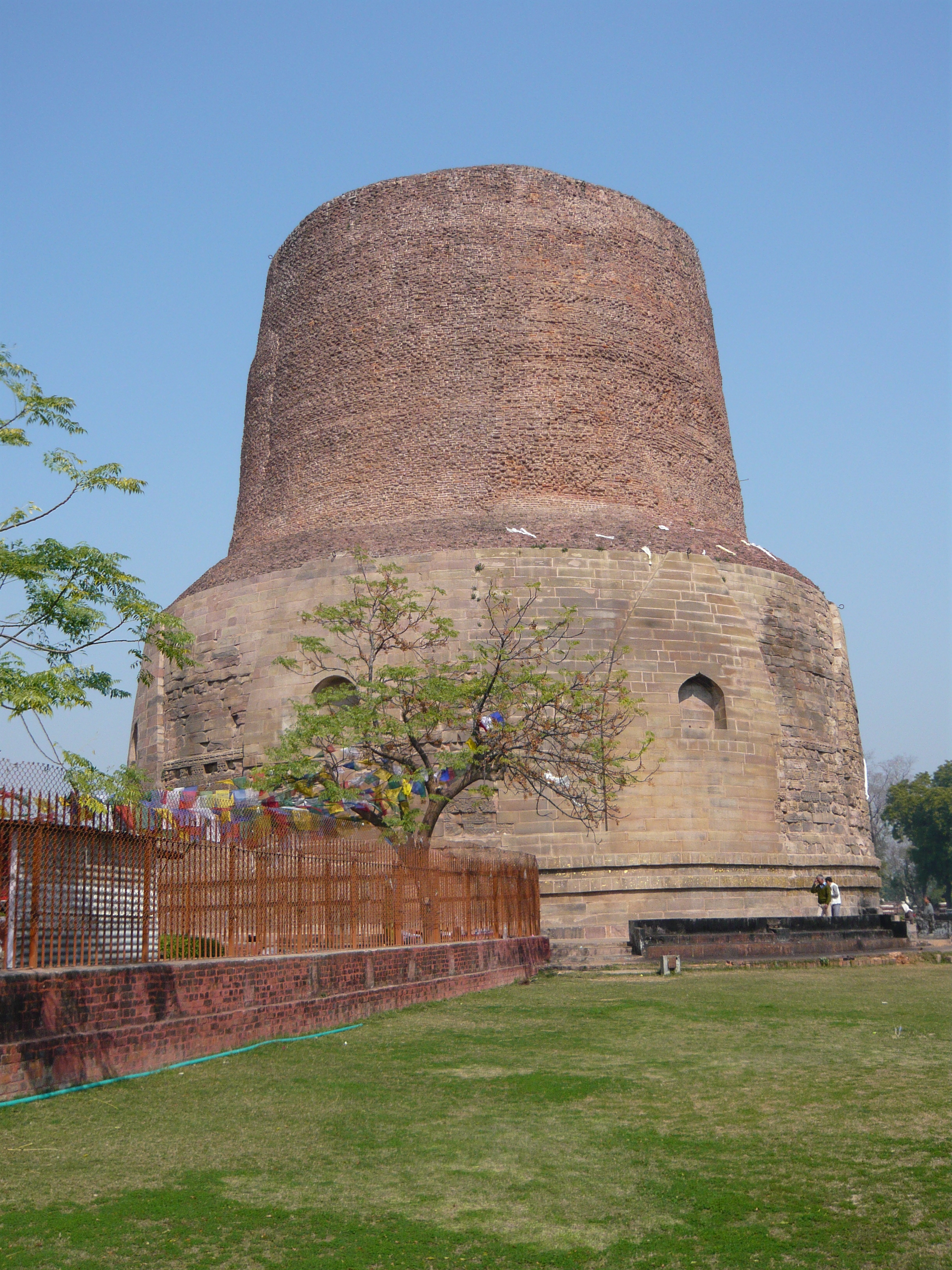
The Dhamekh Stupa. Built in the sixth century, this solid cylindrical tower, 33m high, consists of a stone base with the upper part made of brick, and was virtually the only building to survive the Islamic destruction, perhaps because of its sheer size and bulk. It marks the spot where the Buddha supposedly gave his first sermon. The five former companions, who became his first disciples on hearing him speak, had deserted him when he gave up his ascetic vows. On achieving enlightenment, he determined to follow the ‘Middle Way’, avoiding both luxuries and asceticism. This is the basis of its appeal to me personally – nothing to do with religion, but a sensible lifestyle avoiding extremes, with kindness at its heart. A philosophy of life.

Delicate carvings on the base of the Damekh Stupa.

Just outside the Deer park, there are a number of modern Buddhist monasteries, attracted to the site because of its history. This particular spot was a beautiful peaceful place, but I can’t remember exactly where it was! I think it was outside the Japanese Temple…

Inside the Dharmachakra Japanese monastery

Mulagandhakuti Vihara built by the Mahabodhi Society in 1931

The Conquering Hero Comes!

This is another day when I feel frustrated because I’d like to be out travelling, although I did get to have a great long walk on the South Downs on Saturday. But rather than post about that at the moment, I have a fancy to re-post this piece I wrote a few years ago:

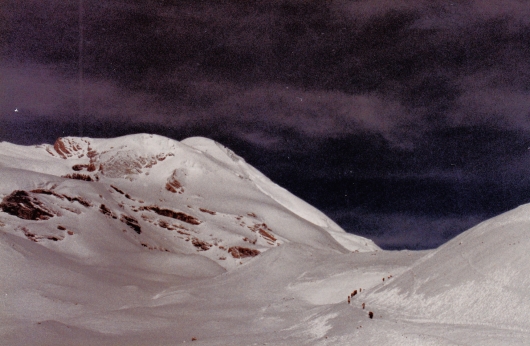
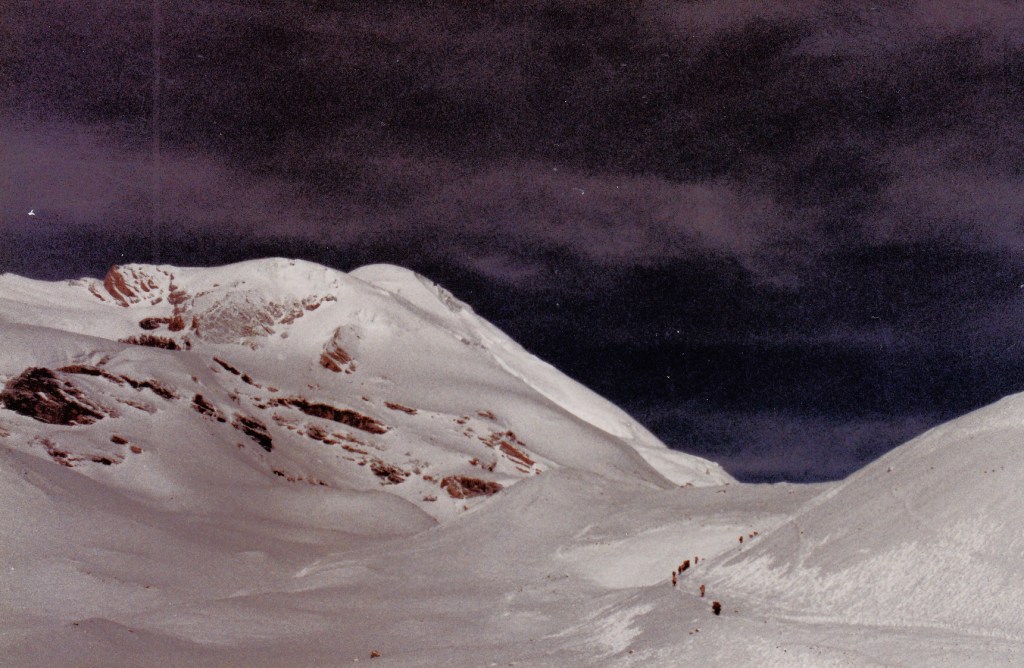
I’ve never wanted to ‘conquer’ mountains.

img_0010

Or any other parts of the world, really.

I’ve always felt this was the wrong way to think of a journey. It was ridiculous to think I could impose my will upon a mountain, or on a desert, or indeed upon any part of my route. That I could, perhaps, somehow bend it to my will.

I feel it is more a case of preparing as best as possible, including mentally, and then perhaps said mountain will tolerate my presence; will allow me passage.

‘Conquering’ also carries the implication of invasion, of fighting, of strife. That is not the sort of relationship I want with mountains, or with any other place I choose to travel.

Certainly, in the past I have travelled at least partly with that mindset at times.

IMG_0005

Some of you may recall I wrote about an extremely foolish journey I took in Oman when I lived there over thirty years ago (Mr. Stupid Goes For a Walk). Although I was running low on water, I pushed myself to the limit to reach the final ridge of hills on the route I had decided I was going to achieve one day, nearly killing my stupid self in the process. And although I achieved my aim, I didn’t feel victorious.

Only a bit stupid.

I prefer instead to think of myself as a visitor. And as a visitor, I need to have some manners. You do not expect to find the visitors pushing through your house and demanding to see this or to be given that, so I don’t.

I am not out to break records, nor to prove how tough I am.

This does not imply a lack of ambition, nor a lack of determination. Indeed, I have both – it’s just that the mindset is a little different. In particular, I give myself different priorities. I want to reach my goal but if I don’t, it does not matter. I think I’m more attuned to my own safety, and perhaps that of others. I hope I can be receptive to the feelings of others, too.

A good example in the climbing world is that of the mountains in Nepal that climbers are forbidden to reach the summit of, due to the belief that they are the abode of gods. Theoretically, a climber will stop some 10 meters or so short of the summit. Opinion is naturally divided over whether a climber would, or wouldn’t, in the absence of any witnesses, respect that ban.

I would respect it every time.

The mountains, of course, are inanimate. They do not wish me harm or otherwise. Neither do deserts or oceans. Even the most inhospitable of landscapes is neutral. It does not care whether I succeed in my aim to reach or traverse a particular part of it, and it will not hinder or help me in the attempt.

154

My feelings about a landscape are just my reactions to it, and if I should choose to give this landscape a kindly or vindictive character, I am only projecting my own feelings onto it.

This may give me comfort, or otherwise, but will make no material difference.

Maybe I am simply suggesting it’s good to travel with humility.

I have touched upon that before!

Be Kind


209a

Be kind.

Achieve wisdom and exercise that skill.

The world has always been filled

With angry greedy people.

You cannot legislate them away,

Or hope that they will die out.

The world has always relied on people

Who are kind and wise,

To act as counterbalances to these others.

Unfortunately, the World supply of angry greedy people

Appears to be limitless,

So there will always be a need for kindness and wisdom.


You might just save the world.


The Stranger

022

While tweaking some stuff around on my site today I slightly updated my Gravatar profile to include my personal mantra, which is ‘Be Kind’.

Having done that it seems a good idea to post this poem, The Stranger

img20181209_10503343

All Hail The Conquering Hero!

I’ve never wanted to ‘conquer’ mountains.

img_0010

Or any other parts of the world, really.

I’ve always felt this was the wrong way to think of a journey. It was ridiculous to think I could impose my will upon a mountain, or on a desert, or indeed upon any part of my route. That I could, perhaps, somehow bend it to my will.

I feel it is more a case of preparing as best as possible, including mentally, and then perhaps said mountain will tolerate my presence; will allow me passage.

‘Conquering’ also carries the implication of invasion, of fighting, of strife. That is not the sort of relationship I want with mountains, or with any other place I choose to travel.

Certainly, in the past I have travelled at least partly with that mindset at times.

IMG_0005

Some of you may recall I wrote about an extremely foolish journey I took in Oman when I lived there almost 30 years ago (Mr. Stupid Goes For a Walk). Although I was running low on water, I pushed myself to the limit to reach the final ridge of hills on the route I had decided I was going to achieve one day, nearly killing my stupid self in the process. And although I achieved my aim, I didn’t feel victorious.

Only a bit stupid.

I prefer instead to think of myself as a visitor. And as a visitor, I need to have some manners. You do not expect to find the visitors pushing through your house and demanding to see this or to be given that, so I don’t.

I am not out to break records, nor to prove how tough I am.

This does not imply a lack of ambition, nor a lack of determination. Indeed, I have both – it’s just that the mindset is a little different. In particular, I give myself different priorities. I want to reach my goal, but if I don’t it does not matter. I think I’m more attuned to my own safety, and perhaps that of others. I hope I can be receptive to the feelings of others, too.

A good example in the climbing world is that of the mountains in Nepal that climbers are forbidden to reach the summit of, due to the belief that they are the abode of gods. Theoretically, a climber will stop some 10 meters or so short of the summit. Opinion is naturally divided over whether a climber would, or wouldn’t, in the absence of any witnesses, respect that ban.

I would respect it every time.

The mountains, of course, are inanimate. They do not wish me harm or otherwise. Neither do deserts or oceans. Even the most inhospitable of landscapes is neutral. It does not care whether I succeed in my aim to reach or traverse a particular part of it, and it will not hinder or help me in the attempt.

154

My feelings about a landscape are just my reactions to it, and if I should choose to give this landscape a kindly or vindictive character, I am only projecting my own feelings onto it.

This may give me comfort, or otherwise, but will make no material difference.

Maybe I am simply suggesting it’s good to travel with humility.

I have touched upon that before!

The Best of Humanity

It is frequently said that when disaster strikes, that is when you will see the best of human nature. Generosity, bravery, selflessness – this was all on display yesterday at the dreadful fire in West London. The bravery and selflessness of the rescue services, and of many individuals caught up in the horror as it unfolded. The generosity of the entire community and beyond as they rallied around to donate food and clothing, money and shelter to the victims. All this and much more.

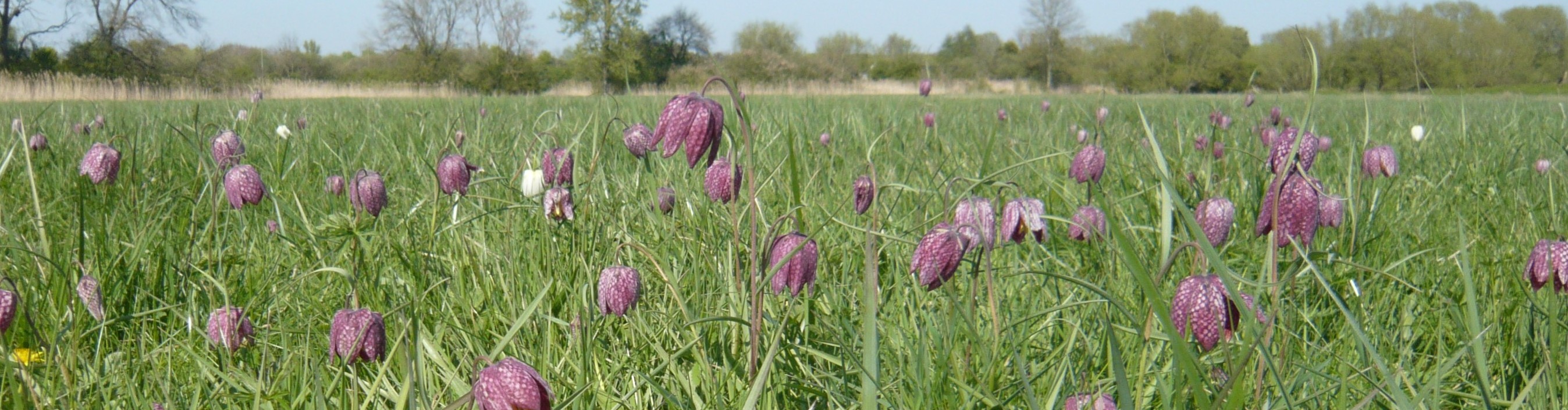
IMGP2282

But it is important to remember also that every single day countless individuals all over the world carry out countless acts of kindness, bravery and generosity that few others, if any, ever know of.

It is often tempting to look at the news and think that the human race is a barbaric, selfish, and bloodthirsty entity, and I know I am guilty of that at times, but we must never lose sight of the bigger picture. Because if there are many occasions when as a race we fall much lower than any other creature on earth, equally, there are many where we rise far higher.