The Travel Bug Bit Me – part 3

When I lived in Oman, the land around where I lived and worked was all stone desert; hills and valleys of razor sharp broken boulders, water worn stones at the bottom of dry valleys, with occasional villages and settlements and old, crumbling, mud brick forts dating from the time that the Portuguese were there. Almost invisible tracks used by goats and nomads wound their way through this wonderful landscape, or simply followed the routes of the wadis, the dry river valleys. I had a very small scale map of the country, as well as a few very large scale maps that I had pinched from the office where I worked (I did return them when I left). These would consist largely of huge areas of blank paper, with the occasional ‘tree’ or ‘large boulder’ helpfully marked, although they did show the main wadi courses and mountain ridges.

I was very tempted to write ‘here be dragons’ on them occasionally.
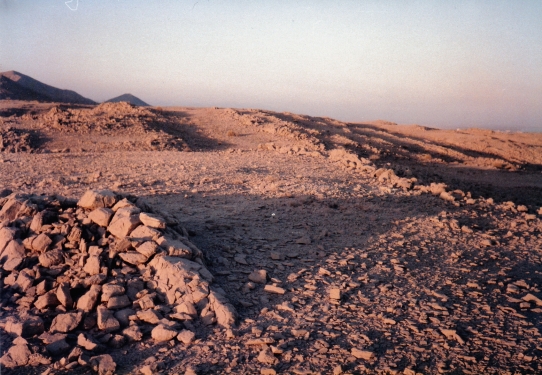
img_0001

Never before had I quite understood what silence was. And it was the first place (to be followed by the Himalaya) that I was to truly see a night sky. I was periodically astonished by the desert’s outbursts – blasts of hot wind like an opened oven door; flash floods that appeared from a blue sky in minutes, to ferociously drench the unfortunate climbers on the top of a previously baking jebel (hill); and tiny earthquakes and landslides – I was no doubt fortunate never to witness a serious one. I would overnight in the desert with friends and we would lie on our backs to watch the unbelievable night sky with its thousands of stars, satellites and shooting stars, before ascending a 10,000ft mountain in the morning, or exploring a stretch of uninhabited coastline.

I spent almost every spare hour that I had out in that desert, either trying to find my way across trackless ridges in my jeep, or just walking; walking everywhere within walking distance and discovering just how much there is actually to see in a desert. I was supremely happy in that environment, and some 20 years later when I had to change aircraft in Muscat, I found myself looking out at the purple tinted hazy mountain lines with something very close to homesickness.

Today, even waiting on the station to get a train to go to the next stop, a coffee in hand, a bag over my shoulder with a book in it, I am on a journey. And that journey feels clearly related to the longest journeys that I have ever taken. There can still be the same sense of travelling, of departing and arriving. The search for food and shelter… I think that it shows just how much a journey largely exists in the mind. Often our perceptions of a journey seem to differ from that journey’s reality (as many things do, I suppose). A long, difficult journey can seem to be over quicker than a short, easy one.

Just packing a rucksack, even an overnight bag when I used to have to occasionally stay over where I once worked – a wash bag and towel, sleeping bag and clothes – I feel as though I’m off on a journey. There is a certain amount of excitement…

And I know, too, how smell is such a strong, evocative, sense. Just with the kitchen window open, at 10pm on a slightly rainy October evening, I suddenly catch a scent of something – something cooking nearby, or a hint of smoke, perhaps – and I am instantly transported to Nepal, high in the mountains, remembering an evening with sherpas and villagers beside a river where we ate and then sat around talking and drinking and listening to those sherpas and villagers singing.

Okay, I’m ready to go and pack, now…

Kathmandu, Nepal

How on earth have I managed to blog for almost a year, now, and still not put up a single post on Nepal? I think I’d better put that right immediately.
I’m going to start with a selection of pictures from Kathmandu, capital of Nepal.
All of these pictures were taken before the dreadful earthquakes of last year, and I do know that some of the buildings in these pictures (especially in Durbar Square) were sadly destroyed.

015a.jpg

The entrance to Swayambunath. Swayambunath is the main Tibetan Buddhist site of Kathmandu. Sitting on top of a hill overlooking Kathmandu, it comprises temples, stupas and various other buildings, including a couple of Hindu shrines. Here, a Hindu holy man lurks in ambush, ready to dab a tikka mark on the forehead of (especially) western tourists and demand rupees for the privilege.


038.JPG

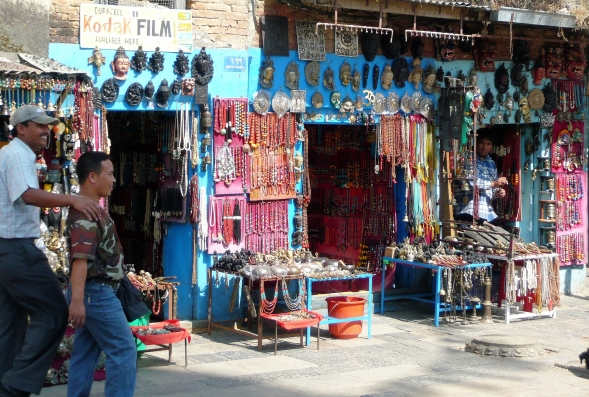
The sacred and the secular at Swayambunath. In Nepal, as in India, it is almost impossible to visit a religious site without Mammon getting a good look in. Here, in the main Buddhist site of Kathmandu, everything from yak bells to masks.


034a
‘One day, my boy, all this will be yours’ – just as long as you have enough money and all the time in the world to bargain hard. More shops – seriously colourful, seriously prepared to sell you anything. And having said that, the hard sell is a world removed from India. It almost feels as though there is no pressure at all. In Nepal, you feel you can relax again, especially if you have just travelled there from India.
056.JPG

Nuns lighting butter lamps beneath a row of prayer wheels at Swayambunath.

030a

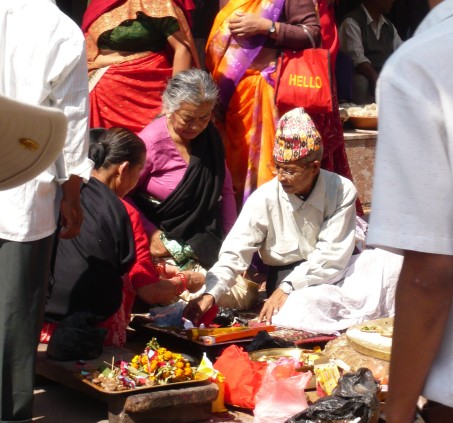
Hindu puja at Swayambunath. Probably a private ceremony at the request of the beneficiary, either for good luck in general or with a particular goal in mind (e.g. birth of a son, successful business venture.)


031b
Portrait of a Hindu lady.
057

Tourist shop in the Swayambunath complex.
100

Buildings in Durbar Square. Durbar (or ‘Palace’) Square is the heart of the old town and the area where the Kings used to live in the 18th and 19th centuries. In contrast to Swayambunath, this area is entirely Hindu, reflecting the vast majority of the lowland Nepali population.

102a

Side street in Thamel, Kathmandu. The lovely old buildings…beautiful wood carvings…collapsing brickwork…wiring all over the place…speed…calm…old and new…………the only things I can’t bring you are the sounds and smells…you must imagine them for yourselves. Coming soon, scratch and sniff websites!!!


098

Bicycle rickshaws awaiting customers in Durbar Square.


067b

Balloon seller and hopeful customer, Durbar Square.


070

Kala Bhairab – an image of Shiva in his most fearsome aspect. Wearing a garland of skulls, the six armed Kala Bhairab tramples a corpse, symbolic of ignorance. Carved originally from a single stone, it was set up by Pratap Malla, king in the 17th century. He was a pious Hindu, but interested in the arts and tolerant of other religions. He even restored much of Buddhist Swayambunath. It is said that telling a lie while standing before Kala Bhariab will bring instant death. It was once used as a form of trial by ordeal.


img
Pashupatinath, on the Eastern side of Kathmandu, is the holiest of the Hindu sites in the city. It is the temple of Shiva, on the Bagmati river and hence it includes the ghats, the most widely used place of cremation for Hindus in Kathmandu, indeed, in Nepal.

My First Long Trip to India (5)

I picked up my bus ticket from the travel agent, and went for lunch. Whilst I was eating, I looked at the newspaper and noticed that the ‘People’s War’ (Naxalites) had blown up the railway line near Jehanabad again. It was a good job that I had decided to get the bus to Patna.

And so, the following morning, after packing, having breakfast and attending to a few final tasks that I had promised I would do, I went off to the Project to say goodbye. I knew it would be difficult! It seemed as though everyone came up for a hug, and then I went off with the manager back to my guest house to pick up my pack, and then off to meet the bus. One final, slightly teary, goodbye, and I was on the bus and off.

Four and half hours later in Patna, I was set down amidst total chaos. There were flashing lights, seas of red flags, loud music blaring through countless loudspeakers,millions of people, it seemed, singing – another Hindu festival. I found the station, with a little difficulty, and then the nearest restaurant and bar, for some sustenance.

I learned that the chaos had a name – Ram Naumi.

As I ate, it felt quite odd to know that outside was Patna, and that the Project and the open countryside weren’t just around the corner. It rather felt as though I had just left home.

My train left roughly on time, and I slept well until the morning. We then trundled along gently, getting in about one thirty (two hours late) to New Jalpaiguri. It was slightly cooler, and felt almost refreshing. I hadn’t expected a temperature drop then, I must admit. Presumably it was because we were that much closer to the mountains. Soon, I found myself and my rucksack jammed into a bicycle rickshaw heading north through the long streets of Siliguri, at the foot of the Himalaya, during what should have been lunchtime. There followed a three hour jeep ride in which we immediately began to climb up away from the plains as we left Siliguri, through farms, tea gardens and jungle that gradually began to look more typical of Nepal than of the India that I had lived in for the previous month and a half.

tea gardens


I arrived in Darjeeling at dusk, found myself a room and settled in to enjoy a week’s rest. I then proceeded to explore the temples, markets and surrounding countryside, make plans to move on to Sikkim and dropped into Joey’s Bar for the odd beer.

Later, I decided to have afternoon tea at the Planter’s Club, a hangover from the tea planting days of the Raj. It’s something that I felt I ought to sample.

I wasn’t disappointed. Inside, I was the only customer and it was much as I had imagined that it would be; dark wood floor and ceiling, brick fireplace, piano in the corner, trophy heads high up all around the walls. I was served tea by a Nepali who wanted to talk politics. That morning there had been a strike that had closed the town down for several hours, over the irregularity of water supplies. We agreed that it was down to the government. And when that’s finally solved, he added, then there’s the electricity…

He asked if I wanted music and I said yes, almost immediately regretting it, but was surprised when it was classical music. Looking around, it really did look as though the Colonels and their ladies had gone home and everything was still waiting for them. Outside, it was raining gently and just above me a couple of lights glowed yellow in the afternoon gloom. The shade of Miss Haversham from Great Expectations seemed to hover at my shoulder. All that was needed was a thick layer of dust over everything and the image would have been complete.

Also, it was strange that there was nothing Indian in there, and if it was in the UK, then it would look really ordinary, yet it had a powerful atmosphere there. Only, I suppose, because I knew that I was in India. And then, as Fur Elise played softly in the background, I was suddenly, utterly and helplessly homesick. Nothing like the continual yes, it’ll be nice to get back and see everyone once I’ve finished here, but I could picture myself strongly, sitting in an old stone inn somewhere in Wales having a beer with friends, or perhaps sitting around a log fire with close family. Seeing my family! As the music continued, I sat at the table with my tea, unable to think of anything but home.

It finished, and another piece started. I forget now what it was, but I had to literally shake myself to break the spell. I sat a while longer, paid the bill, and left.

A couple of days later I went and had tea again at the Planters – this time there were several Indian families in there and some Hindi pop playing – a decidedly different ambience! Although the afternoon was again gloomy, the piano still in the corner and the threadbare heads staring balefully down, I was unable to conjure up anything like the same feelings. It seemed impossible that I should have felt so differently here a couple of days before. I felt that I had re-joined India.

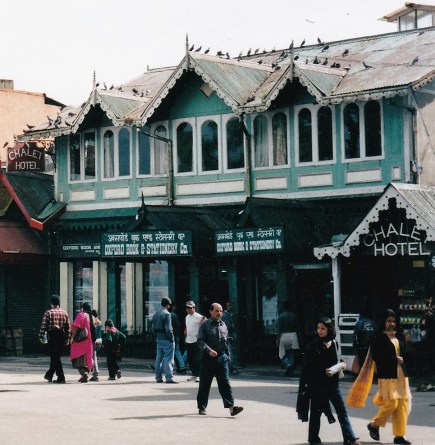
Darjeeling still retains much of its old colonial character, in places.

bookshop (2)

The Oxford Bookshop, on Chaurasta, where I spent far too much and had to have my purchases shipped home.

prayer flags

A sea of prayer flags on Observatory Hill. Darjeeling has a large Tibetan population and many gompas (monasteries) both in the town and surrounding hills. Observatory Hill is the site of the original temple of Dorge Ling , long destroyed, but after which the town was named, once the British had persuaded the then ruler of the area, the Chogyal of Sikkim, to lease them the land to build a hill station. the hill is now home to a Hindu shrine, with the British-built church of Saint Andrew close-by.

But no gompa.

After a week in Darjeeling, I moved on to Sikkim. After a really cold night, I left Darjeeling in a share-jeep for Gangtok on a lovely sunny morning, with clouds ebbing and flowing across the horizon and in the valleys. I got there about two, and then got a room in the travel lodge. It was big and clean, with lots of hot water, and the rest of the day I spent looking around the town.