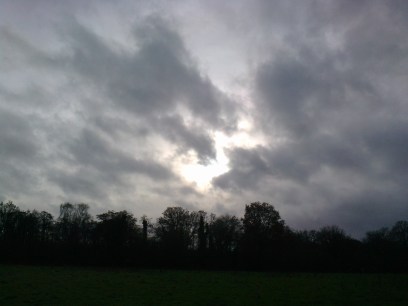
Roaring in rustling and
Tossing trees,
Wailing and moaning
In whipping wires.
A strident, insistent,
Car alarm.
An upset bin, with
Unwanted plastics…
Scraping,
Scratching,
Tumbling,
Chasing along the road.
Aggrieved air
With attitude.
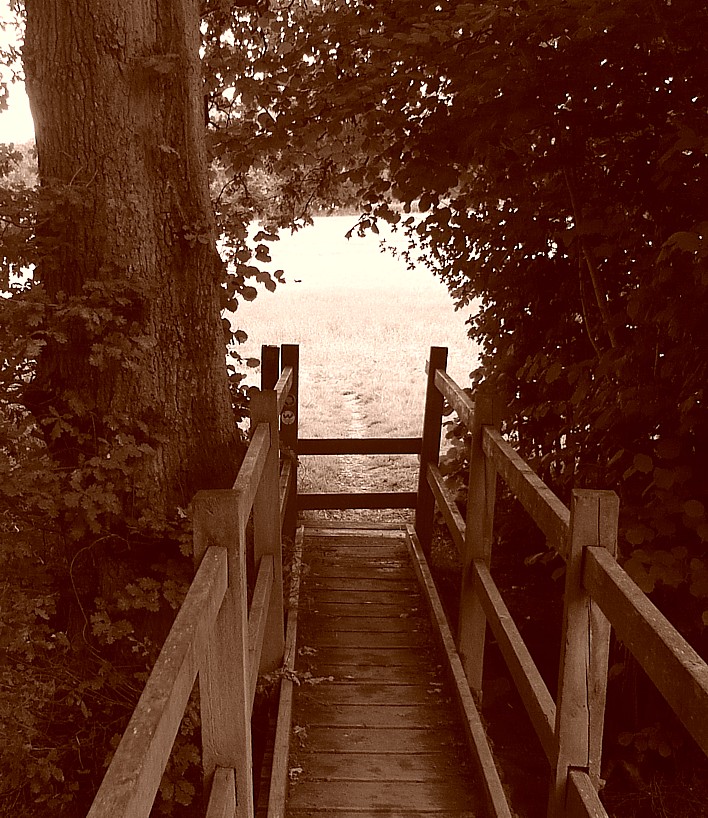
Roaring in rustling and
Tossing trees,
Wailing and moaning
In whipping wires.
A strident, insistent,
Car alarm.
An upset bin, with
Unwanted plastics…
Scraping,
Scratching,
Tumbling,
Chasing along the road.
Aggrieved air
With attitude.
I posted this poem a year or so ago, and I think it bears re-posting again now. In fact, I think I should post it repeatedly every year until everybody understands the situation most of these people find themselves in through no fault of their own.

The first time she ever set eyes on the sea,
She was forty seven.
It was a long road there.
She set off with little enough,
And arrived with much less.
She had a home, once.
A house,
In a well-to-do area of the city.
Life was good.
But fear came,
In the form of bullets, shells and bombs.
Once, gas.
Then everyone lived in fear.
Her house is rubble, now.
Memories and possessions buried,
Alongside her husband.
Alongside her daughter.
Alongside her middle son.
Her hands are scarred from the digging.
For weeks,
Her palms were raw and bloody,
from blocks of masonry,
Too large to move.
Dust and tears.
It was bad enough to lose everything,
But when you’re caught in the cross-fire,
And the food runs out,
What else can you do?
Her eldest son paid for the crossing,
With borrowed money.
Somewhere,
He is ‘paying off’ the loan.
A bonded labourer.
A slave.
She fears for him.
Her youngest son was washed away.
The dinghy was too small,
The passengers too many.
Fear.
You could smell it,
Alongside the despair.
The panic.
There were fewer of them when the sun rose.
There is shelter here,
Of a sort.
But when the wind blows she shivers,
Drawing near to the oil drum blaze.
There is food,
Once a day.
Of a sort.
There was a welcome.
She soon learns what sort.
Now, she walks down to the sea.
She wonders whether she should,
Whether she should just,
Just, slip under,
The waves.
I was writing a haiku yesterday, and decided to go the extra mile with it. Traditionally in Japan these poems were sometimes written in the form of tanka, which are essentially poems of five lines rather than three, with a syllable count of 5/7/5/7/7.
They could also be written as linked verse, with one or two poets writing haiku, and others supplying the two remaining lines between each haiku.
I’ve gone down the linked verse route, and also given myself the remit that each verse (of two or three lines) must contain a word or sentiment linking it to those either side – something that was also commonly done.
Yesterday was cold and miserable, hence the results.
It’s my first attempt – please don’t be too harsh!

The flowers have gone.
Crumbling stems standing askew,
In waterlogged soil.
Outlined against the grey sky,
Old willows by the stream.
Ten thousand leaves are
All that remain of autumn.
Wistful nostalgia.
Memories of warmer days,
Are all but forgotten now.
Wrapped up warm and snug,
Watching the grey willows weep.
Hands in my pockets.
Leaves fall slowly through the air,
Onto silent black waters.
Now a gust of wind
Swirls leaves around and around.
Racing each other.
Shifting clouds race overhead,
Sudden drizzle on the breeze.
Spiteful winter day,
Grasses shiver in the wind.
Low sunlight dazzles.
Walking in meditation,
Clouds unexpectedly clear.
Sudden bright sunshine
Reminds me the cold Winter,
Will change into Spring.
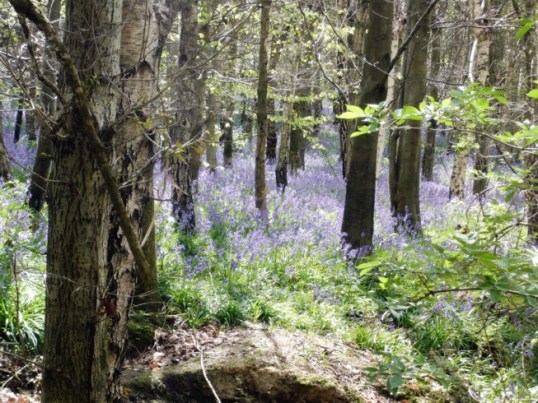

While tweaking some stuff around on my site today I slightly updated my Gravatar profile to include my personal mantra, which is ‘Be Kind’.
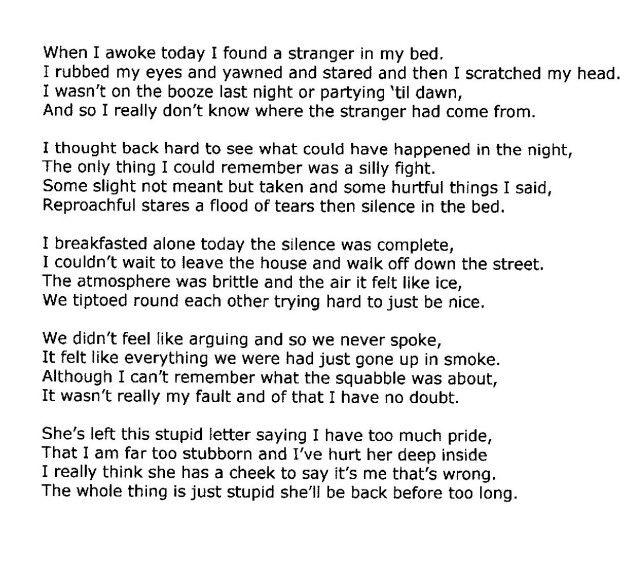
Having done that it seems a good idea to post this poem, The Stranger
I’ve been away from the computer for most of the last week, but now I’m back with a slightly longer poem than I usually write.

At five o’clock the fire is lit.
Around the table we all sit,
With buttered bread and eggs and ham,
With cups of tea and cake and jam.
The idle talk is of the day,
The work now done, the latest play,
And ‘Anything to watch tonight?’
Or in the warmth and soft lamplight,
Perhaps we’ll read and play a hand,
Of whist, or bridge, you understand.
And ‘Don’t forget, at half past nine,
The radio – it’s music time.’
Then bank the fire, put out the lights,
The household settles for the night.
The heat blasts out in every room,
And lights and games and TVs soon
Take over so completely that
It’s pointless even trying to chat.
The sounds of gunfire, screaming cars,
Exploding buildings, and on Mars
The aliens armed with laser beams,
Are killed on several different screens
In different rooms by different boys,
With highly deadly killing toys.
The evening mealtime’s such a treat,
With pizza, chocolate, crisps and sweets.
Although it seems they all are eating
Different things at different sittings.
‘A cup of cocoa? I don’t think
That that will do, an energy drink
Is what I need, the evening’s young,
And there’s still much that’s to be done.
And if I cannot concentrate,
Upon this game, it’ll be too late,
The zombies will have won and then
I’ll go back down to level ten.’
It’s one o’clock, they still can’t sleep.
There’s not much point in counting sheep,
‘cause they’re all battery-powered toys,
Just so much electronic noise
And moving parts all running round,
And round and round and round and round.
I’m standing now beneath night skies,
Pale silver light from fresh moonrise.
I’ve walked for almost half a day,
It takes that long to get away
now, searching for a quiet place
Where I can pause and have some space.
I’m thinking how it used to be,
At five o’clock, the time for tea.
It seems to me that what we’ve gained,
Is not worth any of the pain.
And even more what we have lost,
We should have saved at any cost.
But anyway, now it’s just me
I have my flask, I’ll pour my tea.
It’s October.
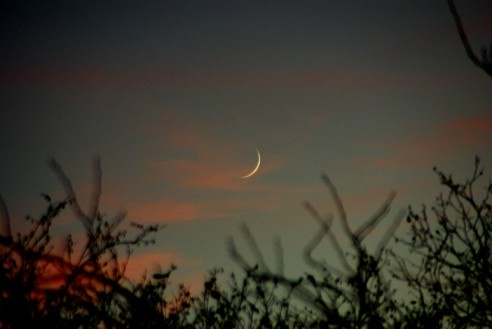
That must mean it’s autumn. It certainly feels like it, now. So here’s a little poem for when the days are drawing in and it’s becoming colder and darker outside.
Keep watch at the window in the Westering light,
On the distant hill in the approaching night,
Under darkling clouds, over dew-touched heath,
Where the flowers of summer are now touched by death,
I’ll be coming home in the fading light.
Keep watch at the window in the fading light,
You’ll see me walking when the moon is bright,
My shadow before me coming down the hill,
My breath opaque in the air now chill,
I’ll be coming home in the last of the light.
Keep watch at the window in the last of the light,
When I’m weary you’ll see me come into sight,
Drawn by the firelight and the thought of wine,
By the thought of you; so glad you’re mine!
I’m home now, let’s shut out the night.
Mouse Lane begins in Steyning and runs along the foot of the scarp slope of the Downs, until it climbs a little towards Chanctonbury Ring, an old hill fort. It is a delightful route, as delightful as its name; a sunken lane full of flowers and bees and butterflies (and, no doubt, mice), cool under the overhanging trees in the hot morning’s sun. It would be pleasant to follow it the whole way, but our route takes us along the ridge, and so we leave the lane to take a footpath up the steep scarp slope.
But where we leave the lane, there is a poem inscribed on a stone block. It was written in 1915 during WWI, by a British soldier poet stationed in the Somme. We pause to read it then stand for a while in silence, each of us alone with our thoughts.

I can’t forget the lane that goes from Steyning to the Ring
In summertime, and on the downs how larks and linnets sing
High in the sun. The wind comes off the sea, and, oh, the air!
I never knew till now that life in old days was so fair.
But now I know it in this filthy rat-infested ditch,
Where every shell must kill or spare, and God alone knows which.
And I am made a beast of prey, and this trench is my lair,
My God, I never knew till now that those days were so fair.
And we assault in half-an-hour, and it’s a silly thing:
I can’t forget the lane that goes from Steyning to the Ring.
Chance memory – John Stanley Purvis 1890 – 1968
Our footpath, ironically, then takes us past an old rifle range. So old, in fact, that according to a walker we stopped to talk with it is still possible to dig musket balls out of the bank behind the range.
On top of the ridge, there is a slight breeze, but it is already very hot and we are clearly in for a hard day’s walking.
Robert Macfarlane, writing in The Old Ways, records sleeping in the Ring one night, and being woken at 2 a.m. by blood-chilling screams that seemed to come from above him, and then proceeded to circle the Ring for a quarter of an hour, although he could see nothing that might account for the sounds – he rules out the possibility of a screech owl – until they finally disappeared and he fell asleep again.
I would never have shut my eyes there again, if that were me.

The Ring has a reputation as the most haunted place in Sussex, with tales of hapless benighted travellers being scared witless for centuries. In 1966, apparently, a group of bikers decided to stay the night there and were forced to flee in terror.
We’ve been to Chanctonbury Ring before and it certainly has an atmosphere. I would have liked to have lingered for a while longer, but the downside of the journey is that we had still to cover quite a few miles in the heat to get to Amberley that afternoon.

Three years ago when we visited the Ring, the weather was gloomy and somewhat more atmospheric, although we were mercifully left alone by whatever might be lurking around there on the astral plane.
Thankfully, it seems they only come out at night.
In a somewhat pensive mood, today.
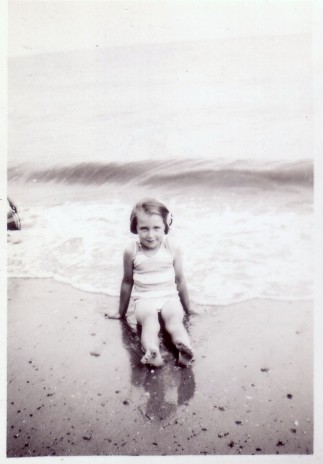
We all try to do it in our own way.
Me, I walk the woods and hills, trying to recapture
That half-remembered birdsong from my childhood.
Looking for the clear nascent sunlight,
And the cool morning breath of a magical wild rose.
Others revisit old haunts,
Tread half-forgotten streets and peer in shop windows,
Leaf through foxed and fragile pages
Of Peter and Jane, hold china dolls,
And gaze wistfully at black and white seasides.
It’s more than elusive,
But what they have in common,
Is leaving today behind.
Maybe, what I’m really searching for,
Is a different me,
Although I wouldn’t want to be a teenager again.
And if you haven’t tried it,
If you haven’t caught the sound of yesterday,
Or smelt the stale cooking and damp mothballs
Of a long-dead indulgent aunt,
Then perhaps you’re still too young.
One more of the poems from a notebook of about 25 years ago. Re-reading them, I am slightly surprised to find I rather like a lot of them, still. Although my style has altered considerably, my sentiments are still much the same. Which is as you would expect, I suppose.
But there are plenty that I certainly won’t be inflicting upon you!

As hard as ice and twice as cold,
The devil that is growing old;
Who taunts our bodies’ feeble frames,
And takes our minds – forgetting names.
As cold as ice and twice as hard,
The back that’s bent, the hand that’s scarred.
The face that’s worn and lined with sorrow,
The fear there may be no tomorrow.
The fear tomorrow may come yet,
And bring us more embarrassment,
But how we cling with greedy hands,
To these poor fragile, shallow, lands!
This is another poem from my notes from some twenty five years ago.
Walking Out Into The Country At Nightfall In Winter Whilst Heavily Pissed Off With Life In General Probably Caused By Artist’s Block

(Painting: Evening #1. Pastels on paper)
Grey clouds in salmon
– Reflected worlds!
Woodlands and valleys, rivers glow
Like magma.
My mood, dulled and burred,
Perceives…
Reluctantly. Stubbornly.
Between shakes of the head,
I see Turner setting up his easel
And painting frantically, dementedly…
Bleary eyed – look!
It has gone now!
Cold green and bluey pale,
Washes in and out
And blurs
Grey
Me
Sky.

