Remnant #1 – The Indian Mutiny

I recently did a deep dive into the burrows of my hard drive. I’m not sure whether I will write another novel at the moment, but whether I do or not there are several part completed ones that will not actually be completed because I ran out of steam…
One such was a set of preliminary drafts for a story set during the so-called Indian Mutiny of 1857. This piece is part of a chapter setting out the background to what happened. It hasn’t been vigorously checked, but I think the facts are all correct. It’s obviously incomplete, but I think it does stand alone.

And should I post a few more of these remnants occasionally?

9th May 1857, and a dreadful heat sits on the Northern Indian plain like breathless death. The air is full of dust and the land is parched, cracked and waterless, eight months or so since the last rains came, yet the suffocating debilitation of the temperature, well over a hundred degrees Fahrenheit for most of the day and a goodly portion of the night, is made more unbearable still by the effects of the high humidity. One felt that one could almost wring water out of the surrounding air, yet the only moisture visible was the sweat covering anyone foolish enough to attempt to move around in this climate.

In Meerut, less than forty miles northeast of Delhi, eighty-five sepoys have just been sentenced by Court Martial to ten years imprisonment. Muslim and Hindu, they are imprisoned for refusing to bite cartridges that have been smeared both with cow fat that was sacred to some and pig fat which defiled them all. In a move of breath-taking stupidity, the British have decided that this concoction is a suitable one for their native troops to have smeared onto cartridges that work by having the top bitten off, before pouring and ramming the contents down the barrel of the new Lee Enfield rifle. To be fair, after the mistake was realised, moves were made to ensure that the grease was made from different ingredients, but the damage by then was done. The belief was widespread that the grease was still composed of these taboo ingredients and, worse still, that it was a deliberate attempt by the British to contaminate and weaken their religions. The crassly insensitive handling of the issue did nothing to improve matters.

Nor is this an entirely new development. For maybe a quarter of a century things have been going rapidly downhill. There have been a number of ‘minor’ mutinies in the past, but these seem to be on the increase. For High Caste Hindus, ‘crossing the black water’ is prohibited, so attempts to force serving soldiers to sail abroad have been invariably interpreted as caste breaking and resulted both in mutinies and draconian punishments. Both this and the foolishness with the new cartridges have acquired added importance, though, due to the increased activity of Christian missionaries in India. It is possible that the British never fully realised quite how important religion was to the Indians. There never had been an Indian nation. India’s history was one of various states, Hindu and Moslem, shifting empires, conquests and absorptions. The idea of Indian nationhood had not yet arisen. Nor did there exist a universal shared culture. As well as the beliefs and traditions surrounding the different religions – Sikh, Parsi and tribal as well as the predominant two – the massive size of India had meant that most regions knew little about the others, even of their existence.

What mattered most to the average Indian, other than the struggle to survive, was his religion. It was what defined his life. And by 1857 it must have appeared to many that the British were determined to defile and break these religions, and then to impose their own. This was hardly helped by the general change in attitude exhibited by the British towards their subjects.

Much had altered over this time. In the late 1700’s, many of the British who came out to India acquired a huge respect, and frequently love, for the country and its people. Scholars such as James Princep and William Jones immersed themselves in the study of the languages and history of India, carrying out research and making huge discoveries. They treated the educated Indians in their circle as equals, treated others with respect and frequently married Indian wives. More than a few also converted to Islam. All this gradually changed in the 1800’s, however. A major factor in this was a steady increase in the number of women who came out to India from Britain. Debutants became aware of the existence of a pool of marriageable young men who were supposedly earning large sums of money and living in style with servants at their beck and call. They only lacked wives to make their lives complete. What could be more natural than to go to their assistance? Thus the ‘Fishing Fleet’ came into existence.

The impact that this had upon the British way of life in India was dramatic. As more of the British men married within their own, the growing community rapidly came to look down with disgust and contempt on those that cohabited with Indian women. And it was a short step from that to frowning upon those who changed their religion, wore native clothes, or even fraternised with the ‘natives’. Attitudes, too, were changing back in Britain. An increase of Christian evangelical zeal coincided with more information finding its way back from India about the country the British were ransacking, most shockingly that the majority were heathens who worshipped idols.

Within the army itself, the Indian troops noticed a change in their officer’s attitudes. Previously, British officers would happily mix with their men, socially as well as on duty and spoke their languages well. They were now more reluctant to learn these languages, found it irksome to talk for long to their men and no longer went hunting or to social events with them. This, the troops tended to put down to the influence of the church – the ‘Padre Sahibs’.  

The British have always referred to the uprising that exploded in 1857 as The Indian Mutiny. The Indians prefer to give it the title of the First War of Independence, yet there had already been a number of mutinies throughout the time that the British had been in India, even within the Bengal army. In 1765, on the eve of the Battle of Baksar, Company sepoys had rebelled and been executed. Then in 1806 an attempt was made to force sepoys in Tamil Nadu to wear a leather badge, anathema to Hindus, which had resulted in rebellion. And throughout the eighteenth and nineteenth centuries there had regularly been mutinies when the British had forced sepoys to serve ‘abroad’, often prohibited by their caste, which was frequently viewed as a deliberate attempt to weaken said castes. And viewed as a prelude to attempting to convert them to Christianity.

There were, of course, many other factors contributing to this outbreak of violence. Over the previous twenty five years or so, the British had steadily been displaying a greater intolerance towards all facets of Indian society than they had done before. The respect that they had previously shown towards India’s long and rich history had all but disappeared, to be replaced by an attitude that they were governing ‘ignorant savages’ who were ripe for conversion to Christianity. And indeed, the company encouraged further Evangelical and Unitarian missionary activity; frequently this consisted simply of setting up schools and medical facilities for the poorer Indians, but this did nothing to allay Indian suspicions. In another insensitive gesture, English also replaced Persian as the official language of both government and education.

So, simmering just beneath the surface of all walks of Indian society was this fear, this suspicion, that the English were determined to break the native religions and to force Christianity upon India. And it only needed a spark like the Meerut incident to ignite a conflagration that would rapidly sweep across Northern India.

Move forward twenty-four hours and dreadful deeds have been done in the Indian heat. In the morning, the remainder of the Indian regiment at Meerut rose up to free their comrades, broke into the armoury, and then began to systematically slaughter the European community.

Even then, it was possible that the revolt might have petered out, if the sepoys had not decided to ride through the night to Delhi, to seek out the aged Mughal Emperor Bahadur Shah Zafar, who ‘ruled’ as no more than a puppet of the English, and to declare themselves as his army of liberation. As they rode, they gathered supporters from the disaffected population and, around dawn, poured into Delhi.

It was the middle of Ramadan, so most of Delhi had been awake for some while, since for all Muslims it is forbidden to eat or drink during the daylight hours of Ramadan, and so across the city meals had been prepared, cooked and eaten before sunrise. At this time of year, too, because of the intense heat, much of the other activity of the city happened around dawn and dusk, whence it was a little cooler. And so, the streets were busy with worshippers making their way to and from mosques and temples, traders and shoppers busy at markets, beggars and hawkers, businessmen and palanquin bearers, soldiers and magistrates, all out and about in the labyrinth of streets and alleys that criss-crossed Delhi between the city gates.

Rumours of rebellion had been abroad for some months before, and so much of the native population of Delhi was in a state of keen anticipation. The rebels immediately found that they had sympathisers who rose in revolt as soon as they entered the city, especially many of the native soldiers stationed there. The British soldiers were mainly barracked outside the city walls and although a few Europeans quickly realised the severity of the situation, in the main events unfolded faster than could be dealt with and the city was largely overrun before the army could effectively intervene.

By nightfall the majority of the European population of Delhi – men, women and children – had either fled the city or been hacked to pieces. The only ones spared during the initial massacre were those few that had converted to Islam.

The next four months saw much bitter fighting across the north, as the rebels tried desperately to widen the rebellion and hold onto areas they had taken, while the British, with any hope of reinforcements many long weeks away, attempted, equally desperately, to break sieges and retake towns and garrisons that had fallen to the rebels. On both sides, tremendous cruelties and massacres were carried out, few more infamous than that at Cawnpore…

An Andalusian Adventure (1) – Re-blog

It is certainly much harder to learn a foreign language when you get older. Since we’d like to do some more European travel (in my case, especially Spain) I’ve been trying to polish up my Spanish, but seem to be making very slow progress.

But I said I would re-blog the occasional post so here’s one from 2020 about a walk I took in Spain back when I was young and a hell of a lot fitter than I am now:

img20190318_12075705

It wasn’t my first trip to Spain, although it was a long time ago now. I walked into Malaga with a rucksack on my back and followed the signs for ‘Centro’ until I found myself in the crowded central district of older narrow streets with three- and four-story shops and cafes, guest houses and cheap hotels. The second hotel I tried offered me a perfectly adequate room on the third floor at a very good price.

The hotel was old. The wooden floors of the corridors were worn and polished by the passage of countless feet, and everywhere seemed gloomy. It gave the impression of having more nooks and corners where light never penetrated than it should. But the only light came from the occasional bulbs hanging from the ceilings, and other than by returning to the street, the visitor would only encounter daylight once they had reached their room and opened the curtains.

The bed was old, and sagged a good deal more than it should, and the furniture was so dark with age it was difficult to make out the grain. As a base for a few days, I decided it would suit me fine. As I unpacked and settled in, I suddenly heard a violin being played. It sounded quite close, and I opened my bedroom door to investigate. I had just decided the sound was coming from a neighbouring room when it stopped, and then a door opened. A man about ten years older than myself emerged and stopped when he saw me.

‘I’m sorry,’ he said. ‘Did I disturb you?’

He introduced himself as a German who I shall call Matthias, although I am no longer certain that was his name, and who immediately invited me to go for a beer.

It would have been rude of me to refuse.

Matthias was meandering around Europe, he told me, and supporting himself largely by busking. Later that week I was to see him playing in the street and be surprised at just how many passers-by threw coins into his hat. It seemed a particularly enjoyable way to travel. Over those beers and then over a few more later in the week, we talked travel and philosophy, music and religion. When I meet someone while travelling, I find it interesting how I often have less constraint than I would when I meet someone for the first time in more familiar surroundings. Frequently, I will reveal things about myself I would never dream of doing to someone I meet perhaps for the first time at a friend’s house, or at my writing group. I presume it is the unspoken knowledge we will never meet again.

Beside the entrance to the hotel was a little café where I made it my habit to take a breakfast consisting of strong coffee, sometimes with slices of thick white bread dipped in olive oil, sometimes with fried eggs. It was a good place to sit and watch Malaga waking up. Its clientele were a broad mixture of workers all grabbing a quick breakfast on their way to office, shop or building site. Mostly they sat in silence, reading the morning paper and smoking, other than to give their orders to the waiter. On the bar a tiny transistor radio chattered away in speech too indistinct for me to make out more than the occasional word. In a way, though, that only added to the atmosphere. Despite it being a familiar situation, there was enough of the unfamiliar and the foreign to make it feel a little exotic.

I wanted adventure, I wanted to explore. I’ve wanted to do that for as long as I can remember. I travelled in those days with a few changes of clothes in a rucksack and a minimum of half a dozen paperbacks, which invariably included something by Hermann Hesse and at least one poetry book.

That, at least, hasn’t changed much.

I liked to travel light (other than the books, of course), so I had no camera with me and probably very few of the essentials most people would think to take on a Spanish holiday. No swimwear, for example. I don’t do beaches, at least not in that way.

But I had come to Malaga because I had a peripatetic nature, and my itchy feet were troubling me. After a few days I decided to take a walk out to the little town of Colmenar, to the north of the city. I would take a room there for one night and return to Malaga the following day. Any other destination would have done just as well; the purpose was the journey, and the journey was the purpose. I chose this route simply because while wandering around the outskirts of Malaga I saw a narrow road winding up into the hills with almost no traffic on it, signposted to Colmenar. The morning after I had made the decision, I packed my rucksack and checked out of my hotel immediately after breakfast.

Part 2 to follow

In Another Lifetime I could Have Been…(2)

…a monk.

Yes, you heard me correctly. a monk. Regular readers of this indulgence will know I pour scorn on organised religion, but also that I have a hankering for the simple life and for solitude. I would love to be disciplined enough to do without fripperies, but I never quite seem to get there. Obviously social media would also have to go if I was a monk. In fact, even if I didn’t become a monk, I think perhaps social media should go. That would be good for me.

But not books, of course. They’re Important.

In another time, a time when belief in the predominant religion was a given, I would have had no problem in becoming a monk. But since I don’t have that belief, it sounds like a contradiction to say that to me the spiritual side of life is extremely important, but the spiritual is, to me, separate from religion. I view the spiritual side of me as being that part that yearns for simplicity, for art, for the minimum possessions required for life, and to be surrounded by nature. Incidentally, I also understand that monks are given a daily ration of beer or wine.

That also sounds good.

And because I was fortunate to have been born in an age of scientific enquiry when most people no longer blindly accept religious dogma, but are generally prepared to question it, I am free to make choices based on my own conscience and on what I consider important.

But I could almost, under certain circumstances, become a Buddhist monk, even in this life. I have said before how I am attracted to Buddhism, although as a philosophy rather than as a religion. I like the way the emphasis is on yourself to make your best life. Gods don’t have to be involved.

I have twice spent a week in that sort of environment – one time a week of Zen meditation, which was very hard work but left me with a great feeling of clear-headed calm, and once on a retreat at a Benedictine monastery where I made a point of attending a simple morning service each day and spending the rest of the day in thought and writing and painting and gently wandering around the extensive grounds. As a panacea for the stresses of modern life it was difficult to beat. I could, as I said, see myself in another life settling into the routine there on a permanent basis. But not in this life.

Belief Systems and Rain

I had a conversation with a blogging friend a few days ago, in the course of which she asked me if I knew why it was that so many Westerners seemed drawn to Eastern beliefs, especially the more ‘esoteric’ ones.

I briefly mentioned the fascination the East has held for Westerners throughout history, and the fact that many in the West have drawn away from traditional religion – specifically Christianity – in the last fifty or sixty years especially, and that leaves a void: when you have been brought up within a belief system, that needs to be replaced by something. The Beatles nudged a whole generation in that direction by visiting the Maharishi in Rishikesh in the 1960’s / 1970’s, and there followed a whole slew of books on the subject, many seeming to want to outdo the others in sheer weirdness. But even before that there had been a lot of interest in both Buddhism and Hinduism from the late Victorian period onward, with a number of popular books available.

I can’t claim to be immune to this, either. I also rejected Christianity long ago, but felt I needed something to take its place despite deciding the concept of gods had no place in my life. The world is a wonderful and incredibly beautiful and fascinating place, all of which is explained perfectly well by science. But I do need something to satisfy the spiritual part of me – a part that, surely, all of us have?

I have read a lot about Buddhism, and for a long while thought of myself as a Buddhist. In a way, I still do, although I can’t entirely buy into the belief sets of any of the three major schools of Buddhism. But I did read Buddhism Without Beliefs by Stephen Batchelor. I can’t remember the details of the book, but that is unimportant, it’s the message of the title in this case. I like Buddhism. I like its core message, which pared down to basics is simply to be kind to everyone and everything. It is the only religion I know that has no need for gods. Oh, sure, they’re there if you want them, but no one is ordering you to have one.

This doesn’t have to be ‘esoteric’ or ‘eastern’, either. It can apply just as well here in the west. And it doesn’t require sacred writings or rituals, I find poetry or a walk in the woods does just as well for me.

I’m listening to the heavy rain as I write this – which is something that seems to happen a lot at the moment, but is something I find particularly soothing. I wonder at the origins of this; is it something primeval, hidden deep in my DNA from the times we lived in caves or rough shelters and we could take comfort from the fact we were snug, and perhaps large sharp-toothed beasts were taking a similar break somewhere and not out looking for early humans to eat? Or is it perhaps just a forgotten memory of a very calming experience I once had, which my subconscious has decided to hang onto for my benefit, but without telling me why? I am aware of a few of the times I’ve experienced it, such as lying in a tent at night hearing the pounding of the rain on the canvas, with a wonderful feeling of warmth and snugness. Then there was another time in the mountains of Spain, coming across an abandoned cottage just as a rainstorm hit and spending the next half an hour or so just sitting on a bench and leaning against the wall, listening to the rain and thinking. I’m sure there must be many more.

In these rainstorms, I feel as though I’m immersed in nature – something that always makes me feel calm and relaxed, and which is but a step from what the Japanese call Forest Bathing. Forest Bathing is essentially taking a walk in woodland, using all your senses to connect with that environment. This reminds me strongly of meditation, especially meditation as I learned it in a Buddhist environment, which is where I’m going with all this rambling. If I have an actual religion now, it has to be nature. A belief in nature as something important, beneficial and precious. I wouldn’t ‘worship’ nature – ‘worship’, for me, has connotations of supplicants on bended knees with hands clasped together intoning religious dogma and praying, but I do have strong feelings of respect and admiration for nature, which I suppose you could call the same thing.

It just seems a pity that more people don’t seem able to accord it the same respect.

A Quiet Place

Hermits have long gone out of fashion, which is rather a shame. At one time I think I might have viewed it as a good career choice. It had its perks; accommodation was provided, usually in the form of a rude hut (that’s rude as in rudimentary, of course, not because there were obscene drawings on the walls. Although heaven knows what the hut’s occupant might have been driven to in the long winter months…) or a romantically ruined building, food was generally provided, although I suspect that within the job description for a hermit it would have been set out that nourishment came in the form of gruel and acorns rather than an a la carte menu, and people generally left you alone to get on with hermitty things. The downside, though, was what those hermitty things consisted of. There would have been long hours of prayer and contemplation, and I think even if the weather was crap, the hermit would be expected to be out in it praying and contemplating – probably contemplating a hot meal, a hot bath and a warm bed. The estate’s owners and guests would expect to view you hermitting, which you’d have to put up with whenever that might occur – probably every time you felt least like hermitting. The rude hut probably leaked and had an earth floor and nowhere to light a fire and you’d probably have to dig a hole in the woods every time you needed a crap and if the estate servants were late bringing the gruel or even forgot about it altogether, I doubt you’d be welcome going up to the Big House to complain.

I’ve no idea whether the terms and conditions of employment were ever open to negotiation, but if the position still existed today, I’m sure they would be. Hopefully, the profession would have been unionised and today’s hermit could look forward to comfortable lodgings with regular meals, well out of the way of the noise and hubbub of society.

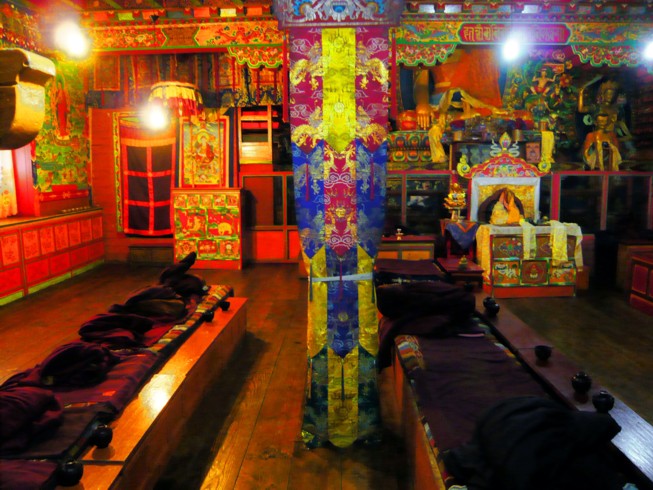
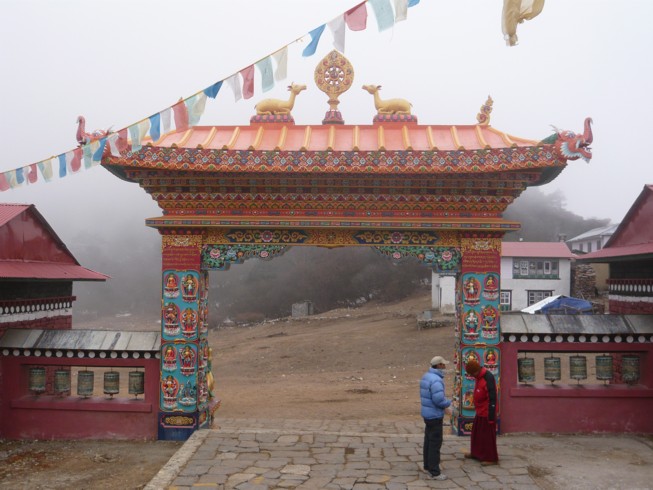
But I didn’t intend to talk about hermits, it just kind of happened. We’ve finally got some decent weather here, and yesterday I was walking through a village in the sunshine and idly thinking there are two situations in which I reckon I could renounce the world. One is in somewhere like Kathmandu in the Buddhist temples there. I’ve always had such a profound feeling of peace and stillness in these places. Buddhism is the only set of beliefs I’ve ever really been attracted to, although more as a philosophy of life than as a religion. I can’t do religion. The world is beautiful and amazing enough without throwing imaginary beings into the mix. But Buddhism is more about being a better person and looking after the world and everyone and everything in it. I could melt into that environment without too much difficulty. At least for a while.

The other situation, especially on an English summer’s afternoon in the countryside, is to retreat to somewhere remote and live a simple life away from the world as much as is practical. I’ve probably told you that before. That’s where the hermit thoughts came in.

But sadly, as already mentioned, hermits aren’t a thing anymore. Not in this country, at least. There are openings available in various other countries, but I don’t think I’m ready to explore those options. Perhaps I’ll just go for another walk.

Winter – 4

Mid-winter is the nadir of the year, and although winter does not ease its grip on the land for several months yet, at least the long, slow, lengthening of the days begins.

I have no idea how arbitrary the date of 25th December is for our celebration of Christmas day (Orthodox Christians celebrate it on January 7th, due to the difference between the Julian (old) calendar and the Gregorian (new)), but it seems to equate well to the winter solstice on 21st December, in that by the 25th it would be apparent to observers that the days were just beginning to lengthen. Is that when our ancestors celebrated? Did they all collectively hold their breath until the priests could confirm the days were getting longer again? Or did they just work on the basis of ‘it’s the Solstice today. Let’s go for it!’? I’m inclined to think it would be more the latter, with the priests declaring ‘It’s today! Time for excessive eating, drinking and unbridled sex!’

Or perhaps a bit of chanting and a sacrifice or two. Who knows?

Would our Neolithic ancestors have kept a calendar in the sense of checking off every day the way we do? I suspect not. Tools such as aligned stones would have done the job for them, confirming it was now the shortest day or the longest one. I don’t suppose there would have been any need for more refined measurements – it would be obvious to them when fruit or nuts or grain were available to be gathered. Obvious when they would need to slaughter livestock. And for that reason, I think points in time such as the solstices would be marked purely by ritual and / or celebration.

We don’t really know how they marked it, of course. We know a lot about how the Victorian writers supposed it was marked – the sacrifices, the wild dances, the bacchanalia, (and it is curious how many of their illustrations seemed to include young maidens dancing wildly in flimsy shifts) – and there is more than enough written about variations on this theme by those who see themselves today as druids, as followers of the old religion. What this old religion is, though, is a somewhat hazy and fluid animal, dragging in everything and anything from ley lines and animist gods through to Morris dancing, via witchcraft, mind-enhancing drugs, depending on who you speak to. Again, we don’t know.

In many ways, it drops comfortably into the melange of New Age beliefs, essentially being whatever the believer wants it to be…although that is something most of us could also plead guilty to, no matter what religion, if any, we follow.

It may well have been marked differently in different parts of the country (I’m really just thinking of Britain, at the moment) – different rituals in the much milder climate of the south west than in the far harsher one of the north, for example. And over the millennia they probably will have changed, being influenced by both outside factors (contact with others who did things differently, perhaps the slow change of climate) and inner ones (changing ideas about gods, relationships to ancestors, size of population).

But when Christianity came along, it substituted its own story of hope and celebration for what was there before, which is why we have it then rather than around March, which is when the internal evidence of that particular Bible story would place it. As the followers of every new religion always do, they found it impossible to prevent an old festival taking place, so instead they usurped it for their own ends.

An Andalusian Adventure (1)

img20190318_12075705

It wasn’t my first trip to Spain, although it was a long time ago now. I walked into Malaga with a rucksack on my back and followed the signs for ‘Centro’ until I found myself in the crowded central district of older narrow streets with three- and four-story shops and cafes, guest houses and cheap hotels. The second hotel I tried offered me a perfectly adequate room on the third floor at a very good price.

The hotel was old. The wooden floors of the corridors were worn and polished by the passage of countless feet, and everywhere seemed gloomy. It gave the impression of having more nooks and corners where light never penetrated than it should. But the only light came from the occasional bulbs hanging from the ceilings, and other than by returning to the street, the visitor would only encounter daylight once they had reached their room and opened the curtains.

The bed was old, and sagged a good deal more than it should, and the furniture was so dark with age it was difficult to make out the grain. As a base for a few days, I decided it would suit me fine. As I unpacked and settled in, I suddenly heard a violin being played. It sounded quite close, and I opened my bedroom door to investigate. I had just decided the sound was coming from a neighbouring room when it stopped, and then a door opened. A man about ten years older than myself emerged and stopped when he saw me.

‘I’m sorry,’ he said. ‘Did I disturb you?’

He introduced himself as a German who I shall call Matthias, although I am no longer certain that was his name, and who immediately invited me to go for a beer.

It would have been rude of me to refuse.

Matthias was meandering around Europe, he told me, and supporting himself largely by busking. Later that week I was to see him playing in the street and be surprised at just how many passers-by threw coins into his hat. It seemed a particularly enjoyable way to travel. Over those beers and then over a few more later in the week, we talked travel and philosophy, music and religion. When I meet someone while travelling, I find it interesting how I often have less constraint than I would when I meet someone for the first time in more familiar surroundings. Frequently, I will reveal things about myself I would never dream of doing to someone I meet perhaps for the first time at a friend’s house, or at my writing group. I presume it is the unspoken knowledge we will never meet again.

Beside the entrance to the hotel was a little café where I made it my habit to take a breakfast consisting of strong coffee, sometimes with slices of thick white bread dipped in olive oil, sometimes with fried eggs. It was a good place to sit and watch Malaga waking up. Its clientele were a broad mixture of workers all grabbing a quick breakfast on their way to office, shop or building site. Mostly they sat in silence, reading the morning paper and smoking, other than to give their orders to the waiter. On the bar a tiny transistor radio chattered away in speech too indistinct for me to make out more than the occasional word. In a way, though, that only added to the atmosphere. Despite it being a familiar situation, there was enough of the unfamiliar and the foreign to make it feel a little exotic.

I wanted adventure, I wanted to explore. I’ve wanted to do that for as long as I can remember. I travelled in those days with a few changes of clothes in a rucksack and a minimum of half a dozen paperbacks, which invariably included something by Hermann Hesse and at least one poetry book.

That, at least, hasn’t changed much.

I liked to travel light (other than the books, of course), so I had no camera with me and probably very few of the essentials most people would think to take on a Spanish holiday. No swimwear, for example. I don’t do beaches, at least not in that way.

But I had come to Malaga because I had a peripatetic nature, and my itchy feet were troubling me. After a few days I decided to take a walk out to the little town of Colmenar, to the north of the city. I would take a room there for one night and return to Malaga the following day. Any other destination would have done just as well; the purpose was the journey, and the journey was the purpose. I chose this route simply because while wandering around the outskirts of Malaga I saw a narrow road winding up into the hills with almost no traffic on it, signposted to Colmenar. The morning after I had made the decision, I packed my rucksack and checked out of my hotel immediately after breakfast.

Part 2 to follow

The Great Sandwich Schism – Again

Well, I don’t know about you, but what with you-know-what and the lockdown I feel a bit bleurgh at the moment, so to try to inject a little cheer – or whimsy, anyway – I thought I’d re-post an old one:

Once upon a time, a long, long time ago, God created the world. And he looked upon the world and said ‘Well, so far so good’.

And the world was full of beautiful things and good things and a great bounty of useful things that humans would later ransack and destroy in the name of greed, although that is a story for another day.

But when the people whom God had created looked upon his great works, they said unto Him ‘How might we thank you, oh God? How might we show our gratitude for your benevolence?’

And God replied ‘Oh, I don’t know. I really wish you wouldn’t bother. But if you must, just make me a sandwich, or something. I’m feeling a bit peckish after all that creating.’

013

And so the people made haste to slice bread and find Good Things to become a tasty and delicious filling for the sandwich they had made for their God. And there arose minor disputes such as whether ham and cheese really went together in a sandwich, or whether mayonnaise actually counted as food, but the people settled their quarrel in an amicable fashion and so the sandwich was created and placed upon a golden plate that was decorated with the names of angels and archangels, and set about with small mountains of salad and just a little dash of mustard in case God should fancy some.

And then one among them rose up and said ‘Wait, for we must cut this sandwich before we present it to our God, unless it be a bit too large for him to handle and he drop pieces of cheese from the sides or drip mayonnaise in his holy lap.’

And all at once there arose discord, for some were found who would cut the sandwich in a diagonal fashion, and yet others who declared that would be an affront to His holiness and that the only Right Way would be to cut the sandwich into equal rectangles.

And lo, the factions took up weapons and fought, yea, even in the Holy Kitchen, and they did massacre one another and each declared that the other faction was a worshipper of Satan, who was completely bemused by all this, since he had no followers (not even on Facebook), and they did create rival churches and rival nations and declared undying enmity against each other, spending the next few thousand years thinking up new and more imaginative ways to hate and kill and destroy each other.

And God groaned and held his head in his hands and said ‘Oh verily, what a cock-up this has become. I think I shall destroy the lot of them.’

Green Christmas

Yesterday was beautiful.

I went out for a walk in the morning as the overnight mist was lifting, and the air was cool but not cold, under a sunny, clear sky filled with birdsong. I felt a powerful sense of renewal in the world.

001a

There is little new growth yet, but the trees were covered in buds. Although we are not long past the shortest day of the year, the ridiculously mild temperature and the sun which felt warm on my face, reminded me that there is one more minute of daylight today than there was yesterday, and tomorrow there will be one more than that. And it will not be long before each day gains an extra two minutes, then three, then four…

009a

The air smelt clearer and cleaner than it had for months, and I felt like beginning a long journey. I yearned to be walking on the Downs, or heading through fields and woods with my destination nothing more elaborate than a bed in a basic bunkhouse or hostel, and somewhere to get a meal, preferably in a tiny village surrounded by hills and streams and woods. This is a feeling I get every Spring, that it is a time to explore more of the world.

Everything seems to be fresh. I need to do something new, something positive. To plant some trees, perhaps (always a good idea).

007a

I thought of Christmas. This year, we had a string of lights in one room, with handfuls of greenery as the only other decorations. This, for me, is a way to make sense of the season. It has nothing to do with religion, unless it be the ancient religions that worshipped the sun and the moon and celebrated the turn of the year at the Winter Solstice when the seasons begin their long, slow journey back towards the promise of Spring and the harvests of Autumn. A simple wisdom, in tune with the natural world.

I do not, I cannot – I will not – associate it with any other form of mythical gods. For me, it is all about the natural cycle of the seasons, simple and uncomplicated.

And I particularly like the period when Christmas is definitely over, and we’re only just getting into the new year. Everything seems to have this feeling of renewal, which was the whole point of the Yule festival. A time to look forward and plan for the coming year. This will be where the tradition of New Year Resolutions comes from, no doubt.

This year, I shall resolve to try and simplify my life further, and to live more in tune with the natural world.

Myth, Science and Religion

Religion begins as science, as an attempt to make sense of the world. The birth of religion marked the dawn of humans as rational, analytical beings. This was humans moving beyond the worries of simply surviving from day to day, and reaching that point in evolution where they looked with wonder upon the world around them and asked: How did this come into existence? What is it that controls the weather and other variables? By observing the natural world around them, the cycles of day and night, the seasons, the migrations of the animals, they would have concluded that these patterns suggested a grand design and order.

003a

An assumption would probably be made that all this was controlled by benevolent beings, but beings who might need propitiating occasionally to keep them sweet; the odd ritual here, perhaps a sacrifice of some sort there.

And if that was so, perhaps they could be propitiated in a somewhat greater way, to grant other boons?

It would not be long before someone claimed a channel to the gods to relay their desires and instructions, and so the priestly class would be born. Self-interest? Quite likely. After all, we see that in most religions today, so why not?

Religions then, over the years, spawned new religions, the spark being reinterpretation rather than inspiration.

We think we see echoes of old religions in myths. Myths are the fragments of history we know, combined with assumptions about how our ancestors acted and thought, frequently combined with scarce written evidence, which may or may not be biased or wholly inaccurate. When our written sources include stories of monsters and miracles, we should probably be advised to treat them cautiously.

Myth-makers frequently come with an agenda, although depending upon your point of view that is not necessarily a bad thing. If you are looking for a scientific analysis of the lives of our ancestors, it’s probably best to give myth a wide berth. Or at least to be very, very, careful what you take from it. But in a way, it does provide an alternative world view that many find preferable to both the stark realities of day to day life, as well as the cold dead hand of religion. After all, if you’re using your imagination, it’s easy to plan your myth-world much the way you’d like it.

And perhaps myth does offer us a way of getting inside the heads of those people, at least superficially.

One assumption we can make is that there would be similarities in the thought processes of those people, with the thought processes of us today. It is perfectly reasonable to assume they would react in similar ways to us, to pain and fear, to pleasure, warmth and cold. Our reaction to the unknown tends to be to populate it with characters or situations based on our experiences, and they probably did the same.

Stonehenge is aligned with the solar calendar. This we know. It’s science. And we know a considerable amount about the geography of the area around Stonehenge at the time it was built, through archaeology and science.

What we don’t know is how it was used. Just because it was aligned with the rising sun at summer solstice and the setting sun at winter solstice, does not mean we know what took place at those times. We assume our ancestors worshipped or venerated the sun there, especially at the time of the solstices, but we do not know that. Were there sacrifices? Did they hold special ceremonies connected with fertility or birth or death? Was it perhaps just like a club where they turned up now and again and got drunk and held orgies? It could be, since there is no hard evidence for anything.

Believers in ley lines also claim it is at the centre of an intricate system of lines connecting natural (‘holy’) locations with important (‘holy’) sites such as churches, wells and crossroads. Pseudoscience? Coincidence?

Our assumptions, though, lead us to think that because of the immense effort required to build the structure, it must have been an incredibly important site, and we are surely justified in concluding important ceremonies were enacted there.

Whatever they were.