Wednesday December 27th

It is windy this morning and the forecast is for rain and high winds later in the day. Consequently, I go out for a walk straight after breakfast, heading for the woods beside the common where I know I will be sheltered from the worst of it, should the winds get up soon. Above, the clouds are thick and dark and what light does make it through the mirk is thin and silvery, glittering coldly on leaves and puddles, the latter wrinkled with tiny wavelets scurrying in bursts across their surfaces.

A couple of rooks are calling irritably overhead, buffeted by the breeze, as I reach the edge of the wood. A few paces in, I pass along the edge of a shallow, long-disused sandstone quarry, its banks perforated with badger holes, and with other entrances deeper into the woods. The whole of the sett appears to occupy upwards of a fifth of an acre, although there may well be entrances I have not yet found.

Moving on, I find I am walking to the rhythm of a tune in my head, something that happens to me frequently. This time, it is a track from an album by Stick in the Wheel, a kind of punk-folk group, the track being the Abbots Bromley Horn Dance. Stick in the Wheel are a group I have only recently discovered, and the only album I have of theirs (so far!) gets played rather a lot. This particular tune has a very pronounced beat and I wonder, as I often do, whether the tune has come into my head as the beat matches my pace, or whether I have unconsciously altered my pace to fit the tune.

I also decide it doesn’t matter which it is.

It is still early enough in the day for there to be very few other people about. In about an hour’s time the air will be filled with barking and shouting as the regular dog walkers invade, but for now I have the place almost to myself.
I have just begun to re-read Robert MacFarlane’s The Old Ways, and in this he tells us that at the time of writing (2012) he reckoned he had walked perhaps 7,000 or 8,000 miles along footpaths in his lifetime. Does this mean each mile is a unique mile, in that he means he has walked this distance all along different routes, or does it include the day to day walks along local routes, routes such as the one I repeat day after day? He doesn’t make that clear, and I would guess it includes all repetitions. He then goes on to quote De Quincy saying that Wordsworth walked a total of 175,000 – 180,000 miles in his lifetime (although how did he know?), which would clearly include his repeated local walks, if true. I wonder how many I have done and make a vague stab at guessing a figure. At various times I have worked out I tend to walk an average of 20 miles a week, allowing for good and bad periods of walking, of which probably one half would be on footpaths. There were times when I did much less, and times when I did much more, but it seems a reasonable estimate. That would give me a figure of between 25,000 and 27,000 miles in my adult life so far, which is probably wildly out but is quite similar to Robert Macfarlane’s.

I’ve no idea what to conclude from that.

But I know I would probably walk quite a bit further if I didn’t tend to stop so frequently just to stand and stare at my surroundings. I do it often enough to sometimes irritate those I walk with, although they’re usually kind enough to say nothing about it. But there are also those who just get their heads down and walk, walk, walk, seemingly on some mission to cover as many miles as possible in the shortest possible time, barely able to glance around them as they go. What is that about, unless it’s some sort of charity event and they’re raising money by the mile? Where is the pleasure?

The Welsh poet W H Davies wrote ‘What is this life if, full of care, we have no time to stand and stare?’

What indeed?

I’ve been doing it quite a lot again this morning. It seems so important. Surely everyone must do it to a degree?
The Travel Bug bit me – part 1

Travelling! My first inclination to travel to remote regions came from my Grandmother, when I was probably six or seven years old, despite the fact that she had never travelled very far at all in her whole life. In fact, I don’t think that she ever left England.

But she would tell me stories of China, inducing images of Emperors and pig-tailed mandarins, peasants and bandits, and this was coupled with a children’s book; an encyclopaedia I presume, with grainy, black and white pictures of strange scenery. It was extremely evocative, although at the time I did not understand that. I was just excited by the mysterious, the strange and the unknown.  I was hooked, and wanted to go there! Ever since then, the places where I’ve most wanted to travel, other than Britain and Europe, have almost all been in Asia.

The list of places that I have at the moment that I would like to visit, are almost exclusively Asian.

Yes, she has a lot to answer for, that sweet old lady.

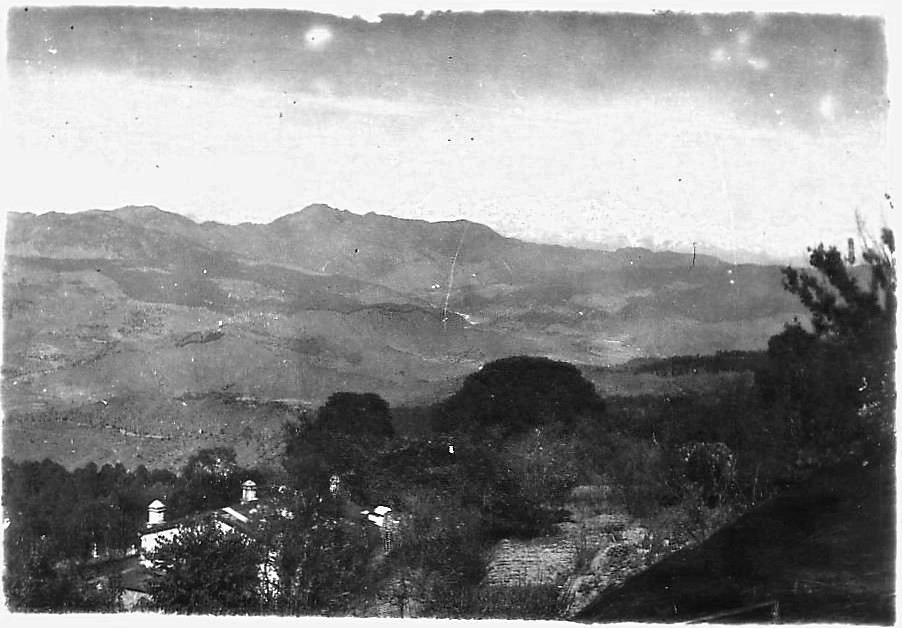
hill station 2

When I was a teenager, I began to use maps, although in rather an ad hoc, hit and miss manner.

They were there for me when I was really stuck, or I just wanted to know in which general direction something lay. It would be a very long time before I began to use them in a skillful way, able to predict the exact lie of the land, navigate in the fog or the dark, or find my way through complicated landscapes with the map and compass. And, do you know, since I’ve learned to do that, I often feel as though I’ve actually lost something rather magical, although I don’t suppose that I can blame it all on that. The maps that I was using as a teenager would tend to be the Bartholomew’s Touring Maps, small scale with little detail. I would feel, as I headed along a Cornish footpath, that I only knew roughly where I was going. It always felt like an adventure; an exploration.

Now, I need to be more and more remote before I can get that feeling, and even then it does not always work. Some ten years ago, I spent a couple of weeks in Ladakh, in the Himalaya in the far north of India, and I was surprised at just how easy all of my walking was. Setting off with map and compass, I always knew exactly where I was, only confused at times by the multiplicity of tracks criss-crossing the landscape. Even then, reference to mountains and villages with map and compass would invariably allow me to set my position.

That doesn’t mean that I wanted to get lost, just that there was a small part of me that said ‘even this is all tame!’ Equally, I can be put off, when using a map, by the knowledge that over the interesting looking ridge that I am heading for, there lies a motorway or building estate, and so I then spend ages trying to plot a route that I try to get perfect, rather than simply heading off in the direction that I want to go and exploring as I go, correcting my course as I travel.

Nothing can tempt me more than a track leading tantalisingly into the distance, perhaps meandering through Mediterranean scrub towards a notch in the skyline, perhaps leading through a glowing archway of trees. Even now, when using map and compass to navigate, I often have to resist the temptation to ignore the map and head off to follow an interesting looking track. I think that this must be a part of my ‘I wonder what’s over the other side of the hill?’ nature. It’s another reason why I’ve never been able to lie on a beach – apart from the fact that this seems a particularly pointless pastime in any case. Any time that I’ve tried it, it never seems to be more than a couple of minutes before I begin to think ‘What’s round that cliff, I wonder?’ or ‘If I head back up the river, I think I might find a way through those hills.’ And then I just have to go to find out.

There are plenty of other things that can destroy a sense of adventure in travelling, other than over-familiarity with maps, of course. I remember the shock and the sense of let-down I received in Germany about 35 years ago, when I spent the best part of a morning struggling up an ill-defined track through thick woodland to the top of a berg in the Black Forest (I was using a tiny touring map at the time, which showed main roads at best). My elation at arriving at the top and surveying the panorama of hills and mountains around me was completely destroyed within a minute, as a coach roared up the other side of the hill, came to a halt a few feet away from me, and then disgorged about 30 Japanese tourists. They spent about two minutes firing off photographs of everything in sight, including myself, before leaping back on board the coach, roaring off down the hill and leaving me gob-smacked in the sudden silence and slowly settling dust.