Wednesday December 27th

It is windy this morning and the forecast is for rain and high winds later in the day. Consequently, I go out for a walk straight after breakfast, heading for the woods beside the common where I know I will be sheltered from the worst of it, should the winds get up soon. Above, the clouds are thick and dark and what light does make it through the mirk is thin and silvery, glittering coldly on leaves and puddles, the latter wrinkled with tiny wavelets scurrying in bursts across their surfaces.

A couple of rooks are calling irritably overhead, buffeted by the breeze, as I reach the edge of the wood. A few paces in, I pass along the edge of a shallow, long-disused sandstone quarry, its banks perforated with badger holes, and with other entrances deeper into the woods. The whole of the sett appears to occupy upwards of a fifth of an acre, although there may well be entrances I have not yet found.

Moving on, I find I am walking to the rhythm of a tune in my head, something that happens to me frequently. This time, it is a track from an album by Stick in the Wheel, a kind of punk-folk group, the track being the Abbots Bromley Horn Dance. Stick in the Wheel are a group I have only recently discovered, and the only album I have of theirs (so far!) gets played rather a lot. This particular tune has a very pronounced beat and I wonder, as I often do, whether the tune has come into my head as the beat matches my pace, or whether I have unconsciously altered my pace to fit the tune.

I also decide it doesn’t matter which it is.

It is still early enough in the day for there to be very few other people about. In about an hour’s time the air will be filled with barking and shouting as the regular dog walkers invade, but for now I have the place almost to myself.
I have just begun to re-read Robert MacFarlane’s The Old Ways, and in this he tells us that at the time of writing (2012) he reckoned he had walked perhaps 7,000 or 8,000 miles along footpaths in his lifetime. Does this mean each mile is a unique mile, in that he means he has walked this distance all along different routes, or does it include the day to day walks along local routes, routes such as the one I repeat day after day? He doesn’t make that clear, and I would guess it includes all repetitions. He then goes on to quote De Quincy saying that Wordsworth walked a total of 175,000 – 180,000 miles in his lifetime (although how did he know?), which would clearly include his repeated local walks, if true. I wonder how many I have done and make a vague stab at guessing a figure. At various times I have worked out I tend to walk an average of 20 miles a week, allowing for good and bad periods of walking, of which probably one half would be on footpaths. There were times when I did much less, and times when I did much more, but it seems a reasonable estimate. That would give me a figure of between 25,000 and 27,000 miles in my adult life so far, which is probably wildly out but is quite similar to Robert Macfarlane’s.

I’ve no idea what to conclude from that.

But I know I would probably walk quite a bit further if I didn’t tend to stop so frequently just to stand and stare at my surroundings. I do it often enough to sometimes irritate those I walk with, although they’re usually kind enough to say nothing about it. But there are also those who just get their heads down and walk, walk, walk, seemingly on some mission to cover as many miles as possible in the shortest possible time, barely able to glance around them as they go. What is that about, unless it’s some sort of charity event and they’re raising money by the mile? Where is the pleasure?

The Welsh poet W H Davies wrote ‘What is this life if, full of care, we have no time to stand and stare?’

What indeed?

I’ve been doing it quite a lot again this morning. It seems so important. Surely everyone must do it to a degree?

Those Old Paths

We seem to be in the middle of a spell of warm, sunny weather. It seems Spring really has arrived, although things could always change quickly, of course. But it’s the sort of weather that tempts me out to go walking as much as I can. We are extremely fortunate in the UK to have such a wonderful network of footpaths, open to the public.

042a

Dartmoor footpath

Many of the ancient tracks are still just that; just trackways that have never been turned into roads over the years. Often, this is due to their locations in the landscapes they traverse. Neolithic or Bronze Age man lived in a landscape that frequently comprised dense, almost impenetrable, forest, with networks of streams meandering through marshy lowlands, and wherever possible they would utilise the higher ground to move around, and hence we have long-distance footpaths today still following these same routes such as the Ridgeway, while modern roads tend to utilise the lower, flatter land where possible. Walking these Old Ways (and it is impossible to even mention them without referencing Robert Macfarlane’s wonderful book, The Old Ways!) always gives me goosebumps, as I feel I’m following in the steps of these prehistoric travellers.

And yes, we are lucky. Not only do we have so many of these paths, but we have the right to walk them whenever we please. But this has not always been the case. Up until comparatively recently, huge areas of the British countryside were owned by the landed gentry who denied the public any access. In 1932, the first mass trespass by five hundred men and women at Kinder Scout, in the Peak District, led to the imprisonment of five of the trespassers but this led to a second, three weeks later at nearby Castleton, involving ten thousand trespassers.

This growing movement, demanding the right to roam, led eventually to the creation of the first of the national parks in 1951, and to the Countryside Right Of Way act in 2000. So today it is possible to walk plentiful footpaths pretty well anywhere in the country, thanks to this incredibly successful movement of direct action.

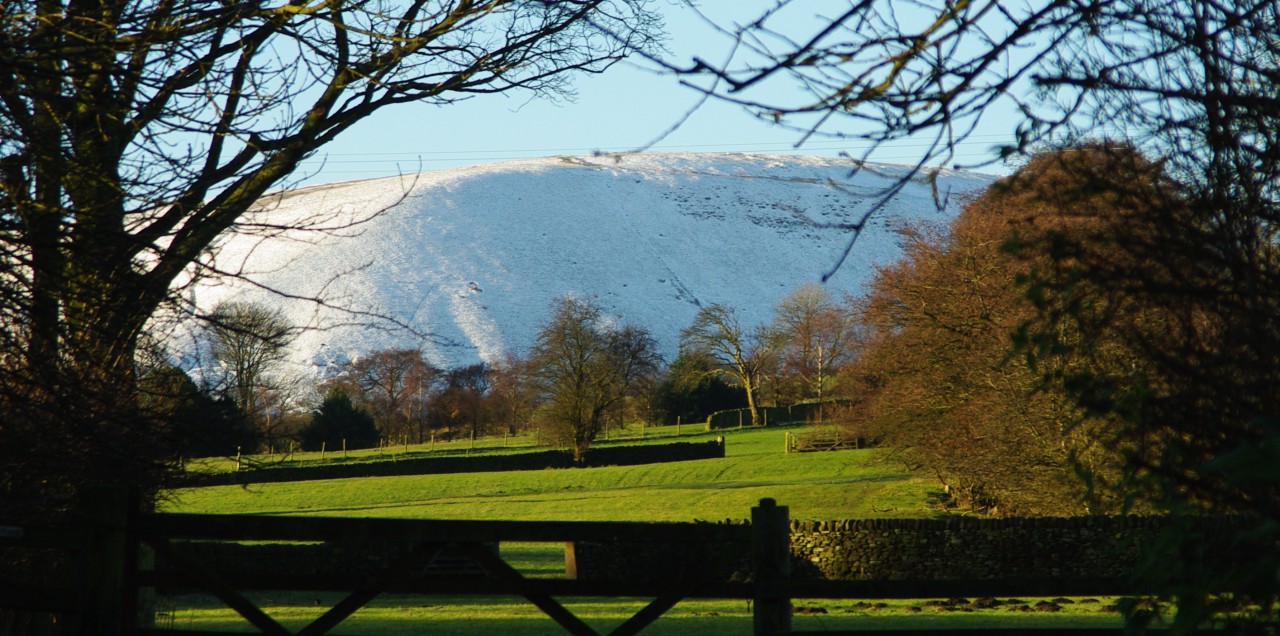
My header picture at the very top of the page, incidentally, is a view of the Peak District looking towards Kinder Scout.

And it’s another gorgeous day today, so we’re off for a walk to make the most of it. I’ll catch up with everyone later.

South Downs Way 2 – Steyning up to Chanctonbury Ring

Mouse Lane begins in Steyning and runs along the foot of the scarp slope of the Downs, until it climbs a little towards Chanctonbury Ring, an old hill fort. It is a delightful route, as delightful as its name; a sunken lane full of flowers and bees and butterflies (and, no doubt, mice), cool under the overhanging trees in the hot morning’s sun. It would be pleasant to follow it the whole way, but our route takes us along the ridge, and so we leave the lane to take a footpath up the steep scarp slope.

But where we leave the lane, there is a poem inscribed on a stone block. It was written in 1915 during WWI, by a British soldier poet stationed in the Somme. We pause to read it then stand for a while in silence, each of us alone with our thoughts.

064a

I can’t forget the lane that goes from Steyning to the Ring

In summertime, and on the downs how larks and linnets sing

High in the sun. The wind comes off the sea, and, oh, the air!

I never knew till now that life in old days was so fair.

But now I know it in this filthy rat-infested ditch,

Where every shell must kill or spare, and God alone knows which.

And I am made a beast of prey, and this trench is my lair,

My God, I never knew till now that those days were so fair.

And we assault in half-an-hour, and it’s a silly thing:

I can’t forget the lane that goes from Steyning to the Ring.

Chance memory – John Stanley Purvis 1890 – 1968

Our footpath, ironically, then takes us past an old rifle range. So old, in fact, that according to a walker we stopped to talk with it is still possible to dig musket balls out of the bank behind the range.

On top of the ridge, there is a slight breeze, but it is already very hot and we are clearly in for a hard day’s walking.

Robert Macfarlane, writing in The Old Ways, records sleeping in the Ring one night, and being woken at 2 a.m. by blood-chilling screams that seemed to come from above him, and then proceeded to circle the Ring for a quarter of an hour, although he could see nothing that might account for the sounds – he rules out the possibility of a screech owl – until they finally disappeared and he fell asleep again.

I would never have shut my eyes there again, if that were me.

091a

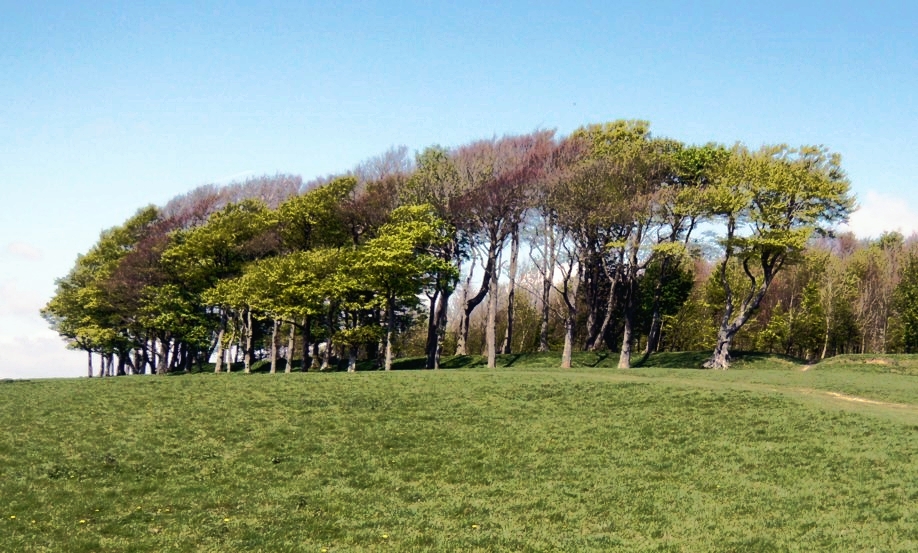
The Ring has a reputation as the most haunted place in Sussex, with tales of hapless benighted travellers being scared witless for centuries. In 1966, apparently, a group of bikers decided to stay the night there and were forced to flee in terror.

We’ve been to Chanctonbury Ring before and it certainly has an atmosphere. I would have liked to have lingered for a while longer, but the downside of the journey is that we had still to cover quite a few miles in the heat to get to Amberley that afternoon.

057a

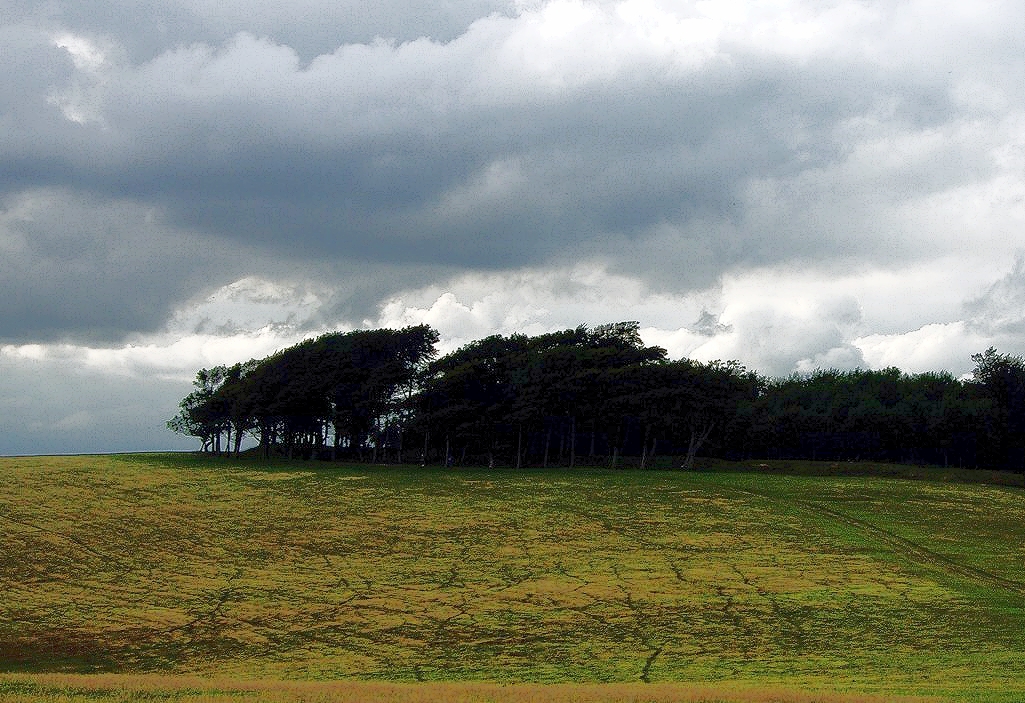
Three years ago when we visited the Ring, the weather was gloomy and somewhat more atmospheric, although we were mercifully left alone by whatever might be lurking around there on the astral plane.

Thankfully, it seems they only come out at night.