India – my first time (1)

Just a few photos this time, taken on my first proper trip to India. On the only previous visit, in 1988, I had spent a manic 18 hours in Delhi, and then taken a long bus journey to Nepal. That was a journey that really should be the subject of a blog itself, sometime.

On the following year, then, I returned to India, intending to spend rather longer there this time. As it turned out, I had to return to England after a few weeks, but the short time that I was in India whetted my appetite for more. It is said that western visitors to India tend to fall into one or the other of two categories. Either they fall in love with the country, and return whenever they can, or they swear never to go within a thousand miles of it ever again.

I’ve been back about ten times.

Delhi Red Fort 1

The Red Fort (1989)

I arrived in Delhi with a copy of Lonely Planet’s ‘West Asia on a Shoestring’. In those days, the Lonely Planet tomes really were aimed at backpacking budget travellers, with their recommendations for rooms tending to be dormitories and really cheap hotels. My flight arrived in the late afternoon, so that not only was I weary from the long journey, but the light was already fading when I walked out of the airport. In the chaotic maelstrom outside of passengers and taxi drivers fighting over them, I managed to remain calm enough to locate the corner where the buses of the Ex-Servicemen’s Air Link Transport Services waited. I think they are still in operation today (I’m sure someone will tell me), with their yellow (I think) buses providing a cheap link into the centre of Delhi where I was heading.

I was dropped off near the hotel I had decided to use, the Ashok Yatri Niwas, which stood at the junction of Janpath and Ashoka Road. It has long gone, now; a great concrete monster of a place with cement beds and lifts that seemed to take half a day to do the full journey up to the top floor. I don’t think that many people mourn its going, but I was reasonably comfortable there for a couple of nights. It was where I had stayed the previous year for the one night I was in Delhi. There was hot water in the bathroom, as long as you rose early enough, and I remember the cafeteria being fairly basic, but adequate. For someone on a tight budget, it was fine. Back then, it was a case of turn up and hope there was a room, especially if you had just arrived in the country. There was no email in those days. But it was pretty big, and there was room for me.

Unlike my previous flying visit, I now had time to wander about and savour everything around me. And for the first time, it really did seem an alien and exotic society. I had enjoyed browsing in the souks (bazaars) when I had lived in Oman, and also out in the little villages there, but my first taste of India seemed to me to be as exciting and exotic as it got. Everywhere I went, I was surrounded by the noise of traffic and the odours of exhaust fumes. But the traffic was different; the buses appeared to be almost falling to pieces, loud and fierce, with people hanging off the outside as well as being crammed inside behind open, barred, windows. I saw tuk-tuks everywhere; the little three-wheeled taxis that buzzed like wasps through the traffic, squeezing through every available gap. Amongst this impatient, petulant, hooting traffic, carts pulled by horses or buffaloes plodded. Motorbike riders forced their way through, and cyclists cautiously weaved their way along. Everywhere, pedestrians took their lives in their hands to cross the roads, but the traffic all swerved out of the way for the cattle that wandered imperiously through the streets, ignoring it all.

Incredibly, through the traffic pollution so thick that you could grab handfuls of it out of the air, there were dozens of other smells assailing me everywhere I went. I was tempted every few steps by cooking foods, and then I might pass a doorway and a strong smell of incense would waft out. Seconds later, I would suddenly wrinkle my nose as I passed a pool of sewage on the sidewalk, but then immediately I might pass a fragrant flower stall.

delhi_gate

Delhi Gate, in the old city near Chandni Chowk. (1989)

There were temples everywhere, and a shrine of some description every few steps. Here and there were green and white mosques, stalls of old sacking and weathered boards set up outside gleaming new metal, glass and concrete shops. There were holy men jostling office workers, great hump-backed cattle and pariah dogs in corners or in the middle of the footway, beggars, shoe shiners, touts and hustlers, people in a hurry and idlers passing the time of day. I was urged to discretely change money, buy drugs, see pornographic videos, have a massage, change hotels, visit ‘my brother’s’ shop or book a trip to another part of India.

It was dirty, colourful, loud, exciting, and different and I loved it.

I walked everywhere I could, not just because I was on a tight budget, but it is always how I have got to know a place. I went to the Red Fort, on my first full day there, enjoying the relative peace and quiet inside, and it was here that I discovered Mogul architecture: The beautiful soft red stone and the marble, the carvings and inlay, the arches and columns…the only time I’d seen architecture that beautiful, before, was in Grenada, in Spain.

And now, looking at the photos I took, I am struck by an odd discrepancy. In my memory, one of the defining things about Delhi when I arrived was the incredible press of traffic. In my photos, though, there are comparatively few people, and even less traffic. Is my memory at fault? Is it just that there were obviously far fewer people in India 30 years ago? Perhaps it is chance alone.

But I think I’ll return to the architecture at a later date.

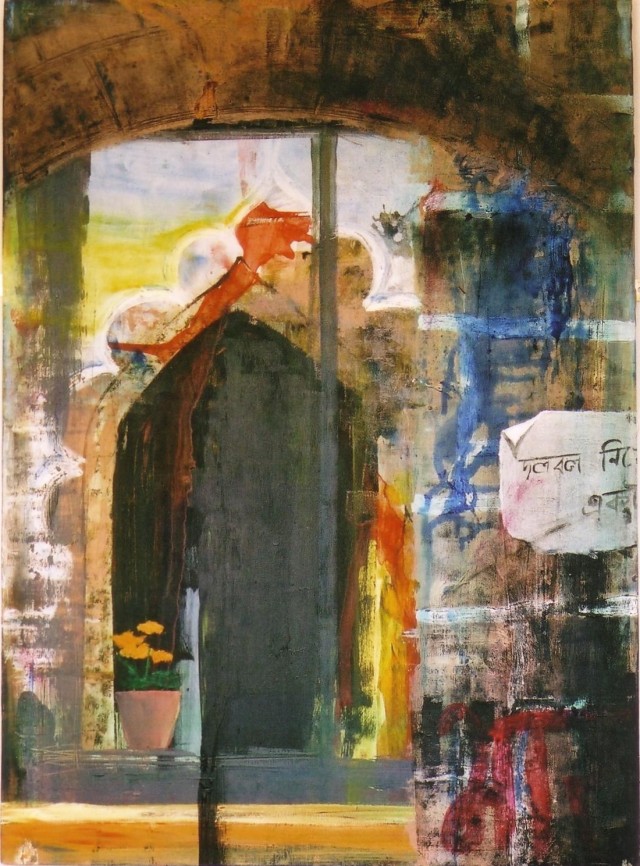
A bit of paint splashed around

A different sort of creativity, today. I paint, at times, so here are a couple of my paintings that were inspired by my trips to India.

bihari door

This one is of a door on a house in the North India state of Bihar.


india #1

And this one a more impressionist rendering of doorways, arches and windows.


Although writing has always been the primary medium through which I have tried to express my thoughts and feelings, it was my first trip to India, 28 years ago, that persuaded me to try to paint seriously. Although I have done little in recent years, I still dabble on occasions, and suspect that it is only a matter of time before I begin work on a new painting.

A Day in Ladakh

Wednesday 13th April 2005

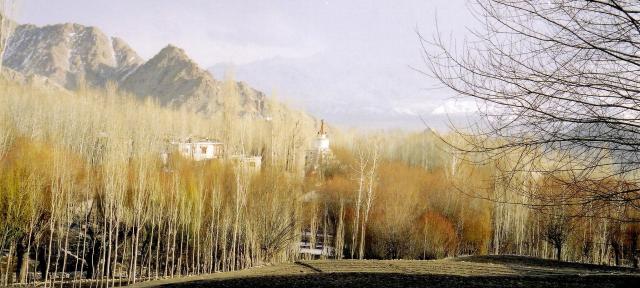
This morning, there is a clear blue sky, with just a couple of clouds sitting on top of the Stok Mountain Range. It doesn’t seem quite as cold in the morning as it has been recently.

I go for breakfast at the Budoshah. I don’t really know why I eat here (I certainly don’t always), unless it’s because the morning sun warms the corner that I’m sitting in. I’m the only person here and when I walk in, the waiter always seems frightened to see customers. When I’m eventually given a menu (and everything is always ‘off’ – it’s a Kashmiri restaurant, so two thirds of their dishes are chicken or mutton. The day before yesterday, people were being told ‘no chicken no mutton’.), I ask for scrambled eggs on toast.

I’m told no, they can’t do it. Fried, boiled or omelette, yes. But the cook obviously can’t scramble them.

And black coffee.

‘Pot?’

How big is the pot? I ask.

‘Ah…I get one’. He disappears back into the kitchen, never to return. I sit back and contemplate the Ladakh Mountains in the sunshine, prayer flags waving lazily beside the temple. With luck, it will be another warm day. I think I’ll catch a bus to Thikse Gompa.

My coffee arrives. In a glass.

The toast arrives with heart-stopping chunks of Ladakhi butter – like everything here that calls for butter. I thought at first that it must be cheese. It seems to be the Ladakhi/Tibetan way. I made a mistake and had a cheese sandwich the other day – the cheese is just like butter, so you can imagine what it was like for my poor western tastebuds. I had to scrape most of it off.

leh street

It’s 12.45, and I’m sitting on a rock in hot sunshine at the foot of Thikse Gompa. The bus ride here was remarkable (and where else in India would you find that the driver would wait a few minutes whilst a passenger nipped off the bus to buy some bread?). All the way here, we passed through this wonderful desert scenery, with fairy-tale castles and palaces and the like clinging precariously to the tops of cliffs.

The Ladakhi buses are like all Indian buses, though. Today’s had plenty of pictures inside and on the windscreen (The Dalai Lama, Buddha, etc.), two vases of flowers and a fancy piece of wooden scrollwork on the dashboard, and several drawers incorporated into this.

At the moment I’m having my apricot and water lunch to the accompaniment of drumming in the background; a ritual going on somewhere. There are so many gompas here, and every private house performs their own pujas, that it could be coming from anywhere.

We passed through Shey on the way here. More of this tomorrow, I think. I intend to spend the day there.

I ‘strolled’ up to the gompa, and was shown around by a monk. We chatted in a mixture of Ladakhi, Hindi and English. He is a Ladakhi, in fact all of the monks here are. There are no Tibetans. In fact, despite the large Tibetan population here, he says that there are only two monasteries with Tibetan Lamas.

Untitled-TrueColor-01

We watched a group of young monks kicking around a football, a hundred metres or more below us.

Do families still send one son to be trained as a monk?

No, but there are still many coming.

I was first shown the giant statue of Maitreya Buddha, which is fairly modern, then the fourteenth century gompa, which is very dark and unlit, which made it difficult to properly see the wealth of thankas and statuary. I had to tell him about my family, job and anything else he could think of. That was quite hard going, and I don’t think we totally managed to get through. A pigeon flew into the gompa and started a discussion (not literally, you understand). In Ladakhi, pigeon is (I think) Po-ro, fairly onomatopoeic. In Arabic, I told him, it’s Bulbul, also onomatopoeic. Possibly it is the same in Hindi and Urdu.

Untitled-Scanned-01

Back for tea and a bucket shower.

Later, I’m walking around the market. How strange to go around market stalls and shops in India, not getting pressured and hassled at all. At times it seems almost unreal. You wonder whether suddenly it’s all going to crash around you and normal India will be resumed as soon as possible. The longer that you spend here, the more laid back you become. I don’t think you can help it! Everyone strolls around smiling and Julay-ing you and each other. I know that Ladakhis consider it the height of bad manners ever to lose one’s temper, but it really does seem unreal. I think it would be easy to just sink into the ambience of it all and find you’d suddenly missed your flight out and had overstayed by weeks, or months…

Andrew Harvey said, and I’ll have to paraphrase because I can’t remember the exact quote, ‘The wonder of Leh is that there is absolutely nothing to do. Nothing to do except slow down, switch off and just observe. Just be.’ I understand that, now. I realise that that is what I have been doing the last few days without realising it.

trees

I had Phung Sha and rice for supper at the Amdo -a Tibetan dish. It is a sort of thick vegetable stew, which I shall certainly have again.

I have always wanted to read Rumi, the thirteenth century Persian mystic and poet, and I picked up a copy today from the little bookshop. I am now wrapped up in my blanket reading it by the light of my candles.

Downstairs, my hostess is singing again. Last night, I tiptoed out to the landing to listen to her singing what I was told this morning were Ladakhi folksongs, and I creep out again to listen now.

This time it’s ‘Bob the Builder’.

Jaipur

I have recently discovered Arv’s lovely blogsite ‘Jaipur thru my lens’:

https://jaipurthrumylens.wordpress.com/

and after reading several posts and enjoying the pictures, I felt that I had to revisit my own photos of Jaipur and share a few of them.

They’re a bit of a mish-mash, but, there you go.

I was there in 2009 for a few days, and probably the thing that I remember most about it is that because I was unwell for much of the time (unusually for me),  I did not get to see many of the places there that I had wanted to see.

I think this is why I enjoyed Arv’s pictures so much.

115


102


089a


091a


092a


157a


109a


132


146a


131


121


156a


123a

The Mad Woman of the Hill Station

A few years ago I was staying in a town in the Indian Himalaya; one of those towns that would have been described as a ‘hill station’ in the days of the British Raj, where the climate is tolerably similar to that found in Britain, and the Colonial masters were able to retreat for that half of the year that the temperatures on the plains became just too hot for them to endure. When that happened, they would load up themselves and their possessions, even down to plants in plant pots, so that native servants could drive them or carry them for weeks on end, on the long journey up into the hills. Nothing would be too much bother…for the servants and ‘coolies’, that is. At that time, the Westerners considered themselves to be utterly superior to the ‘native peoples.’

       coolie 1

Of course, that kind of attitude has been consigned to history, now, hasn’t it?

Anyway, it is a lovely town, this town that I am referring to, full of historical buildings associated not only with the British, but also with Indians (of course), Nepalese, Tibetans, and several other races. For this reason, amongst others, it attracts a goodly number of tourists, Western and otherwise.

hill station 2

One day I sat eating breakfast in a restaurant there, when a group of five other Westerners entered and sat down at a table nearby. Within about half a minute, they had begun to complain bitterly to each other about their travels. They appeared to think that the whole world was a freak show, put on for their benefit as they travelled around viewing it, but everyone that they met in these backward places (‘I don’t miss Western civilisation at all.’ Remarked one of them, whilst playing with his i-phone) were either out to fleece them, or to thwart their plans in some way or another by pretending not to have what they were asking for, or by taking ages to do what was demanded of them.

However, I was distracted from listening to their conversation and wondering how best I could kill them all without being arrested, by the arrival of another Western lady, aged, I would think, about sixty, dressed in a slightly odd mix of Indian and Western dress. She had appeared the previous morning in the restaurant, and had a shouting match with the same group of Westerners, although I had been on the other side of the restaurant that morning and could not understand what it was about.

Today, she popped her bag down on the table next to mine, disappeared for a while, and then returned, with a loaf of sliced bread that she had obviously gone out especially to buy. She took out four slices, turned to me and said ‘Try these; they are much nicer. Are you a priest?’

‘Thank you.’ I replied (I was in t-shirt and trousers, nothing particularly priestly). ‘No, I’m not.’ Our conversation continued for about ten minutes. She was a Plantagenet royal, brought to 2013 by a time machine, which the CIA discovered in 2000. That is why so many people are unhappy; they have been sent away from their proper times. She apologised for not being able to hear very well, although I could see no problem in that respect, but she had been hypnotised. Then she wished me goodbye and went out again.

What a splendid woman. She was a breath of fresh air, and unknowingly saved the lives of five other Westerners that day just by being there.

Unfortunately for me, though, that same evening I chose to eat in a restaurant that was empty when I arrived, so that when a couple of girls came in and sat down two tables away from me, I could hear every word that they said, whether I wanted to or not. There was a Swiss girl, whose role in the conversation was to say ‘yes’ and ‘no’ and very little else, whilst the other girl, who was British, just spouted on and on and on…

It appeared that she was travelling around the world. If I was a relative, I would have given her the money and said ‘go off for a few years. Enjoy yourself.’ And then moved house. She had been to Marrakesh. To Cairo. Thailand, Cambodia, Australia…I forget where else. Almost everywhere, she hated the food. It generally made her sick. She hated the people. They were horrible. Rude. She was excited because someone was shot in a bar in Cambodia whilst she was in the bar. It seemed to have been the highlight of her travels so far. ‘Was he killed?’ ‘Of course!’ she said, excitedly. And on and on and on…

Perhaps we should all be made to stay at home.

Two weeks in Middle Earth

It is so easy to travel, nowadays…

Our holiday began with a couple of day’s home stay in Hobbiton, the only settlement of any note in the Shire. Unfortunately, this rather set the tone for the rest of the trip. Immediately, it proved impossible to pick up a mobile signal of any kind, a problem we were to encounter time and again throughout Middle Earth, which made trying to alter our travel arrangements extremely difficult.

Our host claimed that we had been given what he called ‘the best room in the house’. Hole, more like, in every sense. One could be forgiven for thinking that flush toilets had never been invented. Admittedly, it was pleasant in a rather rustic, bucolic sort of way, and the meals were everything that we could have wished for, but the beds were a nightmare – ours seemed to be made for a child, and Cheryl and I lost count of the number of times we banged our heads on the low doorframes.

Then, looking for entertainment, we visited three of the bars in the village, all of which advertised themselves as gastropubs, and I’m afraid that each was full of tobacco smoke and were quite simply too noisy. Incidentally, it was in the third one that we visited, that this guy we spoke to slipped me some odd ring, and since then a whole lot of strange dudes seem to be following us around.

The courier seemed a little surprised at our complaints, the following day, claiming that for most tourists Hobbiton is one of the highlights of their holiday, but agreed that we should move on a day early, if he could not find better accommodation for us. As a result of this, we went on to Lothlorien, which could not have been a greater contrast. Two days there at least made us appreciate Hobbiton – where that had been rather rough and ready, noisy and dirty, Lothlorien was simply bland, boring and anodyne. Entertainment seemed to consist solely of rather highbrow concerts and book readings, restaurants were all rather expensive and uninteresting and we felt that we should be tip-toeing around the whole time, hardly daring to speak other than in whispers. At least, though, the oddballs that had been tailing us disappeared for the duration.

But forgive me if I say little of the journey from Hobbiton. Several days through a bleak, cold and windswept landscape, with nothing to see and no accommodation other than our tents. The last part was the worst part, though. We travelled through some ghastly, cold tunnel, where we felt threatened by attack from bandits at any moment, and all sorts of dreadful noises kept happening. It was simply awful, but the courier insisted that it was normal and quite safe. I will be putting in a strongly worded complaint about him after we return.

However, I don’t want it to sound as though it has all been bad, and that we have done nothing but complain. Possibly the best part of the trip so far, certainly for Cheryl, was staying in the eco lodge in Rohan. She was delighted that we were so close to horses the whole time, and the lodges reminded her strongly of the yurt that she stayed in on a previous trip away. Our hosts were friendly and happy to indulge us in our whims – mine to sit outside the lodge at sundown with a glass or two of the local (admittedly rather rough) ale, and Cheryl’s to help with the mucking out in the stables.

Personally, I definitely preferred Gondor, a modern, forward looking country with a booming economy. Although some border regions are still occasionally subject to unrest, the capital, Minas Tirith, is considered by the Foreign Office to be safe to visit, although I was less than impressed when our caravan was attacked by a lone Nazgul, which succeeded in killing two of the armed escort that the travel company had provided for us for this stretch of our journey. Our courier, however, assured us that this was an unusual occurrence and that all steps would be taken to ensure that there would be no repeat. It was after this, though, that they suggested we abandon the daytrip to see the ruins at Osgiliath, which was rather a disappointment, and something that we had both been looking forward to.

It was equally disappointing to find that they absolutely refused to take us to Mordor. We met a number of folk in Gondor who assured us that it is completely safe to travel there, now, and so eventually we booked a couple of nights on a houseboat there, through one of them. We did do our research, and after speaking to several of these guys, we are happy that what we are paying is a reasonable sum. After all, it may not seem much to us, but it is a lot to people living in these third world places. This did entail us having to make our own way there, but it proved easy enough to book a place on a caravan leaving tomorrow morning, through a friend of the houseboat guy who we met in a nearby bar.

One great plus here, is that the authorities apparently consider it vitally important that a good signal is available for everyone, which is very welcome after a couple of weeks of mobile coverage that has been, at best, very patchy. I would have been in touch sooner, but that has proved impossible. One consequence of this is that it has taken us some twenty minutes or so just to update our profiles.

Ah, the guy on the front desk has just called to say that these caravan dudes are here to meet us. We are packed ready, and just need to slip away without being seen by the courier. We have left him a note. I’ll keep you updated what happens!

Darren

Sent from my iphone, Minas Morgul.