Wind And Wandering

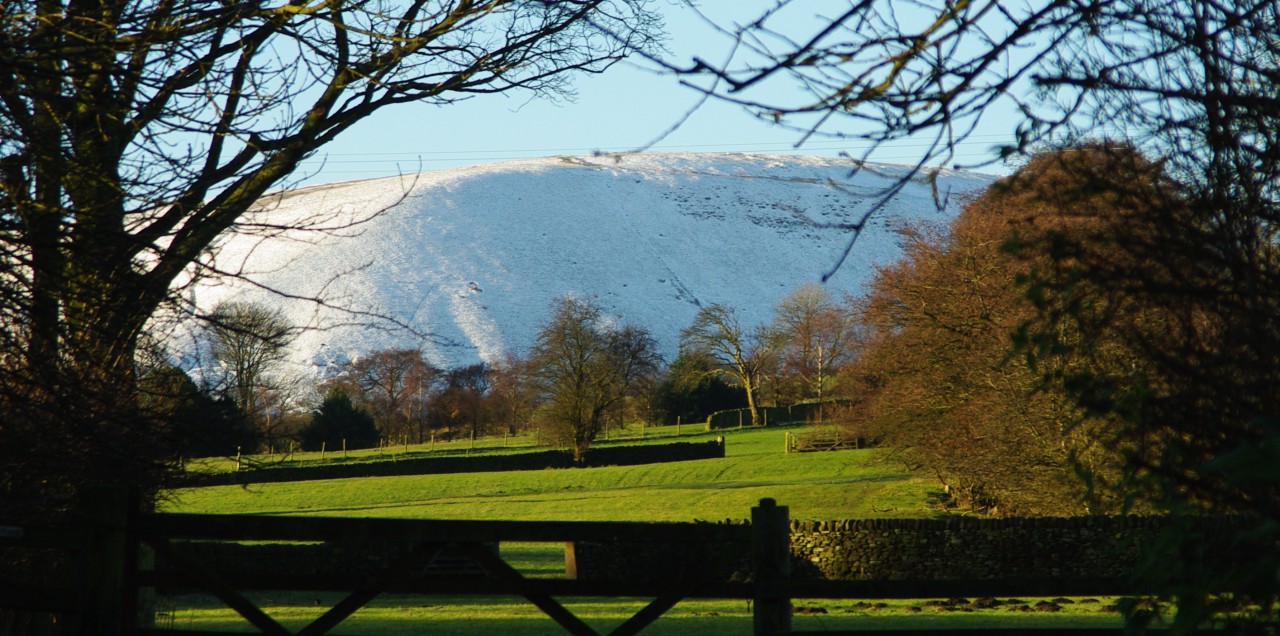
We went down to Brighton for the weekend. Staying two nights there gave us a chance to watch the starling murmurations that regularly put on amazing displays around the old pier. It also gave us the chance to get up onto the South Downs for a good walk.

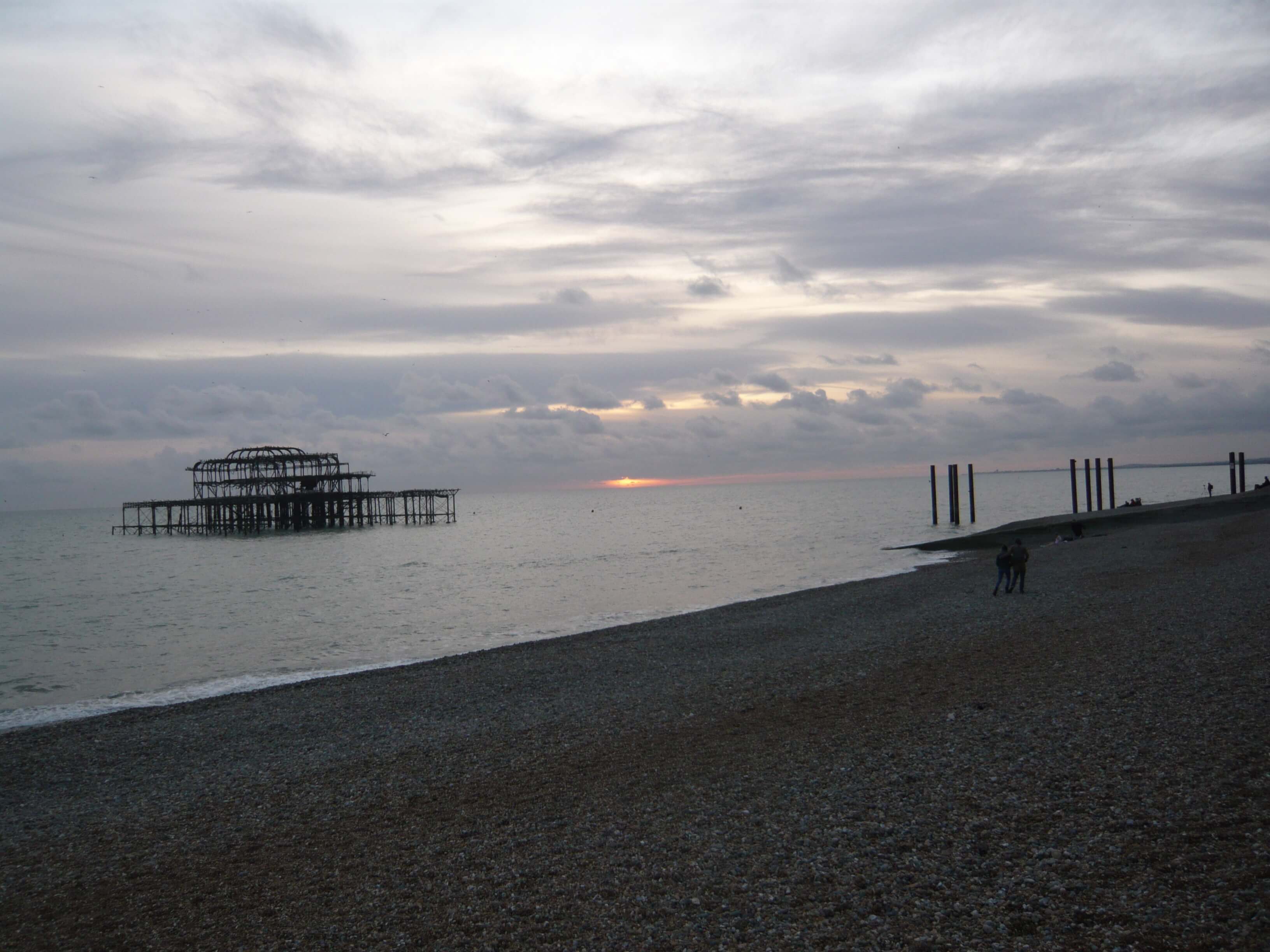
On the first evening we walked down to the seafront to await the starlings. It was a lovely sky, but with an extremely keen wind blowing in off the sea. After about half an hour our wait was rewarded with a brief but great display as the starlings whirled and dipped and soared in formation around the Old Pier. But guess who’s camera decided to stop working because of the cold? So, no murmuration photos, I’m afraid.

Next morning we caught the bus up to Ditchling Beacon. We were to walk from there to Devil’s Dyke, then catch another bus back down to Brighton. It was very cold and windy in Brighton, and all the way up gusts of wind buffeted the bus. Not a good omen. Anyway, the bus arrived at the top of the Downs and stopped. We got off the bus.

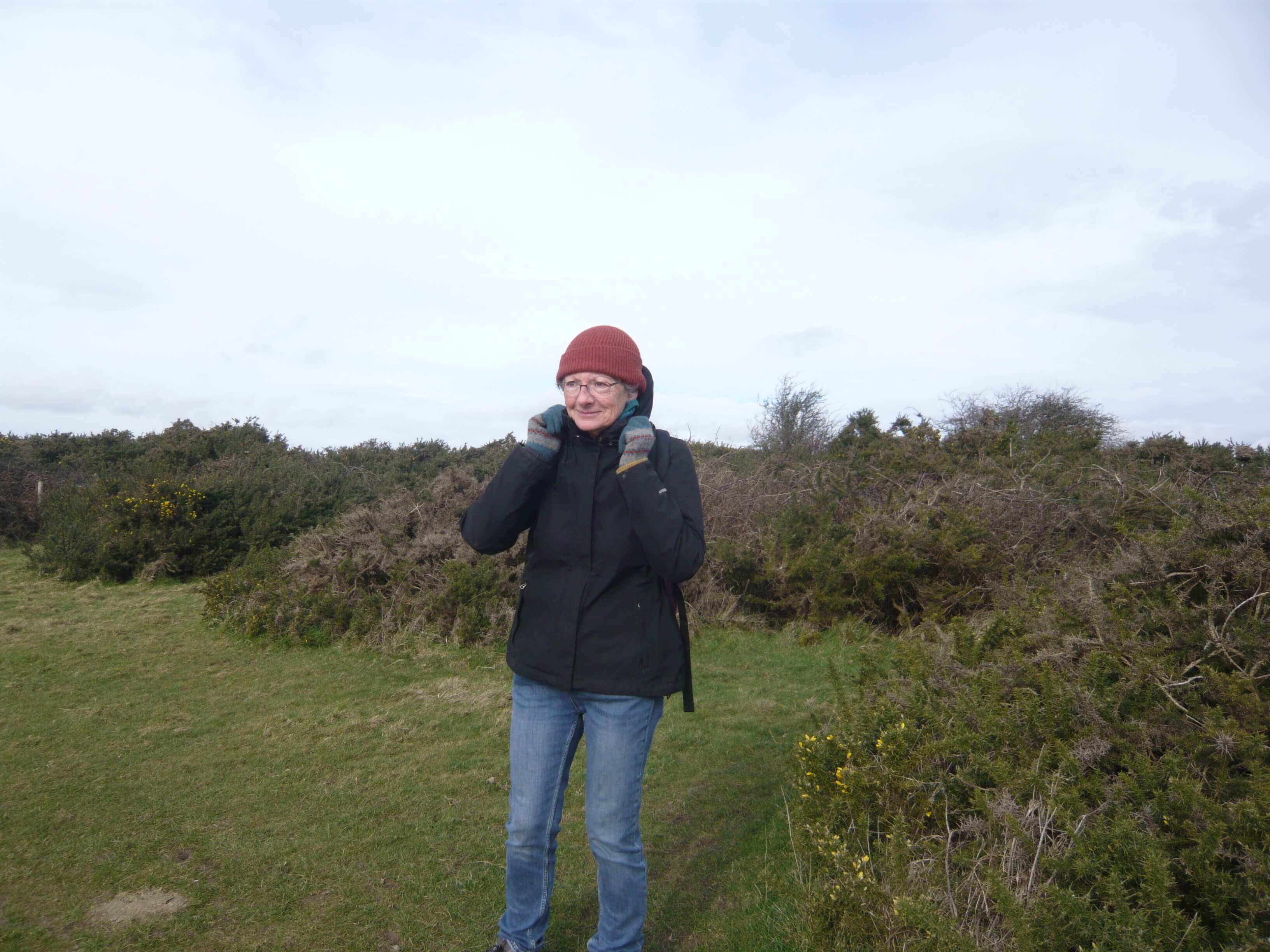
My God, it was bloody cold!

It was extremely tempting to turn around and get straight back on the bus again, but we (just) resisted it.

No, really, it’s lovely. Quite refreshing. Why do you ask?’

When we last passed this dew pond four or five years ago, the weather was deteriorating and a few wavelets wrinkled the surface, while the sky was largely blue but with a few clouds rolling in. Today the sky was greyer and waves were careering wildly across the water. Does it look cold? It was bloody cold! I may have mentioned that already.

After an hour or so, we dropped down to the village of Pyecombe and had a quick look around the lovely old church. Then the long, slow walk back up onto the Downs on the other side of the valley. At this point on our previous walk the rain had been pouring down and the clouds getting lower and lower. This time, despite the cold (I have mentioned that, haven’t I?) it was clear and sunny. And by this time, thankfully, we had warmed up somewhat.

Our route took us down a lovely sheltered holloway to another valley, where we began the final walk up to Devil’s Dyke.

By now it was sunny and despite the wind it was lovely. We felt we could have stood there and just looked at it all day. However, we had a pub with hot soup and cold beer to get to before our bus trip back down to Brighton, so we hurried on.

A Scottish Coast to Coast Walk (2)

20th June 1994

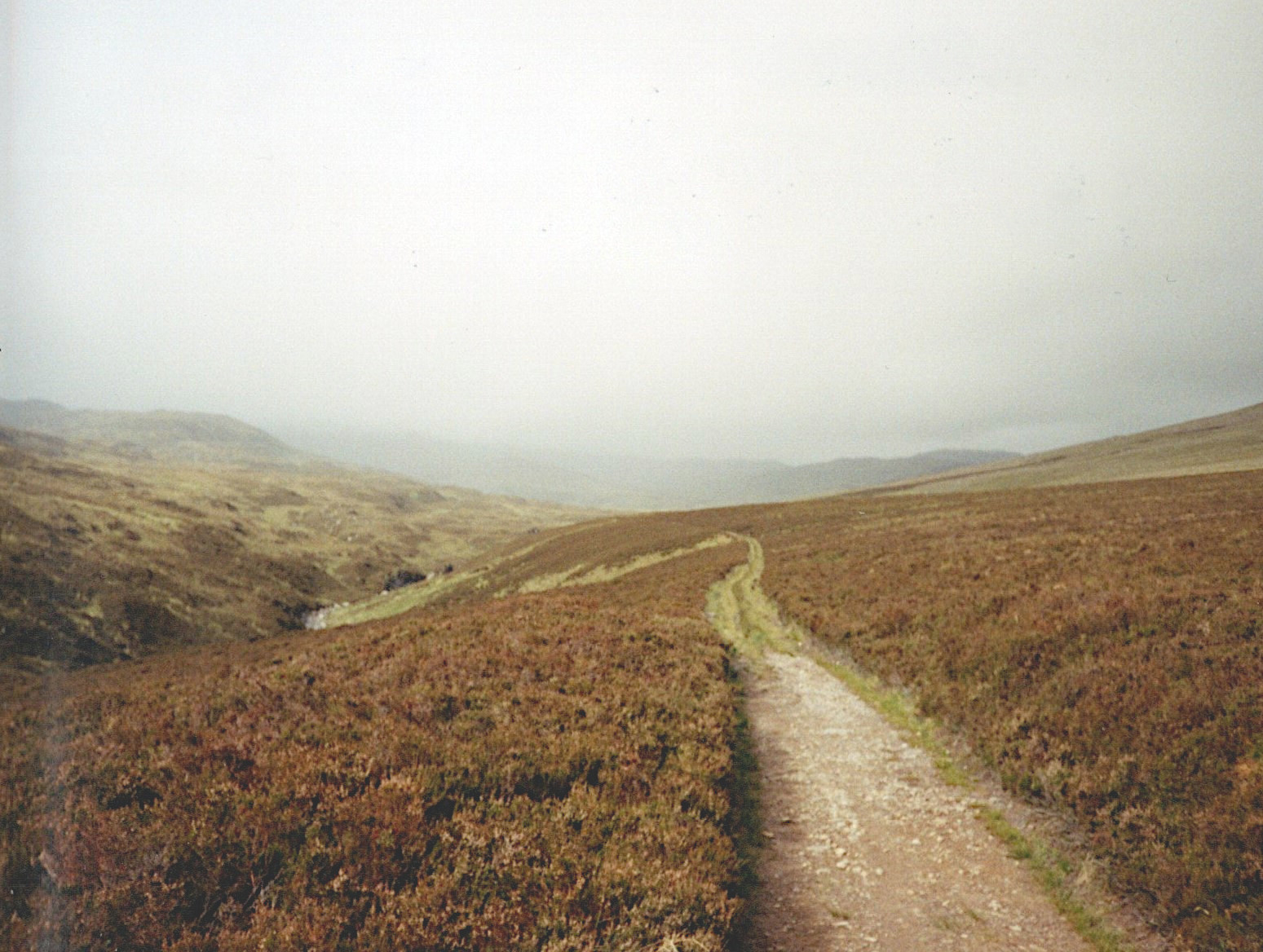
It rained during the night, but when I emerge from my bivvi in the morning it has eased to an occasional drizzle. Down the valley to the east, the sun is glittering on the trees, while the hilltops are shrouded in cloud. Cotton grass and heather dance around me in the breeze, and it is warm.

Glen Coiltie, looking west.

Through the morning, I work my way further west up Glen Coiltie, the wind slowly increasing in strength and the drizzle turning gradually to heavy rain. When I top a final ridge and begin to head down towards Loch Aslaich the wind positively howls. I plod along and gradually up onto a plateau where the path simply disappears. With the low cloud drifting across at ground level this becomes a good test of my navigational skills.

The weather worsens again. At times I stop just to retreat further into my waterproofs rather like a turtle withdrawing its head into its shell. It is a lovely landscape, desolate and wild, but just too wet and windy to enjoy, never mind even to think of taking any photos.

By the evening I am alongside Loch Beinn a Mheadhoin, after a long, wet, day. For a couple of miles I had been looking for somewhere to camp, but the path was through old pine forest and the ground was several feet deep in fallen logs and branches, all covered in moss and lichen. Eventually I find a spot near a waterfall amongst a few birches at one edge of the lake. It is a lovely spot, but I know what will await me in the morning.

21st April 1994

I unzip my bivvi and immediately a huge cloud of midges descends upon me. I forego breakfast for the moment and pack up as quickly as I can, flapping my arms around ineffectively and swearing my very bestest swears.

Not the best place to camp, beside open water with lots of tree cover

Soon enough, though, I am away from the water and ahead of me snowy peaks rear up above the trees. The thrill is upon me again! As I walk through the morning, the clouds are lowering and thickening again, but for now the rain holds off, for which I am thankful. It had been so wet the previous day the rain had managed to soak everything inside my rucksack. During the night I had gradually brought maps and clothes into my sleeping bag for my body heat to dry out. By the morning probably about half of it was dry.

It is colder than yesterday. The snowline looks to be lower here; I am at about three hundred meters and there are pockets of snow level with me on the mountains nearby. But with the improved weather as well as the scenery, my mood is much better and I am enjoying just being part of the environment. It reminds me of other walks and treks I have done – I keep thinking of Nepal! – and in this mood the miles seem to melt away as I walk. The previous day, at one point I had managed less than five miles in three hours up on the plateau in the atrocious weather, so this day is a huge improvement.

The Five Sisters in the distance and Creag a Chaorainn on the right,

I follow a river for a while, and where the water is moving slowly I can really appreciate how beautifully crystal clear it is, even though it has a deep brown hue from the peat. There are tiny orchids in the grass, although I don’t know their name, but few other flowers just here.

An Tudair on the left and Sgurr na Lapaich on the right

And now I pass a couple of walkers and we stop for a brief chat. These are the first people I have seen since leaving Inverness and although yesterday the weather was so bad that only idiots would have been out in it (or one idiot, anyway), in a world of five and a half billion people, to spend a whole day travelling without seeing another soul from dawn to dusk is an increasing rarity.

River Affric near Athnamulloch. The sheep track is so worn it has almost become a tunnel.

I stop for an early lunch and then soon after I set off again I find the path disappears in a particularly boggy area and, predictably, it begins to rain. I take a compass bearing and step forward cautiously. Half a kilometre later I find the path again and the rain stops. Now I go uphill again, over the Eionngleann (lots of these names sound as though they come from Lord of the Rings), down into a long valley where the weather comes in again, and down to the village of Carn-gorm. The village sits at the head of Loch Duich, which joins Loch Aish and this opens up to the Atlantic Ocean. I’m definitely in Western Scotland now. Now to see if there’s anywhere in the village to get a pizza or something more interesting than what’s left in my rucksack.

Eionngleann
Looking North West down Gleann Lichd, my route down to Carn-gorm

Review of Wilding by Isabella Tree

I wrote this just over a month ago, and never got around to posting it, for some reason.

91wfR0v1kNL._AC_UY218_ML3_

I have just finished reading Wilding, and I am almost overwhelmed with several feelings. The first is that I need to come back to this book after a month or two and re-read it, since there is just so much to take in. The second is that this book presents so much information that appears new to us in the twenty first century, yet was common knowledge some fifty to a hundred years ago and was hiding all the while in plain sight, as well as some new conclusions that were also, really, hiding in plain sight. And third, a feeling this might just be one of the most important books I have ever read.

This means I am attempting what appears to be ridiculous, and that is to review a book I don’t think I am yet ready to fully appreciate. But first impressions count for a lot, so here goes, although to keep this brief enough for one blog post, I can hardly even skim the surface.

Knepp is an estate in Sussex, England, which the author and her husband farmed for many years the way most farming is done nowadays – intensively. But as returns gradually diminished and the soil became more and more degraded despite the application of the usual chemical cocktails, they decided in desperation to take a leap of faith and re-wild part of the farm. The reasoning was they were going broke farming traditionally, so something new was needed – perhaps something revolutionary. What had they got to lose?

It was a huge learning curve for them, and many of the steps they took had unforeseen consequences. By allowing the land to revert to the condition it would have been in thousands of years ago, they discovered that many of our birds and insects, for example, actually favour environments and foods different to those we have assumed they do. Interestingly, on reading books written a hundred years or so ago about, for example, birds, they were simply rediscovering what was known then, but overlooked since. Just one example – pigeons do not actually prefer the seeds of cereal crops, but wild grass seed. The fact that they eat so much cereal seed today is due to the destruction of the areas of wild grass they would gave grazed before.

Probably the most important conclusion to take from this book is that a return to a more traditional, environmentally-friendly form of farming is not only better for the environment, but in the long term is even better for farmers who might be initially worried about losing out financially. It’s a win-win situation in that it would enable much wildlife to recover from its precarious, endangered, situation, it would reduce the risk of flooding during periods of heavy rainfall, restore soil fertility without pumping massive loads of chemicals onto the land and, consequently, into the water systems, and reward farmers with not only a better environment but healthier crops and stock which, in turn, would be healthier and more nutritious for the consumer.

Along with most others, I have always understood that back in the Neolithic period, when man was first making his mark upon the landscape in what would become Britain, most of the land was covered in thick, dense, woodland. I also understood that the large wildlife here – the megafauna – consisted of the likes of elk, cattle (aurochs), wild horse, mammoth and the such-like. Basically the kind of large animals that graze and browse the open, lightly wooded, grasslands of the African savanna today. Could we really not see the contradiction in this? This strongly suggests that the natural post-glacial vegetation of the British Isles was an open woodland, rich in undergrowth and grass, maintained by the regular grazing and browsing of this megafauna.

And from that, we understand that much of the habitat association we make today with our native wildlife is just plain wrong – we see birds and animals favouring a particular habitat and assume that is their preference, rather than understanding we have forced them into this by removing their real preferred ones.

There is so much to take in and think about in the this book, as I said at the beginning of this post, that a single review can only begin to hint at the mass of information to take in.

If you have any interest at all in our environment and what we have done to it, this book is an essential read.

In Praise Of Trees

It has been mind-buggeringly hot and humid for most of the last week, breaking records for mind-buggeringly hot heat here in the UK. But now, with heavy rain and gloom and a delicious green light filling the kitchen from the trees and bushes outside in the garden, it not only feels refreshingly cooler but looks it, too.

During this last week, almost the only way I could bear to be outside at all, was sitting on our lawn in the shade of the gorgeous hazel tree that dominates the garden.

005a

In so many countries, trees are planted to provide shade whether it be for travellers, or for residents in towns and villages or city squares.

They understand the value of the shade the trees provide in hotter climates, but in the UK we, and by that I mean governments and entrepreneurs and business people, we seem to be obsessed with cutting down trees, almost for the sake of it.

012a

Yet we can no longer pretend we have no idea how vital trees are; for us, for the ecosystem, for the planet. We need them to remove the carbon from the air and to replenish oxygen. They are habitats for huge numbers of wildlife. Their roots help bind and provide stability to the soil, preventing erosion, landslides, and the spread of deserts. Where they exist in sufficiently large numbers the water vapour they give off helps to bring down local temperatures and increase rainfall.

067a

They are sources of food for animals and for people, and for thousands of years their wood has been used for building dwellings, making furniture and utensils, fencing, tools, boats and wagons, and as a beautiful raw material for artworks.

And they soothe the soul!

Used intelligently and sustainably, they will continue to perform this role for as long as we wish.

001a

Yet despite all we now know, we continue to cut down trees at a ridiculous rate. In Brazil, we are losing rainforest now the size of three football fields per minute! The rainforest in Indonesia is also being cut down at a rapid rate. The HS2 rail link planned for the UK will cost a stupid amount of money and destroy massive amounts of woodland, just to take a little time off rail journeys that already happen.

IMG_0018a

Yet there are many smaller – petty – instances of trees being cut down that amount to official vandalism, no less. I feel particularly strongly that in many towns in the UK it has long been the policy that when trees planted along streets have become larger than the council thinks appropriate, they cut them down but rarely if ever replace them with new, younger, ones.

The call to re-wild areas of the UK is growing, and I feel we should now be devoting as much land as possible to the creation of new woodland, as well as re-planting hedgerows to replace fences, and individual trees in gardens and parks and along roads.

And stop cutting them down!

Spain 1

I’ve been to Spain a dozen or so times, although I’ve never posted about it before.

I’ve been there as a tourist / traveller – the words are interchangeable, and where one stops and the other begins is very much a matter of personal taste. Some travellers would be highly offended if you referred to them as tourists, yet the Oxford dictionary defines a tourist as a person who makes a tour, a traveller, esp. for recreation. It is a snob thing, really. Many travellers like to think of themselves as being too serious to be a mere tourist. Perhaps it has a lot to do with that word tour, with the inference it is an organised thing, probably by a travel company, and probably full of holiday-makers who need to be guided around these awkward foreign places and told what to see and do. A Package Tour, perhaps. And so also that word recreation.

And I can be as guilty of that snobbish attitude as the next traveller. I can think of a number of times when I’ve been travelling and said ‘I’m just going to be a tourist, today‘, when I’ve felt like a day just wandering around a place and taking photographs and sitting in cafes.

Mea culpa.

I’ve also had the pleasure of going to Spain numerous times as an instructor with a group, and spending a week taking people canoeing, walking and climbing. So, all that and getting paid for it, too. Pretty fortunate, actually.

If you have ever read the book As I walked out one midsummer morning by Laurie Lee, which is the follow-up book to Cider with Rosie, you will know it is the record of his journey on foot through Spain in the 1930’s, just before the outbreak of the Spanish Civil War. It is a truly marvellous book, and well worth anyone’s time reading it, but I mention it only because I wanted to do something like that, and so my second visit to Spain was to spend a couple of weeks walking in the hills and mountains in the South of the country.

I flew into Malaga, I walked out of Malaga.

Heading north, the walker quickly gets into the foothills of the Sierra Nevada, the mountain chain that extends for a couple of hundred miles parallel to the south coast of Spain. And for the best part of the next two weeks I worked my way first Eastwards, and then Westwards back to Malaga, avoiding roads wherever possible. I slept each night on a hillside, or in the corner of a field, or anywhere else convenient where I could lay out my sleeping bag away from town or village.

img20190318_12020089

img20190318_12030670

As a journey, it was not without its difficulties – finding water was frequently a problem. Passing through villages there would inevitably be a tap somewhere I could fill up my bottles (and myself; I rapidly learned the thing to do was to drink as much as I possibly could when I found a water supply!), but away from any habitation it was a lot harder. Many water courses had dried up and I had to take every opportunity to fill up.

img20190318_12103098

img20190318_12092043

But as a way of seeing the Spain that few casual visitors see, it was unrivalled.

img20190318_12045312

When the Arabs conquered part of Spain in the early part of the eighth century, they created water courses known as Falaj (which can still be seen in use in many countries such as Oman and Iran) to channel water over long distances. This one is still in use now in the Sierra Nevada.

img20190318_12075705

Morning View…

img20190318_12111452

…and a dusk photo at one of my wild camps. 

Mr. Stupid Goes For a Walk

I have been posting a bit about walking, recently, what with my frustration at being unable to do a great deal of it after my foot operation.

Foolishly, I made reference to the following episode in a reply to someone on one of the ‘walking’ posts, and admitted I might write about it sometime. Well, take this as a Warning From Someone Who Learned The Hard Way.

Thirty years ago I lived and worked in Oman. I was a seismologist, working on seismic data for an oil exploration company – but before you all shout at me, my conscience is clear. I don’t think I was particularly good at it, and I don’t think my efforts contributed to anyone finding any oil.

*phew!*

I do worry that as a result of this post, though, someone will now contact me and say ‘Hello, Mick. I was a geophysicist in Muscat when you were there, and I remember that one of the projects you worked on found absolutely stonking amounts of oil!’ But I doubt it.

Anyway, let me set the scene.

I lived near Muscat, the capital, which lies on the north coast of Oman. Behind me, towards the interior, ran a line of high hills

It is a massive simplification, but just at this point the hills run east to west, parallel with the coast, and consist of a series of ridges (jebels) and valleys (wadis). So to cross them from north to south (or in the opposite direction) the traveller has to continually climb up and down for the entire journey.

IMG_0005

I bet you can already see where this is going.

When I had a few free hours, I would often walk out of my house, and up into the hills to just wander around and explore. As a result of this, I knew the first couple of wadis and jebels pretty well. There was a high, prominent jebel to the south, though, which was the final ridge before the land fell away to a wide stony plain, and I had never gone that far on foot up till then. This ridge was easy to spot, however, as there was a large microwave (radio) transmitter on top, and I knew it was the final ridge as we would often drive past it on the south side.

I had a day off.

I don’t know exactly what time of year it was, but it must have been in the ‘cooler’ season, because even I wouldn’t have been stupid enough to try when it was really hot.

Surely?

I didn’t even have a proper rucksack, I had a small roll-bag, which I slung uncomfortably over my shoulder. Inside, I had a single bottle of water, and a dozen small packaged juice drinks. I had a compass, but no map. I had a hat, I had a camera.

So, well-equipped and well-prepared, I set off.

The first couple of hours went well. I crossed two or three ridges and felt fine. I guess I should say at this point, that I was pretty fit. The project probably wasn’t an unreasonable one, by any means.

Certainly not for someone with the right equipment and supplies.

IMG_0008

I was probably just beginning to feel a bit hot and tired when I crested what I thought would be the penultimate ridge, only to find I was looking down on another two smaller ridges that I still had to cross before reaching the final large one.

And the large one was looking very large indeed!

I can be ridiculously, unreasonably, stubborn, at times. I remember that on the final ascent I had to force my legs to bend and stretch, to take each step, but the top was getting nearer and nearer and I wasn’t going to give in.

I made it.

IMG_0007

I enjoyed the view and the moment. It was, admittedly, very impressive and I knew I’d done pretty well to get there.

And really, all I needed to do then was to carry on down the south side of the ridge, walk another kilometre or two to the road I mentioned earlier, and hitch a lift back to Muscat.

IMG_0006

Have I mentioned I can be unreasonably stubborn?

I turned around and started heading down the north side towards home.

I could draw this out into a long dramatic story of my walk, but I’ll give you the abbreviated version.

I found I was in difficulty as soon as I had to go up the next hill. especially as I had finished all my drinks by then.

It took me several hours and more energy than I realised I had at one point, just to get to the final ridge. But at that point, I knew I no longer had the energy or strength for that last climb. I could not do it. Fortunately for me, I knew I could follow the valley for a mile or two east, where it would come out to the coast plain. So I turned and stumbled that way. By now, I was desperate to find some sort of shade, just for a moment, but there was nothing.

But I staggered along, and as the hills either side dropped down, I came to a cluster of buildings. I don’t know what exactly they were, but I staggered in through a doorway and an Indian working there took one look at me, sat me down and brought me water.

‘Slowly!’ I remember him saying, as I poured it down my throat. ‘Not good to drink too quick!’

I didn’t care. I drank it like a camel on steroids given twenty seconds to fill up. I got through an awful lot of water, but he made me sit and rest for a while before I went off again. I think he offered me food, which I refused, and I think he offered to find someone to drive me, but I don’t really remember too much from that point on. I did walk home eventually, though. I just hope I thanked him sufficiently.

It was not one of my more intelligent adventures.