He’s Big, He’s Bad, He’s Very, Very, Bad

I wrote this four or five years ago, but having name-checked nursery rhymes, folk songs, folklore and the like over the past few weeks, now seemed like a good time to post it.

The BBW

or He’s big, he’s bad, he’s very, very, bad

That Big Bad Wolf – it now appears

We’ve had it wrong for all these years.

You know the way the story goes

He dresses up in grandma’s clothes

After he’s had her for his lunch

(they make much play of how he’d crunch

Her up and then he’d gulp her down,

Then put on sleeping cap and gown,

Get into bed, pretend to sleep,

I’m sure he never counted sheep!)

Then in comes young Red Riding Hood,

Who travels blithely through the wood,

So innocent – without a care,

Apparently, she’s not aware

It’s full of perils – hungry wolves

Who dress up in old women’s clothes

To name but one – there’s more, no doubt.

But any one would catch her out.

She’s pretty thick, it must be said,

She sees a big bad wolf in bed

Instead of being cross and furious

She stands there looking vaguely curious

Says ‘What big eyes you’ve got today.’

Is that all she can think to say?

Big eyes? Big eyes? Well, what about

The pointed ears, the great long snout,

Did she not have the slightest thought

This might not be the one who ought

To welcome her to Primrose cottage,

That frail old woman in her dotage?

And what about – ah yes, the teeth.

You knew we’d get around to teeth

Before too long – I think you’d say

About the pearlies on display

It would not take much of a guess

To know that they weren’t NHS.

And so back to that gormless youth

Who stands there staring at the wolf

With no great wonder or surprise

Except to say he had BIG EYES!

And now I wonder more and more

If she had seen her gran before.

Now, if it was left up to me

I’d let the wolf have her for tea.

Just eat her up and finish there.

Although that just might be unfair

Perhaps the girl had poor eyesight,

That’s why she never quite took flight.

I hear it now, a low voice quavers,

‘She should have gone to Specsavers!’

But let’s just leave all that for now,

I hinted some way back just how

This story has become perverted,

The happenings have been inverted.

The emphasis on Riding Hood

When actually I think it should

Be focused more upon the roles

The wolf was playing with the clothes.

We’ve never paid it much attention,

Because it only gets a mention

As a ploy to fool the brat.

I think there’s more to it than that.

The clues were there, before our eyes

It isn’t much of a surprise.

The women’s clothes, the wolf, the bed,

The things that story left unsaid.

The true events I’ll tell you now,

A charming little tale of how

A handsome wolf had searched worldwide

For love (or something on the side).

A simple tale in many ways

It tells how he had passed his days.

He’d been with several little pigs,

And tried some other casual gigs,

But nothing seemed to satisfy

He needed something else to try.

He heard how in the Big Wild Wood

The father of Red Riding Hood

A widowed man, still lithe and strong,

Was also searching for someone.

(The woodland folk had seen his chopper

And word was it was quite a whopper!)

His mind made up, he hatched a plan

To win this handsome, big strong man.

You know the rest, or at least some,

A perfumed letter asking him to come.

A rendezvous deep in the woods,

Where he could view some tempting goods

He might find pleasing. The next day

The wolf, now nervous, in bed lay.

He wondered should he have done more,

But then a knock upon the door.

He held his breath, the door swung wide,

The woodman slowly came inside.

Cue clapping hands and smiles and laughter –

They both lived happily ever after!

At The Hop

I was talking about hop pockets and pokes last week – and pigs, of course, which was how it all started, but forget the pigs for now. Let’s stick with the pokes and pockets. At the weekend we went for a walk through a part of Kent we hadn’t walked for a few years and part of the walk took us through this field:

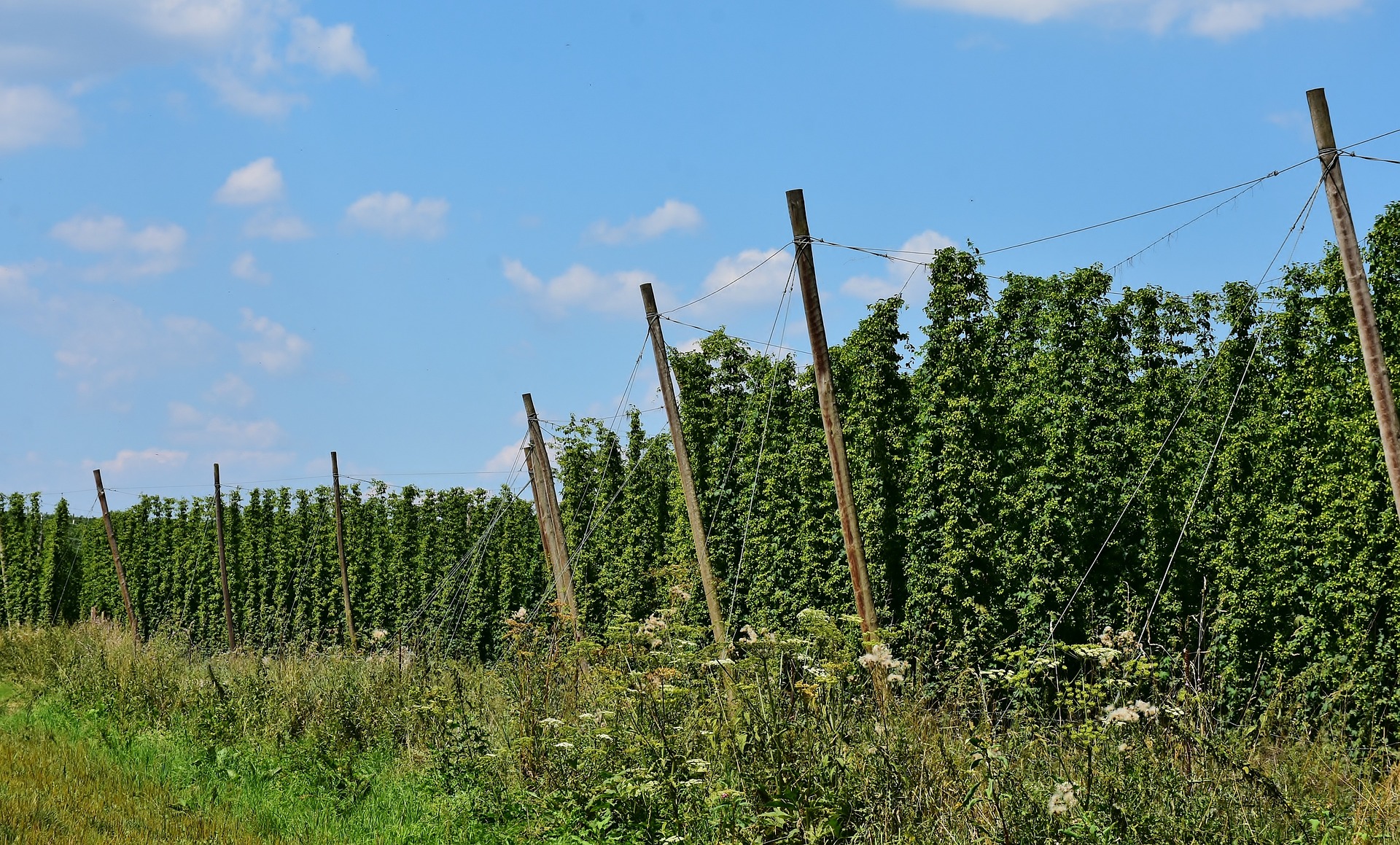
This was a hop garden many years ago. Conveniently close to the oast houses so that as soon as the hops were picked they could be taken in and dried before there was any chance of them spoiling. Taken in bagged up in pokes, and once dried shipped out to the brewers in pockets. A word of explanation for those not familiar with these terms: hops are not grown in fields, they are grown in gardens. Not like your or my back garden, but like a field. But a field full of poles. Hop poles. With huge cable-like wires strung between them to support the hop bines as they grow.

When they are ready for harvesting, the bines are pulled down and the hops picked and put in pokes – large sacks (but you knew that, of course. You remembered it from last week). Then once dried they are shovelled into pockets – another size of sack.

And what are the hops for? Making beer, my friend. Lovely beer.

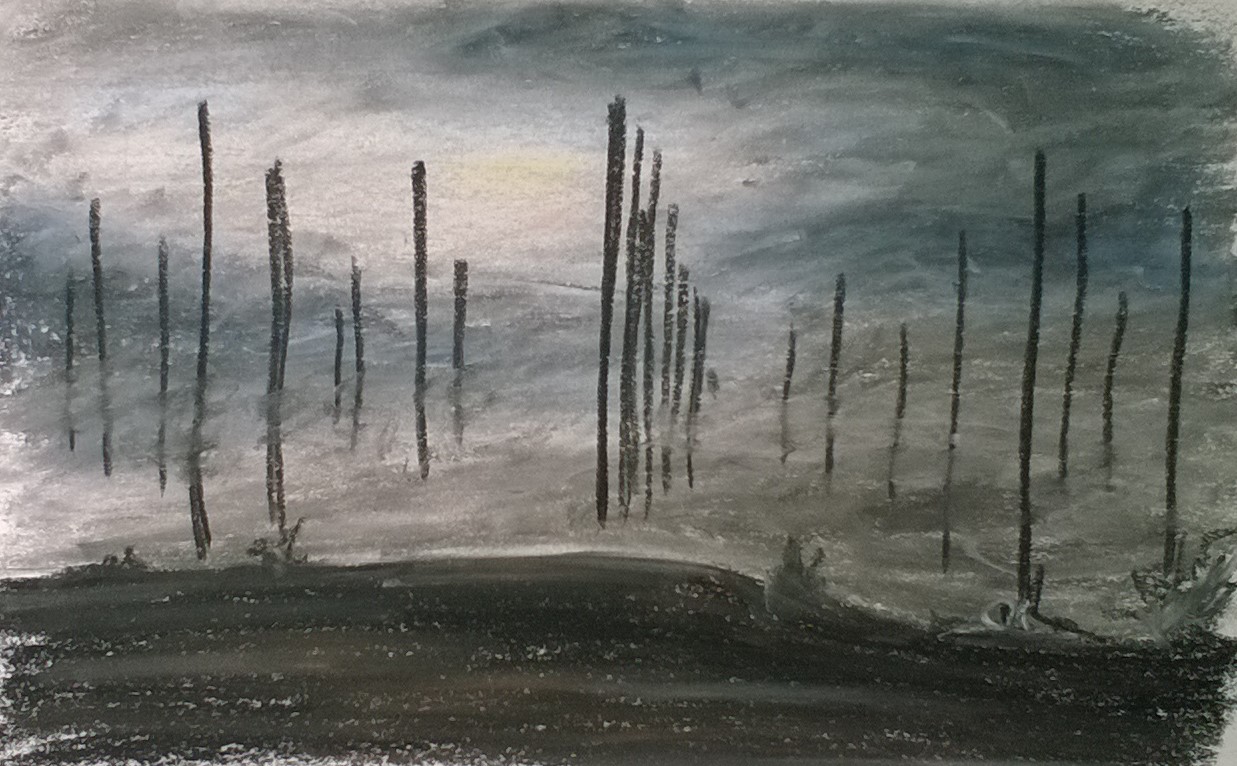
I don’t have a picture of the hop garden from back then, but late one cold, misty, autumn night about thirty years ago, I walked through it and the eeriness was instantly imprinted on me and once I was home I felt compelled to make an oil pastel painting of it (below).

Anyway, as I said I don’t have a photo of the hop garden in question, but this one from Pixabay illustrates very nicely the hop poles and wires with the growing hop bines growing up and across them:

Image by -Rita-👩‍🍳 und 📷 mit ❤ from Pixabay

The poles were supported by wires kept under tension, anchored into the ground around the edge of the garden. Quite a few of these are still in situ around the very edge of the field and just into the woodland and hedgerows bordering it.

In 1872, there were 72,000 acres of land in England growing hops, the majority of these being in Kent, employing over 100,000 seasonal workers at picking time. By 2003, the acreage in Kent was down to just over 1,000 and for the first time ever the county had been overtaken by Herefordshire, which now grew more, although the decline does at least appear to have halted for now. In 2011 there were a total of just over 2,500 acres under cultivation in England but it is such a small number there were fears the industry could die out. Although hops are still used in beer brewing, much of the requirement is imported, especially with a popular shift towards less bitter-tasting beers. But in much the same way that Kent has also lost a huge percentage of its apple orchards, a once rich and diverse farming landscape has become more and more homogenised, with endless huge fields of arable crops and sheep and cattle replacing the hop bines and apple trees.

I spent one autumn apple picking around thirty years ago and the farm I was working on had a large acreage of hop gardens (both apples and hops all sadly gone, now). It was an incredibly busy and bustling time, with our diverse group apple picking – a mixture of locals and Europeans come over for the work – and a traditional mix of workers in the hop gardens; as well as locals, there were a lot of gypsies and possibly still a few people down from London’s East End, which was a traditional way for those workers to make some extra money in the nineteenth and early twentieth centuries. It was busy, noisy, very hard work, and a lot of fun.

And, not surprisingly, there are a number of traditional songs about hop picking. So here is the wonderful Shirley Collins and the Albion Dance Band to perform ‘Hopping down in Kent’ especially for you.

A Pig In A Pocket

Most people know the meaning of the saying to buy a pig in a poke, of course. It means to buy something without first checking you’re getting what you think you’re paying for. And where does the saying originate? Again, most people can tell you it comes from a few hundred years ago – actually the Middle Ages – when a buyer at a market might be offered a piglet in a sack and if they were foolish enough to buy it without first checking the contents, were likely to find later that the sack contained only a cat, although why it didn’t make a fuss and let people know it was a cat, and a cat that really didn’t want to be in this dratted sack, no one is saying.

(And was it actually a live cat or a dead one? Over to schrodinger for that one…)

If the buyer was wise enough to check, and opened the bag to see what was within, they would then be letting the cat out of the bag.

So, what is a ‘poke’, then? Let’s take the long route to this one, the scenic route… Go back a couple of hundred years when pockets weren’t something let into our clothes, but were more like cloth bags tied around the waist. A kind of medieval bumbag, if you will. Or just a bag on a piece of string tied around the waist if you won’t. This is why in the nursery rhyme we learn that:

‘Lucy Lockett lost her pocket,

Kitty Fisher found it;

Nothing in it, nothing in it,

But the binding round it.

which sounds very odd if you think only of what we understand as pockets nowadays and must confuse huge numbers of children when they hear it.

But the point is that the pocket was a bag, which in French is ‘poche‘ and from which comes the old English word for a large bag, a sack, which is ‘poke‘, with pocket being a diminutive of that: poke-et.

So, let’s back up there. A poke is a large bag, a sack. As mentioned above, I’ve seen dictionaries citing ‘poche‘ as the origin of the word, but a favourite source of mine, a Victorian dictionary of Sussex dialect, when discussing the saying cites the original Anglo Saxon word Pocca, meaning a pouch.

They’re probably both right.

But just to add a little more weight to all this, when hops are picked (at least in Kent and Sussex) they are first measured by the tallyman into a poke (yes, a large sack), then taken to an oast house where they are dried, after which they are shovelled into a hop pocket (a different sized sack) before being taken off for sale to the brewer.

To make lots of lovely beer!

Red Herrings

I had a couple of conversations the other day on detective novels, in which red herrings were mentioned, and it reminded me of something I had been reading a few days before, as well as one verse of an old nursery rhyme, the words recorded in the 1800’s, which goes thus:

The man in the wilderness asked of me
How many strawberries grew in the sea.
I answered him, as I thought good,
As many as red herrings grew in the wood.

Pixabay image

It is supposedly one of the lesser-known nursery rhymes, but I came across it in one of the books my children had when they were small. Possibly, the Tale of Squirrel Nutkin. Again, there is an old song occurring along the English east coast called the Red Herring, of which these are the first two verses:

1
What shall we do with the red herring’s head?
Oh, we’ll make that into feather beds, and all such things,
We’ve red herrings and heads and feather beds, and all such things.

Chorus
Of all the fish that swim in the sea, red herring it is the fish for me,
And all such things.

2
What shall we do with the red herring’s eyes?
Oh, we’ll make ’em into puddings and pies, and all such things,
We’ve red herrings and eyes and puddings and pies,
Red herrings and heads and feather beds, and all such things.

There seem to be many versions of this, one of which was collected by Cecil Sharp, well-known as one of the first people to travel around England in the early 1900’s collecting and writing down folk songs, afraid they would become lost as, in a rapidly modernising world, fewer and fewer people now sang them.

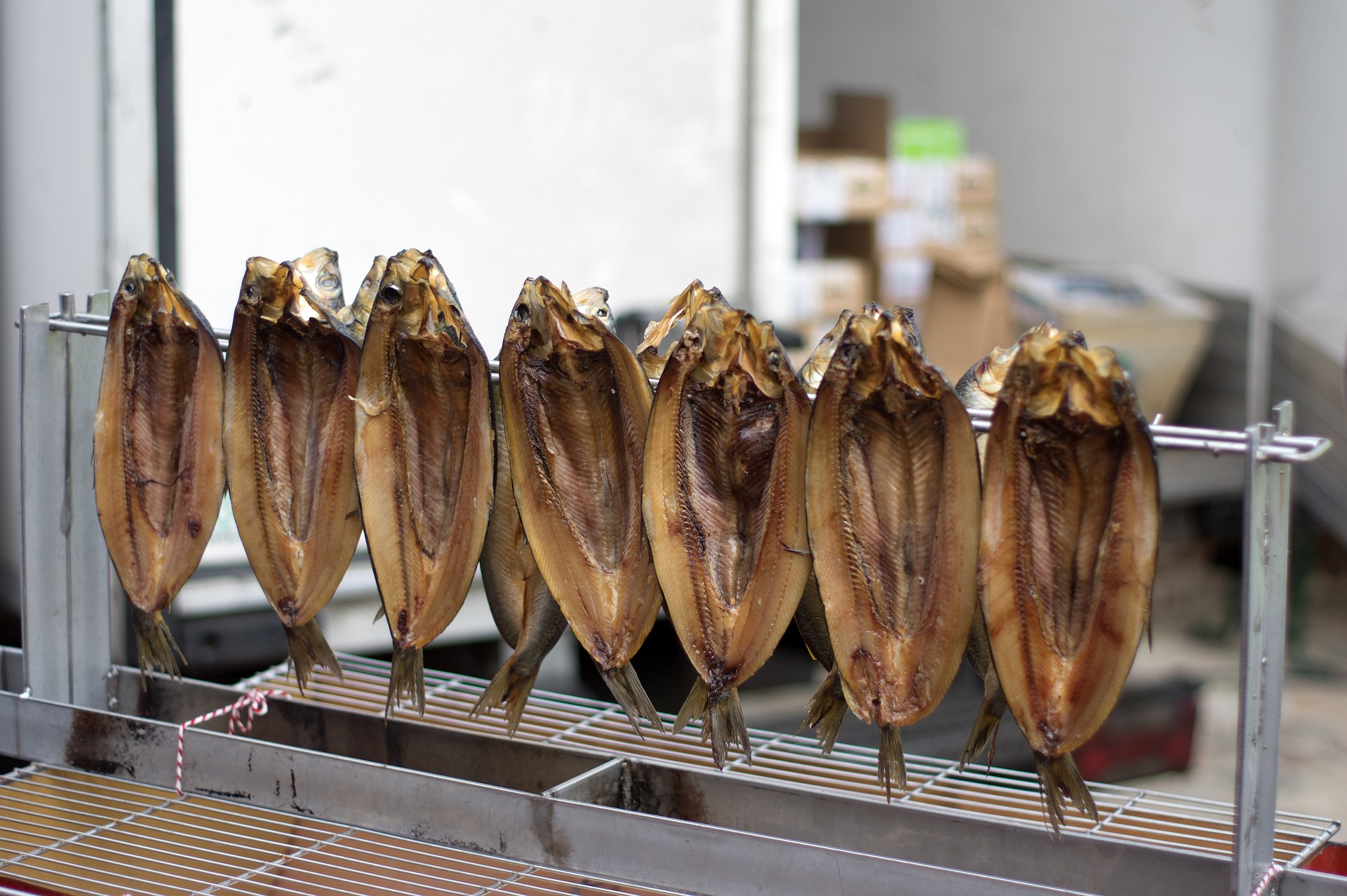
Unusually (because I never trust it as a source) I looked at Wikipedia which merely defined a red herring as a distraction, or something misleading. It suggests the term came from a strong smelling smoked kipper which could be dragged across a track to put hounds off of a scent.

And what it reminded me of was that a dictionary of the Sussex Dialect, published in 1875 does not have a particular entry for red herring, yet under ‘White-Herring’ is found the definition: A fresh herring, as distinguished from a dried one, which is called a red-herring. Delving a little deeper, we find references to dried, smoked, herrings – named red herrings – in use to mask the scent of trails both literally and figuratively, in a story published by William Cobbett in 1807 and also a couple of references from the 1780’s. There is apparently a bit of disagreement over where the phrase was used first in that context, but that doesn’t seem relevant here, it’s just interesting to find out that red herrings actually exist, and how they came to assume the role they have in literature and everyday conversation.