My Great Grandfather moved from rural Hampshire to London sometime in the late 1870’s, during the course of which he changed his surname first from Prater to Cannon, and then to Canning. We don’t know the reason why, but I suspect a family rift of some sort. Whatever the reason, from that point onwards our family were Cannings, rather than Praters.
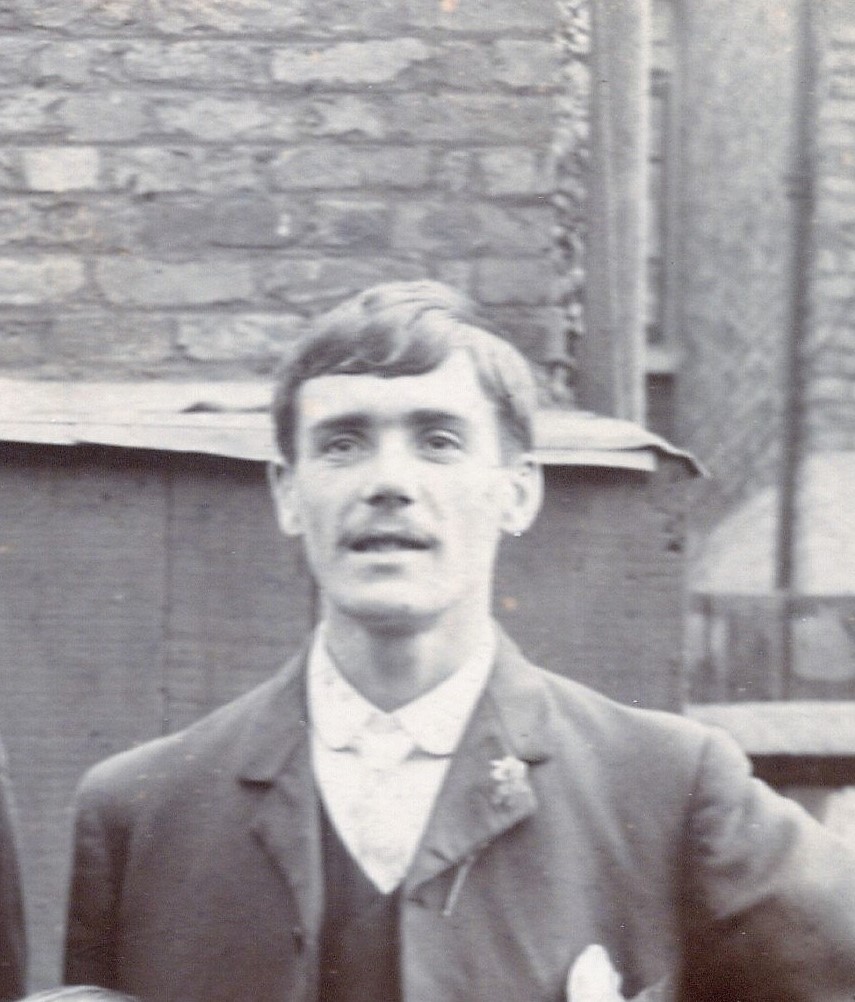
Great Grandad pictured in 1904 in East Ham, London.
So really, my name should be Mick Prater.
But it isn’t.
Does it matter? In any way at all?
Of course it doesn’t.
And this, I think, illustrates the absurdity of those – primarily men – who think it is of paramount importance that the family name is continued. I know this supposedly gives a kind of spurious immortality to family members but, really, it’s a nonsense.
 Mick Canning
I never understood the keep the family name going thing…
LikeLiked by 1 person
No. And I’m sure it’s a mainly male thing.
LikeLiked by 1 person
Baffles me too.
LikeLiked by 1 person
Strange, isn’t it?
LikeLike
Short and to the point expression of insight, Mick. Plus with the support of personal ‘source’ material – yourself.
I can’t help but think of how this reminds me of ‘coming to America’ to start a new life (and in many cases surname – our family’s one of those) only in ‘reverse’. Your family was already in America – but the need to start anew was deeply rooted.
What’s in a name, indeed!
LikeLiked by 1 person
This is in England, Laura, but what you said still applies. So many people moved from the country to the cities and towns during the Industrial revolution and just after it, indeed to start a new life. And yes, changing his name might just have been part of that,
LikeLiked by 1 person
Oh my bad! I read it as ‘New’ Hampshire…I’m so sorry for the wrongful assumption, clearly glaringly Americentric.
😦
LikeLiked by 1 person
No worries! I can be equally guilty of being Anglocentric at times.
LikeLiked by 1 person
I agree that family names are of little importance, Mick. Nonetheless, I kept my family name when I got married. My husband has a difficult to spell and difficult to pronounce name–so he uses mine more than his own.
LikeLiked by 1 person
Well, that’s practical, Donna. And then there’s the whole ‘take-your-name-or-keep-my-name’ that comes up in marriage, which I’m pointedly not going into here!
LikeLiked by 1 person
When my Norse ancestors migrated to this country their names were changed: Nilson became Nelson and Vaaxland became Foxland. So … an awfully lot of people in this country are not carrying on their true family names!
LikeLiked by 1 person
I’m sure it must happen a lot, in various ways.
LikeLike
I have mixed feelings about family names, Mick. During my family’s history, surnames were often changed because my ancestors were fleeing their home countries. My father’s parents were initially called Freudman. However, they had to flee their home in Poland in WW2, and that name was a Jewish name, which put them more at risk. It was then changed to Freeman. When they settled in the UK, the name was changed again (not sure why) to Thompson, which I grew up with. When I married, I became Ellie Lane, which I never liked, but then, I wasn’t too keen on my now ex-husband either! As soon as we divorced, I returned to my maiden name, Ellie Thompson, and I have every intention of staying with that, as I have absolutely zero desire to marry again! But that’s another story for another day. X
LikeLiked by 1 person
A totally different kettle of fish when names carry loaded messages, and certainly a good reason why some might change them. I think women are likely to view the subject a little differently to men, too, since traditionally they would change their names on marriage and take their husband’s.
LikeLiked by 1 person
I think the family name only serves one purpose. To trace your lineage and a connection with the past. For some, it doesn’t matter. In many countries, it can also symbolize social standing but it is again an old practice and completely out of reality; we live in a different world.
LikeLiked by 1 person
Yes, it’s rather the social standing part of it I’m taking aim at, Arv. As though one name is more important than another,
LikeLiked by 1 person
True.
LikeLiked by 1 person
I agree with you Mick! What’s in a name indeed!
LikeLiked by 1 person
Thanks, Shail.
LikeLiked by 1 person
True. What’s in a name?
LikeLiked by 1 person
I had a few friends who asked why I changed my name when I got married, because they thought I should keep my original last name. But honestly, I’m fine with the name Coleman…it’s just a name, as you say. If I had felt strongly about it, I wouldn’t have made the change.
LikeLiked by 1 person
This has got mentioned a couple of times, Ann. There’s a lot of stuff around the keep name / change name bit of getting married, which can only be a personal decision.
LikeLiked by 1 person
As for marriage, I took my husband’s name when we married, but when divorce happened, I actually kept my married name; it was the name I’d become known by professionally, and besides — who wouldn’t like “LLL” as a monogram? However: even that name went through some changes. When his family came to this country, they were “Leinenkugels,” the same as a famous brewery here. It was shortened to Leinen, as a way of Americanizing, I suppose.
The one thing I’ll say is that for purposes of genealogical research, name changes can be problematic. A lot of ‘dead ends’ can result if descendants don’t have a record of the change.
LikeLiked by 1 person
Yes, it was genealogical research that threw up this name change. No one in the family had any idea it had happened, and it’s only recently we’ve tied all the records together sufficiently to be able to say with absolute certainty that Great Grandad changed his name.
LikeLiked by 1 person
A family rift or perhaps he was dodging some arrest warrants? Perhaps some highwaymen or bank robbers in the family tree.
LikeLiked by 1 person
Pretty certain he wasn’t dodging either the law or local heavies, since although he changed his name completely his wife kept her Christian name and they only moved a few streets away from their old place. It’s possible they defaulted on their rent payments, I suppose. We’ll probably never know.
LikeLike
Back when my wife and I got hitched I gave her the option of keeping her maiden name – so she did. No big deal, we weren’t going to have kids, being already a bit long in the tooth, so no confusion there. But even now, it seems like some folk wonder if we’re really married when we’re newly introduced, or if we’re just partners.
LikeLiked by 1 person
That must happen a lot now, since more people choose to live together than used to be the case, and more women choose to keep their maiden names.
LikeLiked by 1 person
In India, people drop or change their second names if they do not wish to disclose their caste (sadly, caste is still a thing). Those of the upper caste retain it because the second name commands respect and a certain status in society. So, in India, a name says quite a lot. As for me, I kept my maiden name after marriage because I liked it and didn’t feel the need to change it.
LikeLiked by 1 person
Ah, I did wonder whether people might do that. If you’re Hindu, does your second name always betray your caste?
LikeLiked by 1 person
Yes, it does. And if you’re a Christian, it betrays the State you’re from.
LikeLiked by 1 person
That I didn’t realise, either. Can you give an example of how it works?
LikeLiked by 1 person
For example, a Mascarenhas or a Pinto would be from Mangalore or Goa, Anthony, Mathew, Varghese from Kerala or in Tamil Nadu, the first name would be Christian and the second name a Hindu name or just their father’s name.
LikeLiked by 1 person
Thanks. I assume then that a Vivian (a Christian I came across in Kolkata) would be a Bengali? Unless he’d moved from another state, of course…
LikeLike
I know a Vivian from Kerala, too.
LikeLiked by 1 person
Hmm…not far away…
LikeLiked by 1 person
Yup🙂 and lots in common
LikeLiked by 1 person