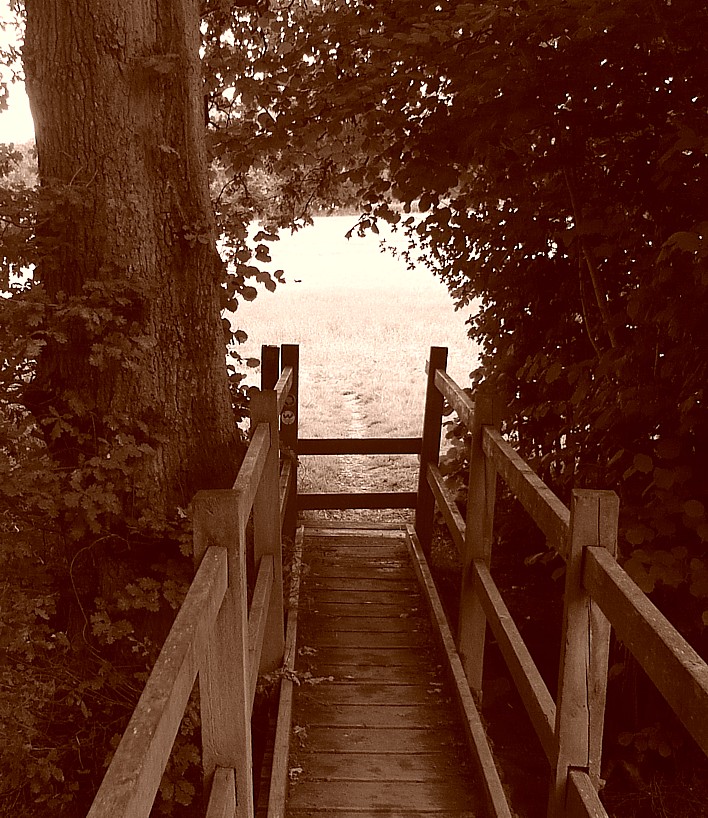
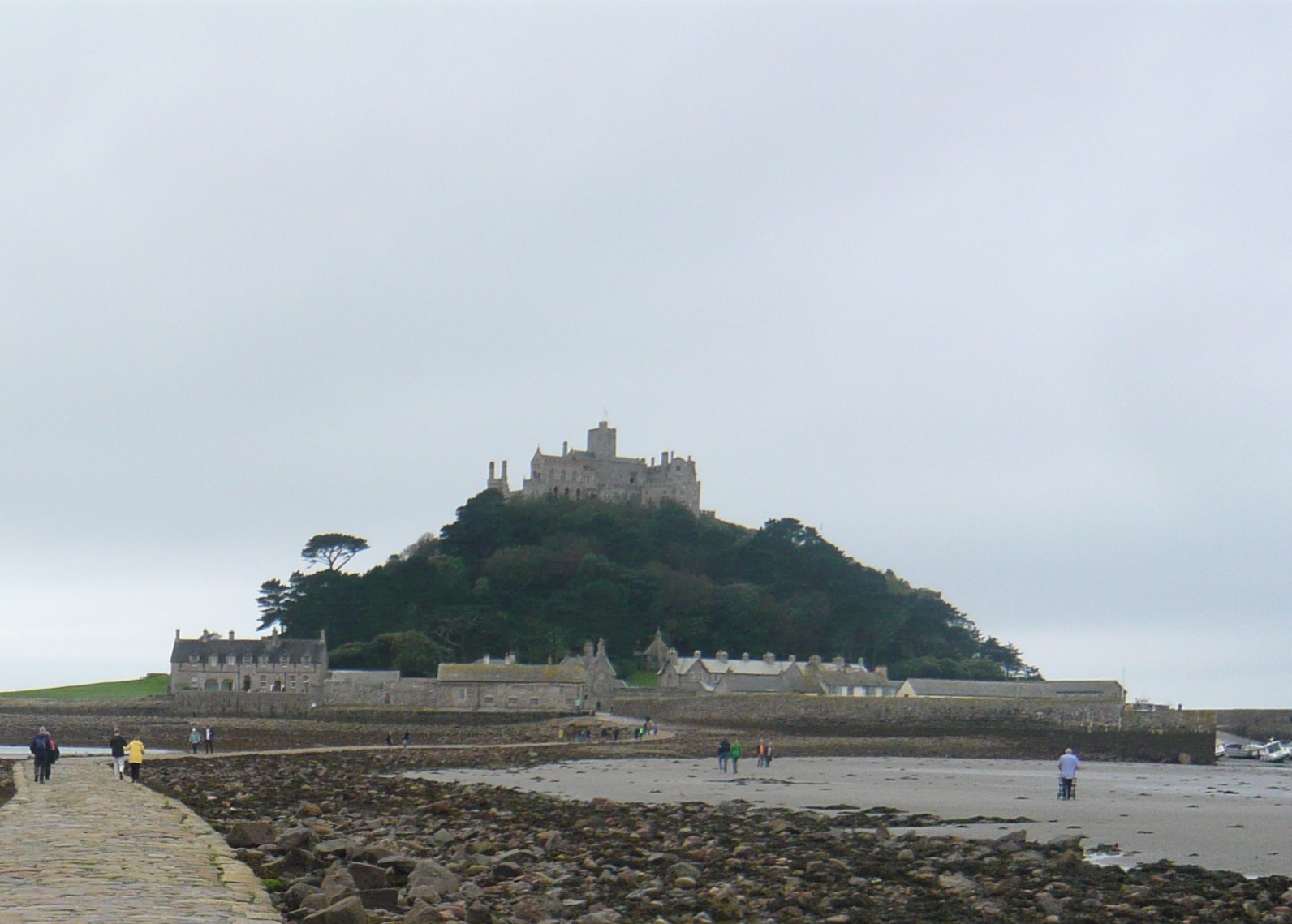
We recently returned from a week in Cornwall, and where we stayed was close to the end of a pilgrim route, St Michael’s Way. This is a short twelve and a half mile walk from the North Cornish coast to St Michael’s Mount, in Mount’s Bay on the South coast. Although the route is such a short one – a day’s walk for most people – it still apparently qualifies for a pilgrim ‘stamp’ on the official pilgrim passport for the very much longer long-distance Camino pilgrimage, since in the Middle Ages many pilgrims walked this route to the Benedictine monastery on the island, then took a boat to France to continue on towards Santiago de Compostela.
I am interested in learning – as far as it is possible for the staunchly non-religious person to learn – what the religious get out of pilgrimages. In the past, they were generally viewed as a way of gaining merit, of putting a few points in the bank when it came to whether you were headed for heaven or hell in the afterlife. Frequently, they were also undertaken in the hope of cures from diseases; various remnants of saints such as bones or clothing were held to have miraculous properties, and the touch of these might cure whichever disease ailed you.

Personally, I view pilgrimage as a spiritual thing, rather than a religious one. Something that puts the pilgrim in touch with their ‘finer’ feelings – a way of understanding what is important in life; relationships, simplicity, art maybe, minimal possessions – we will all have a different interpretation of this. In the past I have considered attempting one of the Camino routes – through France and Northern Spain to Santiago de Compostela. These are long, serious, routes, hundreds of miles long. Had I done so, I would have walked these for pleasure, as well as a personal challenge, rather than as a pilgrimage. Now, though, I am curious to see how much of the ‘religious’ experience I might have.

Whether visiting a church or a standing stone, a ‘holy’ well or a Sufi shrine, all are invested with spirituality. All are invested with meaning to many people and although I know I will never be able to experience the feelings of, say, a Christian at a site they consider holy, I might experience something akin to it. I’m not suggesting I might feel awe at the shrine of a saint, more that I might get an impression of the feelings of the visitors who do. And because I cannot quite find the words to express what I might hope to find, I reckon that’s an indication it’s an experiment worth making.
 Mick Canning
Hi Mick, it is possible to experience great awe and spiritual awareness. I agree you don’t need to be religious.
LikeLiked by 1 person
I reckon so, yes, Robbie. The natural world frequently does it for me.
LikeLike
I know of a friend who walked the Camino together with her sister, recently, as a personal fitness challenge. From all accounts, it was a gruelling walk. I think religious pilgrims are probably invested with an extra energy which helps them go the whole way of some really challenging pilgrimages. Thanks for a very interesting post. I’ve often wondered why pilgrims undertake such hardships and how do they benefit, spiritually and in living everyday life.
LikeLike
I don’t know whether they have extra energy, but it may be pure determination that gets them there. I also know someone who walked the Camino and they too found it very gruelling. I’ve walked long distances in the South of Spain, and certainly the heat saps your energy. I don’t think I’d be up to it now.
LikeLiked by 1 person
As you probably know my blog began as I walked the Pilgrims Way to Canterbury so for me it has a lot to answer for. As an atheist it was however a fine walk. The walk over to St Michael’s Mount is fun but the inflatable tractor on the way back is better.
LikeLiked by 1 person
I didn’t know – I only came across your blog comparatively recently. I probably wouldn’t do that walk, as I already know many parts of it. I might be tempted by the Winchester to Canterbury route, though.
LikeLike
That was the one I did, I didn’t fancy the Southwark version.
LikeLiked by 1 person
Me neither. Although someone who did wrote an excellent book on it:
https://www.goodreads.com/book/show/58315326-heavy-time?ac=1&from_search=true&qid=FQ1hfQ4bqd&rank=3
LikeLike
And we never saw the inflatable tractor!
LikeLike
Have a safe trip, mick. I don’t know what you may find…but am sure it will change you, even if in a minor way…when you write abt it! 🙂
LikeLiked by 1 person
Thanks, Sushi. It’s not even at the planning stage yet, just an idea I’d like to put into practice in the next year or two. Incidentally, I’d begun writing this post when we had our conversation a couple of days ago. Quite the coincidence.
LikeLiked by 1 person
In a universe that’s so organised, could there be co-incidences, mick? 🙂
LikeLiked by 1 person
Always coincidences, Sushi. So many things are happening all the time there are bound to be coincidences.
LikeLiked by 1 person
Hmmm. Out of all my online friends (talking about those I haven’t met and are from other cultures), only you still connect with me… it could be a coincidence no doubt… but one that’s meant to trigger conversation about something that interests both of us at the same time in our respective journeys. Or maybe i take my role as a story writer way too seriously!! Hahahaha!!
LikeLiked by 1 person
Oh, I don’t suppose that counts as a coincidence, Sushi. Online friends come and go, but the ones that stick around tend to be the ones who find they have something to say to one another.
LikeLiked by 1 person
I tend to look at life as a story right from the beginning till now… events happening one after the other…dilemmas, growth, support, resistance…then one fine day…poof. If it’s a story…then there’s a writer…and it’s written probably…the whole stuff… just a perspective 🙂
LikeLiked by 1 person
I don’t think a story needs a writer, just a reader. We can interpret any series of events as a story, just as selectively as a writer will. We can decide the beginning and the end and which events constitute the story. And, just like stories we actually write ourselves, the characters in the story will obstinately go their own ways!
LikeLiked by 1 person
That’s a nice concept too! What a quirky world this is. 🙂
LikeLiked by 1 person
It certainly is. But I rather like that!
LikeLiked by 1 person
Phil Cousineau wrote a wonderful book called The Art of Pilgrimage. Like you (and me), he doesn’t view pilgrimage as a religious endeavor, but a spiritual one. No matter where we may be going, he believes any trip can become a pilgrimage if the traveler is committed to paying attention, savoring, lingering, and finding something personally sacred along the way. It’s a wonderful book and has been my companion on some memorable travels.
LikeLiked by 2 people
I’ve never heard of that, Donna, but the sentiments echo my own exactly. And the onus is very much on the traveller paying attention, as you say. They should be actively seeking, not just wandering along waiting for something to drop into their lap.
LikeLiked by 1 person
I now have a copy, which I’m starting to read today. Thanks for the recommendation, Donna.
LikeLike
Hope it resonates for you as it did for me, Mick.
LikeLiked by 1 person
Having skimmed through it, it certainly looks hopeful.
LikeLike
I had to smile at your remark about being ‘staunchly non-religious.’ I could be tempted to view walking as your religion: a path to a different sort of salvation, perhaps, but a path nonetheless. I suppose in a way I view religion — etymologically a ‘binding together’ through traditions such as pilgrimage — as a way to a deeper spirituality. When religion’s viewed as a means to different ends, it can become totally disassociated from spirituality, to the detriment of both.
LikeLiked by 1 person
Thanks, Linda. I’m making a point of specifically separating spirituality from religion, regarding religion as traditionally being something that has a god and a specific rulebook, full of thou shalt / shalt not instructions.
I guess the two words can be interchangeable, but I would be uncomfortable doing so.
LikeLiked by 1 person
I share your views on pilgrimages and, through this site have come to see you imbue your writing and your art with the wonder, gratitude, and meaning that many would call spirituality.
LikeLiked by 1 person
Thanks, Laura. If that comes through I suspect I’m doing something right.
LikeLike
I can relate to this post, Mick. I’m also staunchly non-religious, a trekker, and curious about the spiritual elements of pilgrimages and places that seem to collect spiritual energy. I know someone who is in her late eighties and is walking the Camino de Santiago right now. For her, it’s deeply religious and connects her viscerally to her faith. Fascinating really.
LikeLiked by 1 person
Well, that is really impressive. I can’t imagine me being able to do that in my late eighties, much though I would love to be able to.
LikeLiked by 1 person
She has more stamina than I do. 🙂
LikeLiked by 1 person
More than most people I would think.
LikeLiked by 1 person
I recently read about Camino de Santiago walk and official pilgrim passport. It was all interesting. I think all such walks need a lot of determination and good physical strength.
LikeLiked by 1 person
Certainly that one does – hundreds of miles long!
LikeLiked by 1 person
Hmm.
LikeLiked by 1 person
Thanks for sharing this idea. Anita
LikeLiked by 1 person
Thanks, Anita.
LikeLiked by 1 person
Might be worth a shot. But then, a nice long walk on a beach might be just as nice, or even better.
LikeLiked by 1 person
Indeed, Dave. It’s all down to what you get out of the journey.
LikeLiked by 1 person
I love this line: “Something that puts the pilgrim in touch with their ‘finer’ feelings – a way of understanding what is important in life; relationships, simplicity, art maybe, minimal possessions.” As a non-religious person who ends up in all kinds of places of worship, it is rarely about the religion for me. Rather an opportunity to connect with something much much bigger, and at the same time the very basics of living. Thank you for writing this piece.
LikeLiked by 1 person
Thanks, Rama. I agree – those connections are very important. Spiritual rather than religious.
LikeLiked by 2 people